

⏱️ Read Time:
TL;DR
The traditional management consulting model, built on charging premium hourly rates for large teams of junior analysts doing manual research, is rapidly unraveling due to generative artificial intelligence. As automated software completes baseline data analysis in minutes, corporate clients are rejecting inflated bills, forcing legacy firms to downsize entry-level roles, shift to technical hiring, and adopt outcome-based pricing or subscription software models.
Key Takeaways
- Collapse of the Leverage Pyramid: Generative AI automates the heavy lifting of entry-level data processing and presentation drafting, making the classic model of billing high markups on junior analyst labor financially unsustainable.
- The Jagged Frontier Effect: AI speeds up task completion by 25 percent and raises output quality by over 40 percent inside its capability frontier, but it reduces analytical accuracy by 19 percentage points when applied to complex qualitative tasks outside its boundary.
- Erosion of Entry-Level Career Paths: Consultancies are cutting generalist analyst positions and shifting recruitment toward software engineers and data scientists, creating a severe long-term gap in training future business leaders.
- Rejection of Billable Hours: Over half of corporate clients now expect reduced fees, pushing firms like BCG and PwC toward outcome-linked contracts and recurring software platform subscriptions.
- Rise of Lean, Tech-First Competitors: Automated strategy tools allow specialized boutique firms and departing senior partners to deliver executive-grade analysis at a fraction of the cost, threatening incumbent market dominance.
Introduction
In 2024, New York City hired McKinsey to advise city officials on an urgent urban problem: how to put municipal garbage into trash bins. The consultancy delivered an 80-page presentation focused on containerization and rat mitigation strategies. The bill came to four million dollars, which works out to roughly 42,000 dollars per presentation slide. While paying millions for straightforward corporate advice was standard practice for decades, the economic foundation supporting this business model is undergoing a fundamental shakeup.
For generations, management consultancies built one of the most lucrative engines in modern commerce. They recruited thousands of top graduates from elite universities, worked them through exhausting hours, and billed their research and slide decks to clients at massive markups. Senior partners at the top captured extraordinary profits by leveraging large teams of junior analysts. Today, generative artificial intelligence executes much of that foundational research and data processing in minutes, collapsing weeks of spreadsheet cleaning into automated workflows.
These technical advances are accelerating major shifts across professional services. Legacy firms including McKinsey, Deloitte, PwC, and Accenture are trimming generalist positions, shrinking project team sizes, and shifting recruitment toward technical software engineers. Meanwhile, corporate clients are questioning elevated fee structures when automated software handles the heavy lifting. Management consulting is confronting an era where standard strategic advice is rapidly commoditizing, forcing advisory firms to redefine how they deliver genuine business value.
From Post-Merger Cleanups to Public Sector Contracts
To understand why management consulting is vulnerable today, one must examine how its primary revenue drivers evolved over the past thirty years. During the 1990s, widespread economic deregulation swept through the United States, creating an environment ripe for rapid corporate expansion. In less than a decade, the annual value of corporate mergers and acquisitions exploded from 200 billion dollars to over 1.7 trillion dollars.
These massive corporate consolidations created widespread administrative chaos. Newly merged entities routinely found themselves burdened with duplicate human resources departments, overlapping finance teams, and conflicting marketing divisions. Consultancies stepped into this operational clutter to rationalize corporate structures, determining which divisions added value and which could be eliminated without breaking core operations. By solving these post-merger integration challenges, firms like McKinsey and Boston Consulting Group established themselves as permanent fixtures of corporate governance.
When the corporate deal rush cooled following major governance scandals in the early 2000s, consultancies executed a major strategic pivot toward public sector contracts. Over the course of a few years, United States federal spending on outside management consultants tripled as government agencies outsourced core administrative and operational functions.
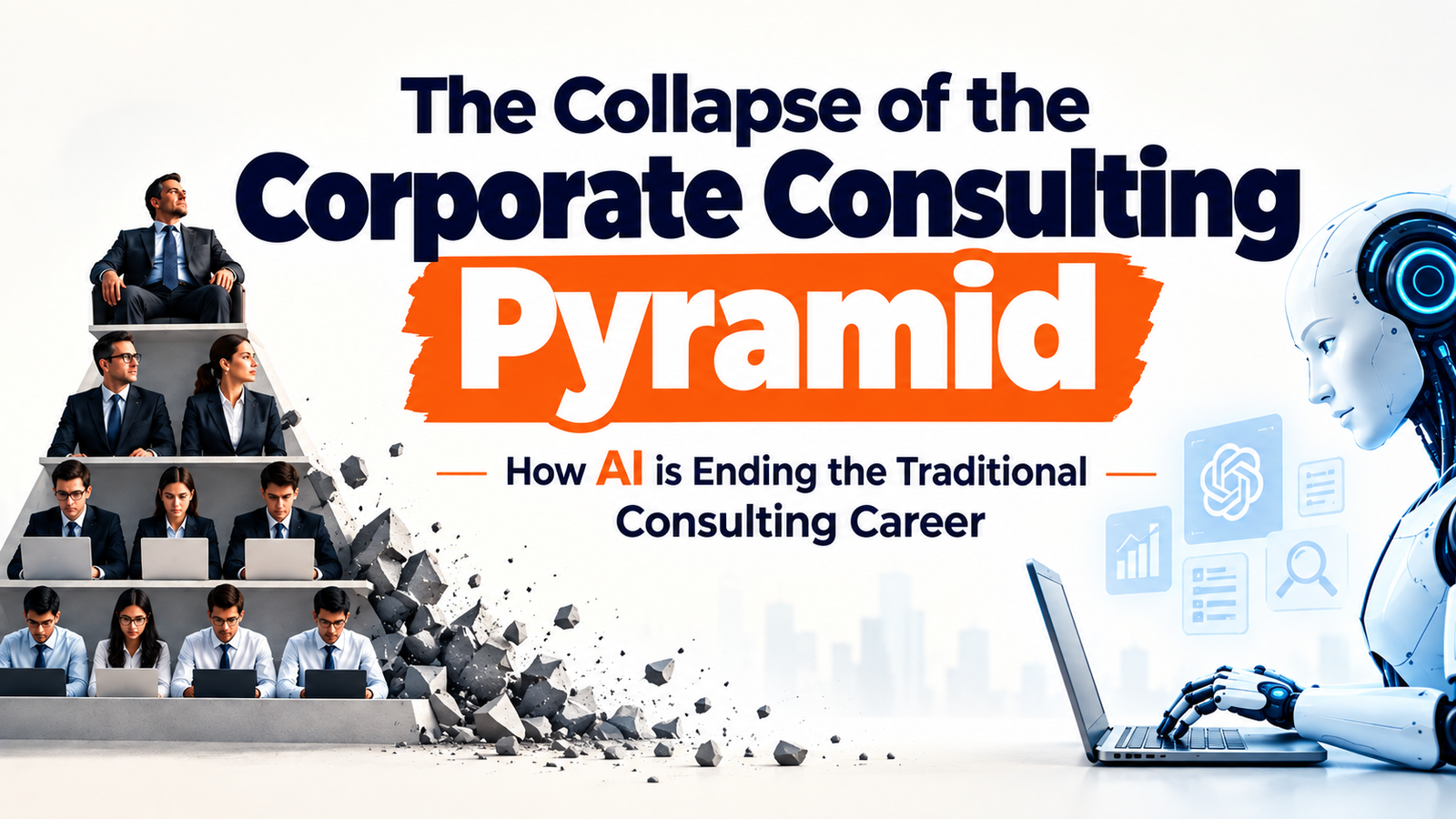
This expansion perfected the pyramid business model. Senior partners brought in client contracts and maintained executive relationships while overseeing multiple project teams simultaneously. Underneath each partner sat managers and a deep base of junior analysts. These analysts spent long weeks reviewing transcripts, cleaning financial data, and building presentations. The financial engine relied on billing rate leverage. A firm paid junior staff fixed entry-level salaries while billing clients premium hourly or project rates, allowing partners to capture enormous profit distributions from the collective output of junior teams.
Beyond analytical support, consultancies provided executive teams with an effective corporate risk shield. Unpopular executive decisions, including corporate restructurings, mass layoffs, or division spin-offs, could be justified by pointing to external strategic reviews. However, this incentive structure encouraged dense corporate terminology over measurable operational outcomes. By 2024, client sentiment had soured dramatically, with industry surveys showing that only 13 percent of corporate client executives believed consultants delivered more value than harm.
The Jagged Frontier of Artificial Intelligence
The rapid rise of generative artificial intelligence has fundamentally disrupted knowledge work, exposing severe vulnerabilities in the traditional consulting leverage model. A landmark 2023 empirical study conducted by researchers from Harvard Business School, MIT Sloan, Wharton, and Warwick Business School, in collaboration with Boston Consulting Group, evaluated 758 professional consultants executing realistic business assignments.
The researchers discovered that artificial intelligence operates across a jagged technological frontier. The capability boundary does not align neatly with human perceptions of task difficulty. For assignments situated inside the artificial intelligence capability frontier, such as creative product brainstorming, market segmentation, and drafting go-to-market plans, consultants using OpenAI’s GPT-4 achieved dramatic performance boosts. They completed 12.2 percent more tasks, worked 25.1 percent faster, and produced output quality rated more than 40 percent higher than unassisted control groups.
The study also uncovered a significant skill leveling effect. Consultants scoring in the bottom half of baseline professional abilities experienced a 43 percent improvement in work quality when supported by artificial intelligence, whereas top-tier performers saw a 17 percent increase. However, this gain in individual output quality came with a trade-off: overall variance among generated ideas decreased, indicating that relying on standardized artificial intelligence models can homogenize corporate strategies.
| Performance Metric | Unassisted Baseline | AI Assisted (Inside Frontier) | AI Assisted (Outside Frontier) |
|---|---|---|---|
| Task Completion Speed | Baseline | 25.1% Faster | Reduced Efficiency |
| Total Tasks Completed | Baseline | 12.2% Increase | Baseline |
| Output Quality Score | Baseline | >40% Higher | Significant Quality Degradation |
| Analytical Accuracy Rate | Baseline | Baseline High | 19 Percentage Points Lower |
| Lower Skilled Worker Gain | Baseline | 43% Boost | Not Applicable |
| Higher Skilled Worker Gain | Baseline | 17% Boost | Not Applicable |
The study revealed severe operational risks when tasks extended outside the capability frontier. When consultants used artificial intelligence for complex assignments requiring nuanced qualitative judgment, multi-step financial logic, or identifying hidden patterns across interview notes, their performance collapsed. AI-assisted consultants working outside the frontier were 19 percentage points less likely to arrive at the correct strategic recommendation compared to unassisted peers.
This performance drop highlights what researchers call the trust trap. Because generative language models produce fluent and authoritative output even when factually incorrect, professionals frequently accept flawed logic without adequate interrogation. The study observed two primary modes of successful integration: Centaurs, who consciously divide responsibilities between human oversight and machine execution based on task fit, and Cyborgs, who continuously weave automated generation throughout their analytical workflow.
The Breakdown of the Junior Analyst Career Path
The automation of routine analytical tasks creates a fundamental dilemma for professional service firms. Historically, entry-level research was tedious, but it served as the core training ground for developing business judgment. Junior analysts learned how financial models functioned by building them manually from scratch. They learned how to spot unreliable sources by reviewing raw documents line by line.
When artificial intelligence generates draft decks and summaries in seconds, firms naturally cut entry-level roles to maximize short-term margins. Yet, reviewing automated output without understanding how it was produced deprives young professionals of critical skill-building experiences. An analyst might examine a polished slide deck without realizing that the underlying strategic recommendation hinges on a flawed assumption. While senior consultants are equipped to catch these subtle errors, the industry risks failing to train the next generation of leaders capable of doing so.
The real-world impacts on employment are already pronounced across top advisory firms. McKinsey reduced its global headcount from approximately 45,000 employees in early 2023 to roughly 40,000 by mid 2025 through targeted performance evaluations and natural turnover. Accenture launched an 865 million dollar restructuring initiative in 2025, actively shifting its hiring focus toward software engineers, data scientists, and systems integrators. Leaders at PwC United States confirmed that recruitment for traditional entry-level consultants has declined, noting that new roles heavily exposed to artificial intelligence are seven times more likely to require advanced skills normally expected of senior employees.
Rising Partner Payouts and the Threat of Disruption
Even as overall consulting revenues face headwinds, senior partners have managed to preserve elevated profit payouts by trimming junior headcounts and operational expenses. During fiscal year 2025, Deloitte United Kingdom saw its technology and transformation revenue fall by 10 percent. Despite this decline in business volume, the average profit distribution per partner actually increased by 4 percent, climbing above one million pounds. This financial outcome demonstrates the partner incentive structure: when top-line growth slows, firms protect executive compensation by reducing the pool of employees sharing in the firm’s earnings.
However, client tolerance for high advisory bills is rapidly eroding. Survey data reveals that by late 2024, 58 percent of consulting clients expected project fees to drop due to automated efficiencies, up from 27 percent just one quarter earlier. Corporate buyers recognize that technology makes research faster, and they are demanding that savings be passed along. To protect relationships, major firms like BCG are adjusting fee structures by linking a portion of their compensation to measurable client metrics rather than billable hours.
| Market Participant | Operational Action | Business Impact |
|---|---|---|
| McKinsey & Company | Streamlined headcount through turnover and reviews | Staff decreased from ~45,000 to ~40,000 between 2023 and 2025 |
| Accenture | Reallocated capital into technical and AI engineering roles | Spent $865M on restructuring; logged $6B in GenAI bookings in FY2025 |
| Deloitte UK | Reduced operational overhead amid revenue declines | Tech revenue dropped 10%, yet partner payouts rose 4% to over £1M |
| West Monroe | Released automated strategy tools for corporate planning | Distributed free AI strategy agents in June 2026 to win technical contracts |
| Unity Advisory | Built lean advisory model with automated delivery | Founded by former EY and PwC executives with $300M in funding |
| PwC | Shifted intellectual property into enterprise platforms | Launched PwC One platform in March 2026 for continuous subscription access |
At the same time, artificial intelligence gives experienced consultants fewer reasons to remain tied to legacy firms. In past decades, senior partners relied on global offices, proprietary databases, and deep analyst pools. Today, small specialized teams can replicate much of that analytical capability using advanced software.
In June 2026, advisory firm West Monroe demonstrated this dynamic by offering free artificial intelligence strategy agents capable of assessing corporate expansion plans, risk exposure, and workforce strategies. By providing automated first drafts at no charge, West Monroe bypasses traditional strategic fees and positions itself to win lucrative implementation work. Similarly, former EY and PwC executives secured 300 million dollars in funding to launch Unity Advisory, a boutique built around low central overhead, automated delivery, and value-linked pricing.
To defend their market position, major consultancies are trying to turn their intellectual property into recurring software subscriptions. In March 2026, PwC launched PwC One, an enterprise platform that bundles internal methods, regulatory frameworks, and artificial intelligence agents into a continuous access model. Instead of assembling a new project team every time a corporate issue arises, clients pay for ongoing access to software tools. Despite these strategic pivots, investor nervousness over service commoditization wiped out approximately 100 billion dollars in combined market valuation from Accenture and Cognizant by 2026.
High Stakes Tech Failures and Rebuilding Internal Expertise
As consultancies shift away from high-margin advice toward complex technology implementations, operational risks increase significantly. Unlike presentation slides, software deployments yield clear functional outcomes. When probabilistic artificial intelligence models are integrated into mission-critical corporate or government processes without sufficient technical depth, the results can be catastrophic.
A clear example occurred during Accenture’s 75 million dollar contract with the United States Patent and Trademark Office. The initiative was intended to embed machine learning into patent examinations to accelerate reviews. Instead, the system frequently misclassified applications, overlooked existing patents, and generated fictional citations, prompting the agency to ban generative artificial intelligence outright. Broader industry studies show that 90 percent of corporate artificial intelligence initiatives fail to meet their target objectives, with 42 percent of companies abandoning their efforts within a single year.
These delivery stumbles echo the institutional analysis presented by economists Mariana Mazzucato and Rosie Collington in their 2023 book, The Big Con: How the Consulting Industry Weakens Our Businesses, Infantilizes Our Governments and Warps Our Economies. Mazzucato and Collington argue that excessive outsourcing depletes internal state and corporate capacity, creating a cycle where organizations lose the baseline knowledge needed to manage complex projects independently. Consultancies often win initial low-cost contracts, only for clients to become permanently reliant on external advisors as internal skills wither away.
To reverse this trajectory, leading economists and management experts recommend a comprehensive rebuilding of internal capabilities. Organizations must invest directly in training and retaining technical talent to maintain operational independence. Concurrently, governance frameworks should require strict disclosure of vendor conflicts of interest and structure commercial contracts around verified performance metrics rather than subjective deliverables.
Consulting Firms Are Becoming Software Companies
The traditional consulting model was built around people, and that arrangement shaped nearly every aspect of how firms organized themselves. A client had a problem, a consulting firm assembled a team, and that team spent weeks or months researching the issue, building models, preparing presentations, and presenting recommendations to senior executives. The firm’s intellectual property was largely embedded in the people delivering the engagement, which meant that growth depended on hiring, training, and deploying more of them.
Artificial intelligence is beginning to change that equation in ways that strike at the foundation of the model. If research, analysis, benchmarking, document review, and even the first draft of strategic recommendations can be automated, consulting firms have less reason to organize their businesses around large project teams, and the leverage that once justified those teams begins to erode.
The logical response is to turn accumulated expertise into software, and several firms are already moving in that direction. PwC’s launch of PwC One in March 2026 illustrates this shift, because rather than assembling a new team for every individual client problem, the platform combines the firm’s methodologies, regulatory frameworks, and artificial intelligence capabilities into a continuous-access model. The underlying idea is straightforward: instead of selling expertise exclusively through consulting hours, firms can package that expertise into technology that clients can access repeatedly.
Other firms are pursuing similar strategies with varying degrees of ambition. Accenture has shifted significant investment toward artificial intelligence, software engineering, and systems integration, while advisory firms such as West Monroe have experimented with AI agents that can produce initial assessments of corporate expansion plans, risk exposure, and workforce strategies. These products can automate parts of the work that previously formed the foundation of a traditional consulting engagement, which raises uncomfortable questions about what remains for junior staff to do.
This creates a fundamental change in the economics of professional services, because a traditional engagement scales by adding people, whereas a software-enabled engagement can scale by adding users. That distinction matters because the consulting pyramid depended on leverage, since a senior partner could manage several projects, each supported by managers, consultants, and large teams of analysts, and the more junior employees a firm could place beneath each senior professional, the more revenue the model could generate.
Software changes that relationship in a way that is difficult to reverse. Once a firm’s methodology is encoded into an AI system, adding another client does not necessarily require adding another team of analysts, and the marginal cost of delivering the next piece of analysis can fall dramatically, which undermines the pricing logic that sustained the pyramid for decades.
This does not mean consulting firms will simply become software companies, because complex strategic decisions still require human judgment, organizational context, technical expertise, and accountability. Instead, the emerging model is a hybrid in which software handles more of the repetitive analytical workload while experienced professionals focus on interpreting results, making difficult decisions, and managing implementation. The result is a consulting industry with fewer people performing routine analysis and more technology embedded in the delivery process, which reshapes both the career ladder and the firm’s cost structure.
The strategic question for legacy firms is therefore no longer simply how many consultants they can deploy, but rather how much of their accumulated knowledge can be transformed into reusable technology, and how effectively their remaining experts can create value beyond what that technology can provide.
The shift is already visible in how major consulting firms are investing in AI, software, and automated delivery:
| Firm | AI Initiative/Statistic | Description |
|---|---|---|
| McKinsey & Company | 1. ~25,000 AI Agents 2. 1.5 Million Hours Saved | 1. Operates roughly 25,000 AI agents alongside its 40,000 human staff, aiming for parity by the end of 2026. 2. Proprietary AI agents saved 1.5 million human hours in six months. |
| Boston Consulting Group (BCG) | 25% Faster Tasks | Consultants using GPT-4 completed tasks 25% faster with higher quality. |
| BCG GAMMA | Dedicated AI Unit | A business unit combining cutting-edge AI, ventures, and software products. |
| Bain & Company | 50% Revenue Target | Aims for 50% of its revenue to come from AI-driven work by 2026. |
| PwC | PwC One Platform | Launched an AI-powered platform in March 2026 to combine PwC’s knowledge and methodologies. |
| Accenture | 1. Generative AI Bookings 2. AI Refinery for Industry | 1. Reported almost $6 billion in generative AI bookings during its 2025 fiscal year. 2. Launched an AI refinery with 12 industry-specific agent solutions in January 2025. |
What the Next Five Years Probably Look Like
The next phase of consulting is unlikely to be defined by the disappearance of consultants, and a more plausible transformation is a gradual separation between work that can be automated and work that still requires human judgment. Several changes are already becoming visible, and together they point toward a leaner industry rather than one that simply vanishes.
First, consulting teams are likely to become smaller, because routine research, data preparation, benchmarking, and presentation development can increasingly be handled by AI systems. A project that once required a large analyst team may increasingly be delivered by a smaller group of experienced consultants working alongside automated tools, which changes both the cost structure and the staffing logic of an engagement.
Second, technical skills will become more important, because as consulting firms move deeper into AI implementation, software, data engineering, and systems integration, the distinction between a management consultant and a technology professional becomes less clear. Firms will increasingly need people who can understand both business problems and the technical systems used to solve them, which places new demands on hiring and training.
Third, the traditional analyst-to-partner career ladder will become less predictable, since junior analysts historically learned by performing the repetitive work that supported senior consultants. If AI performs much of that work, firms face a difficult training problem: how do they develop experienced professionals when the traditional apprenticeship layer becomes smaller, and where does the next generation acquire the judgment that once came from years of manual analysis?
Fourth, consulting fees will increasingly be tied to outcomes, because when AI reduces the time required to perform research and analysis, clients have less incentive to pay simply for hours worked. Pricing models are therefore likely to move further toward subscriptions, fixed fees, implementation contracts, and compensation linked to measurable business results, which shifts risk onto the firms themselves.
Fifth, consulting intellectual property will increasingly become software, since frameworks, databases, regulatory knowledge, analytical models, and industry expertise can be embedded into AI agents and enterprise platforms. This allows firms to sell access to their accumulated knowledge repeatedly rather than recreating the same analytical process for every engagement, which is a fundamentally different business than the one they ran for decades.
Sixth, the boundary between consulting and technology companies will continue to blur, because consulting firms will increasingly compete with software companies, AI-native boutiques, and internal corporate teams. Their advantage will depend less on the number of consultants they can deploy and more on the quality of their proprietary knowledge, technology, implementation capabilities, and relationships, which are harder to replicate than a large bench of analysts.
Taken together, these changes point toward a leaner consulting industry rather than an industry that simply disappears, and the highest-value work will increasingly sit at the intersection of expertise, technology, and accountability. Routine analytical work will continue moving toward automation, while complex decisions, organizational change, and high-stakes implementation will remain areas where experienced professionals can provide differentiated value that technology alone cannot supply.
The consulting career will therefore not vanish overnight, but the economic logic that made the traditional pyramid so effective is becoming harder to sustain, and firms that treat the shift as a temporary downturn rather than a structural one are likely to find themselves adjusting too late.
The Bigger Lesson: When Expertise Becomes Software
The disruption facing consulting is part of a much broader transformation in knowledge work, and for decades many professional services operated on a simple economic assumption: expertise was scarce, and the most practical way to deliver that expertise was through highly trained people. Lawyers reviewed documents, analysts built financial models, consultants conducted research, accountants reconciled data, and junior professionals performed much of the repetitive work while senior professionals interpreted the results and advised clients.
Artificial intelligence is beginning to separate those two layers, and when machines can perform research, summarize documents, analyze datasets, generate financial models, or produce a first draft of a presentation, the value of the underlying expertise does not disappear. Instead, the economics of delivering that expertise change, which is why the consulting industry’s experience matters well beyond consulting itself.
The same pattern can emerge wherever businesses rely on large numbers of professionals to convert information into standardized outputs, because AI can reduce the amount of human labor required to produce those outputs while increasing the relative importance of judgment, accountability, and execution. That creates a difficult transition for organizations, since the repetitive work being automated today is often the same work through which professionals historically developed expertise. Junior consultants learned strategy by conducting research, analysts learned finance by building models, and professionals developed judgment by repeatedly handling relatively routine assignments before taking responsibility for more complex ones. If those entry-level tasks disappear too quickly, organizations may gain short-term efficiency while weakening their long-term talent pipeline.
There is another risk worth considering, because outsourcing has already encouraged many organizations to depend heavily on external expertise. As Mariana Mazzucato and Rosie Collington argue in The Big Con, excessive reliance on consultants can gradually weaken internal capabilities, leaving organizations less able to manage complex problems independently, and AI could either reinforce that dependency or help reverse it depending on how organizations deploy the technology. Companies that treat AI simply as a way to reduce headcount may save money in the short term but risk losing institutional knowledge, whereas companies that use AI to augment their internal teams can potentially build stronger capabilities while allowing employees to focus on higher-value decisions.
The distinction is important because the future of knowledge work is unlikely to be purely human or purely automated and will increasingly consist of human professionals working with systems that can perform large portions of the analytical process. That changes what organizations should value, since research becomes cheaper, analysis becomes faster, and standardized expertise becomes easier to replicate. What becomes relatively more valuable is the ability to decide what should be done, understand the consequences, take responsibility for the outcome, and execute when the answer is not obvious.
That is ultimately what the consulting disruption reveals, because AI is not simply replacing individual tasks but forcing professional industries to reconsider where human expertise creates its highest value. The firms and professionals that adapt to that shift will compete less on the ability to produce more analysis and more on their ability to turn analysis into decisions and decisions into results.
Recommended Readings
- The Big Con: How the Consulting Industry Weakens Our Businesses, Infantilizes Our Governments and Warps Our Economies by Mariana Mazzucato and Rosie Collington (2023). An exhaustive examination of how corporate reliance on external advisory firms erodes internal capability, undermines political accountability, and creates financial dependency.
- Prediction Machines: The Simple Economics of Artificial Intelligence by Ajay Agrawal, Joshua Gans, and Avi Goldfarb (2018). An insightful economic analysis of how artificial intelligence reduces the cost of prediction, restructuring labor demands and professional workflows across knowledge-intensive sectors.
- The Management Myth: Why the Experts Keep Getting It Wrong by Matthew Stewart. A former consultant’s demolition of the intellectual foundations of management theory, useful context for why the industry’s value was always partly performed.
- The Firm: The Story of McKinsey and Its Secret Influence on American Business by Duff McDonald. The definitive account of how the world’s most famous consultancy built its reputation and its political reach.
- Power, for All: How It Really Works and Why Everyone Is the Answer by Julie Battilana and Tiziana Casciaro. Not a consulting book, but the best modern guide to the real asset partners hold: client relationships and organizational trust, which is precisely what AI cannot replicate.
- Co-Intelligence: Living and Working with AI by Ethan Mollick. A practical, grounded view from one of the researchers behind the famous BCG productivity study on how knowledge work changes when capable AI enters the room.
Frequently Asked Questions (FAQs)
How is artificial intelligence impacting junior analyst roles in management consulting?
Artificial intelligence is significantly reducing entry-level hiring for generalist analysts. Software tools can now automate research, spreadsheet cleaning, and presentation drafting in minutes. As a result, consultancies require smaller project teams and are shifting their recruiting focus toward technical software engineers and data specialists.
What is the jagged technological frontier in professional services?
The jagged technological frontier describes the uneven boundary of artificial intelligence capabilities. AI excels at tasks like product ideation, basic drafting, and document summarization, dramatically boosting speed and quality. However, it struggles with complex multi-step reasoning and subtle qualitative synthesis, where uncritical reliance can lead to severe analytical errors.
Why are corporate clients pushing back against traditional consulting fees?
Corporate clients recognize that artificial intelligence dramatically reduces the time required to complete research and modeling tasks. Consequently, clients are demanding that consultancies pass along these operational savings through lower project fees or outcome-based pricing tied directly to business metrics.
What are Centaur and Cyborg collaboration models?
Centaur workflows involve a clear division of labor where professionals delegate specific routine subtasks to artificial intelligence while retaining high-level strategy for human judgment. Cyborg workflows represent a continuous integration where human cognition and machine generation continuously iterate together throughout the entire work process.
Will AI replace management consultants entirely?
No, and the evidence points the other way. The Harvard and BCG experiment showed AI fails badly on tasks outside its capability frontier, and clients still need someone accountable for consequences. What AI replaces is the junior production layer: research, summarization, first drafts, and model building. The advisory and relationship layer survives, with fewer people beneath it.
Are consulting firms actually shrinking?
Some are. McKinsey’s headcount fell from roughly 45,000 in early 2023 to around 40,000 by mid 2025, and Accenture cut more than 11,000 roles in its 2025 restructuring. Others, including Accenture, are still hiring overall, but into technical roles rather than traditional consulting roles. The industry is shrinking in specific places rather than everywhere at once.
Will consulting fees go down?
Clients clearly expect them to. The share of buyers expecting prices to fall jumped from 27 percent to 58 percent in a single quarter of 2024. Firms are resisting outright price cuts by shifting to outcome-based pricing, where part of the fee depends on measurable results. Expect bills to look different before they look dramatically smaller.
Is consulting still a good career for a new graduate?
It depends on what you want from it. As a two- or three-year training ground for business fundamentals, it remains excellent, and brand value is intact. As a thirty-year climb toward partnership in the traditional mold, the math has genuinely worsened: fewer seats, steeper requirements, and less apprenticeship. Graduates with strong technical skills have the best odds in the new structure.
Why did firms overhire if AI was coming?
The overhiring happened in 2021 and 2022, when pandemic-era demand for digital transformation work looked permanent. The correction that followed was initially about interest rates and weak demand, not AI. AI became the reason not to refill the roles afterward, because a firm with AI tools no longer needs to staff for its busiest hypothetical year.
What is outcome-based pricing in consulting?
A model where part of the fee is tied to results, such as cost savings or performance improvements, rather than hours worked or team size. McKinsey has said roughly a quarter of its global fees already work this way, and BCG links fees on its largest AI projects to results. It protects firm revenue while making junior hours less central to the economics.
Are the Big Four and strategy firms responding differently?
Broadly, the same direction at different speeds. Accenture and Deloitte are leaning into large technology implementation work. PwC is productizing expertise through its PwC One platform and shifting hiring toward engineers. McKinsey and BCG are moving fees toward outcomes. Everyone is converging on the same conclusion: sell results and systems, not hours and slides.
Conclusion: The New Reality of Executive Advisory
The corporate consulting industry is not going through another cyclical slowdown, because its underlying economics are changing. For decades, the pyramid worked by turning inexpensive junior labor into highly priced research and recommendations, with senior partners capturing the value of that leverage while clients paid for the organization’s accumulated expertise.
Artificial intelligence is attacking that foundation, since research, data processing, first-draft analyses, and strategic frameworks can now be generated at a fraction of the traditional time and cost, making large teams of junior analysts increasingly difficult to justify. This does not make human consultants irrelevant so much as move the value upward, toward judgment under uncertainty, deep industry context, accountability, organizational influence, and the ability to turn a recommendation into an outcome. The consultant of the future will be valued less for producing more analysis and more for knowing which analysis matters, what decision should follow, and how to make it work in the real world.
That shift will change the consulting career, because the traditional analyst-to-partner path depended on an apprenticeship model in which junior employees learned by doing the analytical work themselves. If AI absorbs much of that work, firms must find new ways to develop judgment and experience, and while the industry may become leaner and more productive, it will also have to solve the difficult problem of training its future decision-makers.
Competitive advantage will increasingly move from headcount toward technology, proprietary knowledge, implementation capability, and trusted relationships, and firms that turn their intellectual property into software and AI-enabled services may serve more clients with far smaller teams. The pyramid is therefore not disappearing so much as compressing, with routine analysis automated at the bottom, generalist roles shrinking and becoming more technical in the middle, and experienced professionals at the top handling the decisions where context, judgment, and accountability matter most.
AI is not merely replacing consultants but changing what organizations are willing to pay them for. The future of executive advisory will belong less to firms that produce the most slides and more to those that combine intelligent systems with human judgment to deliver measurable results. The old model sold expertise through people, and the emerging model will sell expertise through people, software, and outcomes, which may be the end of the traditional consulting pyramid, but could also be the beginning of a very different consulting industry.





Leave a Reply