

- Home
- /
- Case Studies
- /
- Qualcomm Snapdragon vs. MediaTek Dimensity:…
⏱️ Read Time:
The Flagship Duel: Snapdragon 8 Elite Gen 5 vs. Dimensity 9500
The pinnacle of the mobile processor market in 2026 is defined by an intense rivalry between Qualcomm’s Snapdragon 8 Elite Gen 5 and MediaTek’s Dimensity 9500. This segment represents the zenith of technological competition, where both companies deploy their most advanced silicon to power devices priced at ₹50,000 and above. The choice between them has evolved from a simple question of peak performance to a nuanced evaluation of architectural philosophy, real-world efficiency, and feature innovation. Qualcomm, historically the dominant force in the high-end space, has responded to significant competitive pressure from MediaTek with its custom-designed Oryon CPU cores, aiming to reclaim the performance crown. Meanwhile, MediaTek has solidified its reputation not just as a challenger but as a co-leader, leveraging a decade of strategic refinement to offer a compelling alternative centered on efficiency and cutting-edge AI capabilities.
The core of the debate lies in the fundamental differences in their central processing unit (CPU) architectures. The Snapdragon 8 Elite Gen 5 integrates two ultra-fast prime cores based on Qualcomm’s new Oryon Gen 3 architecture, capable of reaching speeds up to 4.74 GHz, alongside six smaller performance cores clocked at up to 3.6 GHz. In contrast, the Dimensity 9500 utilizes a more conventional ARM-based design, featuring a single ultra-high-performance Cortex X4 Prime Core clocked at 3.62 GHz, three high-performance Cortex X4 cores at 3.2 GHz, and four efficiency Cortex-A720 cores at 2.2 GHz. On paper, the Snapdragon’s peak clock speed appears significantly higher, suggesting a potential advantage in single-threaded performance, which directly impacts app responsiveness and gaming frame rates. Benchmark data largely supports this, with the Snapdragon 8 Elite Gen 5 consistently posting higher scores. For instance, it achieves a 16% higher CPU score in one comparison, with figures of 1,213,845 versus 1,043,247 for the Dimensity 9500. Another source reports the Snapdragon scoring approximately 3800 points in a single-core Geekbench 6 test and around 12,000 in multi-core tests, highlighting its prowess in demanding computational tasks. An October 2025 AnTuTu chart confirmed the Snapdragon 8 Elite Gen 5’s dominance over the Dimensity 9500 in this tier. However, it is crucial to note that these benchmarks often measure peak, short-term performance rather than sustained efficiency under load.
In stark contrast, the graphics processing unit (GPU) battle presents a different narrative, with MediaTek holding a distinct edge. The Dimensity 9500 is powered by the Immortalis-G925 GPU, which boasts a faster clock speed of 1612 MHz and is noted for its exceptional gaming performance. One analysis points out that the Dimensity 9500’s GPU clock speed is 550 MHz faster than its competitor’s. This advantage translates into tangible benefits for gamers. Reviews have shown the Dimensity 9500 achieving a higher GPU score of 1,510,982 compared to the Snapdragon’s figure, favoring MediaTek in graphical rendering. Furthermore, the Dimensity platform introduces a 40% improvement in ray tracing performance and can achieve 120 frames per second with ray tracing enabled, a first for mobile platforms. This makes the Dimensity 9500 particularly attractive for users who prioritize console-quality visuals and high-framerate gaming in modern titles. The Snapdragon 8 Elite Gen 5, while undoubtedly powerful, appears to cede ground in pure graphical horsepower and next-generation visual effects to MediaTek’s offering.
This leads to the most critical battleground: thermal efficiency and sustained performance. Historically, MediaTek has built its brand on delivering cool-running, efficient chips, a reputation established even with older Helio processors that could outperform competitors without melting down. This legacy continues with the Dimensity 9500, which is positioned as a platform capable of handling prolonged gaming sessions without significant throttling. Conversely, Qualcomm’s push for maximum peak performance with the Snapdragon 8 Elite Gen 5 has raised concerns about heat management. Reports indicate that the chip can prove too hot for some device chassis, potentially impacting sustained performance during long gaming marathons. While it may deliver blisteringly fast initial frame rates, its ability to maintain them over time is a point of contention. This creates a classic dilemma for consumers: choose the Snapdragon for its absolute highest ceiling in CPU-bound tasks and gaming, accepting the risk of thermal compromise, or opt for the Dimensity 9500 for its proven stability, consistent performance, and superior thermal management, which ensures a reliable experience during extended use.
Artificial intelligence has become another major axis of differentiation. Both companies heavily market their flagship chips’ AI capabilities, but their approaches vary. The Snapdragon 8 Elite Gen 5 features a massive 8th-generation NPU with a peak throughput rated at approximately 60 TOPS (Trillion Operations Per Second), providing a formidable foundation for on-device AI tasks. MediaTek’s Dimensity 9500 also boasts a powerful 3rd-generation NPU, capable of 100 TOPS in peak performance. However, MediaTek is pushing the boundaries with its architectural innovations. The company highlights its NPU 90 engine, which runs AI calculations directly inside memory arrays, drastically reducing the energy wasted in moving data between the processor and memory. This could lead to significant efficiency gains, allowing for more persistent AI functionalities. Additionally, MediaTek claims its upgraded Speculative Decoding (SpD+) technology on the Dimensity 9400+ provides a 20% faster inference speed for Agentic AI tasks, enabling phones to reason across apps autonomously. The Dimensity 9500 also supports running large language models (LLMs) entirely on-device, a key feature for future privacy-centric AI applications. These advancements position MediaTek as a leader in on-device generative AI and efficient AI processing, a critical factor for users interested in the latest AI-driven phone features.
Finally, the perception of brand trust and ecosystem maturity plays a pivotal role. Qualcomm has long been the default choice for flagship devices, a status reinforced by its partnership with Samsung for the Galaxy S26 Ultra. This association gives it a psychological edge, especially among enthusiasts who equate the Snapdragon logo with “true flagship” status. However, MediaTek’s credibility has skyrocketed. It now powers premium devices from brands like Oppo and Vivo, including the high-profile Oppo Find X9 Pro and Vivo X300 Pro. Its adoption by other premium brands like OnePlus and Xiaomi further validates its quality and reliability. This shift signifies that MediaTek is no longer seen as a “budget” option but as a viable, and in many cases superior, smart choice for stability and efficiency. Ultimately, the decision comes down to user priorities. For those who demand the absolute fastest single-core performance and cutting-edge CPU features, the Snapdragon 8 Elite Gen 5 remains the logical choice. However, for gamers, power users, and anyone concerned with device longevity and thermal stability, the Dimensity 9500’s combination of strong GPU performance, industry-leading efficiency, and innovative AI features makes it a highly compelling and arguably more practical flagship platform.
| Feature | Qualcomm Snapdragon 8 Elite Gen 5 | MediaTek Dimensity 9500 |
|---|---|---|
| CPU Architecture | Custom Oryon Gen 3 (Prime + Performance Cores) | ARM Cortex-X4 / A720 (All-Big-Core Design) |
| Max CPU Clock Speed | Up to 4.74 GHz (Prime Cores) | Up to 4.21 GHz (Cortex-X4 Prime Core) |
| GPU | Adreno GPU (Specific model not available) | Immortalis-G925 (12-core) |
| GPU Clock Speed | Not Available | 1612 MHz |
| AnTuTu CPU Score | 1,213,845 | 1,043,247 |
| AnTuTu GPU Score | Not Available | 1,510,982 |
| Peak NPU Performance | ~60 TOPS | 100 TOPS |
| Key Differentiator | Peak CPU Performance, Brand Legacy | Thermal Efficiency, Ray Tracing, Generative AI |
| Notable Devices | Samsung Galaxy S26 Ultra, OnePlus 15 | Oppo Find X9 Pro, Vivo X300 Pro |
Upper-Mid-Range Showdown: Power, Efficiency, and Value
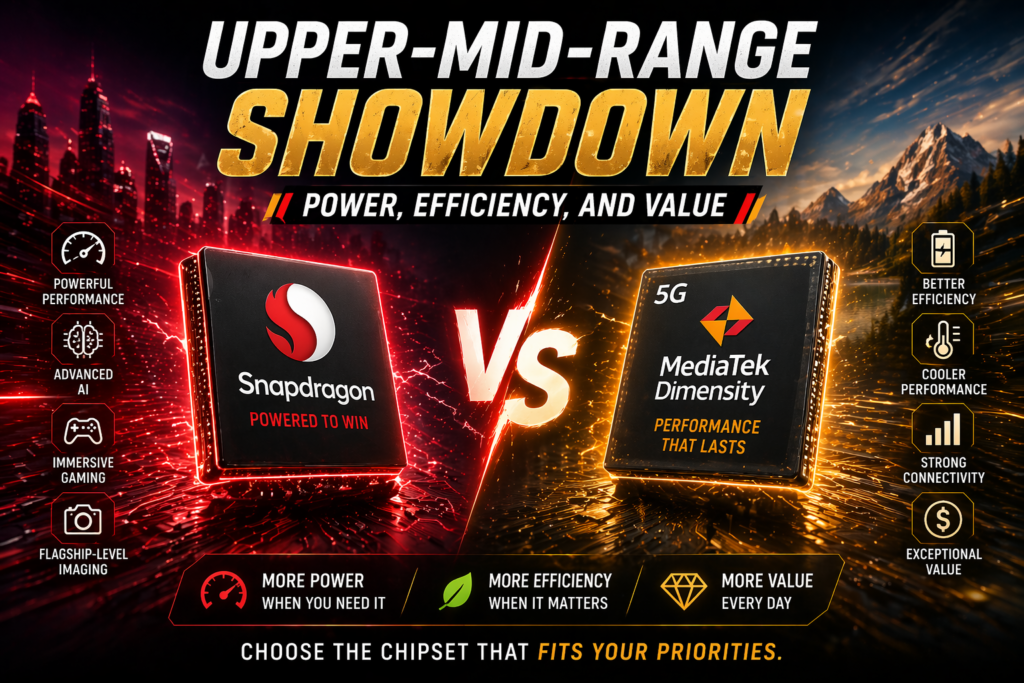
The upper-mid-range smartphone market, encompassing devices priced between ₹30,000 and ₹50,000, has become the most dynamic battleground for mobile processors. In this fiercely contested segment, MediaTek has strategically positioned its Dimensity 9400 and 9300+ chips to deliver a “flagship killer” experience, challenging Qualcomm’s dominance with a potent mix of raw performance, exceptional power efficiency, and advanced features typically reserved for more expensive handsets. Qualcomm, in turn, deploys its own refined processors, such as the Snapdragon 8 Gen 5 and the highly specialized Snapdragon 8s Gen 4, to cater to different user priorities within this price bracket. The competition here is less about a clear-cut winner and more about a sophisticated trade-off between peak performance, sustained efficiency, and specialized functionality.
MediaTek’s strategy in this tier is rooted in the successful evolution of its all-big-core CPU architecture, perfected with the Dimensity 9300. The subsequent iterations, the Dimensity 9400 and 9400+, build upon this foundation, promising superior performance per watt. This focus on efficiency is a direct response to user demands for longer battery life and cooler-running devices, especially during intensive tasks like gaming or video editing. The Dimensity 9400+ is marketed as a platform with a best-in-class Generative AI Engine, supporting first-to-market features and global Large Language Model (LLM) support. It boasts a peak NPU performance of 100 TOPS, placing it ahead of competitors on paper, and its upgraded speculative decoding technology promises a 20% faster inference speed for Agentic AI tasks. This positions the Dimensity series as the go-to choice for users who want access to cutting-edge AI features and a stable, thermally-managed experience without paying a premium price. The Vivo X200 series, which ships with the Dimensity 9400, pushed past 2.8 million on the Antutu benchmark, demonstrating its capability to rival flagship-level performance.
Qualcomm’s approach in the upper-mid-range is twofold. The Snapdragon 8 Gen 5 is presented as a lighter, more affordable version of its flagship sibling, designed to bring flagship-tier performance to a wider audience. It is found in devices like the OnePlus 15R, which retails for around ₹49,633, making it an accessible entry point to high-end processing power. While it may lack some of the extreme peak performance of the 8 Elite Gen 5, it still delivers a robust and versatile user experience suitable for demanding applications and games. The more interesting contender in this space is the Snapdragon 8s Gen 4. This chip is specifically engineered for gaming and performance, offering a compact yet powerful solution. Reviews of the IQOO 15, powered by the Snapdragon 8s Gen 4, describe it as a fantastic, affordable gaming smartphone, highlighting its smooth performance in demanding titles. The Snapdragon 8s Gen 4 is praised for its excellent performance in mid-range games and its ability to run high-end games with decent quality, ensuring a fresh and smooth experience. This makes it an ideal choice for users whose primary priority is a high-fidelity gaming experience.
When comparing the two, the Dimensity 9400/9300+ series holds a significant advantage in thermals and efficiency. The all-big-core design, where powerful cores finish tasks quickly and then power down, consumes less total energy than traditional small-efficiency cores that take longer to complete the same work. This results in lower power consumption and less heat generation, a crucial factor for maintaining sustained performance during long sessions. This inherent efficiency makes MediaTek’s chips highly desirable for slim and light devices that cannot accommodate aggressive cooling systems. Qualcomm’s chips, while powerful, are generally associated with higher thermal output, though the Snapdragon 8s Gen 4 is optimized to manage this better than its larger siblings. For users who plan to game extensively or use performance-intensive apps for hours, the Dimensity’s superior thermal management could translate into a more enjoyable and reliable long-term experience.
Camera processing is another area where both platforms excel, but the final output is heavily influenced by the manufacturer’s tuning. Both the Snapdragon 8 Gen 5 and the Dimensity 9400 feature advanced ISPs capable of handling high-resolution sensors and complex computational photography tasks. The Snapdragon 8s Gen 4, for example, is noted for its solid main camera performance, particularly in low-light conditions. Similarly, the Dimensity 9400 is described as having a best-in-class Generative AI Engine and top-tier photography capabilities. However, because the underlying hardware is so capable, the difference in day-to-day camera quality often comes down to the algorithms, lens hardware, and post-processing applied by the phone maker. Therefore, in the upper-mid-range, the chipset itself is less of a determining factor for camera excellence than the overall system integration by brands like OnePlus, Xiaomi, and Realme.
Ultimately, the value proposition in the ₹30,000–₹50,000 range hinges on user priorities. For dedicated gamers and power users who want the best possible performance in a portable package and appreciate advanced AI features, the MediaTek Dimensity 9400/9300+ series offers an unparalleled combination of power, efficiency, and forward-looking technology. Its superior thermals ensure that the performance doesn’t drop off over time, making it a more sustainable investment. For users who prioritize a balanced, versatile experience with a known quantity, the Snapdragon 8 Gen 5 provides a familiar and reliable flagship-grade performance profile. The Snapdragon 8s Gen 4 carves out its own niche as the premier choice for those who identify primarily as gamers and want a device optimized for that purpose. The “better” chip is not universal; it is contingent on whether a user values the absolute peak performance and versatility of Snapdragon or the sustained efficiency and advanced AI of MediaTek.
| Feature | MediaTek Dimensity 9400 / 9300+ | Qualcomm Snapdragon 8 Gen 5 / 8s Gen 4 |
|---|---|---|
| Primary Target | Flagship Killer, Balanced All-Rounder | Versatile Flagship Alternative, Specialized Gaming |
| CPU Design | All-Big-Core (e.g., Cortex X4, A720) | Big.LITTLE (ARM-based) |
| Key Strength | Thermal Efficiency, Power Savings | Peak CPU Performance, Versatility |
| GPU Advantage | Superior Ray Tracing Performance | High-Framerate Gaming (especially 8s Gen 4) |
| AI Capability | Advanced Generative AI, 100 TOPS NPU | Strong NPU (~60 TOPS), General AI Tasks |
| Ideal User | Gamers, Power Users, AI Enthusiasts | General-Purpose Power Users, Reliable Performer Seekers |
| Example Devices | Vivo X200 series, Oppo Find X8 series | OnePlus 15R, IQOO 15 |
Mid-Range Battle: Gaming Prowess vs. Balanced Performance
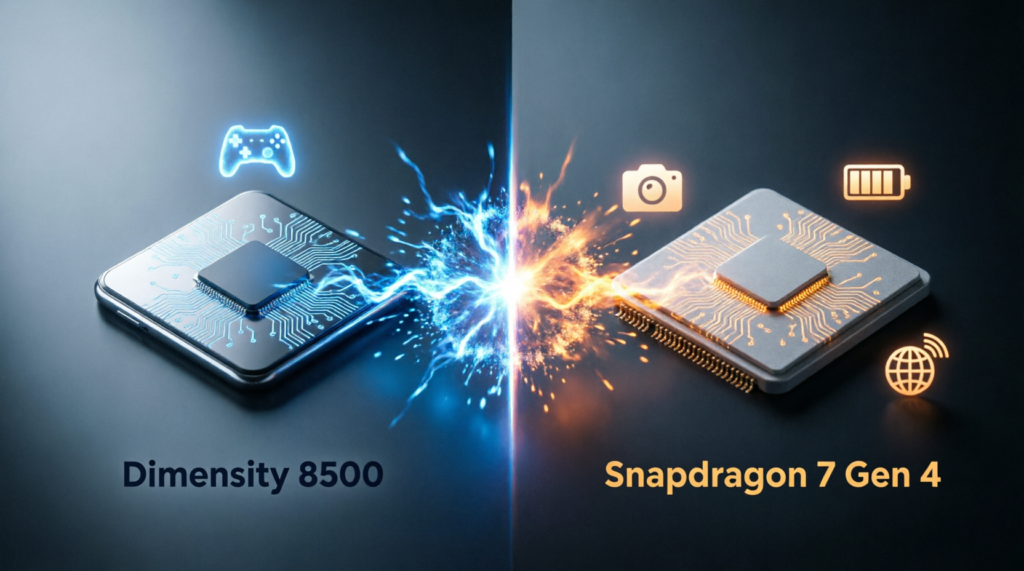
The mid-range segment, spanning smartphones from ₹20,000 to ₹30,000, is characterized by intense competition where manufacturers strive to deliver a premium feel at an accessible price point. In 2026, this arena is dominated by MediaTek’s Dimensity 8500 and Qualcomm’s Snapdragon 7 Gen 4 and 7s Gen 4. This tier showcases a clear divergence in strategy: MediaTek is aggressively targeting gamers with its high-performance Dimensity 8500, while Qualcomm offers a more conservative, balanced approach with its Snapdragon 7 series, emphasizing reliability and a well-rounded feature set. The result is a compelling choice for consumers, pitting raw, console-like gaming power against dependable, all-around performance.
MediaTek has made a significant statement in this category with the launch of the Dimensity 8500. Positioned as a chip that takes mobile gaming to the next level, it is engineered for lightning-fast, ultra-smooth performance, giving users a decisive edge in competitive gaming scenarios. The specifications back up this claim, showcasing a CPU configuration with a very fast prime core and several high-performance cores, resulting in a significantly faster overall CPU speed compared to its main rivals. This focus on raw power allows the Dimensity 8500 to run demanding games with ease, delivering a fluid and responsive experience that was previously exclusive to much more expensive flagships. This chip effectively raises the bar for what consumers should expect from a mid-range device, making it the clear choice for anyone who prioritizes gaming above all else. The Poco X8 Pro Max, powered by a variant of this chip, is expected to showcase this enhanced gaming performance.
Qualcomm’s strategy in the mid-range is more measured and centered on providing a safe, reliable, and versatile experience. The Snapdragon 7 Gen 4 is the cornerstone of this strategy, offering a balanced performance profile suitable for general-purpose use, multimedia consumption, and moderate gaming. It is designed to provide a “good enough” experience across the board without excelling in any single area. This makes it an ideal choice for the average user who values consistency, long-term software support, and a proven track record. Brands like Realme are leveraging the Snapdragon 7 Gen 4 to deliver well-rounded devices, pairing the chip with capable cameras and other features to create a cohesive user experience. The Snapdragon 7s Gen 4 serves as a slightly downgraded, more affordable option, targeting the lower end of this price bracket (around ₹25,000) and catering to users with less demanding needs. This tiered approach allows Qualcomm to cover a wide spectrum of the mid-range market, ensuring there is a suitable option for nearly every type of user.
The performance gap between the Dimensity 8500 and the Snapdragon 7 series is substantial, particularly in gaming. The Dimensity 8500’s architecture is explicitly tuned for gaming workloads, promising sustained frame rates without throttling, a critical feature for an immersive experience. In contrast, while the Snapdragon 7 Gen 4 can handle popular mobile games, it is not designed for the most graphically intensive titles at maximum settings. For users who engage in “light” or “moderate” gaming, the Snapdragon 7 Gen 4 is perfectly adequate. However, for those who consider gaming a primary activity, the Dimensity 8500’s superior processing power and dedicated gaming optimizations make it the vastly superior choice. The PassMark benchmark data shows the Dimensity 8500 performing exceptionally well in multi-threaded CPU tests, indicating its strength in handling complex, parallel tasks common in modern games.
Beyond gaming, the choice between these chips also depends on other priorities. The Snapdragon 7 Gen 4 is often paired by manufacturers with high-quality camera systems, making it a strong contender for users who are passionate about photography. Its ISP is capable of producing excellent images, and when combined with good lens hardware and software tuning, it can compete with more expensive platforms. The Dimensity 8500 also features a capable ISP, but its marketing and development appear more focused on its gaming credentials. For non-gamers, the Snapdragon 7 Gen 4 remains a prudent and reliable investment, backed by Qualcomm’s long-standing reputation and commitment from OEMs to provide multiple Android OS upgrades and security patches. This long-term software support enhances the overall value and lifespan of a device, a crucial consideration for budget-conscious buyers.
In conclusion, the mid-range battle is a straightforward case of choosing between specialization and balance. The MediaTek Dimensity 8500 is the undisputed champion for gamers, offering a level of performance that blurs the line between mid-range and flagship devices. Its ability to deliver console-like experiences in handheld form makes it incredibly compelling for its target audience. On the other hand, the Qualcomm Snapdragon 7 Gen 4 and 7s Gen 4 serve as excellent, reliable workhorses for the majority of users. They provide a smooth and consistent experience for everyday tasks, web browsing, streaming, and casual gaming, backed by a reputation for stability and long-term software support. Therefore, the “better” chip is entirely dependent on the user’s lifestyle. If gaming is your passion, the Dimensity 8500 is the clear winner. If you seek a reliable, well-rounded device for general use, the Snapdragon 7 Gen 4 is the safer and more balanced choice.
| Feature | MediaTek Dimensity 8500 | Qualcomm Snapdragon 7 Gen 4 / 7s Gen 4 |
|---|---|---|
| Target Audience | Serious Gamers, Performance Seekers | General Users, Casual Gamers |
| CPU Configuration | 1x 3.4 GHz, 3x 3.2 GHz, 4x 2.2 GHz versus.com | 1x 2.8 GHz, 4x 2.4 GHz, 3x 1.95 GHz (Gen 4) |
| Key Strength | Ultra-Smooth Gaming Performance | Balanced All-Round Performance, Reliability |
| Real-World Use Case | Competitive Gaming, Demanding Apps | Everyday Tasks, Multimedia, Moderate Gaming |
| Thermals | Designed for Sustained Performance | Generally Good, but less optimized for extreme loads |
| Ideal User | Gamers, Tech Enthusiasts | Students, Professionals, Average Consumers |
| Example Devices | Poco X8 Pro Max (Expected) | Realme 14 5G, Motorola Edge 60 Stylus |
Budget Segment Face-Off: Performance Per Rupee
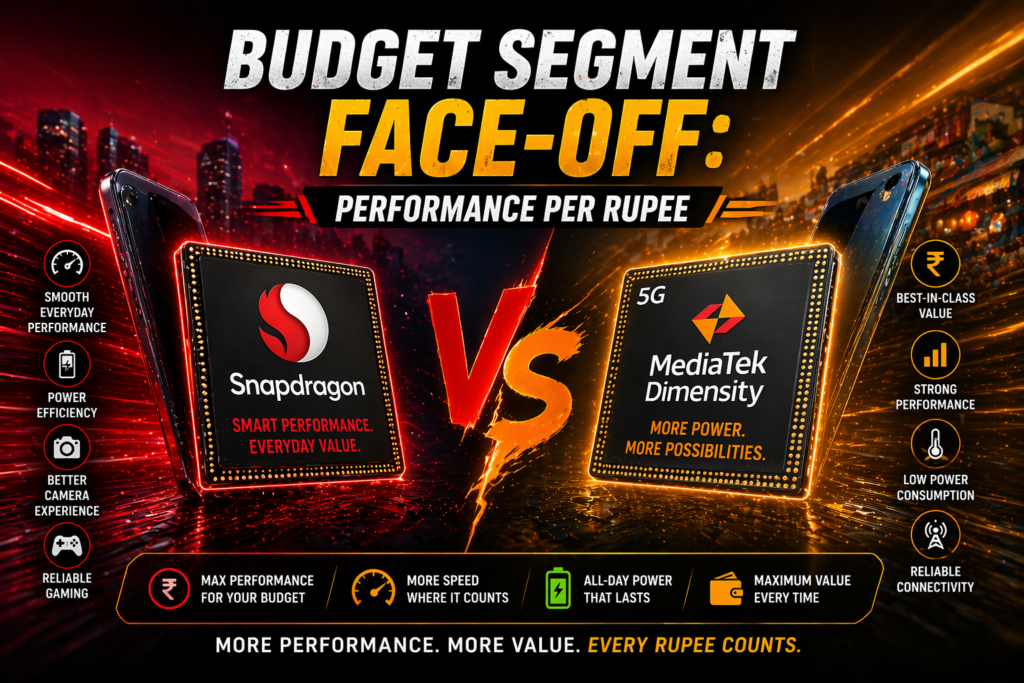
In the highly price-sensitive budget segment, where smartphones cost under ₹20,000, the competition shifts dramatically. Here, the focus is not on achieving flagship-level performance but on delivering a functional, smooth, and responsive user experience for everyday tasks at the lowest possible cost. In 2026, MediaTek maintains a strong presence with chips like the Dimensity 7020 and the upcoming Dimensity 7500, while Qualcomm offers the Snapdragon 6 Gen 4 and its predecessors. The analysis of this market reveals a clear hierarchy of performance, with MediaTek’s offerings generally providing a more capable and modern experience, albeit with some critical warnings against certain outdated options.
MediaTek’s Dimensity 7020 emerges as a standout performer in the budget space. Despite its low price point, it is capable of running mid-range games smoothly and delivering graphics that feel “fresh” and responsive. This is a significant achievement, as many budget phones struggle with stutter and lag during gameplay. The chip’s technical specifications contribute to this positive experience. It features a relatively high RAM speed of 2750 MHz, which is considerably faster than many of its direct competitors. It also boasts a wider memory bandwidth (51.2 Gbit/s) compared to rivals like the Snapdragon 6 Gen 4 (25.6 Gbit/s), which helps in data-intensive tasks. Furthermore, its 4nm manufacturing process is more advanced than the 6nm process used by some competitors, leading to better power efficiency and potentially lower heat generation. These underlying advantages mean that a phone powered by the Dimensity 7020 can offer a noticeably smoother and more capable user experience than a similarly priced device with a different chipset. The upcoming Dimensity 7500 is expected to continue this trend, bringing further improvements to this popular series.
Qualcomm’s lineup in the budget category is functional but lacks the standout qualities of MediaTek’s offerings. The Snapdragon 6 Gen 4 is a viable option for users who need a reliable device for basic tasks like social media, web browsing, and watching videos. However, when compared to the Dimensity 7020, it falls short in several key areas, including RAM speed and memory bandwidth. Its predecessor, the Snapdragon 6 Gen 3, is already considered outdated and should be approached with caution. The Snapdragon 4 series is largely relegated to the sub-₹10,000 market, where it serves as a basic connectivity tool rather than a true multimedia device. A critical piece of advice from the provided sources is to actively avoid the MediaTek Dimensity 6300. This chip is described as being significantly outperformed by the Dimensity 7020 and should be bypassed entirely in favor of newer, more capable alternatives, even if they come at a slightly higher price.
The real-world value in the budget segment is determined by a combination of raw performance, feature set, and long-term usability. The Dimensity 7020’s ability to handle mid-range games and its superior RAM technology give it a tangible advantage. This means users are not limited to only playing “light” games and can enjoy a broader library of titles without significant compromises. This extra performance per rupee is a key selling point. When evaluating phones in this category, consumers should look beyond the processor alone and consider the overall package. For instance, a phone with a Snapdragon 6 Gen 4 might compensate with a larger battery or a better display, but for pure performance, the Dimensity 7020 is the recommended choice.
Another important factor is software support. Leading brands that sell phones in India, such as Xiaomi and Realme, are increasingly committed to providing multiple years of security patches and even full Android OS upgrades for devices equipped with MediaTek chips. For example, some Realme devices are eligible for four major Android OS updates, a policy that aligns with Google’s recommendations and significantly extends a phone’s useful life. This commitment mitigates one of MediaTek’s historical weaknesses, poorer software support, and enhances the overall value proposition of its budget and mid-range offerings. This means that investing in a phone with a modern MediaTek chip is likely to result in a device that receives timely security fixes and stays current with the latest versions of Android for longer than a comparable device with an older Qualcomm chip.
In summary, the budget smartphone market in 2026 is not a level playing field. MediaTek has established a clear leadership position with chips like the Dimensity 7020, which offers a superior blend of performance, modern features like fast RAM, and long-term software support. For consumers on a tight budget, prioritizing a device with a Dimensity 7020 or a similar modern MediaTek chip will yield a far better user experience than opting for a device with an older Snapdragon 6 Gen 3 or, worse, a completely obsolete chip like the Dimensity 6300. The goal in this segment is to get the most performance for the least money, and MediaTek’s portfolio currently provides the best path to achieving that objective.
| Feature | MediaTek Dimensity 7020 | Qualcomm Snapdragon 6 Gen 4 / 6 Gen 3 |
|---|---|---|
| RAM Speed | 2750 MHz | 2133 MHz (for 6300) |
| Memory Bandwidth | 51.2 Gbit/s | 25.6 Gbit/s |
| Manufacturing Process | 4nm | 6nm (for 6300) |
| Gaming Performance | Smoothly runs mid-range games | Runs mid-range games, may struggle with high-end titles |
| Recommended Status | Recommended Choice | Viable but Outperformed by Competitors |
| Outdated Chip to Avoid | Not specified | Dimensity 6300, Snapdragon 6s Gen 3 |
Cross-Cutting Technologies: AI, Thermals, and Software

Beyond the segmented comparisons of specific price brackets, a deeper understanding of the MediaTek vs. Qualcomm rivalry requires analyzing the cross-cutting technologies that define the modern smartphone experience. In 2026, artificial intelligence, thermal efficiency, and long-term software support have transcended their roles as secondary features to become primary differentiators in the competitive landscape. Both companies are heavily investing in these areas, but their strategies and execution reveal distinct philosophical approaches that cater to different user priorities. MediaTek is pushing the envelope with innovative AI architectures and a relentless focus on efficiency, while Qualcomm leverages its scale and brand recognition to deliver a mature, reliable, and powerful ecosystem.
The race for on-device artificial intelligence is perhaps the most significant technological frontier. Both the Snapdragon 8 Elite Gen 5 and the Dimensity 9500 feature massive Neural Processing Units (NPUs) designed to accelerate AI tasks locally, preserving privacy and enabling new functionalities without constant cloud connectivity. Qualcomm’s Snapdragon 8 Elite Gen 5 is reported to have a powerful NPU with a peak throughput of around 60 TOPS, providing a strong foundation for a wide range of AI applications. MediaTek, however, is pursuing a more ambitious and technically novel path. Its Dimensity 9500 incorporates a 3rd-generation NPU, and its latest platform introduces a revolutionary concept: compute-and-memory. This technology involves running AI calculations directly within the memory arrays themselves, eliminating the energy-intensive step of shuttling data between the processor and memory. This could lead to dramatic efficiency gains, allowing for more complex and continuous AI operations. Furthermore, MediaTek is pioneering features like Agentic AI, where the phone can autonomously reason across applications, and GenAI Super Zoom, which uses AI to reconstruct image detail at extreme zoom levels. While Qualcomm’s sheer NPU power is undeniable, MediaTek’s architectural innovations could provide a decisive advantage in efficiency and enable a new class of always-on, context-aware AI features that are simply not feasible with current technology.
Thermal efficiency and sustained performance remain a core battleground, representing a fundamental clash of design philosophies. Qualcomm’s traditional big.LITTLE architecture, which uses a mix of high-performance and power-efficient cores, has long been the industry standard. This approach aims to balance performance and power consumption by assigning tasks to the most appropriate cluster of cores. However, as seen with the Snapdragon 8 Gen 5, this can sometimes lead to higher thermal output under sustained load, potentially causing performance throttling. MediaTek, on the other hand, has bet heavily on its all-big-core design, famously introduced with the Dimensity 9300. This architecture relies on a set of very large, powerful cores (like the Cortex X4). The counterintuitive principle behind its efficiency is that these big cores can complete tasks almost instantly before powering down, consuming less total energy than smaller cores that take longer to finish the same job. This design philosophy has proven remarkably effective, giving MediaTek chips a strong reputation for staying cool and delivering stable performance over long periods. This is particularly evident in gaming scenarios, where the Dimensity 9500 is positioned to provide sustained high frame rates without the thermal compromise often associated with high-performance chips. For users who prioritize a consistent, uninterrupted experience during marathon gaming sessions or extended video calls, MediaTek’s focus on thermals and stability provides a tangible real-world benefit.
Finally, long-term software support has emerged as a critical factor influencing both consumer choice and brand loyalty. Historically, MediaTek has struggled with inconsistent and delayed software updates, a weakness that Qualcomm expertly exploited to cement its position as the premium choice. However, in 2026, this dynamic is changing. Major Original Equipment Manufacturers (OEMs) like Xiaomi and OnePlus, who have wholeheartedly embraced MediaTek for their premium devices, are now making public commitments to provide multiple years of security patches and even full Android OS upgrades. For instance, Xiaomi is preparing updates for devices dating back to 2022, and brands like Realme are promising four major Android OS updates for their eligible devices. This commitment transforms the value equation. A phone with a capable MediaTek chip that is guaranteed to receive timely security updates and future OS versions becomes a much more durable and valuable long-term investment. This shift addresses a key pain point for consumers and significantly narrows the gap between the two ecosystems, making MediaTek a far more credible and attractive option for users who plan to keep their devices for several years.
In synthesis, the competition between MediaTek and Qualcomm in 2026 is multifaceted. Qualcomm remains a formidable opponent with its powerful and versatile processors, strong brand equity, and a mature software ecosystem. However, MediaTek is no longer just a challenger; it is a sophisticated competitor that has successfully carved out a unique and compelling identity. By focusing on radical efficiency through its all-big-core architecture, pioneering next-generation AI with innovative NPU designs, and partnering with OEMs to guarantee long-term software support, MediaTek has created a product line that directly counters Qualcomm’s strengths. The choice between them is no longer a simple matter of preference but a calculated decision based on which set of priorities, be it peak CPU performance, sustained thermals, cutting-edge AI features, or long-term software assurance, a user values most.
Recommended Readings

To deepen your understanding of the semiconductor industry, mobile architecture, and the strategic shifts that have defined the MediaTek vs. Qualcomm rivalry in 2026, we recommend the following books. These selections move beyond spec sheets to explore the engineering, business, and historical context behind the chips in your pocket.
1. Chip War: The Fight for the World’s Most Critical Technology by Chris Miller – This is the definitive text on the global geopolitical and economic battle for semiconductor dominance. While it focuses heavily on the US-China dynamic and companies like TSMC, Intel, and NVIDIA, it provides essential context for why foundry relationships (like MediaTek’s partnership with TSMC vs. Qualcomm’s use of Samsung) are so critical to performance and efficiency. It explains the “why” behind the manufacturing processes discussed in this article.
2. The Idea Factory: Bell Labs and the Great Age of American Innovation by Jon Gertner – Understanding modern chip design requires appreciating the history of innovation. This book details how structured research environments led to breakthroughs like the transistor and the laser. It offers a fascinating contrast to today’s fast-paced, market-driven chip wars, helping readers understand the long-term R&D cycles that allow companies like Qualcomm and MediaTek to leapfrog each other with new architectures like Oryon or All-Big-Core designs.
3. Creativity, Inc.: Overcoming the Unseen Forces That Stand in the Way of True Inspiration by Ed Catmull – While not about hardware, this book is crucial for understanding the corporate culture shifts required for innovation. MediaTek’s rise from a budget-component supplier to a flagship contender mirrors the kind of cultural transformation Catmull describes. It offers insights into how companies can break free from legacy thinking (like Qualcomm’s reliance on big.LITTLE) to embrace risky, innovative architectures (like MediaTek’s all-big-core approach).
4. The Second Machine Age: Work, Progress, and Prosperity in a Time of Brilliant Technologies by Erik Brynjolfsson and Andrew McAfee – As AI becomes central to mobile processors (with NPUs hitting 100+ TOPS), this book provides a broader framework for understanding how exponential technologies like on-device generative AI will reshape user experiences and expectations. It helps contextualize why features like “Agentic AI” and memory-integrated computing are not just specs, but harbingers of a new era in personal computing.
Frequently Asked Questions (FAQs)

Q1: Is MediaTek finally better than Qualcomm in 2026?
A: It depends on your priorities. MediaTek has surpassed Qualcomm in thermal efficiency, sustained gaming performance, and certain AI architectural innovations (like memory-integrated NPUs). However, Qualcomm still holds the edge in peak single-core CPU performance and brand legacy for ultra-premium flagships. For most users, especially gamers and power users, MediaTek is now often the “smarter” choice due to its stability and efficiency.
Q2: Which chipset is best for heavy mobile gaming in 2026?
A: For dedicated gamers, the MediaTek Dimensity 9500 (Flagship) and Dimensity 8500 (Mid-Range) are currently the top recommendations. Their all-big-core architecture and superior thermal management allow them to maintain high frame rates for longer periods without throttling or overheating, unlike some Snapdragon counterparts which may prioritize peak bursts of speed over sustained consistency.
Q3: Should I buy a phone with a Snapdragon 8 Gen 3 or wait for a Dimensity 9400 device in 2026?
A: If you can find a Snapdragon 8 Gen 3 device at a significant discount (below ₹40,000), it remains a very capable chip. However, the Dimensity 9400/9300+ offers better power efficiency, newer AI features, and often comes in devices with more aggressive pricing in the upper-mid-range segment. Unless you are deeply entrenched in the Snapdragon ecosystem for specific software optimizations, the Dimensity offers better future-proofing and value in 2026.
Q4: Are budget MediaTek chips like the Dimensity 7020 reliable for long-term use?
A: Yes. The Dimensity 7020 is currently the best value proposition in the sub-₹20,000 segment. It offers faster RAM speeds and better memory bandwidth than competing Snapdragon 6 series chips, leading to a smoother experience. Additionally, major brands like Xiaomi and Realme now offer extended software support (up to 4 years of OS updates) for devices powered by these MediaTek chips, making them a safe long-term investment. Avoid older chips like the Dimensity 6300.
Q5: Does the choice of processor affect camera quality significantly?
A: While the Image Signal Processor (ISP) is part of the chipset, both Snapdragon and MediaTek flagships have highly capable ISPs that can handle 200MP+ sensors and advanced computational photography. In 2026, the difference in camera quality is determined more by the phone manufacturer’s tuning, lens hardware, and software algorithms than by the chipset itself. Both platforms can deliver flagship-grade photography if paired with good sensors.
Q6: Which chipset handles On-Device AI better?
A: This is a close battle. Qualcomm’s Snapdragon 8 Elite Gen 5 has a powerful NPU (~60 TOPS). However, MediaTek’s Dimensity 9500 boasts a higher peak TOPS rating (100 TOPS) and introduces revolutionary “compute-in-memory” technology, which drastically reduces power consumption for AI tasks. MediaTek also leads in implementing “Agentic AI” features that allow phones to reason across apps autonomously. For cutting-edge, efficient, on-device generative AI, MediaTek currently has a slight architectural advantage.
Q7: Why do some people still prefer Snapdragon over MediaTek?
A: Brand perception and legacy play a huge role. Snapdragon has been the default “flagship” chip for Android for over a decade. Many users trust its consistent driver support, broader compatibility with certain games or emulators, and the prestige associated with brands like Samsung using it in their Ultra models. Additionally, some users prefer the raw peak CPU speed of Snapdragon’s Oryon cores for specific benchmark-heavy tasks, even if real-world efficiency favors MediaTek.
Overall Verdict: Determining the Best Chipset for Every User
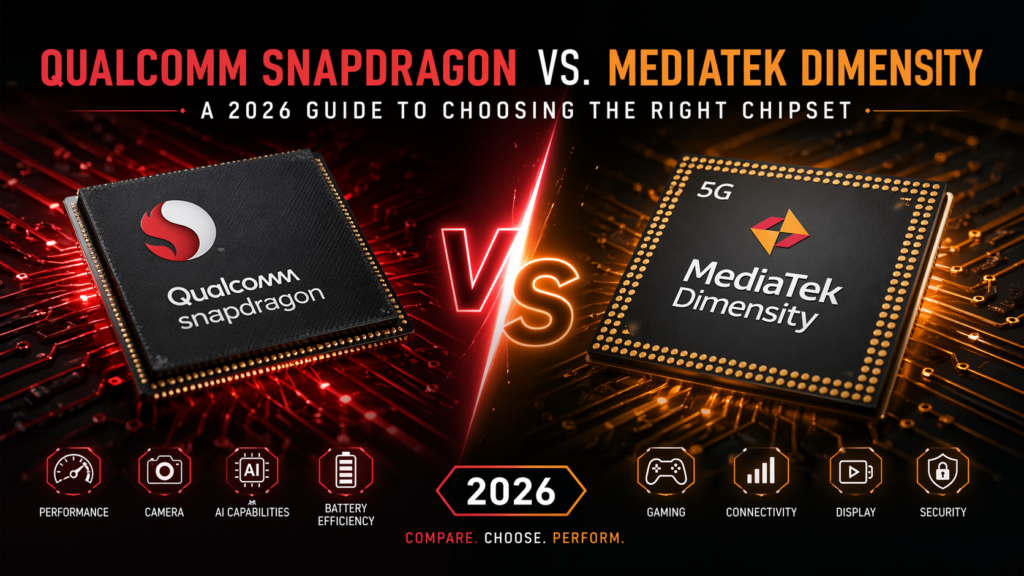
After a comprehensive analysis of the competitive landscape in 2026, it is clear that the question of whether MediaTek or Qualcomm offers a better processor does not have a single, universal answer. The optimal choice is contingent upon a user’s specific priorities, intended use case, and budget. Both companies have produced exceptional silicon that pushes the boundaries of mobile technology, but they do so with different emphases. Qualcomm continues to champion raw, peak CPU performance and carries the weight of a long-standing “flagship” legacy, while MediaTek has forged a powerful reputation for exceptional thermal efficiency, sustained performance, and innovative AI capabilities. The following verdicts are tailored to specific user profiles and price segments, synthesizing the technical specifications, real-world performance indicators, and market positioning detailed throughout this report.
For the Flagship User (₹50,000+), the decision rests on a fundamental trade-off between peak performance and real-world stability. If your primary concern is achieving the absolute highest scores in CPU-bound benchmarks and experiencing the fastest possible single-threaded performance in demanding applications and games, the Qualcomm Snapdragon 8 Elite Gen 5 is the logical choice. Its custom Oryon cores provide a significant advantage in raw speed, and its established brand prestige offers peace of mind. However, if you are a dedicated gamer or a power user who values a consistent, uninterrupted experience over hours of use, the MediaTek Dimensity 9500 presents a more compelling case. Its superior thermal management ensures that high framerates and performance don’t degrade due to throttling, making it a more reliable platform for sustained gaming. Furthermore, its lead in GPU-powered ray tracing and its innovative, memory-integrated NPU for AI make it a technologically forward-looking choice. The Dimensity 9500 is the smarter investment for those who prioritize a holistic, stable, and feature-rich flagship experience.
For the Power User and Gamer in the Upper-Mid-Range (₹30,000–₹50,000), MediaTek’s Dimensity 9400 and 9300+ series emerge as the clear winners. This segment is where MediaTek’s “flagship killer” strategy is most effective. The combination of immense performance delivered with remarkable power efficiency is unparalleled. Gamers will benefit immensely from the superior thermals and advanced GPU features, ensuring a smooth and stable experience during long gaming sessions. The inclusion of a state-of-the-art AI engine also provides access to cutting-edge features that are typically locked behind a higher price tag. While the Qualcomm Snapdragon 8 Gen 5 offers a solid and versatile performance profile, it cannot match the Dimensity’s efficiency and advanced feature set in this price bracket. For users who want the best possible performance-per-watt and are eager to adopt the latest in on-device AI, the MediaTek chip is the superior choice.
In the Mid-Range category (₹20,000–₹30,000), the choice is sharply defined by user intent. For the Serious Gamer, the MediaTek Dimensity 8500 is the undisputed champion. It delivers a level of raw power and gaming-specific optimizations that elevate the entire experience, bringing a console-like feel to a more affordable device. For the General-Purpose User, the Qualcomm Snapdragon 7 Gen 4 remains a safe, reliable, and well-rounded option. It provides excellent performance for everyday tasks, multimedia consumption, and casual gaming, backed by a reputation for stability and long-term software support from its manufacturer partners. The decision here is binary: prioritize gaming with the Dimensity 8500, or prioritize a balanced, reliable experience with the Snapdragon 7 Gen 4.
Finally, for the Budget-Conscious Buyer (Under ₹20,000), MediaTek once again holds the crown. The Dimensity 7020 stands out as the best value proposition, offering surprisingly strong performance, smooth operation in mid-range games, and modern features like fast RAM that are often absent in this segment. It provides the most capable and enjoyable user experience for the price. The Qualcomm Snapdragon 6 Gen 4 is a functional fallback, but it is clearly outclassed by the Dimensity 7020. It is crucial for budget shoppers to avoid outdated chips like the Dimensity 6300, which offer a poor experience despite their low price.
In conclusion, neither MediaTek nor Qualcomm is definitively “better” overall. They represent two different philosophies in mobile processor design. Qualcomm excels at delivering peak performance and maintaining a trusted ecosystem, making it a strong choice for users who prioritize raw speed and brand familiarity. MediaTek has masterfully differentiated itself by focusing on efficiency, stability, and innovation, making it the superior choice for gamers, power users, and those seeking the best performance-per-watt and cutting-edge AI features. Your ideal chipset is the one that aligns with your personal definition of value.










Leave a Reply