

TL;DR
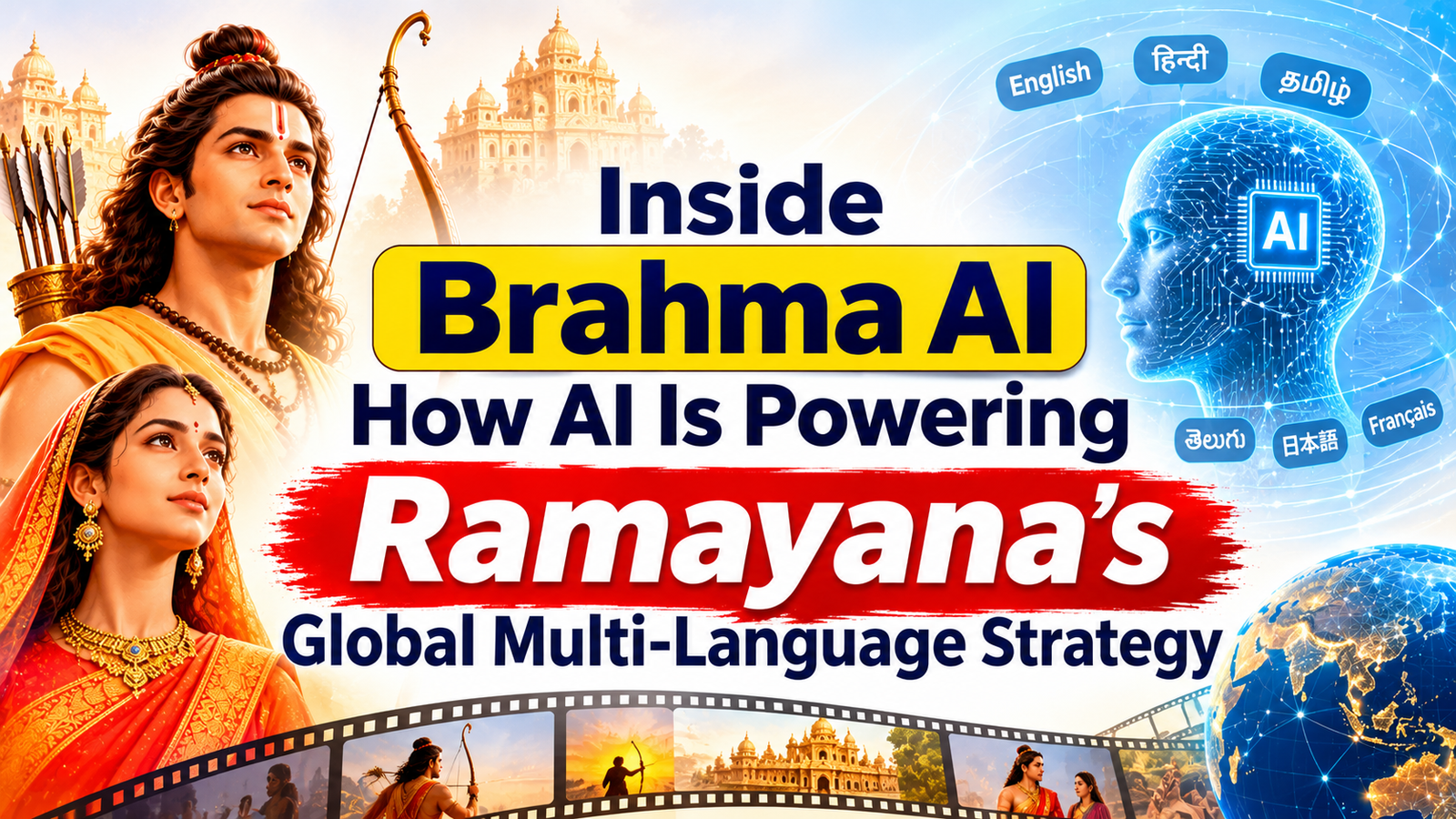
The global entertainment landscape is entering an era where post-production tools can eliminate language barriers without sacrificing physical performance. At the center of this transformation is Brahma AI, an enterprise-grade artificial intelligence operating system designed specifically for audiovisual media. Emerging from the combined technical lineage of DNEG, Prime Focus Technologies, and Metaphysic, Brahma AI achieved a valuation of $2 billion following a preferred share funding round led by Multiples Alternate Asset Management.
The primary public showcase of this technology occurred during the global distribution push for the cinematic feature Ramayana: Part One (also titled Ramayana: Rise of a Legend), directed by Nitesh Tiwari and produced by Namit Malhotra. Rather than relying on synthetic audio generation or expensive physical reshoots, the production implemented a hybrid workflow. Authentic human voice actors recorded translated scripts, while Brahma AI executed precise facial micro-stitching to align the visual lip movements of on-screen actors with the dubbed audio tracks. This report examines Brahma AI’s underlying platform architecture, corporate capital structure, enterprise policy framework, and the technical mechanics of its deployment in global film distribution.
Key Takeaways
- Architectural Consolidation: Brahma AI represents an integration of visual effects tools from DNEG, enterprise media infrastructure from Prime Focus Technologies, and digital human capabilities from Metaphysic.
- Strict Division of Voice and Visuals: In major features like Ramayana, artificial intelligence is restricted to visual facial alignment. Vocal tracks are delivered exclusively by human voice talent, preserving vocal texture while eliminating visual misalignment.
- Enterprise Broad-Market Reach: Beyond theatrical releases, Brahma AI serves enterprise sectors including professional sports broadcasting, corporate healthcare, and international advertising, featuring anchor clients such as Warner Bros., the NBA, and Mayo Clinic.
- Policy-First AI Governance: By appointing seasoned policy leaders to its advisory board, Brahma AI embeds content provenance verification, consent tracking, and regulatory compliance directly into its enterprise technology stack.
Introduction
Language barriers have long restricted the global revenue potential of non-English media properties. Historically, international releases relied on two traditional methods: subtitles, which require continuous reading and can pull viewer attention away from visual framing, or standard audio dubbing, which creates a noticeable disconnect when on-screen lip movements fail to match translated words. While physical multi-language reshoots can solve this alignment problem, they remain economically unviable for large-scale cinematic productions.
The evolution of computer vision and deep learning has introduced a third alternative: algorithmic facial re-performance. Brahma AI has established itself as an enterprise operational system created to manage and execute these complex visual modifications. Founded and led by Prabhu Narasimhan, the company provides tools designed to process, alter, and secure enterprise media assets.
The international release strategy for Ramayana: Part One offers a clear demonstration of how transformational visual tools are moving from experimental labs into mainstream commercial workflows. By decoupling vocal performance from physical facial geometry, the technology allows studios to enter international markets with natural visual integration while preserving the original actors’ emotional expressions.
The Architecture and Genesis of Brahma AI
Corporate Lineage and Technological Origins
Brahma AI was created to address structural fragmentation within visual content localization and synthetic media workflows. Rather than building an enterprise software startup from scratch, the platform was established by consolidating specialized technology stacks and operational frameworks from three industry entities:
- DNEG: The Academy Award-winning visual effects studio contributed specialized rendering pipelines, high-resolution digital asset management, and established studio integrations.
- Prime Focus Technologies: Provided enterprise-scale cloud media management systems, automated content indexing, and global supply chain software.
- Metaphysic: Contributed biometrically accurate facial tracking models and photorealistic digital re-enactment algorithms.
This consolidation was executed under the leadership of Prabhu Narasimhan, who identified the need for an independent, AI-native operating system tailored for enterprise visual content. Namit Malhotra, Founder and CEO of DNEG and Chairman of Prime Focus, supported the independent spin-off to ensure the software could operate across various studio environments while establishing distribution partnerships with companies like DNEG, Google, and Hakuhodo.
| Enterprise Parameter | Strategic Specification | Operational Impact |
|---|---|---|
| Enterprise Valuation | $2 Billion Unicorn Valuation | Positions Brahma AI as a leading platform in visual media infrastructure. |
| Primary Capital Raised | 150 Million (100M led by Multiples + $100M pledged commitments) | Accelerates global engineering expansion, R&D, and digital human software development. |
| Foundational Lineage | Consolidated tech stack from DNEG, Prime Focus Technologies, and Metaphysic | Merges visual effects expertise with scalable enterprise media infrastructure. |
| Core Platforms | Brahma AI Core (Intelligence Engine) & Brahma AI Studio (Creative Suite) | Delivers model-agnostic visual tools, digital human management, and provenance tracking. |
| Key Anchor Clients | Warner Bros., NBA, Mayo Clinic, Hakuhodo | Validates commercial deployment across entertainment, sports, healthcare, and advertising. |
Core Operating Ecosystem
The software platform operates through two interconnected systems designed to manage content across its production lifecycle:
- Brahma AI Core: Operates as an enterprise content assessment engine. It analyzes incoming video data, monitors visual quality metrics, verifies asset licensing, and applies security frameworks to protect intellectual property.
- Brahma AI Studio: Functions as a creative production environment. It provides tools for digital human creation, performance alignment, voice mapping, and automated multi-language lip synchronization.
The platform utilizes a model-agnostic framework, allowing commercial clients to integrate third-party machine learning models or internal neural networks into their pipelines while relying on Brahma AI for data management, workflow orchestration, and security. This technical architecture was recognized with a 2026 Technology and Engineering Emmy Award.
Market Capitalization and Strategic Positioning
Venture Funding and Valuation Dynamics
In late 2026, Brahma AI completed a preferred share funding round that brought in $150 million in new equity capital, led by a $100 million investment commitment from Multiples Alternate Asset Management. The equity round included an additional $100 million in soft investment pledges, pushing the company’s market valuation to $2 billion.
This capital injection is allocated to expand engineering operations, establish a stronger presence in Silicon Valley, and accelerate research into interactive, real-time digital human applications.
Expanding Beyond Cinematic Production
While film localization provides a high-profile application for the software, Brahma AI’s platform is structured to serve a wide range of industries that require dynamic video adaptation and scalable digital personas.
- Sports Broadcast Operations: Working alongside organizations such as the NBA, the platform processes localized game coverage, dynamic digital advertising, and real-time multi-language commentary.
- Enterprise Healthcare Solutions: In collaboration with institutions like the Mayo Clinic, Brahma AI enables medical translation, virtual patient education interfaces, and interactive clinical communications.
- Global Advertising Networks: Partnering with agency networks such as Hakuhodo, the system streamlines localized global campaigns by matching actor lip movements across regional languages without requiring regional reshoots.
Case Study: The Technological Execution in Ramayana
Film Scale and Distribution Strategy
The cinematic adaptation of Ramayana: Part One (also known as Ramayana: Rise of a Legend), directed by Nitesh Tiwari and produced by Namit Malhotra, represents an ambitious release in Indian film history. Starring Ranbir Kapoor as Lord Rama, Sai Pallavi as Sita, and Yash as Ravana, the production was designed from its inception for global theatrical distribution. The project held its world premiere at the Academy Museum in Los Angeles on October 27, 2026, ahead of its global release on November 5, 2026.
To distribute the film internationally without sacrificing performance quality, the producers deployed a localized lip-sync workflow powered by Brahma AI.
| Workflow Stage | Primary Input Data | Processing Mechanism | Final Output |
|---|---|---|---|
| Stage 1: Voice Recording | Target script and professional voice artists | Standard audio recording without synthetic voice generation | High-fidelity audio track matching local linguistic nuances. |
| Stage 2: Spatial Driver Matching | Matched driver actors | Biometric tracking of facial movements matching audio phonemes | Structural spatial data guiding mouth geometry. |
| Stage 3: AI Micro-Stitching | Original master plates + Driver data | Algorithmic re-stitching of lower facial features | Photorealistic lip alignment preserving original actor expressions. |
Deconstructing the Three-Stage Pipeline
Initial coverage of the movie created consumer confusion, with some early reports claiming that artificial intelligence had been used to synthesize the actors’ voices. Director Nitesh Tiwari clarified the production process at the Los Angeles premiere, confirming that real human voice artists recorded every dialogue line in the film and that no synthetic voice generation tools were used.
The actual deployment relied on a three-stage hybrid production pipeline:
- Human Voice Performance: Professional voice actors recorded the translated script in studio environments. Where appropriate, original cast members fluent in English recorded their own lines to preserve performance continuity.
- Human Driver Matching: To generate accurate physical lip dynamics, secondary voice actors matching the facial dimensions of the original cast performed the dialogue on tracking stages. This step created a physical baseline for muscular movement and phonetic articulation.
- Brahma AI Micro-Stitching Engine: Brahma AI ingested the driver spatial tracking data along with the final dubbed audio track. The software modified only the lower facial region of the on-screen actors. The algorithm stitched modified lip movements directly onto the original film plates, preserving the actors’ subtle eye movements, micro-expressions, skin textures, and lighting profiles.
| Traditional Localization Pipeline | Brahma AI Hybrid Pipeline |
|---|---|
| Step 1: Original Shoot Step 2: Translated Voice Dubbing Step 3: Visual Uncanny Misalignment | Step 1: Original Shoot Step 2: Human Voice Dubbing Step 3: Driver Tracking Step 4: Brahma AI Micro-Stitching Step 5: Synchronized Visual Release |
Industry Response and Public Reception
Initial confusion around the technology caused friction within the industry. False rumors suggesting the production used synthetic voice cloning led some international film reviewers to cancel screening plans over labor concerns. Industry analyst Parth Chaturvedi publicly clarified the workflow details, explaining that human performers voiced the dialogue while Brahma AI was restricted to visual alignment.
Following the release of the English-language trailer, audience reactions shifted positively. Viewers noted that the precise lip alignment eliminated the visual distraction typical of traditional dubs. Commentators highlighted the integration alongside complex visual effects sequences, such as the mythological flying white elephant Airavata. Multiple reviewers observed that the synchronized visual alignment gave the localized performance a high level of natural fluidity.
Enterprise Policy, Ethics, and Regulatory Compliance
Integrating Policy into Software Infrastructure
As visual transformation tools become more common across enterprise workflows, identity rights, digital consent, and provenance tracking present key regulatory considerations. In response, Brahma AI adopted a policy-first governance model.
In September 2026, the company appointed Shweta Rajpal Kohli as Senior Policy Advisor and Advisory Board Member. Kohli brings over two decades of public policy experience, having previously led government relations across Asia for Peak XV Partners, Sequoia Capital India, Salesforce, and Uber, as well as serving as President and CEO of the Startup Policy Forum.
| Policy Directive | Operational Mechanism | Governance Outcome |
|---|---|---|
| Digital Identity Rights | Explicit contractual and biometric authorization protocols | Prevents unauthorized manipulation of an actor’s likeness. |
| Content Provenance Engine | Cryptographic metadata tagging inside Brahma AI Core | Verifies whether media frames have undergone visual modification. |
| Regulatory Frameworks | Active collaboration with regulatory bodies and international unions | Ensures alignment with evolving global policy standards for synthetic media. |
Ethical AI Frameworks in Enterprise Production
Brahma AI operates under the principle that ethical protections, user consent protocols, and content provenance features must be built directly into enterprise software architectures.
- Likeness Protection and Consent: Ensuring that visual re-performance tools operate under verified contractual parameters, keeping actors in control of how their likeness is modified.
- Cryptographic Asset Tagging: Applying metadata standards within Brahma AI Core to verify whether media assets have undergone neural lip-syncing or visual modification.
- Proactive Global Governance: Engaging directly with international regulatory bodies as global legal frameworks governing transformational media take shape.
Macro Trends and Future Outlook for Global Content Localization
Economic Impacts on Media Distribution
The implementation of visual performance alignment changes the unit economics of global film distribution. Historically, international releases required studios to accept trade-offs between dubbing costs, subtitling friction, and regional audience reach.
By eliminating the need for multi-language reshoots while delivering accurate visual synchronization, production companies can deploy global distribution strategies more efficiently. This capability lowers the barrier for foreign-language films entering Western markets, enabling non-English productions to compete more effectively in global theatrical releases.
Next-Generation Applications: Real-Time Digital Humans
Beyond post-production workflows for film, Brahma AI’s development roadmap targets low-latency visual transformation engines and interactive digital humans.
By pairing the low-latency capabilities of Brahma AI Core with digital asset management systems, the company is building tools capable of live dynamic translation. This technology has practical applications for real-time sports broadcasting, live gaming, virtual corporate communications, and educational environments.
Recommended Readings
- Deepfakes: The Coming Infocalypse by Nina Schick. A sharp primer on synthetic media, consent, and the provenance questions Brahma AI is now selling answers to.
- The Creativity Code: Art and Innovation in the Age of Machine Learning by Marcus du Sautoy. A thoughtful examination of what machines can and cannot do to creative work, useful context for the human driver versus AI amplifier debate.
- Sita: An Illustrated Retelling of the Ramayana by Devdutt Pattanaik. For readers whose interest in the technology led them to the epic itself, this is an accessible and richly layered retelling.
- Rise of the Robots: Technology and the Threat of Mass Unemployment by Martin Ford. The clearest articulation of the displacement argument, and a useful counterweight to industry optimism about AI and jobs.
- The Coming Wave: Technology, Power, and the Twenty-First Century’s Greatest Dilemma by Mustafa Suleyman. A founder’s perspective on building powerful AI while containing its risks, which mirrors the policy-first posture Brahma AI has adopted.
Frequently Asked Questions (FAQs)
What is Brahma AI, and who founded the platform?
Brahma AI is an enterprise operating system built for audiovisual media creation, assessment, and transformation. Founded and led by CEO Prabhu Narasimhan, the company consolidated technology stacks from DNEG, Prime Focus Technologies, and Metaphysic. It is backed by investors including Multiples Alternate Asset Management, which led a $150 million preferred share funding round that valued the platform at $2 billion.
How was Brahma AI utilized in the production of Ramayana?
In Ramayana: Part One, Brahma AI was deployed to synchronize the visual lip movements of the lead actors (Ranbir Kapoor, Sai Pallavi, Yash) to match the English-language dubbed audio track. This allowed international audiences to view the film in English with matching lip movements while preserving the actors’ original facial performances.
Were synthetic AI voices used for the dialogue in Ramayana?
No. Director Nitesh Tiwari confirmed that no artificial intelligence was used to generate dialogue voices. All lines were recorded by human voice actors. Brahma AI was used strictly to adjust lower facial visual geometry so that mouth movements matched the recorded human voices.
How does the Brahma AI lip-syncing workflow operate?
The system utilizes a three-stage pipeline. First, human voice actors record translated audio dialogue in studio settings. Second, matching driver performers generate facial tracking baselines for phonetic movements. Third, Brahma AI’s micro-stitching engine alters the lower facial features of the on-screen actors to match the new audio, leaving the eyes, micro-expressions, and lighting unchanged.
Which industries use Brahma AI outside of cinematic releases?
Beyond feature film localization, Brahma AI serves enterprise clients across live sports broadcasting (the NBA), healthcare communication systems (Mayo Clinic), and commercial advertising networks (Hakuhodo).
Conclusion
Brahma AI’s evolution highlights how artificial intelligence is transforming global media infrastructure. Supported by a $2 billion valuation and built upon technology from DNEG, Prime Focus Technologies, and Metaphysic, the platform provides specialized tools designed for complex visual content transformation.
The practical application demonstrated in Ramayana: Part One clarifies the distinction between synthetic content generation and visual performance alignment. By preserving human vocal performances while utilizing algorithmic micro-stitching for visual lip synchronization, the production established a clear approach to multi-language content distribution. Combined with an active focus on policy governance and asset provenance, Brahma AI provides a baseline for how media platforms can expand globally while navigating legal, ethical, and operational standards.




Leave a Reply