

⏱️ Read Time:
TL;DR
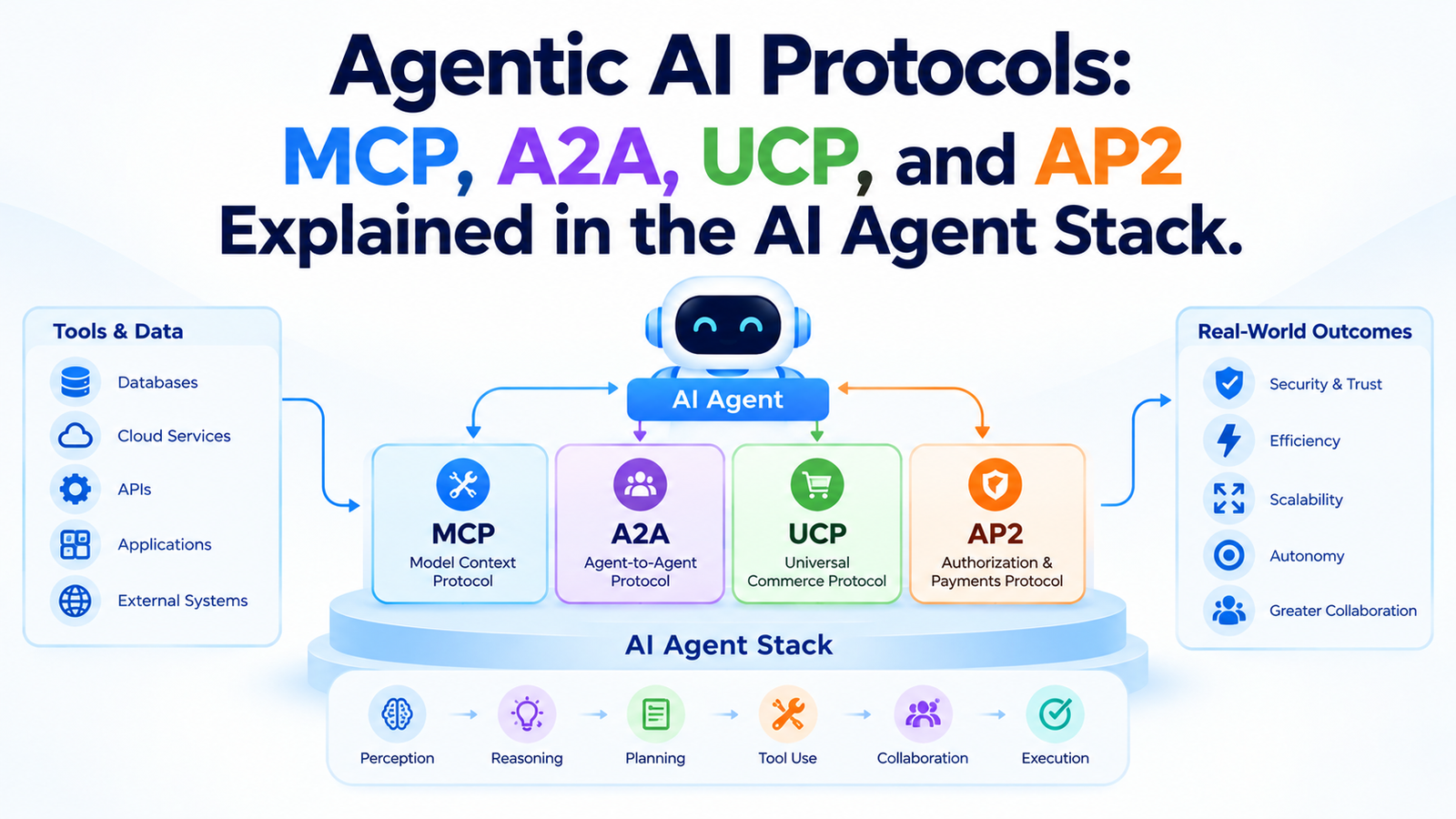
Agentic AI turns foundation models into autonomous systems capable of reasoning, planning, using tools, and completing multi-step tasks. Open protocols such as MCP, A2A, UCP, and AP2 provide the interoperability, collaboration, commerce, and security layers needed to scale these systems across enterprise environments.
Key Takeaways
- Agentic AI goes beyond chat. Agents can plan, execute, evaluate outcomes, and adapt independently to complete complex workflows.
- Protocols are the connective tissue. MCP standardizes access to tools and enterprise data, turning isolated AI capabilities into interoperable systems.
- A2A enables multi-agent collaboration. Independent agents can discover capabilities, delegate tasks, exchange updates, and coordinate across organizational boundaries.
- UCP brings agents into commerce. It standardizes catalog discovery, checkout, fulfillment, and order tracking while keeping merchants in control of transactions.
- Security must be architectural. AP2 adds authorization boundaries and verifiable transaction controls, while agent systems require safeguards against prompt injection, tool abuse, and execution risks.
- The future is a protocol-driven agentic ecosystem. MCP, A2A, UCP, AP2, AG-UI, and A2UI collectively create the infrastructure for secure, interoperable, and scalable autonomous systems.
Introduction
Artificial intelligence has evolved beyond passive statistical pattern recognition into an active paradigm capable of dynamic reasoning, tool manipulation, and autonomous execution. For software architects, technical leaders, and system engineers, understanding this shift requires moving past high-level marketing terms to evaluate the structural mechanics of modern intelligent systems.
Building enterprise software around foundation models involves far more than simply scaling neural network parameter counts. It requires standardized transport protocols that allow models to safely discover external functions, query enterprise data stores, coordinate across multi-agent networks, execute commerce, and stream interactive user interfaces. This research report breaks down the architectural hierarchy from foundational machine learning to fully agentic systems, detailing the open protocols powering the next generation of autonomous infrastructure.
The Evolutionary Hierarchy of Artificial Intelligence
Modern artificial intelligence architectures are best understood as an interconnected hierarchy where each layer inherits and extends the capabilities of the layers beneath it. Rather than competing technologies, these concepts represent progressive steps toward systemic autonomy.
Artificial Intelligence
Artificial intelligence serves as the overarching domain. It encompasses any computational system capable of simulating human cognitive processes, including rule-based logic, symbolic reasoning, adaptive control loops, and environmental learning. Early implementations relied heavily on deterministic expert systems, decision trees, and hardcoded heuristic algorithms.
Machine Learning
Machine learning is a mathematical subset of artificial intelligence focused on pattern recognition. Instead of executing explicitly programmed rules, machine learning models analyze training datasets to discover statistical relationships. Once trained, these algorithms make probabilistic predictions or classifications on new data. Core production use cases include spam detection, transactional fraud scoring, predictive maintenance, and personalized recommendation engines.
Deep Learning
Deep learning advances machine learning by employing deep artificial neural networks with multiple hidden processing layers. These layered networks automatically construct high-level feature representations directly from complex, unstructured raw data without requiring manual feature engineering. Deep learning drove major breakthroughs in computer vision, automated speech recognition, natural language processing, and autonomous vehicle operation.
Generative AI
Generative artificial intelligence represents a specialized branch of deep learning designed for content creation rather than data classification. By modeling high-dimensional joint probability distributions across training collections, generative models sample from learned representations to generate original outputs. These include natural language prose, high-resolution imagery, synthetic audio, full motion video, and executable source code.
Large Language Models
Large language models are a domain-specific deployment of generative artificial intelligence built primarily on self-attention transformer architectures. Trained over vast natural language corpora containing hundreds of billions of parameters, these models master linguistic syntax, contextual semantics, and complex instruction following. Leading examples include GPT-4, Claude 3, Gemini 1.5, Llama 3, Mistral, and Qwen.
Retrieval-Augmented Generation
Retrieval-Augmented Generation connects static language model parameters to dynamic external knowledge bases. Because large language models are limited by fixed pre-training cutoffs and can generate factual hallucinations, retrieval architectures search indexed enterprise databases or vector stores during runtime. The system retrieves relevant context snippets and appends them directly into the model prompt context window, ensuring grounded and verifiable outputs.
Agentic AI
Agentic artificial intelligence represents the modern apex of this operational hierarchy. While standard language models respond passively to single prompts and retrieval systems simply inject context, autonomous agents use foundation models as core reasoning engines to complete multi-step goals. An agent plans task sequences, accesses external tools, evaluates runtime feedback, adapts to environmental failures, and iterates independently until the target outcome is reached.
| AI Paradigm | Architectural Focus | Primary System Function | Enterprise Production Examples |
| Artificial Intelligence | Universal cognitive computation | Simulates human logic and rule execution | Expert systems, industrial robotics, classical game engines |
| Machine Learning | Statistical pattern extraction | Learns data distributions to predict outcomes | Spam filtering, recommender engines, fraud detection |
| Deep Learning | Multi-layered artificial neural networks | Learns representations from unstructured data | Image recognition, speech processing, autonomous driving |
| Generative AI | Probabilistic density sampling | Synthesizes realistic new content modalities | Diffusion models, synthetic voice tools, image synthesis |
| Large Language Models | Parameterized transformer networks | Understands and generates natural language | GPT-4, Claude 3, Gemini 1.5, Llama 3, Qwen |
| Retrieval-Augmented Generation | Vector retrieval coupled with prompting | Grounds model answers using external factual data | Enterprise document search, customer support engines |
| Agentic AI | Autonomous reasoning, memory, tool usage | Executes multi-step workflows independently | Software engineering agents, autonomous enterprise copilots |
Anatomy of an Autonomous AI Agent
Transitioning from a passive text generation model to an active agentic system requires surrounding the core neural network with systemic infrastructure.
An intuitive way to conceptualize this architectural stack is through a functional physical analogy:
- The LLM functions as the Brain, delivering core reasoning, semantic parsing, and pattern comprehension.
- RAG acts as Brain plus Books, supplying rapid, searchable access to external reference documents.
- An AI Agent operates as Brain plus Hands, pairing the core reasoning engine with planning loops, operational memory, and execution mechanisms.
- Protocols (such as MCP) serve as the Connection Layer, standardizing how the system interacts with enterprise tools, APIs, and microservices.
Unlike traditional Robotic Process Automation (RPA), which blindly follows rigid, predefined scripts, an agentic system adapts dynamically when encountering runtime errors. If an API request fails, an agent analyzes the returned error code, adjusts its parameters, or selects an alternative execution path to fulfill its assignment.
Key Architectural Modules
An agent relies on four main software modules to manage long-running workflows:
- The Reasoning Engine: The central language model processes environmental state, interprets instructions, determines necessary intermediate actions, and formulates tool execution payloads.
- Memory Infrastructure: Agents combine short-term memory (the model context window tracking immediate conversation history) with long-term memory (vector engines or graph databases storing past execution results and user preferences across operational sessions).
- Planning and Reflection Loops: Agents decompose high-level objectives into Directed Acyclic Graphs of smaller sub-tasks. Self-reflection frameworks evaluate execution outputs at each step, identifying errors and generating corrected follow-up actions.
- Tool Execution Interfaces: Agents call external functions, query SQL databases, run code inside isolated sandboxes, send communications, and process payments via structured schema definitions.
The Open Protocol Infrastructure: Standardizing the Agentic Web
As enterprise organizations began deploying autonomous agents, software developers hit a major scaling bottleneck known as the N X M integration problem. Connecting N distinct agent frameworks (such as AutoGPT, LangGraph, or custom enterprise applications) to M enterprise tools (including PostgreSQL, GitHub, Salesforce, and internal microservices) required N X M custom integrations. Each connection required dedicated authentication handling, schema formatting, transport serialization, and error recovery logic.
Open protocols solve this integration sprawl by creating an N + M ecosystem. Tool developers build a single protocol server endpoint, while agent developers write a single protocol client. Any compliant agent can immediately discover, query, and invoke any compliant enterprise tool.
Model Context Protocol (MCP)
Introduced by Anthropic in November 2024, the Model Context Protocol (MCP) emerged as an open standard for connecting language models to local and remote data sources. To establish vendor-neutral governance, Anthropic donated MCP to the Agentic AI Foundation under the Linux Foundation in December 2025 alongside co-founders Block and OpenAI. OpenAI adopted MCP in March 2025, followed by Google DeepMind in April 2025. By early 2026, the official open-source SDKs crossed 97 million monthly downloads across an ecosystem of over 17,000 public servers.
MCP draws structural inspiration from the Language Server Protocol, which standardized how software development environments interface with programming language compilers. Operating over JSON-RPC 2.0, MCP uses a client-server topology:
- Host Application: The central orchestrator container that the end user interacts with, such as Claude Desktop, Cursor, Zed, or a custom internal agent runtime.
- Client: A lightweight broker process running inside the host application that manages a dedicated, stateful session with a specific server.
- Server: An independent local process or remote web service exposing tools, data resources, and structured prompt templates.
Core Server Primitives
MCP servers expose capabilities using three standardized primitives:
- Tools (Model-Controlled): Executable functions that the language model chooses to invoke based on execution context. Tools are defined using standard JSON Schemas that specify parameter names, descriptions, and required data types.
- Resources (Application-Controlled): Read-only data sources identified by standard Uniform Resource Identifiers. Resources allow hosts to inject static context directly into the prompt window, such as file contents, schema definitions, or internal wiki pages.
- Prompts (User-Controlled): Pre-configured prompt templates surfaced to users as menu options or slash commands to standardize common corporate tasks.
Client Primitives
MCP defines reverse primitives that allow servers to request actions from client applications:
- Sampling: Enables an MCP server to request nested language model generation calls through the host, supporting multi-step reasoning inside tool processing without hardcoding API keys in tool servers.
- Roots: Defines directory or URI filesystem boundaries to keep server operations contained within authorized paths.
- Elicitation: Standardizes how a server requests additional user input during workflow execution.
Transport Layers
MCP supports two primary transport configurations:
- Local Subprocess (
stdio): Uses standard input and output streams for high-speed execution of local developer utilities, CLI tools, and local file systems. - Remote Transport (
HTTP with SSEorStreamable HTTP): Connects remote cloud infrastructure, enterprise microservices, and external SaaS platforms over network boundaries.
Engineering Trade-offs
Adopting MCP introduces specific operational challenges that engineering teams must manage:
- Token Context Overhead: Registering dozens of MCP tools injects their complete JSON Schemas into the model context window during session initialization. This token overhead consumes context capacity on every invocation turn, increasing API costs and degrading attention accuracy over long chats.
- OAuth and Authentication Sprawl: While MCP standardizes message passing, it leaves enterprise identity management and authentication implementation to the developer. Managing token rotation across dozens of remote servers creates system complexity.
- Security Execution Hazards: Exposing raw code execution endpoints to probabilistic systems creates attack surfaces. MCP architectures are vulnerable to tool description poisoning, indirect prompt injection via untrusted tool outputs, and confused deputy exploits. Security research in April 2026 revealed thousands of publicly exposed MCP servers running unsanitized
stdioconfigurations over open network interfaces.
The table below summarizes some of the key business use cases and quantified impacts of MCP across various industries, illustrating its broad applicability and value.
| Industry Vertical | Key Use Cases | Reported Quantitative Impact |
|---|---|---|
| General Enterprise | Code review assistant, CI/CD monitoring, cloud cost optimization | Turnaround time reduced by 35-45%; Cloud cost optimization of 15-25% |
| Customer Support | Accessing ticket history, drafting responses, refund processing | Support ticket deflection of 30-50%; Refund processing resolution time reduced by 50-70% |
| Sales & Marketing | CRM data hygiene, deal-stage analysis, lead enrichment, campaign brief drafting | Deal-stage analysis, lead enrichment, campaign brief drafting |
| Finance & Accounting | Invoice reconciliation, FP&A modeling, financial reporting | Invoice reconciliation time saved by 60-75%; Fraud loss reduction of 20-30% |
| IT & Security Operations | Security incident triage, vulnerability scanning, IT incident investigation | Information not available in provided sources |
| Legal & Compliance | Contract clause search, regulatory compliance checks | Information not available in provided sources |
| Healthcare | Prior authorization, claims validation, clinical documentation, drug interaction checks | Autonomous retrieval of clinically relevant info for infectious disease management mcpmanager.ai; Generation of concise clinical insights |
| Financial Services | Risk profiling, portfolio monitoring, financial analysis | Raiffeisen Bank improved risk assessment by 40% www.synvestable.com; Grasshopper Bank delivers financial analysis to business clients |
Agent-to-Agent Protocol (A2A)
While the Model Context Protocol (MCP) establishes the foundation for an AI agent to access data and tools within an organization, the Agent-to-Agent (A2A) Protocol addresses the next frontier of complexity: collaboration. Where MCP facilitates vertical integration between an agent and its environment, A2A enables horizontal coordination, allowing autonomous agents from different vendors, teams, or even competing organizations to discover, communicate, and collaborate seamlessly. Developed by Google and now maintained under the Linux Foundation, A2A operates as an open standard designed to break down the silos that traditionally hinder the orchestration of complex, multi-step business processes. Its core function is to create a common language for agents to exchange information and delegate tasks, transforming a collection of single-purpose agents into a unified, intelligent workforce. This capability is essential for executing sophisticated workflows that span multiple domains, such as planning a complex corporate event, managing a global supply chain, or providing end-to-end customer service that involves sales, fulfillment, and technical support agents.
The architecture of A2A is built around a client-remote agent model and relies on JSON-RPC for communication, ensuring a lightweight and familiar transport mechanism. A central concept in A2A is the ‘Agent Card’, a standardized JSON object that serves as a digital identity and discovery mechanism for an agent. Similar to a business card, an Agent Card contains metadata about an agent, including its capabilities, contact information, and a public key for cryptographic verification. When one agent wants to collaborate with another, it can query for Agent Cards to find suitable partners, much like looking up contacts in a directory. Once discovered, agents can initiate ‘Tasks’, which are stateful work objects that represent a piece of collaborative work. Tasks can be passed between agents, with each agent adding its contribution and updating the task’s status until it is completed. This structured, stateful communication allows for the creation of complex, multi-agent workflows that can adapt and evolve over time. The protocol is designed to be transport-agnostic, supporting various communication methods, which makes it flexible enough to integrate with existing infrastructure, including MCP servers for accessing context.
The business value of A2A is realized when these collaborative capabilities are applied to real-world problems. By enabling disparate AI systems to work together without being locked into a single vendor’s ecosystem, A2A removes a significant bottleneck in enterprise automation. It allows organizations to build modular, composable systems where agents can be swapped out or upgraded without disrupting the entire workflow. This modularity fosters innovation and reduces dependency on a single technology provider. Practical examples of A2A’s power can be seen in large-scale enterprise implementations. One documented case involved an enterprise deploying an A2A-based system to support three main business functions: an Intelligent Customer Service System, an Intelligent Operations Platform, and a Data Analysis Center. The results were striking: customer service efficiency increased by 300%, operations response time was cut by 80%, and overall operations costs were reduced by 60%. The project also demonstrated a 50% reduction in labor costs and a return on investment that validated the substantial upfront investment in building the agent ecosystem. These figures highlight how A2A, when implemented effectively, can drive profound operational transformation.
The momentum behind A2A is evidenced by its widespread industry backing. Just one year after its initial release, over 150 organizations were supporting it as an open standard. Major technology players and enterprise software providers, including Atlassian, Salesforce, SAP, ServiceNow, and PayPal, have embraced the protocol, signaling a strong consensus on its importance for the future of AI. This broad support has led to deep integration with major cloud platforms, positioning A2A as a default standard for building agent-based systems in the cloud. Microsoft has embedded A2A into its Azure AI Foundry and Copilot Studio, while AWS has added support through Amazon Bedrock AgentCore Runtime. This integration by cloud giants lowers the barrier to entry for enterprises looking to build and deploy multi-agent systems at scale, as they can leverage managed services that already support the A2A standard.
As with any emerging technology, A2A has evolved to address early concerns and expand its capabilities. The stable version 1.0 introduced several enterprise-grade features that enhance its viability for production environments. These include robust multi-tenancy support, which allows a single A2A deployment to securely serve multiple departments or customers with logical isolation. Modernized security flows were implemented to better align with enterprise identity and access management systems, and ‘Signed Agent Cards’ were introduced to provide cryptographic proof of an agent’s identity, mitigating impersonation risks. The architecture was also updated to be web-aligned, improving scalability and reliability for high-volume use cases. These enhancements have solidified A2A’s position as a mature and secure foundation for building complex agent ecosystems.
The following table outlines key characteristics and business implications of the A2A Protocol, contrasting it with MCP to clarify their distinct yet complementary roles.
| Feature | Model Context Protocol (MCP) | Agent-to-Agent (A2A) Protocol |
|---|---|---|
| Primary Function | Vertical integration: connects an AI agent to external data and tools. | Horizontal collaboration: enables communication and coordination between AI agents. |
| Core Concept | Standardizes the connection between a single agent and one or more systems. | Standardizes the interaction between two or more agents to achieve a shared goal. |
| Key Architectural Element | Client-Server model with ‘Tools’, ‘Resources’, and ‘Prompts’. | Discovery via ‘Agent Cards’ and stateful ‘Tasks’ for collaborative work. |
| Primary Transport | JSON-RPC 2.0, SSE, HTTP. | JSON-RPC, designed to be transport-agnostic. |
| Maintained By | Initially Anthropic; now donated to the Linux Foundation’s Agentic AI Foundation. | Google, now under the Linux Foundation. |
| Enterprise Benefit | Reduces integration complexity and cost (the “N×M problem”). | Breaks down organizational and platform silos, enabling complex workflow automation. |
| Example Use Case | An agent retrieves customer data from a CRM (a Tool) and product information from a database (a Resource). | A shopping concierge agent coordinates with a logistics agent to confirm delivery dates and a payment agent to secure funds. |
| Key Partners | OpenAI, Google, Microsoft, AWS, Bloomberg. | Atlassian, Salesforce, SAP, ServiceNow, PayPal, IBM. |
Looking ahead, the role of A2A is expanding beyond simple coordination to encompass economic coordination, largely through its synergy with the Agent Payments Protocol (AP2). This evolution positions A2A not just as a communication layer but as a foundational component for a broader economy of autonomous agents. For business leaders, investing in A2A readiness today means preparing for a future where AI-driven workflows are not only intelligent and automated but also interconnected and economically self-sustaining. The ability to orchestrate a team of specialized agents to solve a complex business problem is no longer science fiction; it is a tangible capability being unlocked by standards like A2A.
Universal Commerce Protocol (UCP)
The emergence of the Universal Commerce Protocol (UCP) marks a pivotal moment for e-commerce and digital retail, introducing a new paradigm for how consumers discover, evaluate, and purchase products. Co-developed by Google and Shopify and endorsed by a coalition of over 20 major retailers including Walmart, Target, Etsy, and Best Buy, UCP is an open standard designed to create a common language for AI agents to conduct full commerce journeys. Its fundamental purpose is to empower AI agents to act as proxies for users, discovering products, negotiating terms, filling carts, and completing purchases directly with merchants without the user ever needing to visit a physical storefront. This capability fundamentally shifts the dynamics of the customer journey, moving it from a passive, user-initiated activity to an active, intent-driven inference session orchestrated by an AI. For businesses, this represents both a significant threat to traditional marketing channels and a massive opportunity to engage with a new generation of consumers who increasingly rely on AI for purchasing decisions.
The architecture of UCP is built to be flexible, merchant-centric, and highly extensible. It operates as a RESTful API that standardizes commerce capabilities, allowing an AI agent to programmatically interact with a merchant’s systems. A key feature is its decentralized discovery mechanism. Unlike platform-mediated approaches, UCP allows merchants to publish their capabilities directly on their own domain via a manifest file located at /.well-known/ucp. This manifest is a JSON file that describes the store’s supported capabilities, such as product discovery, cart management, checkout, and order tracking by listing available endpoints and required authentication tokens. This design empowers merchants, allowing them to remain the merchant of record, retain control over their pricing and business logic, and own the direct relationship with the customer. The protocol is explicitly transport-agnostic, meaning merchants can expose their capabilities via REST APIs, and it can also integrate with other protocols like MCP and A2A for richer context and collaboration. Furthermore, UCP employs a reverse-domain naming convention for its extensions, allowing new commerce patterns and features to be developed organically by third parties without requiring approval from a central governing body, fostering innovation within the ecosystem.
The business implications of UCP are profound, touching nearly every aspect of retail and marketing. Perhaps the most significant impact is the potential to solve the persistent problem of cart abandonment, which plagues e-commerce with a global average of 80%. UCP streamlines the checkout process into a single, callable transaction capability. Instead of navigating a multi-step checkout flow with forms and account creation hurdles, an AI agent can submit a complete, validated order request in one call, including SKUs, quantities, shipping preferences, and payment handler information. This dramatically reduces friction and the likelihood of drop-off. For instance, a consumer electronics retailer that loses 65% of customers before reaching checkout could potentially resolve this issue by enabling an AI agent to execute the purchase instantly.
Another major implication is the redefinition of customer acquisition and marketing strategy. Traditional Search Engine Optimization (SEO), which focuses on attracting human traffic to a website, is being supplanted by a new discipline called Agent Engine Optimization (AEO). With UCP, marketing efforts must shift from optimizing for human readers to providing high-density, structured data that AI agents can confidently parse and recommend. Retailers will need to prioritize ‘data-rich snippets’ and ‘attribute-complete catalogs’ with granular details like certifications, precise delivery windows, and technical specifications. A product query might evolve from a simple keyword search to a bounded request like, “Find a carabiner rated for 22kN, made of aluminum, and in-stock for same-day dispatch,” requiring retailers to expose rich, machine-readable product data. This shift transforms marketing spend from attracting undifferentiated traffic into fueling qualified demand from high-intent AI agents.
The following table compares the key architectural philosophies of UCP and its main competitor, OpenAI’s Agentic Commerce Protocol (ACP), highlighting the strategic choices this presents for businesses.
| Feature | Universal Commerce Protocol (UCP) | Agentic Commerce Protocol (ACP) |
|---|---|---|
| Architectural Model | Decentralized and merchant-centric. Merchants publish capabilities on their own domain. | Platform-mediated. Merchants submit product feeds to OpenAI, which surfaces them within ChatGPT. |
| Discovery Mechanism | Agents discover merchants via a public manifest at /.well-known/ucp on the merchant’s domain. | Merchants are discovered through OpenAI’s centralized listing process within the ChatGPT platform. |
| Merchant Control | High. Merchants remain the merchant of record, control pricing and business logic, and own the customer relationship. | Lower. OpenAI acts as a central intermediary and mandates a 4% transaction fee on top of Stripe’s fees. |
| End-User Experience | Standardized interface between agent and merchant, but the end-user experience is not standardized by UCP. | Deeply integrated into the ChatGPT conversational UI, optimized for native buying within that platform. |
| Key Backers | Google, Shopify, Walmart, Target, Etsy, Mastercard, Visa, American Express. | OpenAI, Stripe. |
| Strategic Goal | Create a broad, interoperable commerce web where any compliant agent can transact with any compliant merchant. | Optimize the seamless checkout transaction process for users buying within the OpenAI ecosystem. |
Beyond discovery and checkout, UCP automates the entire post-purchase lifecycle. Repetitive support tasks like tracking orders, requesting cancellations, or initiating returns can be shifted from human agents to direct system actions executed by AI agents. A customer’s request to change an address is validated against the actual order state; if allowed, the action is performed instantly. This frees up human support staff to focus only on exceptions, improving fulfillment consistency and speed. Furthermore, UCP enables the programmatic enforcement of loyalty and incentive programs. Businesses can define real-time rules based on customer identity, order history, and volume, automatically applying discounts or free shipping when conditions are met, moving away from broad, campaign-driven promotions.
The commercial potential of agentic commerce is enormous. Morgan Stanley Research estimates that agentic shoppers could account for $190 billion to $385 billion in U.S. e-commerce spending by 2030, while McKinsey projects the global value could reach $3-5 trillion by the same year. Early adopters are already seeing significant results. Nexus Apparel, a mid-market retailer, saw a 210% increase in ‘Proxy Sales,’ sales executed entirely by an AI agent, within 60 days of implementing a full UCP stack, with a Customer Acquisition Cost (CAC) that was 35% lower than for traffic from traditional Google Ads. These results demonstrate that for businesses, the choice is no longer if to engage with UCP, but how and when. A prudent strategy may involve a phased implementation, starting with MCP for foundational data access and then launching either UCP or ACP based on target platforms, with the ultimate goal of becoming accessible to any compliant agent in the burgeoning agentic marketplace.
Agentic Payments Protocol (AP2)
As AI agents gain the ability to autonomously navigate commerce, the final and most critical hurdle to true autonomy is the secure execution of financial transactions. The Agent Payments Protocol (AP2), announced by Google in collaboration with over 60 global organizations, is the definitive solution to this challenge. AP2 is an open, payment-agnostic standard designed to enable AI agents to safely and securely initiate and transact payments on behalf of humans. It addresses the three pillars of trust in any transaction: Authorization (proving the agent has permission to act), Authenticity (ensuring the agent’s request reflects the user’s true intent), and Accountability (determining responsibility for a transaction). Without a trusted mechanism like AP2, many of the most powerful agentic workflows, especially in B2B contexts like procurement and resource management, remain theoretical. AP2 provides the necessary “Systems of Execution” (SoE) foundation that allows autonomous systems to move from planning to paying.
The core of AP2’s security model is the ‘Mandate’, a cryptographically signed, verifiable digital contract that serves as tamper-evident proof of a user’s instructions for a transaction. There are two primary types of Mandates. The first is the ‘Intent Mandate’, which a user signs upfront with detailed rules and constraints, such as a budget limit, acceptable suppliers, or timing parameters. This mandate delegates authority to the agent to act autonomously within those boundaries. The second is the ‘Cart Mandate’, which the user signs at the point of purchase to lock in specific products, prices, and quantities after the agent has screened options. This creates a non-repudiable audit trail, providing irrefutable evidence of user consent at every step of the transaction process. This cryptographic proof is what builds the necessary trust between the agent, the merchant, and the financial institutions involved. The protocol also includes a ‘Payment Mandate’, a signal sent to payment networks identifying the transaction as agent-initiated, which allows financial institutions to apply adjusted risk controls.
The business value derived from AP2 is twofold: it unlocks transformative efficiency in B2B operations and builds the consumer confidence needed for widespread adoption in B2C e-commerce. In the enterprise, AP2 is a game-changer for procurement and IT resource management. Procurement is identified as a high-return environment for agentic AI due to its complexity and high volume of unstructured data. With AP2, agents can trigger fully autonomous procurement workflows. For example, when a predictive maintenance signal indicates a grid component is failing, an agent can automatically initiate the appropriate procurement workflow to order the replacement part, shifting from reactive to proactive operations. A case study of a software company using AP2 for intelligent IT resource management revealed impressive results: a 70% increase in procurement efficiency, a 15% reduction in costs, and an 80% decrease in manual intervention. Other high-ROI use cases include dynamically scaling cloud server configurations, purchasing additional software licenses based on real-time usage, and autonomously ordering office supplies. PwC estimates that agentic AI could yield productivity gains of up to 70% in fully agent-driven procurement workflows.
In consumer-facing e-commerce, AP2 is critical for overcoming trust barriers. A McKinsey survey found that 65% of consumers are more likely to shop on platforms that integrate AI-driven payments, indicating a growing expectation for convenience and seamless experiences powered by AI. By providing a verifiable chain of user consent, AP2 helps alleviate fears about unauthorized spending and fraudulent transactions initiated by bots. The protocol supports a wide variety of payment methods, including traditional credit/debit cards, real-time bank transfers, and stablecoins, making it adaptable to different markets and use cases. A notable extension is x402, launched in partnership with Coinbase, the Ethereum Foundation, and MetaMask, which specifically enables agent-based cryptocurrency payments. This rail is optimized for low-fee micropayments and cross-border transactions, making it highly relevant for machine-to-machine commerce and digital goods.
The table below details the extensive list of organizations backing the AP2 protocol, underscoring the broad industry consensus on its importance.
| Category | Key Organizations | Significance |
|---|---|---|
| Payment Networks | Visa, Mastercard, Stripe, Worldpay, Adyen | Core infrastructure providers who will process the transactions, ensuring the protocol is integrated into the mainstream financial system. |
| Financial Institutions | American Express, Ant International, PayPal, Intuit, Salesforce, ServiceNow | Major players in banking, fintech, and payments that bring credibility and scale to the initiative. |
| Cryptocurrency & Web3 | Coinbase, Ethereum Foundation, MetaMask | Critical partners for enabling decentralized and programmable payments, extending the protocol’s utility beyond traditional finance. |
| Technology & Platforms | Google, Anthropic, Microsoft, IBM, Amazon | Major tech companies that provide the AI agents and infrastructure on which the protocol will run, ensuring deep integration. |
| Retail & Commerce | Etsy, Wayfair, Target, Walmart, Best Buy, Flipkart, Macy’s, Zalando | End-users of the protocol who will benefit from streamlined checkout and automated back-end processes. |
| Security & Compliance | Forter, Invariant Labs, Adobe | Experts in fraud detection, security, and trust who help shape the protocol’s security and verifiability features. |
Despite its promise, the adoption of AP2 faces significant challenges. For enterprises, integrating the protocol with legacy ERP and procurement systems can be complex, and tailoring it to specific industry compliance models (like HIPAA in healthcare) requires careful engineering. Regulatory alignment with standards like PCI-DSS is also a key consideration. From a legal perspective, unresolved liability frameworks for mistaken or fraudulent transactions remain a barrier. On the consumer side, user acceptance of AI autonomy and the adaptation of legal frameworks across different jurisdictions are ongoing concerns. However, the industry is actively working to address these issues through progressive authorization models, regulatory engagement, and an open architecture that supports multiple payment rails. For business leaders, AP2 represents the final piece of the puzzle for creating truly autonomous business processes. While challenges exist, the protocol provides a secure, auditable, and widely-supported foundation for the future of agent-led commerce, and its adoption is becoming a prerequisite for competitive advantage in an increasingly automated world.
Dynamic User Interface Standards: AG-UI and A2UI
Text-based conversational flows are often inefficient for complex multi-variable decisions, such as comparing flight options or configuring enterprise hardware orders.
- AG-UI (Agent-User Interaction Protocol): Standardizes low-latency event streaming, tool execution visibility, and human-in-the-loop input prompts between agent backends and web frontends.
- A2UI (Agent-to-User Interface Protocol): Allows agents to output structured JSON visual component schemas. The frontend client renders these schemas safely as dynamic dashboards, interactive forms, and comparative tables without exposing the application to dangerous raw code injection.
| Protocol | Operational Layer | Core Function | Primary Transport / Format | Primary Governing Bodies |
| MCP | Tool & Data Connectivity | Connects host applications to local tools, databases, and enterprise APIs | JSON-RPC 2.0 (stdio, Streamable HTTP) | Linux Foundation (AAIF), Anthropic, OpenAI, DeepMind |
| A2A | Agent Collaboration Mesh | Enables task discovery, delegation, and state tracking across independent agents | HTTP/REST, JSON payloads, Async Webhooks | Industry Framework Alliances, Open Community |
| UCP | Digital Commerce | Standardizes product discovery, cart assembly, checkout states, and handoffs | REST API, MCP Bindings, Schema Compositions | Google, Shopify, Target, Walmart, Etsy, Stripe |
| AP2 | Financial Authorization | Manages payment mandates, transaction limits, and secure cryptographic tokens | Tokenized Mandates, Signed Credentials | Payment Networks (Visa, Mastercard, PayPal) |
| AG-UI | Event Streaming | Handles real-time event streams, tool execution states, and human input prompts | WebSockets, Server-Sent Events (SSE) | Copilot Framework Maintainers |
| A2UI | Visual Component UI | Generates dynamic, secure user interface components directly inside web frontends | Structured Declarative JSON Schemas | Front-End Framework Open Source Working Groups |
Enterprise Execution Flow: A Multi-Protocol Scenario
To understand how these protocols coordinate during real-world tasks, consider an enterprise hardware procurement example. A user issues the following instruction to an enterprise copilot:
“Find an enterprise laptop under $1,200, check our corporate purchasing policy, compare reviews, select the best model, purchase it using my corporate allocation, and schedule delivery to our regional office.”
Step-by-Step Execution Sequence
- Policy Lookup via MCP: The primary copilot host receives the request and initializes a session with an internal enterprise MCP server via
stdio. It queriesresource://docs/procurement_policy.pdfto retrieve internal spending limits, confirming that hardware orders under $1,500 do not require manual manager sign-off. - Task Delegation via A2A: The main host instantiates a specialized Planning Agent. Using the A2A Protocol, the Planning Agent delegates product research to an external Market Analysis Agent while delegating shipping verification to a Logistics Agent.
- Merchant Discovery and Cart Assembly via UCP: The Market Analysis Agent queries approved vendor endpoints. It reads the supplier’s manifest at
/.well-known/ucp, selects an eligible laptop model, applies corporate discount pricing, and creates a checkout session. - Dynamic Interface Rendering via A2UI and AG-UI: The primary agent uses AG-UI to stream status updates back to the user’s screen. It sends an A2UI component schema payload, rendering an interactive comparison dashboard that displays product specifications, pricing, and estimated delivery dates. The user clicks an on-screen “Approve Order” button.
- Authorized Payment via AP2: Upon user confirmation, the copilot invokes the AP2 payment service. AP2 checks the approved spending limits, generates a cryptographically signed payment mandate, and passes the payment token to the merchant’s backend. The merchant verifies the token, processes the transaction, and returns a UCP order confirmation.
Security Vulnerabilities and Production Guardrails
Deploying autonomous agents connected to production databases and payment endpoints introduces security risks that require explicit architectural controls.
Primary Attack Vectors
- Indirect Prompt Injection: External inputs processed by an agent (such as unverified customer emails, web page content, or PDF attachments) can contain hidden adversarial prompt instructions. These malicious prompts can hijack the model context, forcing the agent to execute unauthorized secondary tools.
- The Confused Deputy Vulnerability: Because an agent operates using permissions granted by the host system, attackers can trick the model into misusing those permissions. For example, a user without administrative rights might ask the agent to invoke an internal tool that modifies privileged database records.
- Tool Poisoning and Schema Drift: Malicious actors publishing tools on public registries can craft misleading function descriptions. A tool advertised as a simple metric converter could secretly execute unauthorized network requests. Furthermore, unannounced changes to third-party tool schemas can break production agent workflows silently.
Enterprise Security Guardrails
Engineering teams deploying agent infrastructure should implement four core technical controls:
- Zero-Trust Tool Gateways: Implement strict policy controls between the reasoning engine and actual function execution. Require explicit human-in-the-loop verification for destructive operations, such as data deletion or financial transfers.
- Schema Validation and Payload Sanitization: Strip shell escape sequences, raw database query strings, and dynamic code payloads from model outputs before routing commands to execution layers. Validate tool inputs and outputs against strict internal schemas.
- Isolated Process Execution: Never run local
stdiotool servers directly on host system processes. Isolate tool server instances inside restricted container sandboxes with minimal file access and strict outbound network policies. - Write-Once Execution Auditing: Log every step of agent execution. Store prompt payloads, intermediate reasoning steps, JSON-RPC protocol messages, tool parameters, and payment tokens in secure, write-once storage systems to enable security reviews.
Recommended Readings
To deepen your understanding of the strategic, architectural, and ethical dimensions of agentic AI, the following books are recommended:
- AI Engineering: Building Applications with Foundation Models by Chip Huyen – A practical engineering handbook focused on building production-ready software systems powered by foundation models. The book covers prompt engineering best practices, RAG optimization patterns, agent design architectures, system evaluation methodologies, and operational cost controls.
- Build a Large Language Model (From Scratch) by Sebastian Raschka – A code-first technical guide that walks developers through constructing, training, and fine-tuning a transformer-based language model from scratch. It provides detailed insights into tokenization pipelines, multi-head attention mechanisms, pre-training routines, and instruction alignment techniques.
- Designing Machine Learning Systems by Chip Huyen – A foundational engineering text detailing how to design, deploy, and maintain reliable machine learning infrastructure in production environments. It focuses on data pipeline architecture, feature storage design, real-time monitoring strategies, and continuous model deployment patterns.
These titles collectively provide a comprehensive foundation for understanding the technical underpinnings, strategic applications, and governance challenges associated with building and deploying agentic AI systems in a modern enterprise.
Frequently Asked Questions
What is the primary difference between native function calling and the Model Context Protocol?
Native function calling is an internal model capability where a language model outputs structured JSON suggesting a function name and arguments. Software developers must still write custom code to handle authentication, parse payloads, execute functions, and return results. The Model Context Protocol (MCP) standardizes the complete transport layer around function calling. It manages tool discovery, schema registration, session management, resource binding, and execution routing over a standard JSON-RPC 2.0 interface.
Is Retrieval-Augmented Generation still needed when using MCP tools?
Yes, Retrieval-Augmented Generation (RAG) and MCP address complementary technical needs. RAG specializes in searching unstructured document indices to pull targeted context snippets into prompt context windows efficiently. MCP provides direct operational access to external enterprise tools and structured databases. Modern agents often use RAG engines accessed through an MCP resource endpoint to pull reference facts before executing an action tool.
How does UCP keep merchants in control of customer transactions?
The Universal Commerce Protocol (UCP) keeps the merchant as the official Merchant of Record. Merchants declare pricing rules, catalog availability, fulfillment methods, and accepted payment types at /.well-known/ucp. AI agents initiate checkout sessions, but all underlying business logic and payment authorizations execute on the merchant’s infrastructure. If compliance checks or step-up authentication steps occur, UCP seamlessly transfers the user to the merchant’s web interface via a secure handoff link.
What risks exist when running local MCP servers over STDIO?
Executing local MCP tool servers over standard input and output streams (stdio) grants local process execution privileges. If an unmanaged MCP server processes unsanitized input parameters, a prompt injection attack can trick the underlying model into executing dangerous shell commands on the host machine. Production systems mitigate this risk by running tool processes inside isolated, sandboxed containers with strictly restricted system privileges.
How do A2A and MCP interoperate within a multi-agent system?
MCP standardizes vertical connectivity between a single host application and its internal tools or data repositories. A2A standardizes horizontal communication between independent autonomous agents across network boundaries. In a production environment, an orchestrator agent uses A2A to delegate sub-tasks to specialized sub-agents. Once assigned a sub-task, each sub-agent invokes its own local or remote MCP tool endpoints to execute the work.
What is the difference between AI and ML?
AI is the broad goal of making machines behave intelligently. Machine Learning is one method for achieving that goal, where systems learn patterns from data rather than following hand written rules.
Is ChatGPT an AI agent?
Not by itself. ChatGPT as a chatbot is a generative AI application powered by an LLM. When it is wrapped in a system that plans tasks, uses tools, and takes actions toward a goal, that larger system is an agent.
What does RAG actually do?
Retrieval-Augmented Generation fetches relevant documents from an external knowledge base before the LLM answers, so responses are accurate, current, and grounded in your own data instead of relying only on the model’s training memory.
Do A2A and MCP compete with each other?
No. They solve different problems. MCP connects an agent to tools and data. A2A lets agents built by different vendors discover each other and collaborate. The common shorthand is MCP inside agents, A2A between agents.
Should I use a workflow or an agent?
If the process is predictable and needs consistent guardrails, use a workflow where humans design the path. If the task requires judgment, adaptation, and tool use under uncertainty, use an agent. Most production systems combine both.
What is agentic commerce?
It is commerce where AI agents handle the shopping journey on your behalf: discovering products, comparing options, checking out, and paying, using protocols like UCP and AP2. Major players including Google, Shopify, Stripe, Mastercard, and Amazon are building the standards now.
Is agentic AI safe?
It can be, with the right design. Autonomy multiifies the impact of mistakes, so production systems need explicit permission boundaries, human approval for consequential actions like payments, secure credentials handling, and full audit trails. The new protocols bake in many of these controls, but they do not replace good governance.
Conclusion
The shift from static language generation to autonomous agent architectures marks a major evolution in software engineering. While foundation models deliver essential reasoning and retrieval pipelines supply factual context, agent systems combine these assets to execute complex, multi-step operations.
Standardized protocol layers solve the integration sprawl that previously limited autonomous systems. MCP simplifies local and remote tool connectivity, A2A standardizes inter-agent collaboration, UCP organizes digital commerce, AP2 secures autonomous transactions, and AG-UI with A2UI delivers rich, dynamic user interfaces. Organizations that build on these open standards today will establish secure, interoperable, and scalable intelligent infrastructure for the future.


Leave a Reply