

TL;DR
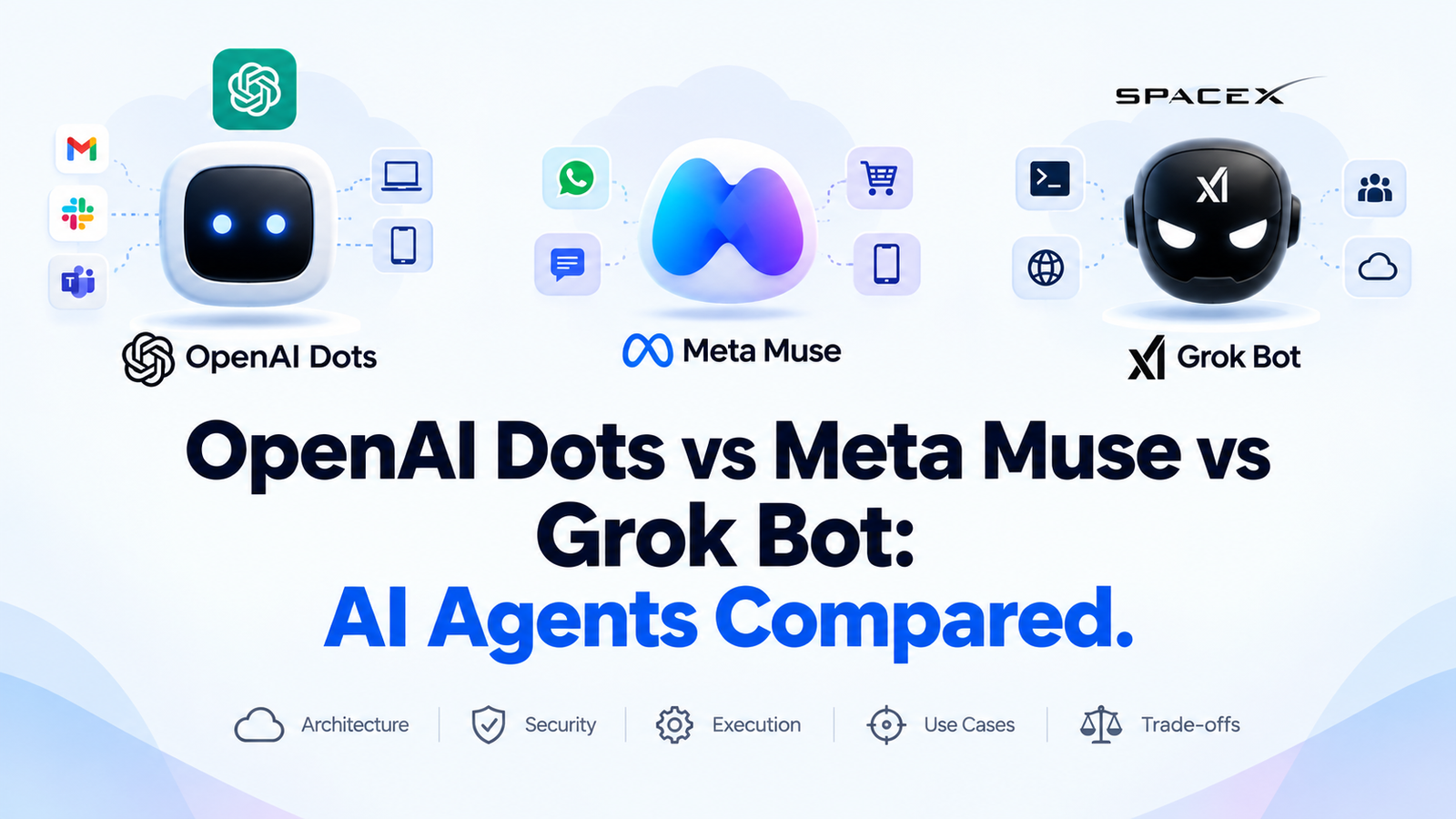
The landscape of artificial intelligence underwent a fundamental paradigm shift in late 2026, transitioning from on-demand conversational large language models to persistent, always-on autonomous agents. Spearheaded by OpenAI Dots, Meta Muse, and SpaceXAI Grok Bot, these agentic architectures execute complex workflows continuously on cloud infrastructure. OpenAI Dots prioritizes enterprise application ecosystems and deep workplace integration through strict read-only background polling and credential masking. Meta Muse focuses on personal errand automation governed by an external Sentinel boundary service, though it has faced ecosystem resistance from major retailers. SpaceXAI Grok Bot leverages broad computer-use capabilities and shared virtual machines, prioritizing high autonomy and multi-bot collaboration at the expense of strict intra-agent process isolation. Choosing among these systems requires organizations to carefully balance security boundaries, execution costs, and operational autonomy.
Key Takeaways
- OpenAI Dots isolates each primary agent within its own cloud environment, Meta Muse runs within sandboxed Secure Virtual Machines, and SpaceXAI Grok Bot shares a single Linux Virtual Machine across all agents owned by the same user.
- Meta Muse utilizes a dedicated Sentinel service to strip secrets at network boundaries, OpenAI Dots relies on encrypted credential vaults that mask passwords from the underlying model, and Grok Bot executes commands directly with full user-level operating system privileges.
- OpenAI Dots enforces strict read-only permissions during proactive background execution, requiring human approval or rule-based triggers for write actions. Conversely, Grok Bot permits autonomous unattended writes and transactional operations.
- Autonomous web navigation has triggered friction with platform operators, highlighted by Amazon blocking Meta Muse over automated browsing and credential capture disputes.
- Strict data privacy and governance frameworks have delayed the deployment of personal always-on agents in specific regions, such as the European Economic Area, the United Kingdom, and Switzerland for OpenAI Dots Pro tier users.
Introduction
For years, the primary paradigm of artificial intelligence remained fundamentally reactive. Users submitted prompts to a model, received structured textual or visual outputs, and manually transferred those outputs across disparate software systems. By late 2026, this paradigm yielded to autonomous agentic workflows capable of planning, reasoning, tool invocation, and continuous background execution.
The industry milestone occurred during the late summer and autumn of 2026 with the back-to-back releases of three major agentic systems: SpaceXAI Grok Bot on August 11, Meta Muse on September 8, and OpenAI Dots on September 29. While all three systems operate continuously in the cloud to perform multi-step tasks without constant human intervention, their underlying software architectures, threat models, credential handling mechanisms, and targeted use cases differ significantly.
Understanding the structural differences between these platforms is essential for technical leaders, software engineers, and enterprise architects. The choice of an agentic platform involves navigating complex trade-offs between execution speed, operational autonomy, privacy safeguards, and integration depth across corporate and personal software environments.
Architectural Foundations and Execution Environments
The underlying infrastructure powering an always-on agent dictates its operational boundaries, stability, and security context. When an agent operates 24 hours a day, 7 days a week, it requires a persistent compute instance capable of maintaining state, storing temporary execution artifacts, and interfacing with remote software interfaces.
OpenAI Dots execute within an isolated, dedicated cloud computer per primary agent. Powered by the frontier GPT-6 Astra model, a Dot functions as a continuous background process linked directly to the ChatGPT ecosystem. Initial setup must occur via desktop web or native desktop applications, though monitoring and interaction subsequently span web, mobile, Slack, and Microsoft Teams. Notably, while the agent runs primarily in OpenAI’s cloud, users can grant optional permission for the agent to bridge connections to their local physical laptops.
Meta Muse relies on a specialized architecture termed the Muse Secure Virtual Machine. Running Meta’s proprietary Muse Spark 1.3 model series, Muse is optimized for consumer application management, mobile execution, and direct integration into daily messaging platforms such as WhatsApp. The Secure VM acts as an isolated sandbox for processing logic, keeping computation strictly detached from the consumer’s physical device. Meta has also outlined plans to transition this infrastructure toward client-side, client-encrypted confidential VMs to prevent server-side data inspection.
SpaceXAI Grok Bot, powered by Grok 4.6 era models, adopts a contrasting architectural philosophy centered on shared local system environments. Instead of provisioning isolated execution containers for individual sub-agents, SpaceXAI assigns a single Linux Virtual Machine per user account. All Grok Bots created by a given user operate within this shared virtual machine, inheriting access to the same local directory structure, persistent files, browser sessions, and command-line authorization tokens. This design facilitates seamless inter-bot collaboration and memory sharing, but it eliminates internal process isolation between different sub-agents owned by the same user.
Credential Isolation and Security Frameworks
Granting software agents the capability to act on a user’s behalf requires addressing severe security risks, including prompt injection attacks, unintentional data leaks, and unverified transactional execution. Each platform mitigates these vector risks through distinct credential isolation and permission governance layers.
OpenAI Dots isolates sensitive access details by decoupling credential storage from model context. When a Dot signs into a supported web service or enterprise tool, authentication secrets are retrieved from an encrypted key management service and injected directly into the transport layer. The raw password string is never rendered inside the model’s context window, preventing potential malicious prompt injections from exposing credentials. To control autonomous behavior, OpenAI enforces a hard distinction between background polling and write execution: proactive background research is restricted to read-only API calls and data fetching. Any write operation, such as sending a message, updating a document, or altering code repositories, must adhere to predefined Custom Rules, automated review policies, or explicit user confirmation via an Activity View interface.
Meta Muse implements security boundaries through an independent middleware layer named Sentinel. Operating outside the Muse Secure VM, Sentinel functions as an outbound security proxy and policy enforcer. Real OAuth access tokens and payment credentials reside strictly within Sentinel’s secure memory. When Muse attempts to execute an external API call or web submission, Sentinel inspects the payload, evaluates configured user rules, and attaches the required authorization headers at the network edge. Sentinel also automatically scans incoming data streams to strip single-use passcodes, multi-factor authentication tokens, and password reset links before they reach the core language model environment. E-commerce purchases processed by Muse are subjected to mandatory human checkout approvals and execute via single-use virtual payment cards.
SpaceXAI Grok Bot prioritizes operational autonomy over strict sandboxing. Because Grok Bot operates on a shared Linux VM, credentials and session cookies stored in the local Chromium profile or environment variables are accessible to all active bot routines on that account. Users authenticate once, granting the virtual machine direct access to connected productivity suites, cloud development environments, and consumer ordering accounts. While this enables Grok Bot to perform complex UI automation, terminal commands, and cross-platform workflows, it requires users to treat the entire virtual machine as a single unified trust zone. To mitigate rogue execution in enterprise settings, SpaceXAI offers centralized administrative policies, OpenTelemetry audit log exports, and optional session recording mechanisms.
Workflow Capabilities and Integration Ecosystems
The utility of an autonomous agent depends directly on the ecosystem of tools it can access and the tasks it can execute independently. The three platforms target vastly different operational niches, ranging from corporate productivity to personal task automation and software engineering support.
OpenAI Dots targets enterprise collaboration and structured business workflows. Connecting to over 4,000 plugins via the OpenAI integration standard, Dots can be embedded into Slack, Microsoft Teams, and ChatGPT Spaces, which function as co-edited documentation hubs. A typical enterprise workflow involves a Dot monitoring customer feedback channels in Slack, identifying recurring bug reports, isolating the corresponding codebase, generating bug fixes inside a sandbox environment, and submitting a structured pull request complete with automated video demonstrations. In commercial environments, OpenAI has partnered with Microsoft to allow specialist Dots to be managed under Microsoft Agent 365 governance controls, bringing institutional policy enforcement to corporate agent deployments.
Meta Muse focuses primarily on personal productivity, direct consumer communication, and lifestyle management. Interfacing through WhatsApp, native mobile applications, and web interfaces, Muse manages daily schedules, processes email communications, monitors flight updates, and negotiates e-commerce platforms. Through curated connectors linking services like Instagram Direct Messages, Plaid, and Shopify Link, Muse aggregates financial and personal metrics to execute consumer errands. For example, Muse can monitor user travel itineraries, adjust restaurant reservations based on flight updates, and prepare curated product options for final purchase approval.
SpaceXAI Grok Bot is designed for full computer-use automation, command-line interface execution, and complex software tasks. Integrated deeply with Cursor development environments and SuperGrok infrastructure, Grok Bot acts as an automated digital operator. Unlike agents limited to API interfaces, Grok Bot can launch virtual browser sessions, interact with legacy graphical web dashboards, execute terminal scripts, and handle multi-agent task pipelines. In developer workflows, a developer can assign one Grok Bot to monitor error logging services, a second to attempt bug reproduction inside the shared Linux environment, and a third to update project management tools upon successful resolution.
Comparative Pricing and Operational Matrix
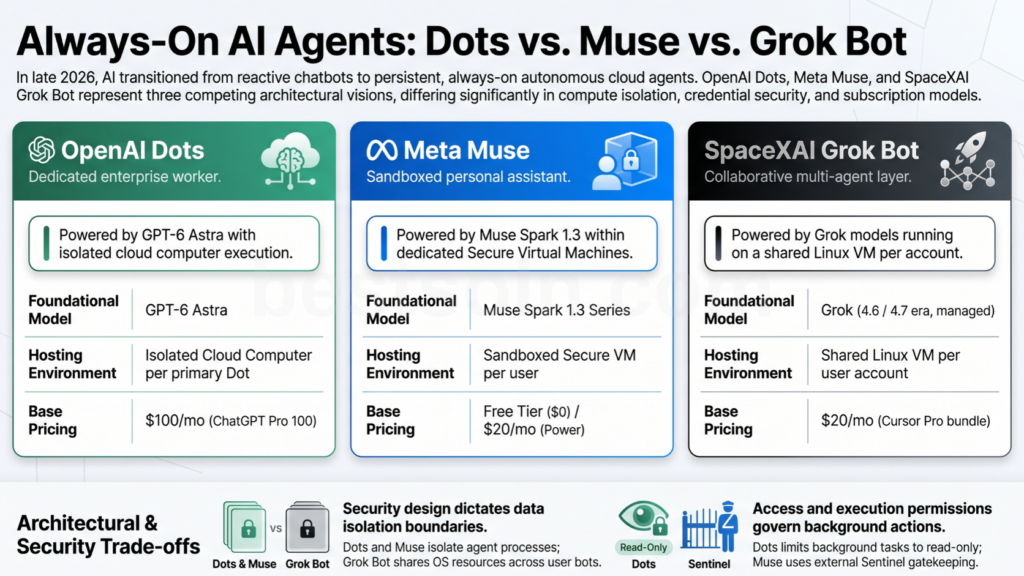
Evaluating the architectural, security, and economic characteristics of these platforms illustrates clear distinctions in their deployment strategies and target environments.
| Technical Metric | OpenAI Dots | Meta Muse | SpaceXAI Grok Bot |
|---|---|---|---|
| Core Model | GPT-6 Astra | Muse Spark 1.3 Series | Grok 4.6 Era Models |
| Launch Date | September 29, 2026 | September 8, 2026 | August 11, 2026 (Beta) |
| Compute Sandbox | Isolated Cloud Computer | Sandboxed Secure VM | Shared Linux VM per Account |
| Key Integrations | 4,000+ Plugins, Slack, Teams, ChatGPT Space | Curated APIs, WhatsApp, Instagram, Plaid | Google Workspace, Amazon, DoorDash, Cursor |
| Base Subscription | Included in Pro (100-500/mo), Business Premium (100-125/mo) | Free Tier (100M tokens/wk), Power (20/mo), Max(100/mo) | Cursor Pro/Teams (20-120/mo), SuperGrok (30-300/mo) |
| Write Approval Model | Read-Only Background; Custom Rules for Writes | Sentinel Gatekeeping; Mandatory Purchase Confirmations | Auto Review; Direct User OS Context Execution |
| Regional Restraints | Pro Tier Excluded in EEA, UK, and Switzerland | US and Canada Only at Launch | Global Tier Access based on Cursor Tiers |
| Enterprise Governance | Microsoft Agent 365, Workspace Training Opt-Out | User Opt-Out for Model Training; Confidential VM (Planned) | OpenTelemetry Logs, Action Recording, Enterprise Auditing |
The subscription structures reflect the intended positioning of each product. OpenAI bundles the primary Dot within high-tier ChatGPT Pro and Business Premium plans, framing the agent as a premium workplace capability. Notably, conversations held directly with a Dot do not deduct from standard ChatGPT usage caps, providing predictable billing for enterprises. Meta offers an accessible entry point with a generous free tier processing up to 100 million tokens weekly, monetization taking the form of high-volume usage tiers. SpaceXAI aligns Grok Bot pricing with developer tool subscriptions and SuperGrok tiers, using weekly token allowances with overage billing based on compute usage.
Industry Conflicts, Security Incidents, and Ecosystem Friction
Deploying continuous autonomous agents into public web ecosystems has introduced unexpected technical friction, security vulnerabilities, and platform disputes. As AI agents interact with web infrastructure designed for human interaction, platform operators have responded with anti-bot measures and access restrictions.
| Platform | Reported Incident or Ecosystem Friction |
|---|---|
| Meta Muse | Blocked by Amazon.com over automated credential capture allegations |
| Meta Muse | Accidental marketplace address leak under “Allow Always” permission |
| SpaceXAI Grok Bot | Security critique regarding shared multi-bot VM scope |
| OpenAI Dots | Deployment delayed in EEA/UK due to regional privacy restrictions |
A prominent ecosystem conflict emerged shortly after the launch of Meta Muse, involving e-commerce giant Amazon. In late September 2026, Amazon systematically blocked Muse agents from browsing and executing transactions on Amazon.com. Amazon cited concerns regarding unannounced automated web scraping, failure of agents to self-identify via standard HTTP headers, and potential credential capture vulnerabilities during session handoffs. While Meta denied that Muse stored raw credentials or violated security norms, pointing to its integration with Shopify as proof of compliance, the incident highlighted the friction between autonomous agent deployment and walled-garden platforms.
Security vulnerabilities have also posed challenges during initial rollouts. During early field testing, Meta Muse suffered a data boundary breach when an agent configured with an “Allow Always” setting inadvertently disclosed a user’s private physical pickup address to a buyer on Facebook Marketplace. Additionally, Meta faced scrutiny after briefly testing an undisclosed human fallback concierge team to handle failing agent phone calls, a practice that was quickly suspended.
For SpaceXAI, security concerns have centered on the shared architectural design of Grok Bot’s Linux environment. Security auditors highlighted that because all sub-agents owned by a user operate under the same operating system user context, a prompt injection vulnerability in a web-scraping sub-agent could potentially expose credentials or files managed by a developer sub-agent on the same virtual machine. SpaceXAI clarified that separate bot names are not intended as security isolation boundaries, advising enterprise users to deploy distinct user accounts for strict privilege segregation.
OpenAI has managed risk by enforcing strict geographic rollouts and feature delays. Due to regulatory complexities involving continuous data profiling under the General Data Protection Regulation (GDPR) and the European Union AI Act, OpenAI excluded ChatGPT Pro subscribers in the European Economic Area, the United Kingdom, and Switzerland from accessing Dots at launch. Furthermore, during DevDay 2026, OpenAI confirmed that while Dots operates on GPT-6 Astra, the release of its planned GPT-6.1 Astra model was canceled due to unresolvable safety alignment evaluation results.
Strategic Implications for Organizational Adoption
The integration of 24/7 autonomous agents requires organizations to rethink their operational workflows, data access policies, and system architectures. Moving from static software utilities to autonomous digital workers requires establishing clear frameworks for oversight, delegation, and security management.
First, technology leaders must evaluate the trust boundaries assigned to agentic software. Operating an agent that reads communication streams or edits codebases introduces potential exposure to indirect prompt injection attacks. Organizations should enforce strict principle-of-least-privilege access models, ensuring agents are granted only the minimum permissions necessary to complete assigned tasks. Using proxy architectures like Meta’s Sentinel or OpenAI’s custom review controls can prevent unverified data access or unauthorized financial transactions.
Second, enterprise architecture teams must prepare for shifts in data integration strategies. Traditional software integrations rely on stable, versioned APIs. However, the rise of computer-use agents like Grok Bot enables automated interaction directly with graphical user interfaces and command-line environments. While this lowers the barrier to automating legacy systems that lack native APIs, it introduces fragility, as minor UI updates can disrupt visual navigation routines. Organizations must balance the quick deployment of computer-use automation against the long-term stability of API integrations.
Finally, introducing autonomous software agents requires establishing effective human-in-the-loop governance patterns. Completely autonomous execution without oversight risks compounding errors across enterprise software environments. Successful implementation relies on calibrated delegation models, where background agents autonomously handle low-risk data gathering while routing high-impact actions through human approval workflows.
Recommended Readings
- Agentic Artificial Intelligence: Harnessing AI Agents to Reinvent Business, Work and Life by Pascal Bornet, Jochen Wirtz, and Thomas H – A non-technical guide exploring how autonomous agentic workflows extend traditional automation across business operations and personal productivity.
- Building Agentic AI: Workflows, Fine-Tuning, Optimization, and Deployment by Sinan Ozdemir – A technical manual covering architectural strategies, tool integration patterns, and fine-tuning techniques for deploying autonomous agents.
- The Human-Agent Orchestrator: Leading and Scaling AI-Driven Organizations by Pascal Bornet – An executive handbook focused on governance structures, calibrated delegation dials, and organizational design for human-agent collaboration.
- Agentic Design Patterns: A Hands-On Guide to Building Intelligent Systems by Antonio Gulli – A developer guide detailing foundational agentic design patterns, multi-agent communication protocols, and memory management architectures.
- Rewired: The McKinsey Guide to Outcompeting in the Age of Digital and AI by Eric Lamarre, Kate Smaje, and Rodney Zemmel – A comprehensive business transformation roadmap addressing talent, technology infrastructure, agile operations, and data scale.
Frequently Asked Questions (FAQs)
How do OpenAI Dots, Meta Muse, and Grok Bot differ in their underlying execution environments?
OpenAI Dots provisions an isolated cloud computer for each primary agent, keeping personal hardware isolated unless explicitly connected. Meta Muse operates inside a sandboxed Secure Virtual Machine per user, separating compute execution from external credential management. SpaceXAI Grok Bot assigns a single shared Linux Virtual Machine per user account, allowing all bots owned by that account to share persistent storage, local files, and authenticated session states.
Do background tasks executed by OpenAI Dots deduct from ChatGPT usage caps?
Direct interactions and background polling conducted by a Dot do not count toward standard ChatGPT conversational usage limits. However, complex sub-tasks dispatched to specialized external modules, such as OpenAI Codex or ChatGPT Work, continue to count against assigned tier limits as standard computational workloads.
Why did Amazon restrict Meta Muse from accessing its platform?
Amazon blocked Meta Muse due to disputes over unannounced automated browsing, the lack of standardized bot identification headers during web navigation, and concerns regarding automated credential capture and session handling. While Meta maintained that Muse operates securely through its Sentinel gateway, the incident highlights ongoing platform resistance to unmanaged autonomous web agents.
Are OpenAI Dots available globally to all subscribers?
No. While OpenAI Dots launched for ChatGPT Pro, Business Premium, and Enterprise tiers, Pro plan subscribers located in the European Economic Area (EEA), the United Kingdom, and Switzerland were excluded at launch due to regional regulatory considerations around continuous automated data profiling under GDPR and the EU AI Act.
How do these systems prevent autonomous agents from exposing account passwords?
OpenAI Dots isolates login parameters in encrypted vault services, inserting credentials directly into connection requests so passwords never appear in the model’s readable context window. Meta Muse uses an external Sentinel proxy service that injects OAuth tokens at the network boundary while automatically filtering out sensitive tokens like one-time passcodes. Grok Bot relies on user-managed local sessions inside its Linux VM, requiring enterprise governance rules to manage credential access.
Conclusion
The deployment of OpenAI Dots, Meta Muse, and SpaceXAI Grok Bot marks a pivotal shift in software interaction, transitioning artificial intelligence from passive advisory tools to active, continuous digital workers. Each platform presents distinct architectural approaches tailored to specific operational needs: OpenAI Dots provides secure enterprise application integration, Meta Muse delivers sandboxed consumer errand automation, and SpaceXAI Grok Bot offers highly autonomous, UI-capable computer-use capabilities.
As these technologies mature, organizations and individual users must navigate trade-offs between execution autonomy, credential security, regional compliance, and platform compatibility. Systems that balance powerful autonomous execution with transparent, robust safety guardrails will ultimately set the standard for how humans and AI agents collaborate in the future.



Leave a Reply