

⏱️ Read Time:
TL;DR
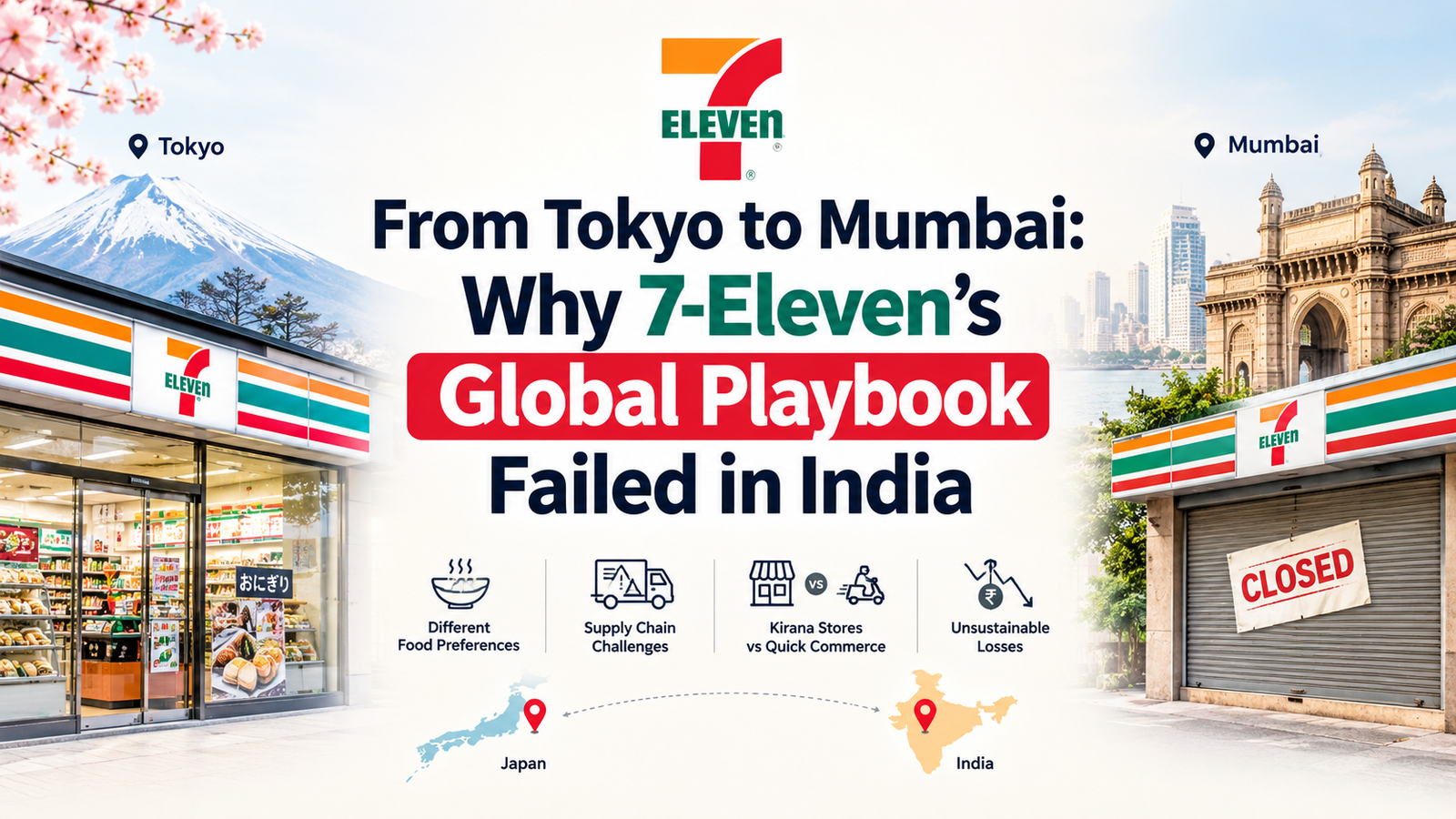
7-Eleven has officially exited India after five years and 31 stores, ending its master franchise partnership with Reliance Retail due to unsustainable losses of nearly ₹90 crore in FY2026. The failure was not caused by a single factor but by a systemic mismatch between the brand’s standardized global playbook and India’s unique retail reality. The venture struggled because it could not replicate its famous Japanese supply chain amid infrastructure deficits, failed to localize products for price-sensitive consumers who prefer fresh street food, and was ultimately squeezed out by the dual dominance of hyper-local kirana stores and ultra-fast quick-commerce platforms. While Reliance Retail pivots toward digital commerce, Seven & i Holdings views this as a strategic pause rather than a permanent retreat, signaling that future success in India will require deep adaptation rather than mere replication.
Key Takeaways
- Localization is Non-Negotiable: The primary cause of failure was applying a “copy-paste” strategy that ignored Indian consumer preferences for fresh, affordable street food over packaged ready-to-eat meals, resulting in a value proposition that resonated with neither mass-market nor premium shoppers.
- The “Squeezed Middle” Trap: The venture was caught in an unwinnable competitive position. It could not match the low prices, credit facilities, and personal relationships of 13 million kirana stores, nor could it compete with the sub-30-minute delivery speed of quick-commerce giants like Blinkit and Zepto.
- Operational Models Are Context-Dependent: The celebrated Japanese supply chain model, reliant on frequent fresh deliveries and dense store clustering, proved financially and logistically unviable in India due to infrastructure deficits and high operational costs. This resulted in annual losses of nearly ₹90 crore against ₹92 crore in revenue.
- Franchise Structure Does Not Guarantee Fit: While the master franchise model with Reliance Retail successfully navigated FDI regulations, it could not compensate for fundamental product-market misalignment or protect against diverging strategic priorities as the partner shifted focus toward digital assets.
- Exit Signals Pause, Not Permanent Retreat: Seven & i Holdings has stated it remains interested in the Indian market long-term. The exit reflects a failure of execution and model fit rather than a rejection of India’s potential, suggesting future attempts would require a radically different, hyper-localized approach.
- Global Success Does Not Guarantee Local Victory: The case reinforces that international retail expansion requires importing local wisdom, not just exporting a brand. Markets with strong informal sectors and rapid digital disruption demand bespoke strategies rather than copy-paste global playbooks.
Strategic Miscalculation: The Copy-Paste Playbook in a Hyper-Localized Market
The decision by Seven & i Holdings, the parent company of 7-Eleven, to pull out of the Indian market after a five-year partnership with Reliance Retail serves as a stark case study in international retail expansion. The closure of all 31 stores across Mumbai and Pune, confirmed by the parent company in September 2026, marks the end of an ambitious attempt to introduce a standardized convenience store format to one of the world’s most complex retail landscapes. The core of the failure lies not in the concept of franchising itself, but in a profound strategic miscalculation: the assumption that a successful global model could be transplanted with minimal adaptation. This “copy-paste” approach, which disregarded deeply ingrained consumer behaviors, cultural preferences, and price sensitivities unique to India, proved fatal. While 7-Eleven has successfully expanded globally by meticulously adapting its systems, the Indian venture represents a critical departure from this proven philosophy, prioritizing brand presence over deep localization and ultimately failing to build a defensible value proposition against entrenched local rivals.
A primary strategic error was the misalignment between 7-Eleven’s core value proposition and the realities of the Indian consumer. In markets like Japan, Taiwan, and even Thailand, the success of 7-Eleven is heavily predicated on a specific offering centered around freshness, convenience, and impulse purchases of ready-to-eat (RTE) meals and beverages. Japanese stores, for instance, offer over 3,000 varieties of fresh food, while Taiwanese stores have adapted by introducing local favorites like tea eggs and baozi. However, this core offering found little traction in India. Consumer reports and user comments consistently highlighted a strong cultural preference for freshly prepared street food, which is perceived as cheaper, tastier, and faster than packaged RTE alternatives sold in convenience stores. This fundamental disconnect meant that the very product category designed to drive foot traffic and repeat visits failed to capture the imagination of Indian shoppers. Instead of becoming a go-to destination for a quick meal, 7-Eleven was often viewed as a high-end importer of packaged goods, a perception that undermined its positioning as a neighborhood convenience hub.
Compounding the product misalignment was extreme price sensitivity among Indian consumers, a well-documented characteristic of the market. Reports indicated that the prices at 7-Eleven outlets were significantly higher than those at nearby kirana stores, with some estimates suggesting a markup of 10-20%. For example, a 500 ml bottle of water might cost ₹30 at a 7-Eleven but only ₹20 at a local shop, a disparity that proved difficult to justify for everyday necessities. This pricing strategy rendered the brand’s value proposition uncompetitive, especially when compared to the low-cost offerings of the vast unorganized retail sector. The failure to adjust pricing models to align with local economic realities, a common challenge for foreign companies entering India, was a critical blow to the venture’s viability.
This lack of localization extended beyond products to the overall brand experience and service standards. Successful international expansions, such as in Taiwan and Thailand, followed phased strategies involving imitation of the initial model, followed by extensive localization, and culminating in innovation tailored to the local context. The Indian venture appeared to bypass this crucial process. The menu was described by users as disappointing and lacking in items that catered to local palates. Furthermore, key brand pillars that define the 7-Eleven experience, such as consistent 24/7 operations and the availability of liquor, were reportedly inconsistent across the network of stores. This inconsistency eroded the promise of reliability and standardization that the global brand is built upon, leading to a negative perception of poor product quality and a lack of value. Some consumers were reportedly unaware of 7-Eleven’s presence in the country, highlighting a significant failure in building brand recognition and trust within the target market. This contrasts sharply with the deeply embedded brand identity seen in Thailand, where the store network is dense enough to create a sense of omnipresence, or in Taiwan, where the brand has become synonymous with urban lifestyle.
The strategic choice of a Master Franchise model with Reliance Retail was a pragmatic response to India’s stringent Foreign Direct Investment (FDI) regulations for multi-brand retail. These rules limit foreign ownership to 51%, mandate substantial infrastructure investment, and prohibit direct e-commerce activities, making a franchise arrangement an attractive alternative. However, this structure did not insulate the venture from the fundamental flaws in its strategic approach. It allowed the operation to proceed under the guise of a familiar model but failed to address the underlying issue of product-market fit. Other organized small-format retailers in India, such as EasyDay, More, and Spencer’s, have also struggled and scaled back their presence, underscoring the difficulty of executing this particular retail format in the Indian context. The failure was less about the franchise model itself and more about applying a flawed strategy through that model. The venture’s inability to adapt its core offering to local tastes, manage prices competitively, and build a compelling brand identity created a vacuum that was quickly filled by more relevant and affordable alternatives, ultimately leading to its demise.
| Factor | Successful Markets (Japan, Thailand, Taiwan) | Indian Market |
|---|---|---|
| Core Value Proposition | Freshness, convenience, and localized ready-to-eat (RTE) meals; a daily necessity hub. | High prices, generic imported snacks, and non-traditional RTE options; perceived as a premium import store. |
| Product Localization | Deep adaptation to local tastes (e.g., tea eggs in Taiwan, chef-designed meals in Thailand). | Lack of localization; menu was described as disappointing and failed to cater to local preferences. |
| Pricing Strategy | Competitive pricing relative to local alternatives, balancing convenience with affordability. | Significantly higher prices (10-20%+) than kirana stores, making it uncompetitive for daily needs. |
| Brand Perception | Strong brand recognition and trust, often seen as a neighborhood staple. | Negative perception due to high prices and poor quality; many consumers were unaware of the brand. |
| Service Standards | Consistent 24/7 operations and reliable store features across the network. | Inconsistent 24/7 operations and unreliable availability of services like liquor sales. |
This table clearly illustrates the strategic chasm between 7-Eleven’s successful global playbook and its execution in India. The failure was systemic, rooted in a fundamental misunderstanding of what “convenience” means to the average Indian consumer and an inability to compete on the two factors that matter most in that market: price and personal relationship. The venture attempted to sell a premium, Western-style convenience experience to a market that remained deeply loyal to lower-cost, highly personalized, and culturally resonant alternatives.
Operational Collapse: Unraveling a World-Class Supply Chain in India
The operational collapse of 7-Eleven in India was a direct consequence of attempting to replicate a world-class, Japan-centric supply chain model in an environment where its foundational assumptions were fundamentally broken. The celebrated efficiency of 7-Eleven Japan, characterized by frequent, targeted deliveries driven by real-time Point of Sale (POS) data, is the engine of its success. This system relies on a dense cluster of stores, advanced technology, and a robust logistics network capable of multiple daily replenishments, sometimes up to three times a day for fresh goods. This precision-driven model, however, proved to be operationally untenable in India due to severe infrastructural deficiencies, prohibitive costs, and complex regulatory demands. The result was an unsustainable cost structure that directly contributed to the venture’s massive financial losses.
One of the most significant operational failures was the inability to execute the rapid replenishment strategy. In Japan, this model is made possible by high population density, efficient road networks, and the strategic placement of stores near train stations, which simplifies last-mile logistics. In India, these conditions do not exist at scale. The country’s infrastructure is plagued by congested roads, inefficient cold chains, and inadequate storage and transport facilities, all of which directly impact logistics and increase costs. Attempting to deliver fresh food items multiple times a day across sprawling metropolitan areas like Mumbai and Pune would have resulted in exorbitant transportation and receiving costs, undermining the very principle of rapid replenishment, which carries its own risks, such as high logistics expenses. This logistical nightmare made it impossible to maintain the product freshness and wide variety of perishable goods that are central to the brand’s appeal elsewhere, further diminishing its value proposition in the eyes of Indian consumers who prioritize freshness.
The financial results of the venture serve as a clear indicator of this operational breakdown. For the fiscal year ending March 2026, the joint venture, ‘7-India Convenience Retail,’ reported revenue of approximately ₹92 crore but posted a staggering net loss of nearly ₹90 crore. This translates to an annual loss of roughly ₹29 million per store, a figure that highlights the severe unprofitability of the operation. This unsustainable financial performance was exacerbated by several operational pressures inherent to the Indian market. High rental costs for prime real estate in urban centers, thin profit margins typical for small-format retail, and rising operating expenses all placed immense strain on the business. The average daily sales per store were reported to be only about ₹81,000, which is less than one-fifth of the average daily sales of mature stores in Japan, indicating a severe shortfall in generating sufficient revenue to cover these high operational costs.
Furthermore, the operation had to navigate a complex web of regulatory requirements that added another layer of complexity and cost. All food businesses in India, including grocery stores, must obtain an FSSAI (Food Safety and Standards Authority of India) license, the type of which depends on annual turnover. Commercial establishments also require a Trade License from the local municipal corporation and must be registered under the Shops and Establishments Act. If the store’s revenue exceeds the GST threshold, GST registration is also mandatory. While the Master Franchise model with Reliance Retail was designed to help navigate the broader FDI landscape, it did not shield the operation from these intricate, state-specific, and local-level compliance obligations. The legal framework for franchises in India is not governed by a single law but by a combination of commercial legislation, making franchise agreements complex documents that require extensive due diligence from both parties. Any misstep in complying with these varied regulations could lead to fines, operational disruptions, or permit revocations, adding further risk to an already fragile operation.
The real estate strategy also faced significant challenges. 7-Eleven’s global success is built on a strategy of dominant store clustering, where a high density of stores in a specific area reduces per-store logistics costs and creates overwhelming brand visibility. However, finding small, high-footfall locations in cities like Mumbai and Pune that were permitted for late-night or 24-hour operations was a major hurdle. Although Maharashtra passed laws allowing shops to operate 24/7, enforcement was reportedly inconsistent, with local police forces sometimes forcing businesses to close. A Bombay High Court ruling clarified that convenience stores were not subject to the same operating hour restrictions as bars or cinemas, affirming their right to 24/7 operations. Nevertheless, securing and maintaining these permits amidst bureaucratic complexities and potential local enforcement issues would have been a constant operational battle. The leasing model often used by 7-Eleven to reduce financial burdens and ensure flexibility was likely impacted by the high commercial rents in desirable locations, further inflating the cost base.
In essence, the operational model that makes 7-Eleven a global powerhouse in places like Japan and the U.S. was structurally unsuited for the Indian context. The combination of unfeasible logistics, an unsustainable cost structure, complex regulatory navigation, and challenging real estate economics created a perfect storm. The world-class supply chain, which is the hallmark of 7-Eleven’s operational excellence, became a liability in India, unable to overcome the country’s infrastructural deficits and economic realities. This operational collapse was not merely a series of isolated problems but the logical outcome of trying to force a highly specialized, resource-intensive system onto a market that demanded a simpler, leaner, and far more cost-sensitive approach.
Competitive Annihilation: Squeezed Between Kiranas and Quick Commerce
The failure of 7-Eleven in India cannot be understood without examining the uniquely brutal competitive landscape it entered. The venture was launched at a time when the concept of “convenience” was being aggressively redefined by two powerful and seemingly unstoppable forces: the ubiquitous, hyper-personalized kirana store and the disruptive speed of quick-commerce platforms. This dual-pressure scenario placed 7-Eleven in a precarious position, squeezed between a deeply entrenched local incumbent and a technologically advanced digital challenger. Neither competitor could be easily outmaneuvered, and 7-Eleven’s standardized, physical format offered no distinct advantage over either, leading to its swift annihilation in the marketplace.
On one side stood the fortress of India’s unorganized retail sector, dominated by over 13 million family-run kirana stores. These small shops control an estimated 91% of the country’s grocery market and represent a formidable barrier to entry for any standardized chain store. Their competitive advantages are numerous and deeply rooted in the Indian socio-economic fabric. First and foremost is price. With lower overheads and the ability to source directly from local suppliers, kiranas can offer products at prices 10-20% lower than branded convenience stores. In a market known for extreme price sensitivity, this price advantage is a decisive factor for millions of consumers. Second, kiranas possess an unparalleled level of personalization and trust. They offer credit, known as ‘udhaar’ or ‘khata’, which is a critical service for many households, and they build deep, long-term relationships with their customers based on mutual understanding and loyalty. This human touch, which involves knowing a customer’s preferred brands and shopping habits, is something algorithms and corporate policies struggle to replicate. Finally, their sheer ubiquity provides unmatched proximity; located within residential neighborhoods, they offer a level of convenience that is difficult for larger, standalone formats to match.
On the other side emerged the tsunami of quick commerce (Q-commerce). Platforms like Blinkit, Zepto, and Swiggy Instamart completely altered consumer expectations for speed and convenience. By leveraging hyperlocal dark stores, small warehouses typically located within a 1.5-2 km radius of customers, these platforms began offering delivery of groceries and daily essentials in under 30 minutes. This unprecedented speed made the physical act of visiting a store seem archaic for many consumers seeking immediate gratification. The Q-commerce market experienced explosive growth in India, with its gross order value increasing by a staggering 24-fold from FY2022 to FY2025. By 2024, Q-commerce platforms accounted for approximately two-thirds of all online grocery orders in the country, cementing their status as a dominant retail channel. This segment is projected to continue its rapid expansion, with Gross Merchandise Value (GMV) forecasts ranging from $40 billion to $50 billion by 2030. The rise of Q-commerce was cited as a major factor in 7-Eleven’s failure, as it made home delivery more convenient than visiting a physical store.
This intense pressure from both fronts left 7-Eleven with no viable niche. Against the kiranas, it could not compete on price or personal trust. Against the Q-commerce platforms, it could not compete on speed or the frictionless experience of app-based ordering. The brand’s attempt to occupy a middle ground, as a physical store offering convenience, was unsuccessful because neither of its primary competitors respected the traditional boundaries of retail. The kirana store offered convenience through proximity and relationship, while the Q-commerce platform offered convenience through speed and technology. 7-Eleven, with its higher prices, slower in-store experience, and lack of seamless digital integration, was left behind.
The timing of the launch in 2021 was also critical. It coincided with the peak of Q-commerce’s disruptive potential, a period when consumer behavior was rapidly shifting towards instant delivery services. The pandemic had already accelerated this shift, and by the time 7-Eleven arrived, many consumers had already formed new habits and dependencies on these digital platforms. The convenience store format, which requires a physical trip, began to look increasingly obsolete. Even if 7-Eleven had been able to perfectly execute its model, it would have still had to contend with a market where the definition of “convenient” had already been rewritten by the twin titans of kirana and Q-commerce. The failure underscores a crucial lesson for international retailers: entering a market already undergoing a fundamental disruption is exceptionally risky, and a standardized global model may be ill-equipped to survive such a dynamic and hostile competitive environment.
| Competitor Type | Key Advantages in India | Impact on 7-Eleven |
|---|---|---|
| Kirana Stores | Extreme price sensitivity, deep-rooted customer trust, provision of credit (‘udhaar’), and hyper-local ubiquity. | 7-Eleven could not compete on price or personal relationships, losing the trust of price-sensitive consumers who preferred the familiarity and affordability of their local shop. |
| Quick Commerce (Q-commerce) | Ultra-fast delivery (under 30 mins), convenience of app-based ordering, creation of incremental demand, and aggressive discounting. | The speed and convenience offered by Q-commerce platforms like Blinkit and Zepto rendered the physical presence of 7-Eleven irrelevant for many consumers, diverting footfall and capturing the “instant gratification” market. |
| Organized Small-Format Retailers | Struggled to find a profitable model due to high rental costs and intense competition from both kiranas and Q-commerce. | Reinforced the difficulty of establishing a successful convenience store format in India, suggesting the entire business model was facing structural headwinds. |
Ultimately, 7-Eleven’s exit from India is a testament to the power of local incumbents and disruptive technology. The venture failed because it tried to impose a standardized solution on a market that had already evolved its own highly effective solutions. The resilience of the kirana economy, combined with the relentless innovation of the Q-commerce sector, created a competitive moat that was too deep for a foreign entrant with a misaligned value proposition to cross.
The Master Franchisee Dilemma: Reliance Retail’s Pivot and the Parent Company’s Pause
The choice of Reliance Retail as the master franchisee for 7-Eleven in India was a strategic maneuver born of necessity, dictated by India’s complex FDI regulations for multi-brand retail. The partnership, announced in 2021, allowed 7-Eleven to enter the market without triggering the stringent rules that cap foreign ownership at 51% and mandate significant back-end infrastructure investment. However, the subsequent failure of the venture raises questions not just about the retail model, but about the strategic alignment between the global franchisor and its local operator. The dissolution of the partnership appears less like a simple termination and more like a reflection of diverging long-term visions, where Reliance Retail pivoted away from investing in struggling physical retail toward consolidating its resources in the more promising digital commerce space, leaving 7-Eleven to absorb the consequences.
Reliance Retail’s decision to shut down all 7-Eleven stores and absorb the trained workforce into its broader grocery and neighborhood retail businesses is a telling sign of its strategic recalibration. This action suggests that Reliance did not view the convenience store format as a viable long-term asset worth salvaging. Instead, by integrating the skilled employees, who had been trained in the 7-Eleven operational system, into its own ecosystem, Reliance ensured that valuable human capital was not lost entirely. This move points towards a consolidation strategy focused on optimizing its existing strengths, particularly its JioMart e-commerce platform and its burgeoning network of dark stores designed for quick commerce. Reliance’s heavy investments in digital infrastructure and its dominance in the Q-commerce space indicate a clear belief in the future of retail being digital rather than physical. Continuing to pour capital into a network of unprofitable brick-and-mortar stores would have been a counter-strategy to its core business ambitions. Therefore, the termination of the 7-Eleven partnership can be interpreted as a rational business decision by Reliance to cut its losses and redirect its focus and resources toward areas with greater growth potential.
From the perspective of the parent company, Seven & i Holdings, the exit signals a strategic pause, not a permanent retreat from the Indian market. The company explicitly stated that it remains interested in exploring other options to advance its presence in India in the long term. This measured response implies that the failure was attributed to the specific execution via the Reliance partnership and the chosen business model, rather than a blanket rejection of the entire Indian market opportunity. The parent company, which operates over 85,000 stores worldwide in successful markets like Japan, Taiwan, and Thailand, understands the nuances of its own brand better than anyone. Its continued interest suggests that it believes a different partner or a radically different approach, one that truly embraces deep localization and adapts to India’s unique competitive dynamics, could still succeed. The failure in India stands in sharp contrast to the successes achieved through partnerships in other regions, highlighting that the choice of a local partner and the structure of the alliance are as critical as the brand itself.
The legal and regulatory framework governing franchise relationships in India adds another layer of complexity to this dilemma. The absence of a dedicated franchise law means that all such relationships are governed by a patchwork of general commercial legislation, including the Indian Contract Act, the Trademarks Act, and FEMA regulations for royalty payments. The franchise agreement becomes the sole governing document, and its ambiguity in clauses concerning territory, renewal, and termination can lead to disputes and uncertainty. While the provided sources do not detail the specific terms of the 7-Eleven Reliance agreement, the general legal environment in India necessitates careful drafting and negotiation. The fact that the partnership was terminated amicably after five years suggests that the agreement likely contained provisions for such an outcome, but the underlying reasons for the failure remain a matter of interpretation.
The history of 7-Eleven’s own internationalization provides a useful backdrop. The company’s success story is, in many ways, a tale of reverse innovation. After acquiring a licensing agreement from the original Southland Corporation in 1973, Ito-Yokado (later Seven & i Holdings) perfected the convenience store model in Japan before eventually acquiring its American parent company in 2005. This demonstrates a willingness to learn from and adapt to a local market, to the point of mastering it better than the originator. The Indian venture, however, seems to have run in the opposite direction, an attempt to export a mature, system-driven model without the same depth of learning and adaptation. The failure thus presents a paradox: a company that mastered globalization by first localizing seemed to forget this lesson when it came to India. The ultimate question for both Reliance and Seven & i Holdings is whether the next attempt will involve a different partner, a more flexible model, or a deeper commitment to listening to the Indian consumer, rather than simply projecting a global brand onto the market.
A Blueprint for Success: Deconstructing 7-Eleven’s Winning Formula Elsewhere
To fully understand why 7-Eleven failed in India, it is essential to deconstruct the formula for its remarkable success in other global markets. The brand’s achievements in countries like Japan, Thailand, and Taiwan are not accidental; they are the result of decades of meticulous adaptation, deep localization, and the relentless execution of a finely tuned operational system. These successes stand in stark contrast to the Indian failure, highlighting the specific points of friction where the global playbook was applied incorrectly. By examining these winning formulas, the strategic and operational missteps in India become even more apparent.
In Japan, 7-Eleven has reached near-mythical status, operating over 21,000 stores and generating over four trillion yen in annual sales. The Japanese model is built on two interconnected pillars: dominant store clustering and a hyper-responsive supply chain. Dominant store clustering involves placing a high density of stores in specific urban areas, which serves multiple purposes: it reduces per-store logistics costs by sharing delivery routes, creates overwhelming brand visibility that fosters habitual shopping, and effectively blocks competitors from securing prime locations. This strategy is supported by a sophisticated supply chain that leverages real-time POS data from every store to enable rapid replenishment. Many stores receive fresh food deliveries multiple times a day, with delivery plans adjusted based on local demand influenced by weather or events. This focus on freshness is deeply embedded in Japanese culture, and 7-Eleven has capitalized on it by developing exclusive private label brands like ‘7-Premium’ and co-developing innovative products with suppliers. The success in Japan is therefore contingent on high population density, efficient urban logistics, and a consumer culture that values and pays a premium for freshness and convenience.
Thailand offers another compelling case of successful localization. The 7-Eleven network there is operated exclusively by Charoen Pokphand (CP) All Public Company Limited, which secured an exclusive master license in 1988. CP All’s success is built on creating a vertically integrated supply chain and focusing intensely on local tastes, particularly in food and beverage. The company transformed 7-Eleven into a “Food & Drink Destination,” opening its own food production facilities to ensure quality and enable rapid innovation. They developed exclusive product lines, such as ‘Chef Collaboration’ menus and ‘All Select’ coffee, which became central to the brand’s identity and a key differentiator. Unlike the diluted version in India, Thai stores offer a wide range of locally tailored products and services. CP All also invests heavily in superior location selection, ensuring that only about 5% of its stores ever close, and focuses on Human Resource Development, creating distinct career paths for its staff. This deep, long-term commitment to understanding and serving the local market, combined with a vertically integrated operational backbone, has allowed CP All to achieve a dominant 70% market share in Thailand’s convenience store sector.
Taiwan showcases a more phased approach to adaptation. When 7-Eleven entered the market in 1980, it went through three distinct phases: imitation of the US model, localization, and innovation. During the localization phase, the company introduced products that resonated with local tastes, such as tea eggs and baozi, and shifted its store locations to high-density residential communities rather than rural street corners. This demonstrated an understanding that the target consumer in Taiwan was different from that in the US. Later, during the innovation phase, 7-Eleven introduced services like pre-ordering, delivery, and i-Cash, a popular e-wallet, to stay ahead of the curve. This iterative, adaptive strategy allowed the brand to evolve alongside the market, rather than imposing a static model. The result is a highly concentrated market with nearly 7,000 stores and intense competition that drives continuous innovation.
Even in established markets like the United States, 7-Eleven has had to innovate to stay relevant. While US stores are typically larger and attached to gas stations, the company is now expanding into larger ‘New Standard’ stores to compete with regional rivals by building commissary networks for proprietary prepared foods. The common thread across all these successful cases is a deep respect for local context. Whether it’s the hyper-density of Japan, the food-centric culture of Thailand, or the phased adaptation in Taiwan, the principle remains the same: the global brand identity is maintained, but the operational and product execution is relentlessly tailored to the local market. This contrasts sharply with the Indian venture, where the attempt to apply a generic model led to a failure of product-market fit, price competitiveness, and brand relevance.
| Market | Key Success Factors | Contrast with India |
|---|---|---|
| Japan | Dense store clustering, hyper-responsive supply chain with multiple daily fresh deliveries, deep focus on private labels and freshness, and alignment with urban commuter culture. | Failed to replicate dense clustering; could not execute frequent fresh deliveries due to logistical constraints; lacked focus on local private labels; misjudged target consumer as office-commuter-focused. |
| Thailand | Exclusive master franchise (CP All), vertically integrated supply chain, intense focus on local food/beverage products, superior location selection, and HR development. | Used a standard franchise model with Reliance Retail; could not establish a specialized supply chain; product mix lacked deep localization; store locations and service consistency were reportedly inconsistent. |
| Taiwan | Phased adaptation (imitation, localization, innovation); introduction of local food items (tea eggs, baozi); focus on residential communities; later adoption of digital innovations like delivery and payment systems. | Skipped the phased adaptation process; product mix was not localized; failed to build a strong brand identity or positive consumer perception. |
These comparative examples provide a clear blueprint for what 7-Eleven got wrong in India. The failure was not an indictment of the brand itself, but a stark illustration of what happens when a powerful global system is deployed without the necessary adaptation to local soil.
Recommended Readings
For those interested in diving deeper into the complexities of international retail strategy, supply chain management, and the specific dynamics of the Indian market, the following books offer valuable insights:
- “The World Is Flat” by Thomas L. Friedman – Provides a foundational understanding of globalization and how technology levels the playing field, which is crucial for understanding the rise of quick-commerce and global retail expansion.
- “Competing in the Age of AI” by Marco Iansiti and Karim R. Lakhani – Explores how digital platforms and AI are reshaping business models, offering context on why traditional physical retail formats struggle against tech-driven competitors like Zepto and Blinkit.
- “India Unbound” by Gurcharan Das – A classic narrative on India’s economic transformation, helping readers understand the socio-economic backdrop, including the resilience of the unorganized sector and the evolving middle class.
- “The Everything Store” by Brad Stone – While focused on Amazon, this book offers deep insights into the logistics, customer obsession, and scale required to dominate modern retail, providing a comparative lens for 7-Eleven’s operational challenges.
- “Poor Economics” by Abhijit V. Banerjee and Esther Duflo – Offers a nuanced look at the decision-making processes of people living in poverty and lower-income brackets, which is essential for understanding the extreme price sensitivity and value-seeking behavior of a large segment of Indian consumers.
Frequently Asked Questions (FAQs)
Why did 7-Eleven close all its stores in India?
The closure was driven by a combination of unsustainable financial losses, a lack of product-market fit, and intense competition. The joint venture reported a net loss of nearly ₹90 crore in FY2026 across just 31 stores. Consumers found the prices too high compared to local kirana stores and the ready-to-eat food options unappealing compared to fresh street food. Additionally, the brand struggled to compete with the speed of quick-commerce platforms like Blinkit and Zepto.
Was the failure due to Reliance Retail’s management?
Not entirely. While Reliance Retail decided to end the partnership to focus on its digital commerce and dark store networks, the fundamental issues lay in the business model itself. The standardized global playbook failed to adapt to India’s unique infrastructure, price sensitivity, and consumer habits. Reliance’s pivot suggests they saw more value in integrating the trained workforce into their existing grocery ecosystem rather than continuing to fund an unprofitable physical format.
How does 7-Eleven’s failure in India compare to its success in Japan or Thailand?
In Japan and Thailand, 7-Eleven succeeded through deep localization, dense store clustering, and highly efficient supply chains tailored to local tastes (like fresh meals in Japan or coffee culture in Thailand). In India, the brand attempted to replicate a generic model without these critical adaptations. It couldn’t achieve the necessary density for logistics efficiency, and its product mix didn’t resonate with local preferences, leading to a stark contrast in performance.
Will 7-Eleven return to India in the future?
Seven & i Holdings has stated that this exit is a strategic pause rather than a permanent withdrawal. They remain interested in the Indian market but are likely to explore different partnership models or a more deeply localized approach. Any future entry would need to address the specific challenges of pricing, local food preferences, and the dominance of quick-commerce.
What role did quick-commerce play in 7-Eleven’s exit?
Quick-commerce played a significant disruptive role. Platforms offering 10-30 minute deliveries redefined “convenience” for Indian urban consumers. 7-Eleven’s physical store model, which required customers to travel to the location, could not match the speed and frictionless experience of app-based ordering. This made the physical convenience store format seem increasingly obsolete for many daily needs.
Could 7-Eleven have succeeded if it had lowered its prices?
Lowering prices might have helped, but it wouldn’t have solved the core issues. The brand also faced challenges with product relevance (packaged vs. fresh food), inconsistent service standards (like 24/7 operations), and a lack of brand trust. Without a compelling reason for consumers to choose them over the personalized service of kiranas or the speed of Q-commerce, price alone would likely not have been enough to ensure long-term profitability.
Synthesis of Failure: Why Global Systems Falter Without Local Adaptation
The abrupt exit of 7-Eleven from the Indian market after five years of operation is not merely the story of a failed partnership but a definitive case study in the perils of global expansion without deep, empathetic localization. The venture’s collapse was not the result of a single misstep but a cascade of failures stemming from a fundamental strategic error: the belief that a successful global business model could be replicated in India without a profound understanding and adaptation to its unique cultural, economic, and competitive realities. The analysis reveals that 7-Eleven was defeated by a trifecta of forces: a misaligned value proposition, an unreplicable operational system, and a hostile competitive environment that it was ill-equipped to handle. The lessons from this experience are universal for any multinational retailer seeking to expand into similarly complex emerging markets.
First and foremost, the case underscores the critical importance of localization. The failure to adapt the core product offering to local tastes was perhaps the most glaring error. By pushing a portfolio of ready-to-eat meals and imported packaged foods, 7-Eleven ignored the deep-seated Indian preference for freshly prepared, affordable street food and the cultural significance of the ubiquitous kirana store. This was compounded by a failure to account for extreme price sensitivity, setting prices that alienated the very mass-market consumers it aimed to attract. As numerous studies on international expansion failures show, assuming that a home-market playbook will travel as-is is a primary cause of disaster. 7-Eleven’s Indian experiment is a textbook example of this mistake, where a superficial understanding of the market led to a complete disconnect with consumer needs and values.
Second, the venture exposed the harsh reality that even the most sophisticated operational systems are dependent on the underlying infrastructure and economics of the host country. 7-Eleven’s legendary Japanese supply chain, built on rapid replenishment and micro-matching of supply and demand, was rendered financially and logistically unviable in India. The country’s congested roads, weak cold chain, and high operational costs made the core tenets of the 7-Eleven model unworkable, leading to unsustainable losses. This highlights a crucial lesson: a global system’s effectiveness is conditional. It works because it is perfectly calibrated to the specific context in which it was developed. Transplanting it elsewhere requires not just replicating the system, but building the supporting infrastructure needed to make it function, a task that is often prohibitively expensive and complex.
Third, the competitive landscape in India was uniquely hostile. 7-Eleven entered a market already saturated with formidable competitors that had already captured consumer loyalty. On one hand, the kirana store presented an unbeatable combination of low prices, personal trust, and the critical service of credit, backed by a network of over 13 million outlets. On the other hand, the rise of quick-commerce platforms like Blinkit and Zepto redefined the meaning of “convenience” by offering speed and technological sophistication that a physical store could not match. 7-Eleven was caught in the middle, unable to compete with the kirana’s price and trust, nor with the Q-commerce platform’s speed and convenience. This “squeezed from both sides” scenario is exceptionally difficult for any standardized retail format to survive, reinforcing the idea that a retailer must carve out a distinct and defensible niche to thrive.
In conclusion, the story of 7-Eleven in India serves as a potent cautionary tale. It demonstrates that in today’s globalized yet fragmented world, success is not about exporting a brand, but about importing wisdom. The journey to market leadership requires more than a famous name and a proven system; it demands humility, a willingness to listen, and the agility to adapt. For Seven & i Holdings, the exit is a strategic retreat, signaling that the Indian market remains a prize worth pursuing, but only with a radically different approach, one that respects its complexity and honors its unique rhythms. For other global retailers, the lesson is clear: your home-market success is no guarantee of foreign triumph. The greatest risk in international expansion is not failing to grow, but failing to understand.





Leave a Reply