

TL;DR
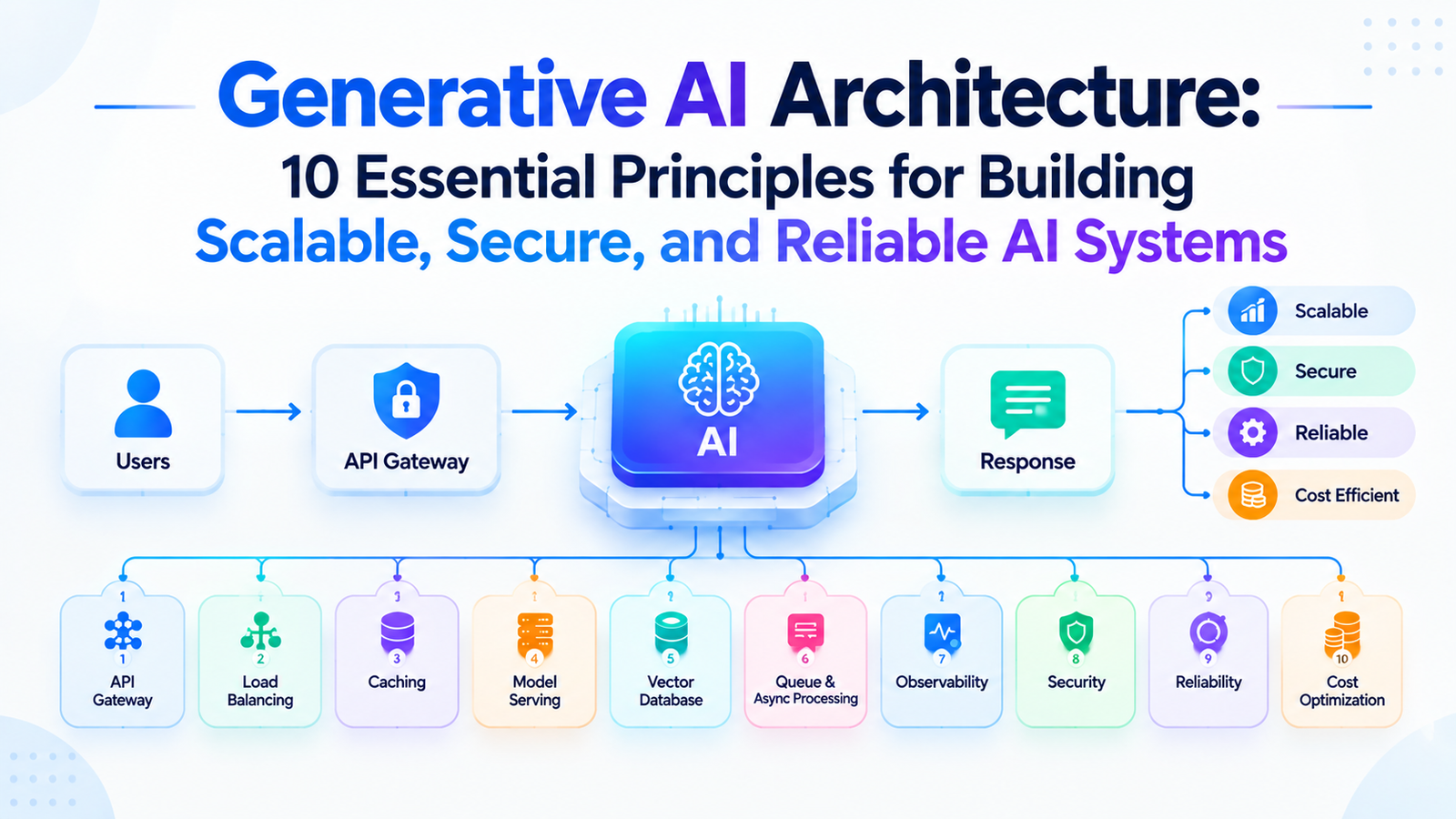
Architecting production-grade Generative AI systems requires a holistic, systems-thinking approach that moves beyond simply integrating a model API. The ten core principles – API Gateway, Load Balancing, Caching, Model Serving, Vector Database, Queue & Async Processing, Observability, Security, Reliability, and Cost Optimization – are deeply interconnected. A modern AI Gateway acts as a content-aware control plane, enforcing token-aware rate limits and security guardrails. Cache-aware load balancing is essential to leverage the Key-Value (KV) caches within stateful serving engines like vLLM, which use innovations like PagedAttention and continuous batching to maximize throughput. A multi-layered caching strategy, combining application-level, semantic, and model-level techniques, is a primary cost-saving mechanism. The vector database enables Retrieval-Augmented Generation (RAG), often through hybrid search architectures for maximum precision. Long-running tasks necessitate an asynchronous, event-driven architecture to avoid system instability. Reliability is achieved through a multi-layered defense of fallback chains, retries, and circuit breakers. Runtime security guardrails are non-negotiable for protecting against threats like prompt injection. Finally, a comprehensive observability platform is required to measure not just performance, but also cost and quality, forming a feedback loop for continuous optimization. Mastering these principles is key to building systems that are robust, scalable, secure, and economically viable.
Key Takeaways
- AI Gateways are Strategic: A modern AI Gateway is not a simple proxy but a content-aware control plane for security, rate limiting, and routing.
- Stateful Orchestration is Crucial: LLM inference is stateful; therefore, load balancing must be cache-aware to be effective, directing requests to replicas with the needed Key-Value (KV) cache.
- Optimization is Layered: Significant performance and cost gains come from a multi-layered approach combining engine-level optimizations (PagedAttention), server-level caching (prefix caching), and application-level caching (semantic/exact-match).
- RAG Requires Specialized Infrastructure: Effective RAG relies on vector databases with features like hybrid search (vector + keyword) and metadata filtering to deliver high-quality, relevant context.
- Asynchronicity Enables Scalability: The “Request-Reply Fallacy” is a critical anti-pattern. Complex AI workflows should be handled asynchronously via message queues to ensure system stability and responsiveness.
- Resilience is a System Property: High availability cannot be an afterthought; it must be architected in using a combination of failover chains, intelligent retries, and circuit breakers.
- Security is Runtime-Focused: LLM-specific threats like prompt injection require continuous, real-time monitoring and interception at the gateway or runtime level, not just preventive measures.
- Observability Must Cover All Pillars: True observability for GenAI extends beyond traditional APM to include automated evaluation of output quality and detailed tracking of economic metrics like token consumption and cost.
- Cost Optimization is Multifaceted: The most effective cost savings come from high-leverage strategies like intelligent model routing, supplemented by foundational optimizations like caching and prompt engineering.
- Interdependencies are Key: The principles are not isolated. For example, choosing an engine like vLLM enables effective prefix caching, which in turn makes cache-aware load balancing highly valuable, creating a virtuous cycle of performance and efficiency.
Introduction
The proliferation of Generative AI has unlocked unprecedented possibilities, but translating these capabilities into robust, production-grade applications presents a formidable engineering challenge. Integrating a Large Language Model (LLM) into a live system is not a matter of a simple API call; it requires architecting a complex, multi-layered ecosystem where every component is optimized for the unique, stateful, and variable nature of LLM inference. A successful architecture systematically addresses the inherent challenges of latency, cost, reliability, and security at every layer, from the initial user interaction to the final response generation. Failure to understand the intricate interdependencies between these layers leads to systems that are brittle, expensive, and insecure. This report provides a deep research analysis of the ten foundational system design principles for building production-ready GenAI applications. Drawing on current industry practices and emerging research, it deconstructs the architectural choices, trade-offs, and best practices required to construct systems that are not only powerful but also resilient, scalable, and economically sustainable. We will explore how an intelligent gateway becomes the first line of defense, how to orchestrate inference efficiently, what optimizations are available in the serving core, how to ground intelligence with vector databases, how to build a multi-layered framework for reliability and security, and how to measure and control costs effectively. The goal is to move beyond a collection of disparate concepts and present a cohesive blueprint for engineering the future of Generative AI.
The Intelligent Gateway: First Line of Defense and Control
In the architecture of modern Generative AI applications, the API Gateway serves as the strategic entry point for all traffic, evolving far beyond its traditional role as a simple proxy. For GenAI workloads, this layer transforms into an intelligent, content-aware control plane, the “AI Gateway,” that understands the nature of the requests it handles. This evolution is not merely incremental; it represents a fundamental shift driven by the unique risks and resource demands of LLM-powered systems. Traditional gateways, which inspect request metadata such as headers, IP addresses, and authentication tokens, are ill-equipped to address threats that reside entirely within the payload itself. Malicious instructions for prompt injection, sensitive Personally Identifiable Information (PII), and other policy-violating content are embedded in the free-text prompts and responses, making them invisible to conventional security controls. Consequently, a production-grade AI gateway must possess the capability to read, analyze, and govern this content in real time to enforce security policies, manage access, and control costs effectively.
The primary function of a modern AI gateway is to act as a unified interface between the application and various AI models or providers, abstracting away the complexities of individual APIs. This centralization enables powerful capabilities like multi-provider failover, where traffic is automatically routed to backup models during an outage or rate limit. However, its most critical role lies in enforcement. Gateways implement token-aware rate limiting, a necessity for LLMs where a single request can consume vastly different amounts of computational resources based on its length and complexity. Unlike traditional request-per-second (RPS) limits, which treat every call equally, token-aware rate limiting accounts for the actual number of input and output tokens processed, providing a much more accurate measure of resource consumption and aligning usage with billing structures. This prevents a single resource-intensive request from disproportionately impacting system stability or budget allocations. Advanced gateways offer multi-dimensional rate limiting, allowing administrators to set quotas based on API keys, organizations, teams, specific models, and even geographic regions, ensuring fair resource distribution in complex, multi-tenant environments.
Furthermore, the AI gateway is the first line of defense against the OWASP Top 10 for Large Language Model Applications, particularly vulnerabilities like LLM01: Prompt Injection and LLM02: Sensitive Information Disclosure. It enforces content policies by scanning both ingress (user prompts) and egress (model responses) traffic. On the way in, it can redact or block PII detected via regular expressions or Named Entity Recognition (NER) before the prompt ever reaches the model. On the way out, it scans for leaked training data, context from other users, or forbidden information before delivering the response to the end-user. This process is crucial for compliance with regulations like GDPR and for preventing inadvertent data exfiltration. Some advanced gateways integrate directly with external services like AWS Bedrock Guardrails or Azure Content Safety to apply sophisticated filtering rules. Configurable guardrails can block disallowed topics, enforce structured outputs, and perform data-loss-prevention (DLP) scanning across entire conversations. MLflow AI Gateway, for instance, supports configurable guardrails that use LLM judges to block or sanitize harmful content.
This enforcement layer also extends to security through authentication and authorization. The gateway acts as the central point for managing identities, integrating with modern identity providers (IdPs) via standards like OAuth 2.1 to handle token lifecycle management. It applies Role-Based Access Control (RBAC) at the identity layer, ensuring that each user or service has the least-privilege access required for their task. This constrains the potential damage if a successful prompt injection attack were to occur, as the compromised system’s permissions would be limited. Comprehensive audit logging is another cornerstone of the AI gateway, providing an immutable trail of every interaction. This log includes the full raw user prompt, the sanitized prompt sent to the model, the complete model response, security actions taken, risk scores, and detailed cost and latency metrics, which are invaluable for compliance, forensics, and internal audits.
The choice of an AI gateway technology involves significant trade-offs between performance, features, and operational overhead. Open-source options like Bifrost, built in Go, are designed for high throughput with low latency overhead (~11 microseconds per request), making them suitable for high-volume production environments. LiteLLM is a popular Python-based alternative supporting over 100 providers but can introduce higher latency due to the Global Interpreter Lock (GIL) under heavy concurrency. Managed services like Portkey, WSO2, and Kong provide enterprise-grade features, including virtual keys with spend limits, automatic retries, and advanced routing policies, but at the cost of vendor lock-in and pricing that scales with usage. Cloudflare’s AI Gateway leverages its global edge network to provide low-latency access and built-in caching but offers less granular control over advanced rate-limiting logic compared to self-hosted solutions. Ultimately, the gateway is not just an infrastructure component but a strategic decision that shapes the security posture, cost structure, and overall reliability of the entire GenAI system.
| Feature | Description | Importance in GenAI Architecture |
|---|---|---|
| Content-Aware Inspection | Scans and governs the free-text content of prompts and responses, not just request metadata. | Essential for detecting and blocking LLM-specific threats like prompt injection (OWASP LLM01) and data leakage (LLM02). |
| Token-Aware Rate Limiting | Enforces limits based on token consumption (input/output) rather than raw request count. | Critical for fairness and cost control in variable-load LLM workloads, preventing abuse and budget blowouts. |
| Multi-Dimensional Quotas | Applies limits across dimensions like user, organization, team, and specific models. | Enables fair resource allocation and precise cost attribution in multi-tenant SaaS environments. |
| Integrated Security & Guardrails | Redacts PII, blocks malicious topics, and integrates with external safety services (e.g., AWS Guardrails). | Provides a first line of defense against data breaches and ensures outputs comply with organizational policies. |
| Centralized Failover & Routing | Manages fallback chains to secondary providers and balances load across multiple models. | Enhances system resilience and availability during provider outages or capacity issues. |
| Comprehensive Audit Logging | Maintains an immutable record of all interactions, including prompts, responses, and security actions. | Vital for compliance (GDPR, EU AI Act), forensics, and debugging complex agentic workflows. |
Orchestrating Inference: Load Balancing and Asynchronous Processing
As Generative AI applications scale, naive approaches to request handling break down, revealing two critical architectural challenges: inefficient load distribution and the inability to manage long-running, variable-latency operations gracefully. Standard web service patterns, such as stateless request handling and round-robin load balancing, are fundamentally unsuited for the autoregressive and stateful nature of LLM inference. An effective architecture requires intelligent orchestration at the gateway and server levels, combining cache-aware load balancing with an event-driven, asynchronous processing model to ensure scalability, responsiveness, and reliability.
Traditional load balancing algorithms fail for LLMs because they treat all requests as uniform units of work, ignoring the vast differences in their computational cost and state dependencies. Round-robin routing, for example, distributes requests sequentially across replicas without regard to their actual burden, leading to severe inefficiencies. More sophisticated methods like “least connections” still fail to capture the nuanced cost differences between generating 10 versus 1,000 tokens. The most significant failure of naive routing is its disregard for the Key-Value (KV) cache, a memory-intensive state maintained by each inference engine replica. When a request arrives, the engine performs an expensive prefill phase to compute attention states for the entire prompt. These states are then reused during the decode phase to generate tokens one-by-one. If a subsequent request shares a common prefix with a previous one, the KV cache for that prefix can be reused, drastically reducing the prefill computation and improving Time to First Token (TTFT). Naive load balancing, however, often routes such related requests to different replicas, each of which lacks the relevant cache and must recompute the prefix from scratch, wasting significant GPU cycles.
To solve this, cache-aware load balancing is essential. This strategy directs requests to the inference engine replica that already holds the relevant KV cache for the request’s prefix. One approach is session affinity using consistent hashing, which routes all requests from the same session to the same endpoint, enabling prefix caching. However, this can lead to load imbalance if many sessions share the same popular prefix (“hot spotting”). More advanced strategies dynamically balance cache reuse with overall system load. For instance, the KVAwareRouter in Ray Serve uses a scoring function that combines KV cache overlap with an estimate of the remaining token load on each replica to select the optimal target. Other systems like llm-d employ a centralized router that ingests real-time KV cache events from all pods to build a global map of cached prefixes and route accordingly. Similarly, PrefixHash, implemented in the KubeAI project, uses consistent hashing on a request’s prefix to select a replica, demonstrating a 95% reduction in TTFT compared to random routing. For even greater precision, some systems use a radix tree to store tokenized prefixes and perform rapid lookups to find the best match, though this adds routing-layer computation. The effectiveness of these methods is profound; cache-aware routing can boost throughput by up to 3.1x and reduce wasted prefill compute from ~88% to ~12% in a multi-replica setup.
While intelligent routing optimizes stateful execution, asynchronous processing is necessary to handle the inherently variable and sometimes lengthy nature of LLM reasoning. The “Request-Reply Fallacy,” which forces complex, multi-step processes into a synchronous HTTP request-response cycle, leads to system instability, timeouts, and poor user experience. When a user submits a prompt that triggers a long chain of tool calls, RAG lookups, and intermediate reasoning steps, waiting for the entire sequence to complete before returning a response is impractical and brittle. An event-driven architecture (EDA) solves this by decoupling the initial request from the background processing. Upon receiving a user prompt, the backend immediately returns an HTTP 202 Accepted status with a unique TaskID. The actual work is then published as an event onto a message broker like Apache Kafka or RabbitMQ. A pool of worker agents consumes these events asynchronously, performing the necessary computations. Progress updates can be pushed back to the client in real-time using streaming protocols like Server-Sent Events (SSE) or WebSockets, providing a responsive user experience without tying up server resources.
For real-time, interactive applications, streaming the generated response token-by-token is crucial for perceived performance. The industry standard for browser-to-server streaming is Server-Sent Events (SSE), which establishes a persistent, unidirectional HTTP connection over which the server can push updates. The OpenAI API itself uses SSE for streaming, validating its suitability for production-grade GenAI systems. SSE is simpler to implement than WebSockets because it operates over standard HTTP and benefits from automatic reconnection capabilities built into the browser’s EventSource API. WebSockets, while more powerful, provide full-duplex, bidirectional communication and are typically reserved for applications where the client needs to send messages back to the server within the same stream, such as for mid-stream cancellations or approving tool calls. A hybrid pattern using SSE for the agent-to-client stream and a separate HTTP POST endpoint for client-to-agent messages offers a good balance between performance and simplicity. By combining cache-aware load balancing to maximize efficiency and an event-driven, asynchronous architecture to ensure scalability and responsiveness, architects can build robust systems capable of handling the demands of modern, complex GenAI applications.
The Performance Core: Model Serving Engines and Caching Strategies
At the heart of any Generative AI application lies the model serving engine, a specialized software framework responsible for loading models into GPU memory, scheduling requests, and optimizing the inference process. The choice of this engine is arguably the most impactful technical decision for determining the performance, cost-efficiency, and scalability of the entire system. Modern serving frameworks have evolved far beyond early deep learning servers, introducing sophisticated optimizations that directly address the unique challenges of LLM inference, such as memory fragmentation and variable request lengths. These optimizations are complemented by a multi-layered caching strategy that sits at the application, model, and request levels, collectively forming the performance core of a production-grade system.
The landscape of LLM serving engines is characterized by specialization, with each framework offering a distinct set of trade-offs. vLLM has emerged as a leader for high-throughput, general-purpose serving, largely due to its foundational innovation of PagedAttention. Inspired by operating system virtual memory, PagedAttention breaks the KV cache into small, fixed-size pages (typically 16 tokens) that can be stored non-contiguously in GPU memory. This elegant solution eliminates the severe memory fragmentation and waste (often 60-80%) caused by reserving large, contiguous blocks of memory for every request based on the maximum possible sequence length. By enabling efficient memory sharing and immediate reuse of freed pages, PagedAttention allows a single GPU to handle two to four times more concurrent requests than older methods. Complementing PagedAttention is continuous batching, a dynamic scheduling strategy where new requests can join an ongoing batch at the level of individual decode iterations. Instead of waiting for a static batch to finish, continuous batching keeps the GPU fully occupied by slotting in new requests as soon as a slot becomes available, boosting GPU utilization from around 30-40% to 75-85%.
Other frameworks cater to different priorities. TensorRT-LLM, NVIDIA’s proprietary engine, is designed for maximum performance on NVIDIA hardware. It achieves superior throughput by performing ahead-of-time compilation to generate highly optimized code, fusing kernels, and leveraging hardware-specific features like FP8 quantization. However, this comes at the cost of vendor lock-in and a steep learning curve. SGLang focuses on low-latency scenarios, especially multi-turn conversations, using RadixAttention to store computations in a radix tree, allowing it to share cached attention states across requests with identical prefixes. For CPU and edge-based inference, llama.cpp is the de facto standard, prized for its aggressive quantization support and unmatched hardware flexibility. The table below summarizes the key characteristics of these leading frameworks.
| Framework | Primary Strength | Key Innovation(s) | Ideal Workload |
|---|---|---|---|
| vLLM | High Throughput & Memory Efficiency | PagedAttention, Continuous Batching, Chunked Prefill | General-purpose serving, high-concurrency APIs, chatbots |
| TensorRT-LLM | Maximum Performance on NVIDIA Hardware | Ahead-of-time Compilation, Kernel Fusion, Quantization | Batch-heavy workloads, performance-critical applications on stable models |
| SGLang | Low Latency, Structured Generation | RadixAttention, Stateful Function Abstractions | Multi-turn conversations, RAG pipelines, agent-based workflows |
| llama.cpp | CPU & Edge Inference, Hardware Flexibility | Aggressive Quantization (int4/int8), SIMD Acceleration | Local development, offline use, resource-constrained devices |
| Text Generation Inference (TGI) | Ease of Use, Hugging Face Integration | Automatic Tensor Parallelism, Broad Model Support | Teams heavily invested in the Hugging Face ecosystem |
To further accelerate inference, model-serving engines implement several key optimizations. Speculative decoding improves generation speed by using a smaller, faster “draft” model to propose multiple candidate tokens, which are then verified in a single forward pass by the larger, more accurate “target” model. This technique can reduce generation latency by 30-50% for workloads with predictable outputs. FlashAttention is a fast attention algorithm that avoids materializing the full attention matrix in memory, reducing memory I/O and speeding up computation, especially for long sequences. Finally, quantization reduces the numerical precision of model weights (e.g., from 16-bit floating point to 4-bit integers), which halves memory requirements and accelerates computation by reducing the amount of data that needs to be moved from GPU memory.
These engine-level optimizations are amplified by a multi-layered caching strategy. At the application layer, an exact-match cache using a fast key-value store like Redis provides deterministic hits for identical queries with near-instantaneous latency. However, its effectiveness is limited by semantic variations in user phrasing. To overcome this, a semantic cache layer uses a vector database to store query embeddings and responses. When a new query arrives, its embedding is used to find semantically similar past queries, allowing the system to serve a cached response even when the wording differs. Semantic caching can achieve hit rates of 20-60% in conversational applications, eliminating redundant model calls and significantly reducing costs. The third layer is model-level prefix caching, an engine-native feature like that in vLLM. This mechanism stores the KV cache blocks for shared prompt prefixes in GPU memory, avoiding redundant prefill computation. Its effectiveness depends on placing stable content like system prompts and retrieved context at the beginning of the prompt, ensuring they form the reusable prefix. Together, these three layers, application-level exact-match, semantic, and model-level prefix caching, create a powerful, synergistic optimization stack that dramatically reduces latency, lowers costs, and increases the capacity of the entire inference system.
Grounding Intelligence: Vector Databases and Retrieval-Augmented Generation
Vector databases are specialized data stores designed to manage, index, and search high-dimensional vectors, which are numerical representations of unstructured data like text, images, and audio. Their primary function is to enable efficient similarity searches, allowing applications to find items based on their meaning or intent rather than just keyword matches. This capability is the foundation of Retrieval-Augmented Generation (RAG), a critical architectural pattern for grounding LLMs in factual, up-to-date, and domain-specific knowledge. By retrieving relevant information from an external knowledge base and augmenting the user’s prompt with this context, RAG mitigates the risk of hallucinations and produces more accurate, reliable, and verifiable responses. The design and scaling of the vector database are therefore paramount to the success of any serious RAG implementation.
The core of a vector database’s functionality is its indexing algorithm, which dictates the trade-off between search speed, recall accuracy, and memory footprint. Four primary types of indexes are used in production systems. Flat indexes, which compare the query vector against every stored vector, offer perfect recall but are only practical for very small datasets (<100k vectors). For larger collections, Approximate Nearest Neighbor Search (ANNS) algorithms are employed, trading a small amount of accuracy for massive gains in speed and space. Graph-based indexes like Hierarchical Navigable Small World (HNSW) build a navigable graph structure that allows for logarithmic O(logn) search times, achieving high recall out-of-the-box. They are well-suited for dynamic datasets but come with higher memory overhead (2-5x the size of the raw vectors). Partitioned indexes like Inverted File Index (IVF) partition the vector space into clusters and search only the most relevant ones at query time. IVF is generally more memory-efficient than HNSW but can suffer from recall degradation over time as new data is inserted, often requiring periodic full rebuilds to maintain performance. Emerging technologies like DiskANN are designed for billion-scale search by operating primarily on SSDs, addressing the memory cost barrier for massive datasets.
To support enterprise-scale RAG, modern vector databases incorporate advanced features for scalability and precision. Sharding distributes data across multiple nodes to handle large datasets and parallelize imports, while replication creates redundant copies to ensure high availability and zero-downtime maintenance. Query performance is further enhanced by hybrid search architectures, which combine dense vector search with sparse keyword search (e.g., BM25). Pure vector search excels at capturing semantic meaning but can miss queries containing specific terms like error codes or SKUs. Conversely, sparse search is excellent for exact matches but misses semantic nuances. Hybrid search runs both in parallel and then fuses the results using a method like Reciprocal Rank Fusion (RRF), which combines ranking positions rather than raw scores, making it robust and scale-agnostic. This approach has been shown to significantly outperform either method alone, particularly on mixed-query enterprise corpora. Furthermore, retrieval quality can be improved by enriching documents with structured metadata before indexing, allowing for powerful filtering and faceted search that narrows the candidate set before the more computationally expensive vector search is performed.
Architecturally, the vector database is a critical component in the RAG pipeline, which typically follows a staged process. First, external data is converted into chunks, which are then passed through an embedding model to create high-dimensional vectors. These vectors, along with their source text and associated metadata, are indexed in the vector database. When a user query arrives, it is also converted into a vector and used to perform a similarity search, retrieving the most relevant document chunks. These chunks are then assembled with the original query and inserted into the prompt for the LLM, which generates an answer grounded in the provided context. The entire process, from query to retrieval to generation, must be instrumented for observability to monitor performance and quality. Key metrics include retrieval precision and recall, and crucially, faithfulness or groundedness, which measures whether the LLM’s answer is factually supported by the retrieved context. Automated evaluation, often using an LLM-as-a-Judge, is essential for tracking this metric at scale. Platforms like Weaviate, Qdrant, Milvus, and Pinecone have matured into comprehensive solutions, offering native support for hybrid search, advanced indexing, and scalable deployment patterns, making them indispensable for building reliable, knowledge-grounded AI applications.
| Feature | Description | Impact on RAG Architecture |
|---|---|---|
| Indexing Algorithm | The method used for approximate nearest neighbor search (e.g., HNSW, IVF). | Dictates the trade-off between search speed, recall accuracy, and memory usage. HNSW offers high recall; IVF offers better memory efficiency. |
| Hybrid Search | Combines dense vector search with sparse keyword search (e.g., BM25). | Improves retrieval by handling both semantic queries and those requiring exact term matches, increasing overall relevance. |
| Result Fusion | The technique used to combine ranked results from different retrievers. | Reciprocal Rank Fusion (RRF) is preferred for being scale-agnostic and robust, avoiding the need for complex score normalization. |
| Metadata Filtering | The ability to filter search results based on structured attributes (e.g., date, author, department). | Allows for pre-filtering to narrow the search space, improving both performance and relevance by focusing on a subset of the knowledge base. |
| Scalability (Sharding/Replication) | Techniques to distribute data across multiple machines for storage and query load. | Essential for handling large-scale knowledge bases and supporting high-concurrency user workloads without performance degradation. |
| Reranking | A two-stage retrieval process where a fast initial search is followed by a slower, more accurate re-scoring of top candidates. | Significantly improves the quality of retrieved documents by prioritizing the most relevant ones before they are passed to the LLM. |
Building Resilience: A Multi-Layered Framework for Reliability and Security
Building a production-grade Generative AI system requires a proactive and multi-layered approach to resilience, as LLM applications are subject to a unique set of failure modes that go beyond typical REST API issues. These include frequent provider outages, unpredictable capacity limits that trigger rate limiting, silent performance degradation where response times balloon, and model deprecations. Simultaneously, the security landscape has expanded to include probabilistic risks inherent to LLM behavior, such as prompt injection and data leakage, which demand runtime defenses rather than just preventive controls. A robust architecture must therefore weave together patterns for reliability, security, and graceful degradation into a cohesive framework that protects the system from both external failures and internal vulnerabilities.
Reliability is achieved through a combination of fallback strategies, intelligent retry logic, and circuit breaking. When a primary model provider experiences an outage or a request fails due to a transient error (e.g., a 5xx server error or a timeout), a sequential fallback chain ensures service continuity by routing the request to a secondary or tertiary model. This chain can be ordered by performance, cost, or capability, with a common pattern being a tiered escalation from a premium model to cheaper alternatives. For latency-sensitive applications, a parallel hedging strategy can be employed, where the same prompt is sent to multiple providers simultaneously, and the first response received is returned, trading increased cost for reduced tail latency. Retries are a necessary part of resilience but must be applied judiciously. They should only be attempted for transient failures and must be combined with an exponential backoff strategy with jitter. Exponential backoff progressively increases the delay between retries (e.g., 1s, 2s, 4s), while jitter adds a small random amount of time to prevent a “thundering herd” problem where many clients retry simultaneously and overwhelm a recovering service. A circuit breaker complements retries by monitoring the health of downstream services. If a predefined threshold of consecutive failures is exceeded, the circuit “trips” to an open state, instantly rejecting all further requests to that service and preventing it from being overwhelmed. After a cooldown period, it enters a half-open state to test for recovery.
Security in the GenAI era requires a defense-in-depth strategy focused on runtime protection. Frameworks like the OWASP Top 10 for LLM Applications and the NIST AI Risk Management Framework highlight the inadequacy of purely preventive measures. Key vulnerabilities like prompt injection (LLM01) and sensitive information disclosure (LLM02) require continuous monitoring and interception at runtime. The AI gateway serves as a critical control plane for this purpose, acting as a “prompt firewall”. It inspects all incoming prompts and outgoing responses, applying guardrails to detect and block malicious instructions, redact PII, and scan for unsafe or non-compliant content. This is particularly important for mitigating indirect prompt injection, where an attacker poisons an external data source (like a document in a RAG system) that the LLM then consumes. Another critical security anti-pattern is treating the system prompt as a secret. Attackers can infer sensitive instructions, credentials, or access rules contained within it, leading to System Prompt Leakage (OWASP LLM07). Therefore, all security-critical logic and privilege separation must be enforced in deterministic, external systems, not within the prompt itself. For applications in regulated industries like finance and healthcare, data sovereignty is a paramount concern. Architectural patterns like deploying models within a private VPC or using sovereign cloud services (e.g., Azure OpenAI Service, Google Distributed Cloud) are essential to keep sensitive data within legal and geographical boundaries, complying with regulations like GDPR.
Finally, resilience culminates in graceful degradation, the practice of maintaining service functionality even when all primary and fallback paths fail. This final line of defense prevents the application from crashing and provides a better user experience. Strategies include serving a cached response for a semantically similar past query, returning a simple rule-based answer for common intents, or displaying a polite error message informing the user that the service is temporarily unavailable. A layered approach, starting with retries and progressing through circuit breakers, fallbacks, and finally graceful degradation, provides multiple opportunities to recover from failure at different stages, creating a robust and dependable system. Centralizing these resilience patterns within an AI gateway simplifies implementation, ensures consistent policy enforcement across all applications, and provides a unified view of system health and failure modes.
| Resilience Pattern | Description | Purpose | Example Implementation |
|---|---|---|---|
| Sequential Fallback Chain | Routes a failed request to a list of secondary models/providers in order. | Ensures service continuity during primary provider outages or rate limits. | GPT-4o → Claude Sonnet → Self-hosted Llama 3 |
| Parallel Hedging | Sends the same prompt to multiple providers simultaneously and returns the first response. | Reduces tail latency for latency-sensitive applications at the cost of increased expense. | Sends to both OpenAI and Anthropic, returns whichever responds first |
| Retry with Exponential Backoff & Jitter | Re-attempts a failed transient request with an exponentially increasing delay and a random offset. | Prevents overwhelming a struggling service and avoids thundering herd problems. | Retry after 1s, 2s, 4s… up to 5 attempts; add jitter to each interval |
| Circuit Breaker | Monitors error rates and temporarily halts all requests to a failing downstream service. | Protects the calling service from cascading failures and gives the downstream service time to recover. | Trips open after 5 consecutive errors; allows one test request after a cooldown period |
| Model Capability Mapping | Checks if a fallback model meets the minimum requirements (e.g., context length, features) before attempting to use it. | Prevents errors when failing over to a model with insufficient capabilities. | Ensures a fallback vision model supports image inputs if the original request was for vision |
| Graceful Degradation | Provides a simplified or cached response instead of failing the request completely. | Maintains user experience and system availability when all other mitigation strategies fail. | Return a cached FAQ answer or a “Service Temporarily Unavailable” message |
Measuring What Matters: Observability and Cost Optimization
In the complex, probabilistic world of Generative AI, traditional Application Performance Monitoring (APM) is insufficient. Without a dedicated observability strategy, development teams operate blind, unable to diagnose silent failures like quality degradation, runaway costs, or performance bottlenecks. Effective observability extends the classic pillars of metrics, logs, and traces to include automated evaluation, creating a diagnostic chain that covers not just operational health but also business impact. This must be paired with a holistic approach to cost optimization, as the variable and expensive nature of LLM inference makes financial control a primary architectural concern. Together, these practices provide the feedback loop necessary to build, deploy, and maintain reliable, economical, and high-quality AI systems.
Observability for GenAI systems requires measuring a new class of metrics that reflect the unique properties of LLM interactions. Beyond standard performance metrics like latency percentiles (P95/P99 TTFT, total generation time) and error rates, production systems must track economic and quality indicators. Key economic metrics include input and output token counts, cost per request, and cost per user session, which are essential for budgeting and identifying anomalies. Quality metrics are equally critical. Faithfulness (or groundedness) measures whether the model’s answer is supported by the provided context, directly combating hallucinations. Answer relevance assesses if the response addresses the user’s question, while toxicity and bias scores help ensure safe and compliant outputs. For agentic systems, workflow metrics such as tool call duration, nesting depth, and handoffs between agents provide insight into the complexity and efficiency of multi-step reasoning processes.
To correlate these metrics, distributed tracing is indispensable. Traces must follow the entire journey of a request through the system, capturing spans for every major step: the initial prompt, any query rewriting, vector store lookups, context assembly, the final LLM generation call, and any subsequent tool invocations. The OpenTelemetry project maintains GenAI Semantic Conventions, which define standardized attributes for these spans, enabling interoperability between different instrumentation libraries and platforms. Given the high volume of traffic, head-based sampling (sampling a fixed percentage of all traces) is often too costly and wasteful. Tail-based sampling is superior, as it samples traces based on their outcome, for example, always sampling requests that resulted in an error, took longer than a threshold, or had a low automated evaluation score. This ensures that the most interesting and problematic traces are captured for analysis, while routine successful requests can be sampled at a much lower rate to manage cost.
Automated evaluation is the fourth pillar of LLM observability and the only viable way to assess output quality at scale. This is typically implemented using an “LLM-as-a-Judge” approach, where a powerful, separate LLM is prompted to evaluate the output of the primary application against a set of criteria like factuality, relevance, and safety. This evaluation can be run asynchronously after a request completes to avoid adding latency to the user-facing path. Specialist observability platforms like LangSmith, Langfuse, Arize, and Helicone are purpose-built to handle these complexities, offering deep trace visualization, customizable evaluation frameworks, drift detection, and dashboards tailored to the nuances of GenAI. A recommended strategy is to pair a whole-stack APM (like Datadog or Honeycomb) for host-level and application health with an LLM-native platform for deep trace and evaluation analysis.
Cost optimization is a direct consequence of rigorous observability. The highest-leverage cost-saving strategy is intelligent model routing, which directs each query to the smallest, cheapest model capable of handling it. Simple tasks like intent classification or summarization can be handled by models that are 10-20 times cheaper than frontier models, with negligible loss in quality. With a typical enterprise query mix of ~70% simple, ~20% medium, and ~10% complex tasks, routing can reduce inference costs by 40-85%. This is complemented by foundational optimizations like prompt compression (which can save 20-40% of tokens) and response caching, which can eliminate redundant API calls for repeated or similar queries. At very large scales (e.g., >1 million queries/month), self-hosting open-weight models can become more economical than using public APIs, potentially saving 50-70% on infrastructure costs while also providing greater privacy and control. Ultimately, a successful GenAI operation is one where observability and cost control are treated as first-class engineering disciplines, providing the data-driven insights needed to continuously improve performance, quality, and profitability.
| Principle | Key Components & Best Practices | Rationale & Impact |
|---|---|---|
| Observability | Metrics: Track latency, error rates, tokens, cost, and quality proxies (e.g., user feedback). Tracing: Implement distributed tracing for the full agentic workflow using OpenTelemetry conventions. Evaluation: Use LLM-as-a-Judge for automated, scalable quality assessment. Logging: Log structured data for every interaction for debugging and analysis. | Provides visibility into system health, performance, and quality, enabling diagnosis of silent failures and data-driven improvements. |
| Cost Optimization | Model Routing: Route simple queries to cheap models and complex ones to expensive models. Response Caching: Implement multi-layered caching (exact-match, semantic, prefix) to eliminate redundant calls. Prompt Optimization: Trim prompts, use compression, and constrain output length. Batching: Process multiple requests together to improve GPU utilization. | Directly reduces the largest operational expense. Can yield savings of 40-85% in inference costs. |
| Security | Runtime Guardrails: Deploy an AI gateway or dedicated framework to inspect and filter inputs/outputs. Data Sovereignty: Use private VPCs or sovereign cloud services to keep data within legal boundaries. System Prompt Hardening: Do not rely on the system prompt for security; enforce policies externally. | Proactively defend against LLM-specific threats like prompt injection and data leakage. Ensure compliance with regulations like GDPR. |
| Resilience | Failover Chains: Maintain a priority-ordered list of backup models/providers. Retry Logic: Use retries with exponential backoff and jitter for transient failures. Circuit Breakers: Halt requests to failing services to prevent cascading failures. Graceful Degradation: Provide fallback responses (e.g., cached, rule-based) when all else fails. | Ensures high availability and a positive user experience despite provider outages, rate limits, and other failures. |
Recommended Readings
- Designing Machine Learning Systems by Chip Huyen – This book provides a foundational understanding of building scalable, reliable, and maintainable ML systems, focusing on explaining the critical trade-offs in system design that are directly applicable to GenAI architecture.
- Building LLMs for Production by Louis-François Bouchard & Louie Peters – This practical guide is specifically focused on bringing LLMs into production, covering operational excellence topics like serving strategies, latency optimization, and observability, which are crucial for real-world success.
- The Pragmatic Programmer for Machine Learning by Marco Scutari & Mauro Malvestio – This book offers pragmatic advice on designing robust ML solutions, emphasizing engineering discipline and reproducibility, which are often overlooked but vital aspects of building production-grade AI systems.
- AI Engineering by Chip Huyen – This work serves as a practical roadmap for building GenAI applications on top of foundation models, covering essential topics like model serving, adaptation techniques, and designing for real-time product constraints.
- Generative AI System Design Interview by Ali Aminian & Hao Sheng – While interview-focused, this book provides a structured framework for tackling complex system design problems, featuring detailed case studies on real-world applications like ChatGPT and RAG systems that illustrate the principles discussed in this report.
Frequently Asked Questions (FAQs)
What is the most critical factor for reducing LLM inference costs?
While prompt optimization and response caching offer quick wins, the single most impactful strategy is intelligent model routing. By directing simple, straightforward queries to inexpensive, smaller models and reserving expensive, frontier models for complex tasks, organizations can achieve cost reductions of 40-85% without a significant drop in overall quality.
Why is my chatbot’s latency so high, and how can I fix it?
High latency is often dominated by the “Time to First Token” (TTFT), which is heavily influenced by the prefill phase (processing the prompt). The primary causes are a long prompt and inefficient prefill computation. Solutions include structuring prompts to place stable content (system instructions, context) at the front to maximize prefix caching hit rates, using chunked prefill to avoid head-of-line blocking, and selecting a serving engine like SGLang that is optimized for low TTFT.
My application crashes when there’s a spike in traffic. What’s wrong with my architecture?
Your architecture likely relies on a synchronous, request-response pattern where long-running LLM operations block server threads. This is known as the “Request-Reply Fallacy.” During a traffic spike, your server can quickly exhaust its thread pool and become unresponsive. The solution is to adopt an event-driven architecture, where the initial request is acknowledged immediately (202 Accepted), and the intensive work is offloaded to a message queue for asynchronous processing by a pool of workers.
How can I protect my application from prompt injection attacks?
Prompt injection requires a defense-in-depth strategy. The first line of defense is an AI gateway that performs content-aware inspection, scanning for and sanitizing malicious patterns in user prompts. Second, never place sensitive logic or secrets in the system prompt; enforce all security rules in deterministic, external code. Third, implement runtime guardrails that validate model outputs to catch any bypassed instructions or leaked information.
Is it better to self-host a model or use a public API?
The answer depends on scale, privacy needs, and budget. For low-to-moderate traffic (<100k daily active users), public APIs offer simplicity and no upfront hardware cost. However, at scale, self-hosting open-weight models can be 50-70% cheaper and provide superior data privacy and stability, as you are not subject to provider rate limits or deprecation policies. A hybrid approach, where simple queries are handled by a local model and complex ones are routed to an API, often provides the best balance.
How does semantic caching differ from traditional key-value caching in AI workloads?
Traditional key-value caching requires an exact character string match between incoming user queries and stored database entries. In contrast, semantic caching transforms incoming prompts into mathematical vector embeddings and computes vector distance against previously answered queries. If the similarity score exceeds a predefined threshold, the cached response is returned immediately. This allows the system to reuse completions for differently worded prompts that share identical user intent, bypassing model inference entirely and reducing latency.
Why is PagedAttention critical for scaling throughput in model serving engines?
During token generation, inference engines store historical key and value tensors in memory within a structure called the Key-Value cache. Traditional serving engines allocate contiguous blocks of memory for the maximum possible sequence length, causing substantial GPU memory fragmentation and waste. PagedAttention addresses this bottleneck by adapting operating system virtual memory paging concepts to Key-Value cache storage. Non-contiguous physical memory pages are allocated dynamically as generation progresses, virtually eliminating memory fragmentation and dramatically increasing dynamic batching capacities.
How do engineering teams decide between fine-tuning a model and deploying retrieval-augmented generation?
Retrieval-augmented generation is ideal for applications that require access to dynamic, rapidly changing enterprise data, precise factual citations, or verifiable source grounding. Retrieval pipelines update system knowledge instantly by refreshing the underlying document vector store without retraining model weights. Fine-tuning is better suited for customizing model behavior, enforcing specialized output formatting, teaching specific domain phrasing, or instilling nuanced stylistic traits. Enterprise architectures frequently combine both approaches: fine-tuning smaller models to optimize domain behavior and wrapping them with retrieval pipelines for real-time factual grounding.
Conclusion
The journey to building a production-grade Generative AI application is not a linear path of implementing features but a holistic exercise in systems design. The ten principles examined in this report – the API Gateway, Load Balancing, Caching, Model Serving, Vector Database, Queue & Async Processing, Observability, Security, Reliability, and Cost Optimization – are not discrete checkboxes but deeply intertwined components of a single, cohesive whole. The evidence overwhelmingly demonstrates that a failure to appreciate these interdependencies inevitably leads to suboptimal designs plagued by high costs, poor performance, and systemic fragility. For instance, the choice of a serving engine like vLLM, with its PagedAttention and continuous batching, unlocks the potential for effective prefix caching, which in turn makes cache-aware load balancing a powerful tool for accelerating the entire system. Similarly, a robust observability platform is not an optional add-on but a prerequisite for tuning the effectiveness of caching mechanisms and understanding the true cost impact of model routing strategies. Security guardrails deployed at the intelligent gateway layer form a protective shield that permeates the entire stack, from the initial prompt to the final response generated by the model engine.
Ultimately, the path to a successful and sustainable GenAI product lies in adopting a systems-thinking mindset. It demands that architects look beyond the allure of the model API and design a complete, resilient, and economical stack where each principle reinforces the others. The frequency of provider outages, the volatility of token costs, and the evolving threat landscape of LLM-specific attacks make a siloed, reactive approach untenable. The future belongs to systems engineered for resilience, where fallbacks are planned, costs are measured, and quality is continuously monitored. By embracing these integrated principles, developers and organizations can move from building experimental prototypes to deploying robust, trustworthy, and economically viable AI-powered products that can withstand the rigors of production environments.








Leave a Reply