


TL;DR
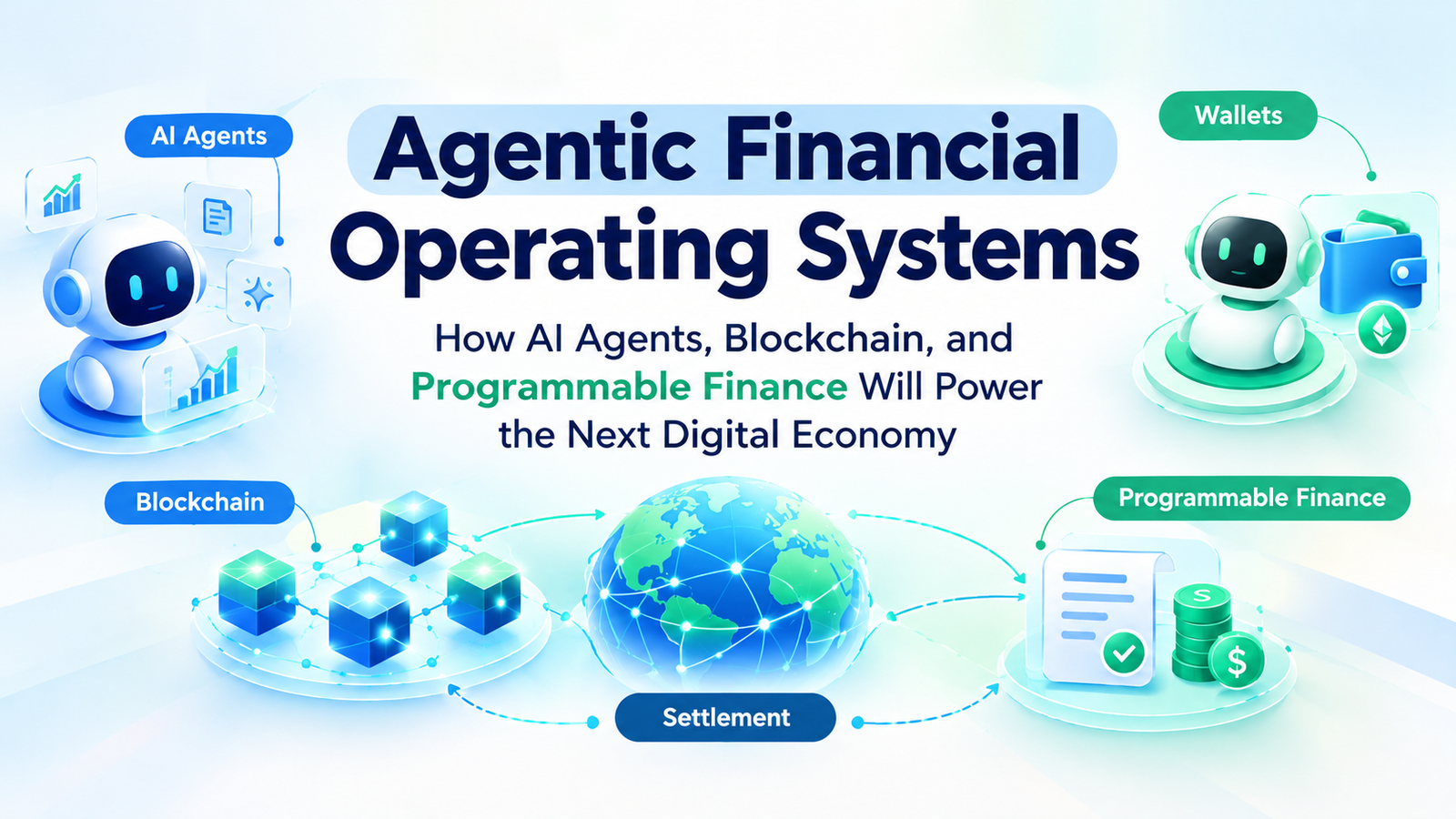
The global digital economy is transitioning from human-directed software interfaces to autonomous financial operating platforms. An Agentic Financial Operating System represents a unified software architecture where artificial intelligence agents independently discover commercial opportunities, evaluate counterparty risks, negotiate contractual terms, authorize transactions, and clear payments with minimal human intervention. Rather than acting as static dashboards or rigid workflow automation tools, these systems pair probabilistic reasoning engines with deterministic blockchain networks and machine-payable settlement infrastructure.
This technological paradigm is driven by the convergence of multi-step AI reasoning frameworks, verifiable open identity standards such as Ethereum proposal ERC-8004, and machine-native payment protocols like HTTP 402 payment flows. By combining scoped digital wallets with cryptographic validation mechanisms including Trusted Execution Environments and zero-knowledge proofs, agentic financial architectures allow software entities to act as direct economic participants. While early commercial implementations focus on cloud compute procurement, data licensing, and treasury operations, corporate adoption depends on resolving key security challenges around transaction reversibility, Sybil-resistant reputation scoring, and legal liability frameworks.
Key Takeaways
- An Agentic Financial Operating System integrates artificial intelligence, cryptographic identity registries, and programmable payment rails to enable software entities to execute economic transactions within predefined parameters.
- The evolution from traditional enterprise financial tools to agentic platforms shifts the operational burden of discovery, negotiation, and settlement from human professionals to goal-driven software agents.
- The Ethereum ERC-8004 proposal establishes standardized on-chain registries for Identity, Reputation, and Validation, enabling agents to establish cross-platform trust without vendor lock-in.
- Protocols like Coinbase x402 utilize the HTTP 402 status code to create web-native micro-payment mechanisms for data queries, specialized compute resources, and software APIs.
- Decentralized intellectual property platforms, such as Story Protocol and Camp Network, supply machine-readable licensing models that permit AI agents to purchase, monetize, and distribute digital rights programmatically.
- Enterprise risk management in agentic finance relies on external deterministic guardrails, including strict budget caps, destination allowlists, enclave attestations, and escrow settlement mechanisms.
Introduction
The next evolution of financial technology may not be another banking app, crypto wallet, or AI-powered dashboard. It could be an entirely new kind of software: an agentic financial operating system that enables autonomous AI agents to discover opportunities, negotiate agreements, manage digital assets, execute transactions, and settle payments with minimal human intervention.
Imagine a business deploying an AI agent to find the best cloud computing provider. The agent compares prices, negotiates usage terms with a supplier’s agent, verifies the agreement, authorizes payment from a controlled digital wallet, and settles the transaction after the service is delivered. Both parties operate within predefined rules, while humans retain control over budgets, permissions, and exceptional decisions.
This is the promise of combining AI agents with blockchain infrastructure and programmable finance. The underlying technologies are developing at different speeds, and a fully autonomous financial economy remains a work in progress. But the foundations are beginning to take shape.
What is an agentic financial operating system?
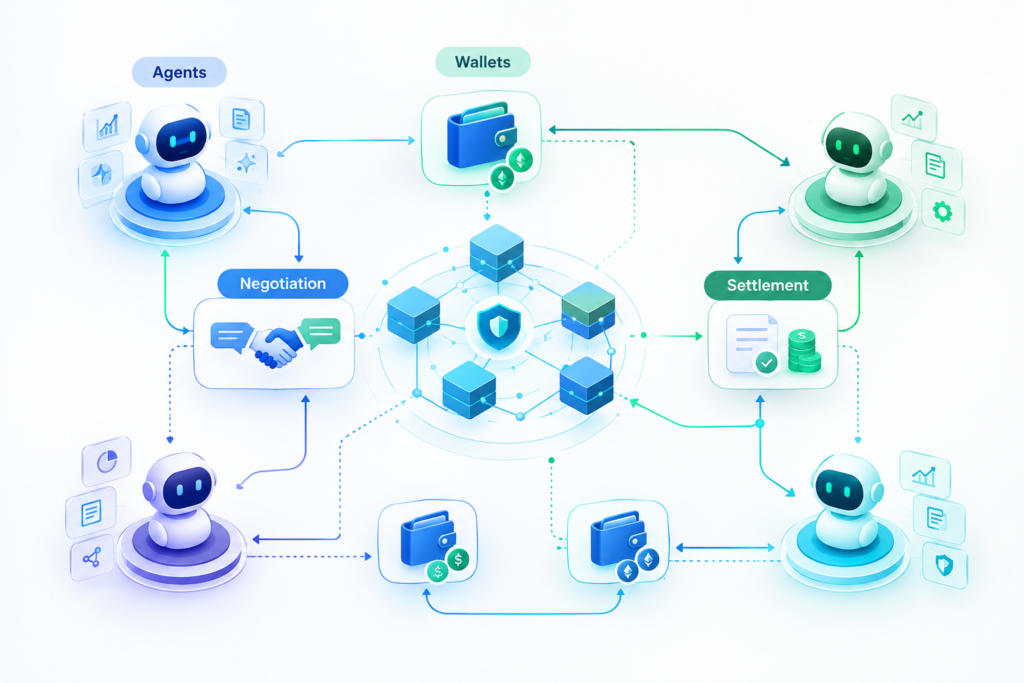
An agentic financial operating system (AFOS) is a software layer that coordinates AI agents, financial accounts, digital assets, business rules, payment systems, and programmable contracts to execute economic activities.
Unlike a conventional financial dashboard, which primarily displays information, or a traditional workflow tool, which follows predefined steps, an agentic system can interpret objectives, plan actions, use tools, interact with other agents, and adapt its decisions within defined permissions.
For example, a company could instruct its procurement agent to source a cloud computing service for less than $5,000 per month, maintain a minimum reliability standard, and avoid providers that fail its security requirements.
The agent could then:
- Discover and evaluate eligible providers.
- Compare prices, service quality, and contractual terms.
- Negotiate with supplier agents within authorized limits.
- Verify the supplier and establish a contract.
- Authorize payment through an approved financial rail.
- Monitor delivery and reconcile the final invoice.
The system would maintain a record of decisions, approvals, agreements, and transactions.
The crucial distinction is that the human specifies the objective and boundaries, while the agent handles the execution within those boundaries.
Visa’s explanation of agentic commerce similarly distinguishes agents that merely recommend purchases from agents that can complete transactions under user-defined rules. Blockchain-based approaches extend this concept to programmable assets, open agent networks, and automated settlement.
How it differs from existing financial software
| Capability | Traditional financial software | Agentic financial operating system |
|---|---|---|
| Decision-making | Primarily human-directed | AI-assisted or autonomous within limits |
| Workflows | Rules and predefined processes | Goal-driven planning and execution |
| Negotiation | Human-led communication | Agent-to-agent negotiation |
| Payments | User or system-initiated | Agent-initiated under authorization |
| Contracts | Stored and processed through workflows | Terms can trigger programmable execution |
| Coordination | Applications and departments | Agents, applications, and organizations |
| Oversight | Reviews and approvals | Continuous controls, audit trails, and escalation |
These categories are not mutually exclusive. Existing enterprise systems can already automate transactions and use AI. The emerging opportunity is to combine reasoning, interoperable agents, financial authorization, and verifiable execution into a coherent operating layer.
Why the convergence matters now
Three technology shifts are coming together.
AI agents: From answering to acting
AI systems are becoming better at planning multistep tasks, using external tools, processing information, and coordinating specialized agents. This creates the intelligence and orchestration layer for autonomous workflows.
Blockchain: From recording ownership to programmable coordination
Smart contracts can enforce supported rules, record transactions, and coordinate asset transfers across participants who may not share the same organization or infrastructure. Tokenized assets can also carry programmable rights and restrictions.
Programmable finance: From manual payments to machine-readable transactions
APIs, stablecoins, digital wallets, and existing payment networks provide ways to authorize and move value. The emerging challenge is allowing software to use these rails safely, with clear limits, identity, and accountability.
The combination matters because autonomous decision-making is useful only when an agent can act. Acting becomes commercially valuable when it can establish agreements, exchange services, pay counterparties, and verify outcomes.
There is tangible infrastructure development behind this thesis. Coinbase introduced the x402 protocol in May 2025 to support internet-native payments, including stablecoin payments for APIs and AI agents. Ethereum’s ERC-8004 proposal addresses agent discovery and trust across organizational boundaries. Visa is developing infrastructure for secure, authorized agent-initiated commerce. These are different approaches to the same broader challenge: enabling software to participate in economic activity.
This does not mean a completely autonomous financial economy already exists. The infrastructure is developing, and important issues around interoperability, security, legal authority, and real-world payment settlement remain unresolved.
The architecture of an agentic financial operating system
An effective AFOS requires more than an LLM connected to a crypto wallet. It needs distinct layers for reasoning, identity, communication, authorization, execution, and financial control.
- User and Business Intent: Objectives, budgets, policies, permissions, and risk limits
- Agent Intelligence and Orchestration: Planning, specialized agents, research, negotiation, and decision-making
- Identity, Trust and Authorization: Agent identity, reputation, verified counterparties, permissions, and approvals
- Contracts and Financial Execution: Digital wallets, smart contracts, APIs, payment rails, and settlement
- Verification and Audit: Transaction records, delivery verification, reconciliation, dispute handling, and monitoring
Layer 1: Agent intelligence and orchestration
The intelligence layer converts business objectives into executable plans. It assigns tasks to specialized agents, evaluates options, handles exceptions, and determines when human approval is required.
For example, a financial operating system could deploy separate agents for market research, due diligence, financial modelling, counterparty screening, and payment preparation.
An orchestration engine coordinates these agents, maintains workflow state, and ensures that decisions made by one agent are consistent with the overall objective.
Layer 2: Identity and trust
If agents from different companies are expected to transact, each party needs a way to establish who an agent represents, what it can do, and how its performance can be assessed.
The Ethereum ERC-8004 proposal addresses this problem through identity, reputation, and validation registries. It is designed to help agents discover and interact with one another across organizational boundaries, including environments where there is no pre-existing trust relationship.
An identity alone, however, does not establish that an agent is honest or competent. A production system also needs authentication, authorization, independent validation, and risk-sensitive trust policies.
Layer 3: Wallets and delegated financial authority
An autonomous agent needs a safe way to access financial resources without gaining unrestricted control over its owner’s assets.
An agent-enabled wallet could support:
- Spending limits per transaction, day, or counterparty.
- Restrictions on supported assets and payment destinations.
- Temporary permissions and revocable credentials.
- Separate wallets or accounts for individual agents.
- Multisignature or human approval for high-value transactions.
- Automated monitoring, alerts, and emergency suspension.
The critical design principle is delegated authority, not unrestricted custody. An agent should receive only the permissions required to complete its task.
Layer 4: Programmable contracts and settlement
Smart contracts can encode supported commercial terms, such as payment amounts, revenue-sharing percentages, licensing permissions, or conditions for releasing funds.
Payment infrastructure then allows agents to purchase services, pay counterparties, and settle transactions. Depending on the use case, this might involve stablecoins, conventional payment networks, bank APIs, or tokenized deposits.
Blockchain is useful where shared state, programmable asset ownership, or coordination between independent parties adds value. It is not necessary for every workflow, and it cannot independently verify every off-chain event.
Layer 5: Verification and auditability
An agent should not treat its own claim that a task is complete as sufficient evidence for payment.
The operating system needs to verify deliverables, reconcile invoices, retain evidence, and handle disputes. For example, payment for cloud computing could depend on metered usage, while payment for a research report might require delivery and acceptance checks.
This layer connects autonomous execution to accountability, which is essential for business adoption.
Agent-to-agent commerce: When software becomes an economic participant
The most important shift is from a person using an AI assistant to a network of agents that transact directly with one another.
In conventional commerce, a buyer discovers a seller, negotiates terms, signs an agreement, and initiates payment. Even when software automates parts of this process, human-designed workflows often remain central.
In agent-to-agent (A2A) commerce, the buyer’s agent and seller’s agent can communicate, exchange proposals, evaluate constraints, negotiate terms, and coordinate execution.
This is not simply two chatbots talking to each other. A commercially useful system needs machine-readable offers, verifiable authority, enforceable agreements, payment mechanisms, and a way to resolve failed transactions.
An example: Two agents negotiate a service contract
Step 1. Buyer agent
Receives a task to procure a service within a budget, quality threshold, and delivery deadline.
Step 2. Discovery and evaluation
Finds supplier agents, verifies their capabilities, compares offers, and screens for risk.
Step 3. Negotiation
The buyer agent proposes a price and service terms. The supplier agent counters with its own conditions until they reach an acceptable agreement or stop negotiating.
Step 4. Agreement and authorization
The system records the accepted terms, checks spending permissions, and creates the appropriate contractual or payment instructions.
Step 5. Delivery and settlement
The service is delivered, the required evidence is checked, and payment is released according to the agreement.
This model could support procurement, cloud infrastructure, data access, software subscriptions, financial research, digital advertising, and licensing of intellectual property.
Story Protocol: Programmable intellectual property for AI agents
Story Protocol provides a particularly relevant example of how this model could work.
Story is designed to register intellectual property on-chain and attach programmable licensing terms. Its infrastructure includes licensing and royalty mechanisms, allowing rights and revenue-sharing rules to be represented in software. Its documentation also explains how IP assets and license terms can be used by AI agents and other applications.
Story’s whitepaper describes an agent-to-agent IP transaction in which agents formulate and counterpropose terms, mint a license, process payment, and deliver the licensed intellectual property. It presents this as a framework for agents to exchange assets such as training data, proprietary algorithms, and creative content.
Consider a practical example:
- A content-generation agent needs permission to use a licensed character.
- The rights-holder’s agent specifies the permitted uses, fee, and revenue-sharing conditions.
- The two agents negotiate within their owners’ authorization limits.
- A license is issued, and payment is processed.
- If the resulting content earns revenue, the applicable royalty rules determine how the money is distributed.
This creates a potential market in which intellectual property can be discovered, licensed, and monetized programmatically rather than through lengthy manual negotiations for every transaction.
There is an important qualification: on-chain licensing and royalty automation do not automatically resolve every copyright dispute, establish ownership of every asset, or guarantee that all off-chain uses comply with the license.
Camp Network: Verifiable IP in an AI-driven economy
Camp Network approaches a related opportunity by positioning itself as an IP layer for AI agents and user-owned intellectual property.
Its stated focus is on enabling creators to own and monetize IP and allowing AI agents to work with user-owned IP through a verifiable registry.
The broader opportunity is to make data, models, creative works, and other digital assets usable under explicit ownership and licensing rules.
For example, a specialist agent could license a dataset to another agent, charge for permitted access, and participate in a revenue-sharing arrangement if the resulting product is commercialized. The exact commercial workflow depends on the implementation and applicable license, but the direction is clear: IP can become a programmable economic resource for autonomous software.
Story and Camp illustrate the IP layer of the agent economy. An agentic financial operating system could sit above such infrastructure, coordinating discovery, commercial negotiation, authorization, payment, and reporting across multiple protocols.
The emerging infrastructure stack
No single protocol currently provides everything required for a complete agentic financial operating system. Different standards and networks address different parts of the problem.
| Technology | Primary role | Relevance to an AFOS |
|---|---|---|
| MCP | Connects AI applications to tools and data sources | Gives agents access to business and financial systems |
| A2A | Enables communication and task coordination between agents | Supports negotiation and collaboration across organizations |
| ERC-8004 | Agent identity, reputation, and validation registries | Helps agents discover and assess unfamiliar counterparties |
| x402 | Internet-native payment protocol using HTTP payment flows | Enables agents to pay for APIs, software, and other digital services |
| Smart contracts | Programmable execution of on-chain rules | Supports licensing, revenue sharing, and conditional transfers |
| Story / Camp | Infrastructure for IP ownership and monetization | Enables programmable rights and potential agent-to-agent IP markets |
| Conventional payment rails | Card payments, bank transfers, and established financial infrastructure | Connects agentic workflows to existing commerce |
These technologies are complementary rather than interchangeable. MCP and A2A focus on interaction and coordination, ERC-8004 focuses on agent discovery and trust, and x402 focuses on payments. Smart contracts and IP-specific networks add programmable asset and rights-management capabilities.
x402: Making the internet machine-payable
x402 is an open payment protocol introduced by Coinbase in May 2025. It uses the HTTP 402 “Payment Required” concept to support payments directly within web interactions.
A service can request payment for an API call or digital resource, and a compatible client or agent can complete the payment flow. Coinbase describes support for stablecoin payments and automatic settlement through existing web infrastructure.
This matters because agents often need to make many small purchases rather than a few large ones. A research agent might pay for individual data queries, while a development agent might purchase compute or access a specialized software API.
Traditional payment methods are not always economical for tiny, frequent transactions. In its July 2026 analysis, Visa described machine-to-machine micro-commerce as an important use case for newer payment protocols, while also highlighting unresolved issues around trust, liability, and disputes.
The key insight is that payments become part of the software interaction itself, not a separate checkout process designed exclusively for human users.
High-potential use cases
The most promising early applications are likely to be workflows where the buyer, seller, deliverable, and payment can be clearly defined and verified.
Autonomous procurement
Buyer agents compare suppliers, negotiate pricing, check contract requirements, and prepare purchase orders. Businesses retain approval controls for high-value purchases while routine procurement becomes more autonomous.
Machine-to-machine services
Software agents purchase compute, data, API access, and specialized services as needed. Usage-based pricing and micropayments could make it practical to pay for individual calls or short-lived resources.
AI data and IP marketplaces
Agents discover datasets, models, and creative assets, negotiate usage rights, and process licensing fees or royalties. This is a natural area for programmable IP infrastructure such as Story and Camp.
Financial research and treasury operations
Agents monitor cash requirements, compare funding options, prepare forecasts, reconcile transactions, and recommend treasury actions. Execution can be restricted to approved accounts, limits, and policies.
Cross-border digital commerce
Agents could coordinate suppliers, currencies, invoicing, compliance checks, and settlement across jurisdictions. Stablecoins may be useful in some corridors, but local regulations, conversion, and off-ramp access remain important.
Private equity and venture capital operations
Agents collect portfolio data, prepare investment memos, track covenants, reconcile fund information, and coordinate reporting. Over time, specialized agents could exchange approved services under explicit budgets and confidentiality constraints.
The private markets use case is especially interesting because financial firms already coordinate many specialized workflows across investment teams, portfolio companies, administrators, and external service providers. An agentic operating system could connect these workflows while maintaining permissions and auditability.
However, high-stakes financial decisions should not be fully delegated simply because the underlying process can be automated. Investment decisions, credit approvals, and regulated activities require additional controls appropriate to their risk.
The business opportunity: Building the operating system, not another agent
As more specialized agents emerge, the market may need a coordination layer that makes them useful together.
A standalone agent can solve a specific task. An operating system can coordinate many agents, manage shared context, enforce policies, connect financial infrastructure, and provide a unified record of business activity.
This creates several potential business models.
| Business model | What the product provides | Potential customers |
|---|---|---|
| Agent orchestration platform | Workflow planning, agent coordination, and monitoring | Enterprises and developers |
| Agent wallet and authorization infrastructure | Scoped spending, credentials, policy enforcement, and payment controls | Agent platforms, fintechs, and businesses |
| Agent discovery and trust network | Identity, reputation, verification, and service discovery | Developers and agent marketplaces |
| Programmable contract infrastructure | Agreement templates, licensing, execution, and revenue sharing | Digital marketplaces and IP owners |
| Agentic financial operating system | Integrated workflows, financial controls, execution, and reporting | Enterprises, funds, and fintechs |
The greatest opportunity may lie in integrating these capabilities for a specific customer segment rather than attempting to build every component from scratch.
For example, a private markets platform could begin with AI-driven financial analysis and workflow automation, add policy-controlled financial actions, and later integrate agent-to-agent procurement and settlement. This creates a practical adoption path while building toward a more comprehensive operating system.
Why vertical-first could win
A general-purpose agent economy is difficult to launch because every participant needs compatible interfaces, trusted counterparties, clear incentives, and reliable execution.
A vertical product can avoid much of this initial coordination problem by focusing on a defined workflow with identifiable buyers and sellers.
Private equity, digital IP licensing, cloud infrastructure procurement, and financial data services are potential starting points because they involve repeatable processes and measurable economic value.
The long-term vision can be broad, but the initial product should solve a specific problem well enough that customers will pay for it.
The hardest problems to solve
The future of agentic finance will depend less on agents being able to generate persuasive language and more on whether they can act reliably within real-world constraints.
Security and delegated authority
An agent can be manipulated by malicious instructions, compromised tools, deceptive counterparties, or faulty model outputs. If it also has access to money, the consequences can extend beyond incorrect answers.
Financial permissions should therefore be enforced outside the language model itself. Transaction limits, destination allowlists, independent policy checks, and revocable access should be applied by trusted execution systems.
Identity, reputation, and Sybil attacks
An agent’s declared identity is not proof of its reliability. Reputation systems can also be manipulated through fake accounts, collusion, and fabricated feedback.
Networks need stronger verification mechanisms, risk-based trust models, and ways to validate performance independently. ERC-8004 explicitly identifies identity, reputation, and validation as separate concerns.
Negotiation and economic incentives
Two agents can negotiate successfully in a technical sense while still reaching a commercially poor outcome.
Agents may optimize different objectives, exploit loopholes, or be manipulated by counterparties. Their owners need to specify acceptable ranges, prohibited terms, reservation prices, and escalation conditions.
Negotiation should produce structured, reviewable terms rather than relying on conversational agreement alone.
Settlement, reversibility, and disputes
Blockchain transactions can be difficult or impossible to reverse once confirmed. Meanwhile, a service may be delivered incorrectly, an invoice may be fraudulent, or a transaction may be authorized by a compromised agent.
A robust operating system needs dispute mechanisms, conditional execution where appropriate, transaction evidence, and clear rules for refunds or compensation. Not every financial flow should be an immediate, irreversible on-chain transfer.
Legal responsibility and compliance
An AI agent does not automatically become a legally responsible financial actor simply because it has a wallet or blockchain identity.
The authority to bind a person or company, the enforceability of digital agreements, data protection, licensing, anti-money-laundering obligations, and liability for errors depend on the jurisdiction and the specific transaction.
The Bank for International Settlements has also highlighted risks associated with programmable and tokenized financial systems, including operational fragility, interconnectedness, opaque dependencies, and governance. These risks become especially relevant when autonomous software can initiate transactions at scale.
Interoperability and reliability
Agents may use different models, communication protocols, identity systems, and payment networks. A financial operating system must bridge these differences without losing transaction context or weakening security.
It also needs deterministic components for critical operations. AI can interpret objectives and propose actions, but balances, authorization checks, contractual conditions, and settlement instructions should be validated by systems designed to enforce exact rules.
A practical roadmap for building an agentic financial operating system
Building a complete agentic economy in one step would be too ambitious. A more credible approach is to progress from assisted workflows to controlled execution and, eventually, interoperable agent commerce.
Phase 1: Automate decisions and workflows
Begin with one vertical use case. Let agents research, analyze, prepare transactions, and coordinate work, while humans approve consequential actions.
Goal: Prove customer value, reliability, and willingness to pay.
Phase 2: Introduce policy-controlled financial actions
Connect wallets, bank APIs, or existing payment rails. Implement scoped permissions, spend limits, approval thresholds, monitoring, and auditable transaction records.
Goal: Move from recommendations to controlled execution.
Phase 3: Enable trusted agent-to-agent transactions
Introduce agent discovery, structured offers, negotiation, contractual terms, and settlement for a defined set of counterparties.
Goal: Demonstrate that independent agents can complete valuable transactions safely.
Phase 4: Build a broader financial agent network
Expand interoperability, reusable agent identities, programmable agreements, reputation, and cross-platform settlement. Support additional industries and financial workflows as the trust infrastructure matures.
Goal: Make the platform useful beyond a single application or marketplace.
The critical milestones should be measurable: successful task completion, transaction failure rates, cost per completed workflow, unauthorized-action prevention, dispute frequency, customer retention, and economic value delivered.
A platform should not be considered autonomous simply because it can initiate a transaction. It must also demonstrate that it can do so correctly, within its authority, and with a reliable mechanism for handling failures.
What the next 5–10 years could look like
The most likely path is gradual rather than a sudden transition to fully autonomous finance.
In the near term, agents are likely to handle bounded tasks such as purchasing digital services, processing invoices, comparing financial products, and coordinating business workflows. Human authorization and conventional payment systems will remain important.
As interoperability improves, agents may increasingly transact with other agents without requiring a human to approve every routine step. Identity and trust standards could make it easier to discover counterparties, while machine-native payment protocols could enable low-value, high-frequency transactions.
Over a longer horizon, programmable IP, tokenized assets, stablecoins, and smart contracts could support markets in which agents purchase data, license models, share revenue, and coordinate complex services across organizations.
A company might deploy agents for procurement, treasury, compliance, research, and customer operations, each with its own delegated authority. Those agents could work with external agents while the company’s financial operating system manages budgets, permissions, risk, and reporting.
This future is plausible, but its pace will depend on measurable economic benefits, reliable security, regulatory clarity, and the willingness of businesses to delegate meaningful authority.
The key question is not whether every financial transaction will move on-chain. It is whether financial systems will become sufficiently programmable and interoperable for software to participate directly in economic activity.
Recommended Readings
- Future Money: Fintech, AI and Web3 by Ronit Ghose
- Understanding DeFi by Alexandra Damsker
- The AI Book: The Artificial Intelligence Handbook for Investors, Entrepreneurs, and FinTech Visionaries by Ivana Bartoletti, Anne Leslie, and Shân M. Millie
- Artificial Intelligence in Finance by Yves Hilpisch
- Bank 4.0: Banking Everywhere, Never at a Bank by Brett King
Frequently Asked Questions (FAQs)
What is the primary difference between an AI agent and an Agentic Financial Operating System?
An AI agent is an individual software component that processes information, formulates plans, and uses tools. An Agentic Financial Operating System is the broader enterprise infrastructure that provides policy guardrails, cryptographic identities, delegated financial authority, smart contract escrows, settlement options, and unified audit trails across multiple agents.
How does an agentic financial architecture protect against AI hallucinations or unexpected decisions?
The system isolates non-deterministic language models from direct monetary control. All financial transactions generated by agents must pass through external, deterministic risk engines that enforce hard programmatic rules, such as daily spending limits, pre-approved destination allowlists, transaction caps, and multi-signature human escalation triggers.
What problem does the Ethereum ERC-8004 proposal solve?
ERC-8004 (Trustless Agents) solves the cross-platform discovery and trust challenge. It establishes three standardized on-chain registries (Identity, Reputation, and Validation) that give agents portable identifiers, queryable feedback histories, and verifiable execution proofs that work across different networks without vendor lock-in.
How does the x402 protocol enable payments for autonomous software?
The x402 protocol utilizes the reserved HTTP 402 “Payment Required” status code. When an agent requests access to a paid web resource, the server returns payment parameters. The agent completes a stablecoin transfer, includes the transaction receipt in the HTTP header, and accesses the resource instantly without manual checkout forms.
Are commercial contracts negotiated by AI agents legally binding on a business?
Contracts negotiated programmatically generally bind the operating business under established agency principles and contract law. However, establishing legal liability for unexpected software behavior remains complex, which is why enterprise implementations use standardized smart contract escrows and explicit legal framework templates.
Conclusion: From AI assistants to autonomous economic infrastructure
The convergence of AI agents, blockchain, and programmable finance opens the possibility of a new software category: the agentic financial operating system.
AI agents provide reasoning and execution. Identity and trust infrastructure help participants discover and assess one another. Wallets and payment protocols enable the exchange of value. Smart contracts can automate supported commercial terms, while audit and policy systems maintain accountability.
Projects such as Story, Camp Network, x402, and ERC-8004 illustrate different pieces of this emerging landscape. None alone constitutes a complete financial operating system, but together they help explain the direction in which the infrastructure is evolving.
The strongest opportunity is not to give every AI agent unrestricted access to money. It is to build systems that allow agents to negotiate and transact autonomously within clear financial, contractual, and security boundaries.
If these systems become reliable enough for real commercial use, AI agents could evolve from productivity tools into participants in a programmable digital economy. The operating system that connects their intelligence to trusted economic execution could become a foundational layer of that economy.





Leave a Reply