

TL;DR
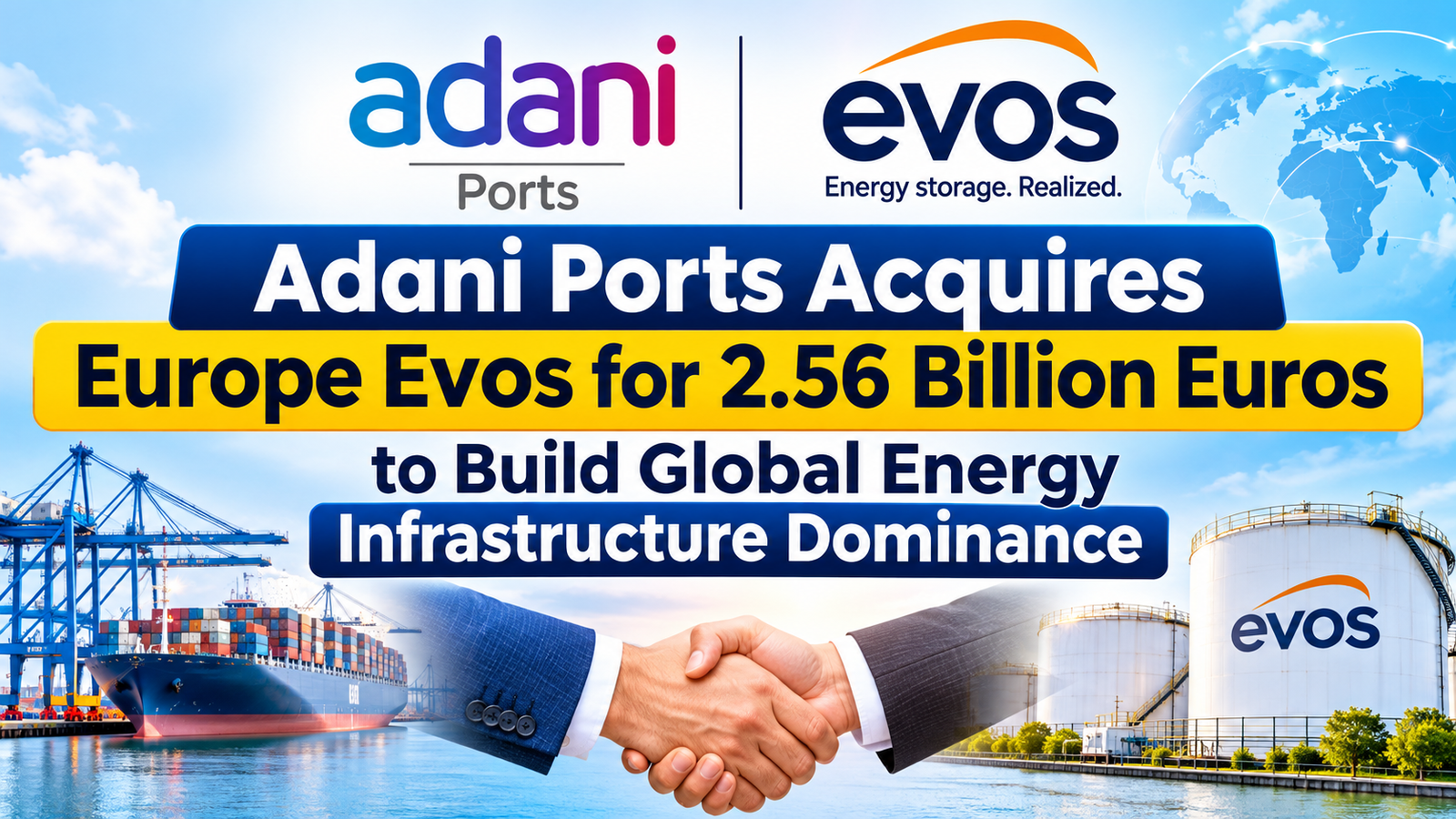
Adani Ports and Special Economic Zone Limited (APSEZ) has reached a definitive agreement to acquire 100% of Netherlands-based tank storage operator Evos B.V. from Igneo Infrastructure Partners. The deal carries an enterprise value of €2.56 billion (approximately $2.88 billion) and an equity consideration of €1.18 billion. Structured as an all-cash, debt-funded transaction underwritten by MUFG Bank, the acquisition adds eight terminal locations across five European nations to APSEZ’s expanding global network. Anchored by a 99% commercial occupancy rate, CPI-linked contracts, and an EBITDA margin of 56%, Evos gives APSEZ an immediate European platform to capture high-margin liquid logistics cash flows while building vital trade corridors for sustainable aviation fuel, green methanol, and hydrogen derivatives.
Key Takeaways
- Transaction Scale: APSEZ acquires 100% equity in Evos B.V. at an enterprise value of €2.56 billion ($2.88 billion) and an equity value of €1.18 billion ($1.33 billion), implying an 11.7x CY25 EV/EBITDA multiple.
- Financing Underwriting: The acquisition is fully funded via debt facilities, backed by a €2.8 billion underwriting commitment from Japanese financial group MUFG.
- Operational Scope: Adds 6.3 million cubic meters of liquid storage capacity across 452 tanks, 63 vessel berths, and deep pipeline links to airports and industrial grids.
- European Footprint: Expands APSEZ from 20 to 28 ports and terminals globally across 10 countries, adding key European sites in Rotterdam, Amsterdam, Terneuzen, Hamburg, Ghent, Algeciras, and Malta.
- Earnings Profile: Evos generated €392 million in revenue and €219 million in EBITDA in CY25, operating at a 56% EBITDA margin with an 83% cash conversion rate.
- Energy Transition Hedge: Positions APSEZ within European green fuel networks, supporting the expansion of sustainable aviation fuels, biofuels, and methanol, which are projected to reach 50% of Evos’s product mix.
- Capital Cost Optimization: APSEZ will utilize Euro debt facilities at approximately 4.5% to refinance existing debt, lowering financing costs compared to domestic Indian Rupee rates while creating a natural currency hedge.
Introduction
Global maritime trade and energy logistics are entering a critical phase of structural realignment. Geopolitical shifts, regulatory pressures from climate policies, and evolving trade routes are forcing infrastructure developers to look beyond traditional transshipment channels. In a bold strategic move, India’s largest private port developer, Adani Ports and Special Economic Zone Limited (APSEZ), has signed an agreement to acquire 100% of Dutch liquid storage giant Evos B.V. from Igneo Infrastructure Partners.
Valued at an enterprise value of €2.56 billion, the transaction represents APSEZ’s largest cross-border deal in Europe. The purchase extends the company’s operational footprint into Western Europe’s industrial core, bringing its global operations to 28 ports and terminals across 10 countries. Beyond increasing raw liquid storage volume, the deal places APSEZ at the intersection of traditional liquid energy transport and Europe’s fast-accelerating green energy transition.
By taking control of deepwater liquid terminals in the Amsterdam-Rotterdam-Antwerp (ARA) hub, Germany, Belgium, Spain, and Malta, APSEZ secures immediate access to blue-chip international customers. The platform combines high-margin financial stability with significant long-term strategic optionality, positioning APSEZ as a multi-regional logistics operator capable of managing energy flows between emerging production centers in Asia and major consumption hubs across Europe.
Transaction Blueprint and Financial Structuring
The structural mechanics of the acquisition reflect a disciplined approach to balance sheet management and deal execution. APSEZ is acquiring full equity control of Evos B.V. for an equity consideration of €1.18 billion, bringing the overall enterprise value to €2.56 billion after incorporating existing net debt. The purchase price implies an acquisition valuation of 11.7x CY25 EV/EBITDA, aligning with historic valuation benchmarks for high-occupancy, infrastructure-grade European terminal assets.
| Financial and Deal Parameter | Transaction Metric / Detail |
| Target Company | Evos B.V. (Netherlands) |
| Selling Entity | Igneo Infrastructure Partners |
| Enterprise Value (EV) | €2.56 billion ($2.88 billion) |
| Equity Consideration | €1.18 billion ($1.33 billion) |
| Implied Valuation Multiple | 11.7x CY25 EV/EBITDA |
| CY25 Financial Performance | Revenue: €392 million | EBITDA: €219 million |
| EBITDA Margin Profile | 56% EBITDA Margin |
| Financing Structure | All-cash offer funded entirely through Euro debt facilities |
| Sole Underwriter | MUFG Bank (Commitment up to €2.8 billion) |
| Legal Advisors | Linklaters (International), Cyril Amarchand Mangaldas (Domestic) |
To execute the acquisition without drawing down domestic cash balances or diluting equity, APSEZ secured sole underwriting commitment for up to €2.8 billion from Japanese banking partner MUFG. This facility covers both equity purchase obligations and potential debt refinancing needs. The deal is structured as an all-cash purchase, insulating domestic capital expenditure initiatives while providing the financial certainty required for overseas completion.
Completion of the deal is expected within 15 months of the November 2026 signing. Closing conditions require standard regulatory clearances across European national jurisdictions, antitrust reviews, and formal consultation processes with European works councils representing local terminal employees.
Asset Infrastructure and European Operational Footprint
Evos B.V. functions as Europe’s second-largest independent liquid storage business, operating a dense network of high-throughput facilities strategically situated along Western Europe’s most active maritime corridors. The company’s asset portfolio encompasses 6.3 million cubic meters of liquid storage capacity spread across eight port terminals located in seven major commercial harbors.
Detailed Port Network and Location Profile
The geographical alignment of Evos assets provides direct access to primary industrial and commercial consumer markets across Western Europe and the Mediterranean. Four key facilities are concentrated in the Netherlands, providing deep operational integration within the Amsterdam-Rotterdam-Antwerp region.
| Terminal Location | Host Nation | Strategic Role and Logistics Infrastructure |
| Amsterdam East | Netherlands | Liquid energy hub handling conventional fuels and expanding biofuel streams. |
| Amsterdam West | Netherlands | Specialized aviation fuel facility connected directly to Schiphol Airport. |
| Rotterdam | Netherlands | Prime position in Europe’s largest port; chemical and refined product storage. |
| Terneuzen | Netherlands | Positioned in the Schelde delta region; focused on industrial chemicals. |
| Hamburg | Germany | Key gateway serving Northern European, Baltic, and inland German industrial markets. |
| Ghent | Belgium | Integrated within North Sea Port; handles chemical and renewable energy feedstocks. |
| Algeciras | Spain | Mediterranean transshipment node positioned at the Strait of Gibraltar shipping lanes. |
| Malta Terminal | Malta | Strategic central Mediterranean transshipment, marine fueling, and storage platform. |
Logistics Integration and Intermodal Connectivity
The operational strength of Evos relies on its deep integration with intermodal distribution networks. Across its terminal network, the company operates 452 tank structures designed for a wide range of liquid products, including gasoline, gasoil, jet fuel, marine fuels, and high-value chemical products. Marine transfer operations are supported by 63 vessel and barge berths, facilitating rapid ship-to-ship transfers, import discharge, and inland waterway distribution.
In addition to maritime logistics, Evos is directly linked to Western Europe’s pipeline infrastructure. Certain terminals maintain operational connections to the Central Europe Pipeline System (CEPS), providing high-volume distribution channels across European domestic fuel grids. Furthermore, the dedicated jet fuel infrastructure at Amsterdam West feeds directly into the supply pipeline servicing Amsterdam Airport Schiphol, making Evos an essential component of Northern Europe’s aviation fuel supply chain.
Strategic Rationale and Revenue Resilience
The decision to acquire Evos aligns with APSEZ’s goal of building a resilient, globally diversified infrastructure platform. By adding high-margin liquid storage assets outside India, the company reduces geographical revenue concentration while securing steady, utility-like income streams.
Contractual Protection and Cash Flow Quality
Evos operates under long-term contract structures that protect earnings from short-term fluctuations in trade volumes or commodity prices. Commercial occupancy across its network averages 99%, underpinned by long-term take-or-pay agreements with major global energy companies, international chemical producers, and commodity trading firms. Under take-or-pay terms, clients pay guaranteed reservation fees for tank capacity regardless of actual product throughput, ensuring high revenue stability.
These customer contracts feature built-in price escalation provisions tied to European Consumer Price Index metrics, establishing automatic protection against inflationary operating cost pressures. In CY25, Evos generated €392 million in revenue and €219 million in EBITDA, representing an EBITDA margin of 56%. This margin outpaces APSEZ’s existing international ports portfolio, which generated an EBITDA margin of 44.8% during the first half of FY27. Furthermore, Evos delivers strong cash conversion performance, translating 83% of its EBITDA directly into operating cash flow.
Operating Efficiency and Capital Returns
APSEZ plans to leverage its operational expertise to increase financial productivity across the acquired asset base. Evos currently operates at a Return on Capital Employed (ROCE) of approximately 7%. APSEZ management aims to increase this return profile to double-digit levels within two to three years.
This target will be pursued through operational mix optimization rather than aggressive greenfield expansion. Key initiatives include repurposing underutilized storage tanks for higher-margin specialty products, accelerating tank turnover rates, and introducing inline chemical blending, heating, and thermal management services. The platform’s real estate foundation provides long-term stability, with underlying port land secured through freehold titles or extended leasehold agreements, some of which run through 2092.
Capitalizing on Europe’s Sustainable Energy Transition
European decarbonization mandates, such as the European Union’s Renewable Energy Directive (RED III) and ReFuelEU Aviation rules, are driving a structural migration from conventional fossil fuels to renewable energy carriers. Evos has actively built out its handling capabilities for transition products, expanding its storage capacity for non-fossil fuels and sustainable chemicals to 1.7 million cubic meters by 2024.
Between 2019 and 2024, the share of sustainable fuels and chemicals in Evos’s total storage mix grew from 13% to 27%. Over the next 15 to 20 years, sustainable products are expected to reach 50% of Evos’s total managed volume.
This transition presents a substantial long-term growth opportunity for APSEZ. As green hydrogen derivatives, sustainable aviation fuels, bio-methanol, and ammonia are produced at scale in Asia and the Middle East, Evos’s deepwater European terminals will serve as ideal import and distribution hubs. Owning these critical reception nodes allows APSEZ to participate directly in the emerging global trade of zero-carbon fuels.
Balance Sheet Integration and Debt Refinancing
Executing an international acquisition of this magnitude requires careful balance sheet management to protect corporate credit ratings and prevent currency mismatches. APSEZ’s financing plan directly addresses both capital costs and currency risks.
Euro-Denominated Debt Refinancing and Currency Matching
At the time of the transaction announcement, Evos carried approximately €1.43 billion in gross debt and €1.37 billion in net debt, representing a net leverage ratio of roughly 6.0x net debt to EBITDA. APSEZ plans to restructure Evos’s capital stack by refinancing existing debt with new Euro-denominated corporate facilities.
| Financial Balance Sheet Metric | Standalone / Pre-Acquisition | Pro Forma Combined Entity |
| APSEZ Consolidated Net Debt / EBITDA (FY26) | ~2.3x | 2.76x (Post-Acquisition Peak) |
| Target Consolidated Net Debt / EBITDA (FY27) | < 2.5x | ~2.5x (Following De-leveraging) |
| Evos Borrowing Cost (Euro Facilities) | ~4.5% | ~4.5% (Refinanced via APSEZ Euro Debt) |
| APSEZ Domestic Borrowing Cost (INR) | 6.4% – 6.6% | 6.4% – 6.6% |
| Operating Cash Conversion (EBITDA to CFO) | 44.8% Margin (International) | 83% Conversion (Evos Base) |
Borrowing in Euro markets offers a clear cost advantage over Indian capital markets. Euro-denominated debt facilities can be secured at effective interest rates of around 4.5%, compared to domestic Rupee borrowing costs ranging between 6.4% and 6.6%. Additionally, funding Euro-denominated assets with Euro-denominated debt creates a natural currency hedge. Operational revenues generated in Euros will directly cover Euro debt service payments, eliminating foreign exchange conversion exposure between the Indian Rupee and the Euro.
Leverage Management and Credit Protection
The addition of Evos’s debt and the acquisition facility will temporarily elevate APSEZ’s consolidated leverage metrics. On a pro-forma basis, the combined entity’s net debt to EBITDA ratio will rise to 2.76x at closing.
APSEZ management plans to reduce consolidated net leverage back to approximately 2.5x by FY27. Strong operating cash generation across both APSEZ’s domestic ports and Evos’s European operations will support this deleveraging path. Keeping net debt below 3.0x protects APSEZ’s investment-grade credit ratings, ensuring continued access to low-cost global debt capital for future expansion projects.
Market Reaction and Analyst Outlook
Stock market reaction to the deal initially reflected typical investor caution around debt-funded overseas acquisitions, followed by positive re-assessments as earnings accretive details emerged.
Following the announcement on November 5, 2026, APSEZ shares dipped 1.3% to close at ₹1,884.60 as markets digested the initial debt load. However, as management outlined its low-cost Euro refinancing model, strong cash conversion metrics, and 56% EBITDA margins, investor sentiment recovered quickly. The stock rose 2.38% the following day to reach ₹1,929.50 and subsequently hit an all-time high of ₹1,962.00, elevating APSEZ’s market capitalization to ₹4.49 lakh crore ($52.2 billion).
The acquisition announcement was supported by solid operational momentum in APSEZ’s core business. For Q2 FY27, the company reported an 18% year-on-year increase in consolidated net profit to ₹3,682 crore, alongside a 24% increase in quarterly revenue to ₹11,340 crore.
Institutional equity analysts updated their long-term target prices following the announcement. Elara Securities maintained its Buy rating on APSEZ while increasing its price target to ₹2,432 per share, up from ₹2,107. Analysts highlighted immediate margin enhancement, long-term cash flow predictability, and strategic entry into European green energy supply chains as primary drivers of long-term value creation.
Recommended Readings
- “The Fortune at the Bottom of the Pyramid” by C.K. Prahalad: This book explores the concept of creating sustainable business models that serve the world’s poorest populations. While focused on a different context, its principles of innovative business models and tapping into emerging markets resonate with the strategic thinking behind APSEZ’s global expansion.
- “The Innovator’s Dilemma: When New Technologies Cause Great Firms to Fail” by Clayton M. Christensen: This seminal work on disruptive innovation provides a framework for understanding how established companies can be threatened by new technologies and business models. It is highly relevant for analyzing how traditional port operators like APSEZ are responding to disruptions from the energy transition and new logistics paradigms.
- “Principles of Corporate Finance” by Richard A. Brealey, Stewart C. Myers, and Franklin Allen: A comprehensive textbook covering the core principles of corporate finance, including capital budgeting, valuation, and financing decisions. It would provide the foundational knowledge to understand the financial mechanics and strategic rationale of a major acquisition like the Evos deal.
- “The World Is Flat: A Brief History of the Twenty-First Century” by Thomas L. Friedman: This book offers insights into the forces of globalization and technological advancement that have created the interconnected global markets in which companies like APSEZ operate. It helps contextualize the strategic importance of building global supply chains and integrated transport platforms.
Frequently Asked Questions (FAQs)
What are the key financial terms of the Evos B.V. acquisition?
APSEZ is acquiring 100% of Evos B.V. for an enterprise value of €2.56 billion ($2.88 billion) and an equity consideration of €1.18 billion ($1.33 billion). The purchase price represents an acquisition multiple of 11.7x CY25 EV/EBITDA.
How is APSEZ financing the transaction?
The acquisition is structured as an all-cash purchase funded entirely through debt. MUFG Bank serves as the sole underwriter, providing financing commitments of up to €2.8 billion to fund equity costs and facilitate debt restructuring.
What liquid storage assets does Evos B.V. operate?
Evos operates 6.3 million cubic meters of liquid storage capacity across 452 tanks and eight port terminals. The infrastructure includes 63 vessel berths, direct pipeline connections to Schiphol Airport, and access to the Central Europe Pipeline System.
Which European ports are included in the transaction?
The deal includes eight terminals located across five countries: the Netherlands (Rotterdam, Amsterdam East, Amsterdam West, Terneuzen), Germany (Hamburg), Belgium (Ghent), Spain (Algeciras), and Malta.
How does this deal align with the green energy transition?
Evos handles both traditional fuels and sustainable energy products, including Sustainable Aviation Fuel (SAF), green methanol, biofuels, and bioethanol. Sustainable energy products make up 27% of Evos’s current product mix, with plans to grow that share to 50% over the next 15 to 20 years.
What is the expected impact on APSEZ’s leverage ratios?
APSEZ’s consolidated net debt to EBITDA will temporarily rise to 2.76x upon closing. Backed by cash generation from Evos (56% EBITDA margin) and core domestic ports, APSEZ expects to reduce net leverage back to approximately 2.5x by FY27.
What is the total value of the Adani Ports acquisition of Evos BV?
The acquisition is valued at an enterprise value of €2.56 billion (approximately US$2.88 billion). The equity value, which is the amount paid to the seller, Igneo Infrastructure Partners, is €1.18 billion.
Why did Adani Ports buy Evos?
The primary reasons were to establish a strong European foothold in the energy sector, gain access to Evos’s high-margin and predictable cash flows, diversify APSEZ’s revenue streams beyond traditional port handling, and secure a platform to participate in the global energy transition by handling new-age fuels like sustainable aviation fuel (SAF) and methanol.
What are the main regulatory hurdles for the deal?
The deal is subject to significant regulatory approval processes. These include reviews by the European Commission and national foreign investment screening bodies in the Netherlands (under the Vifo Act), Belgium, Germany, Spain, and Malta, as the terminals are located in these countries. Additionally, consultation with employee works councils in the Netherlands and Belgium is required before closing.
What are the biggest risks associated with this acquisition?
Key risks include potential delays or restructuring from the lengthy regulatory approval process, the threat of reduced demand for conventional fuel storage due to the energy transition, the financial risk associated with increased leverage, and the challenge of integrating a new European operating unit into the APSEZ corporate culture.
Who is selling Evos and why?
Evos is being sold by Igneo Infrastructure Partners, an unlisted infrastructure asset manager which is part of the First Sentier Investors Group. Igneo initiated a formal sale process for the asset, seeking to exit its investment and realize returns for its institutional investors.
Conclusion
The acquisition of Evos B.V. by Adani Ports and Special Economic Zone Limited marks a major milestone in the global expansion of Indian infrastructure companies. By acquiring Europe’s second-largest independent liquid storage operator for €2.56 billion, APSEZ gains a firm foothold across Western Europe’s most vital energy logistics hubs.
The deal brings immediate, high-margin revenue protected by long-term take-or-pay contracts and high occupancy rates. Beyond immediate financial benefits, it secures strategic reception facilities for the next era of global energy trade. By bridging supply corridors in Asia and the Middle East with key European discharge points in Rotterdam, Hamburg, and Algeciras, APSEZ has strengthened its position as a truly global integrated transport and energy platform.







Leave a Reply