

TL;DR
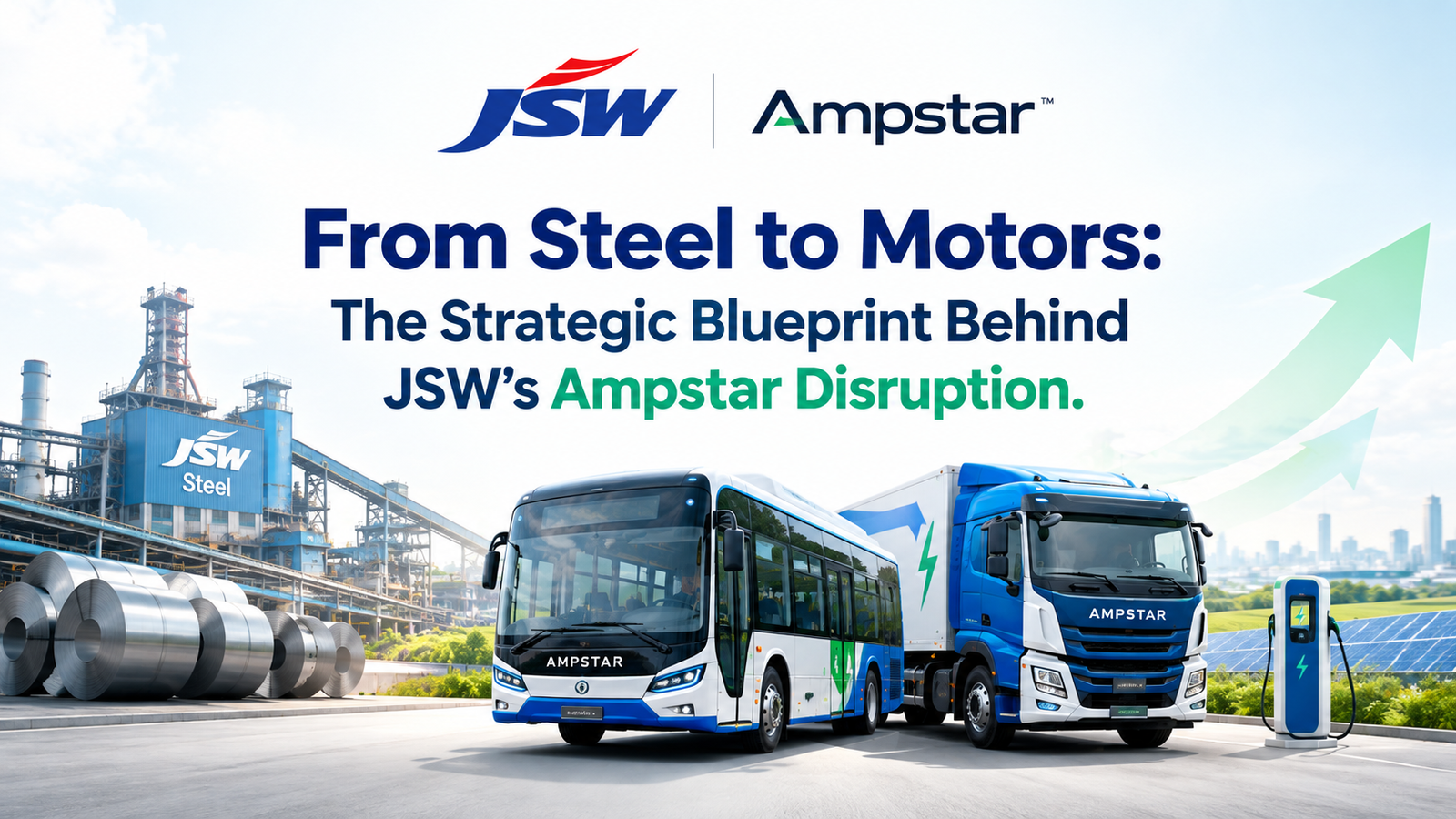
The transition of heavy commercial transportation to zero-emission technology is a complex, capital-intensive undertaking essential for curbing significant vehicular pollution and fuel costs. To address this shift, JSW Group launched AMPSTAR under JSW Greentech Limited, positioning the brand as a full-stack commercial mobility ecosystem provider rather than merely a vehicle manufacturer. Backed by an initial Phase 1 investment of approximately 2,500 crore rupees, AMPSTAR is establishing a greenfield manufacturing facility in Chhatrapati Sambhajinagar, Maharashtra, designed to produce up to 15,000 electric buses and heavy-duty trucks annually. By leveraging internal demand from its existing steel, cement, and energy operations, JSW Group creates a strategic advantage that substantially mitigates early market adoption risks while advancing sustainable logistics infrastructure.
| Key Metric | Strategic Target / Operational Parameter |
|---|---|
| Phase 1 Capital Expenditure | ₹2,500 crore |
| Phase 2 Expansion Plan | ₹1,500 to ₹2,000 crore |
| Manufacturing Base | 90-acre facility at AURIC, Chhatrapati Sambhajinagar, Maharashtra |
| Installed Phase 1 Capacity | 15,000 units annually (10,000 buses + 5,000 heavy trucks) |
| Average Vehicle Selling Price | Approximately ₹80 lakh across portfolio |
| Potential Phase 1 Revenue | ~₹12,000 crore at full capacity utilization |
| Captive Fleet Advantage | ~17,000 trucks in JSW ecosystem; 40-50% targeted for electrification |
| Long-Term Production Goal | 100,000 cumulative commercial EVs sold by 2030 |
| Target Localisation Level | 75% within 9 to 12 months of production ramp-up |
Key Takeaways
- De-risked Launch Strategy via Captive Demand: Unlike traditional automotive startups that face high customer acquisition costs, AMPSTAR leverages JSW Group’s internal logistics requirements of roughly 17,000 heavy trucks to guarantee baseline production volumes and real-world fleet validation.
- Shift from Product to Full-Stack Ecosystem: AMPSTAR addresses commercial vehicle adoption barriers by bundling physical vehicles with charging infrastructure, telematics, wet leasing, and Battery-as-a-Service, lowering upfront capital hurdles for external fleet owners.
- In-House Core Intellectual Property: JSW Greentech has engineered the base logic, software algorithms, and drivetrain integration internally, enabling vehicle customization for specialized industrial applications like mining, steel hauling, and urban transit.
- Unit Economics Driven by High Utilization: While electric heavy trucks carry a significant price premium over diesel equivalents, high annual mileage on closed-loop industrial routes generates massive fuel cost savings, offering up to 33% lower operating and maintenance costs.
Introduction: The Industrial Imperative for Heavy Commercial Electrification
The heavy commercial vehicle sector forms the backbone of India’s freight logistics and public transport infrastructure. However, it remains a primary contributor to urban air pollution and national fossil fuel import dependency. Heavy-duty diesel trucks and municipal transit buses run long daily cycles, consuming significant quantities of diesel fuel. Over a typical ten-year operational life cycle, a heavy 55-tonne diesel truck consuming 40,000 liters of fuel annually generates roughly ₹4 crore in direct fuel expenditure alone.
While policy mandates and municipal e-bus tenders have accelerated electrification in public transit, electrifying heavy freight transportation has faced persistent bottlenecks. High initial capital expenditure, uncertainty regarding battery degradation, missing high-power charging infrastructure, and limited total cost of ownership validation under rugged Indian operating conditions have kept private logistics fleets cautious.
Recognizing these structural challenges, JSW Group established AMPSTAR under JSW Greentech Limited. The venture positions JSW not merely as an automotive supplier, but as an integrated industrial mobility architect. Supported by brand strategy and positioning developed in partnership with global consultancy Interbrand, AMPSTAR aims to bridge the gap between heavy industrial logistics and sustainable, zero-emission transportation.
Manufacturing Infrastructure and Operational Architecture
Manufacturing heavy commercial vehicles requires massive infrastructure, high-precision assembly, and flexible production architectures. AMPSTAR’s operational footprint is centered around a new 90-acre greenfield manufacturing complex located within the Shendra industrial belt at AURIC (Aurangabad Industrial City) in Chhatrapati Sambhajinagar, Maharashtra.
Facilities and Regional Synergy
The Chhatrapati Sambhajinagar region offers strategic access to established automotive supplier networks across western India, while its location along key freight corridors allows efficient vehicle delivery. The facility is built to handle end-to-end heavy vehicle production, encompassing specialized operational units:
- Truck Cabin Fabrication and Body Assembly: Advanced robotic stamping, welding, and automated painting lines for heavy truck cabs and bus frames.
- Integrated Battery Pack Manufacturing: Modular battery assembly lines engineered to build scalable pack configurations for varied commercial applications.
- E-Bus Body Building Line: Flexible assembly tracks capable of producing transit buses ranging from 7-meter feeder vehicles to 18-meter articulated city buses.
- Advanced Research and Development: Supported by a dedicated engineering and R&D center in Pune, focusing on thermal management, vehicle control units, and powertrain electronics.
| Operational Parameter | Phase 1 Details | Phase 2 Projections |
|---|---|---|
| Capital Allocation | ~₹2,500 crore | ₹1,500 to ₹2,000 crore |
| Electric Bus Capacity | 10,000 units/year | Up to 20,000 units/year (flexible) |
| Electric Truck Capacity | 5,000 units/year | Up to 10,000 units/year (flexible) |
| Total Plant Output | 15,000 units/year | 30,000 units/year |
| Utilisation Threshold | Production phase-in | Triggered at 70-75% Phase 1 utilisation |
The manufacturing assembly line is designed with built-in flexibility, allowing production ratios between buses and heavy trucks to adjust based on shifting market demand and municipal procurement cycles.
Product Lineup and Integrated Technology Stack
Engineering commercial electric vehicles requires balancing energy density, structural durability, payload capacity, and thermal stability. AMPSTAR’s product pipeline targets both passenger transit and heavy freight transportation.
Heavy Electric Trucks: High-Tonnage Freight Engineering
AMPSTAR’s flagship freight platform is a 55-tonne heavy-duty electric tractor-trailer, engineered specifically for high-density, harsh-environment industrial logistics such as steel coil transport, bulk cement hauling, port container transfers, and heavy mining movements.
- Drivetrain Power Configurations: Motors delivering peak power outputs ranging from 150 kW up to 500 kW, providing high low-end torque required to haul maximum legal gross vehicle weights up steep gradients.
- Battery System Architecture: Offers both fixed high-capacity battery configurations for long haul routes and swappable battery architectures for continuous 24/7 industrial terminal operations.
- Subsequent Lineup Expansion: Following the initial roll-out of 55-tonne tractor-trailers, AMPSTAR plans to introduce heavy tippers, rigid fixed-body cargo trucks, and specialized dump trucks for earthmoving and infrastructure projects.
Electric Buses: Modular Public and Corporate Mobility
AMPSTAR’s passenger transportation portfolio covers diverse vehicle categories, serving public transit authorities, corporate employee fleets, and institutional mobility providers.
- Size Diversity: Vehicle lengths span from compact 7-meter feeder buses to high-capacity 18-meter articulated city buses.
- Application Focus: Engineered for high-frequency city routes, intercity passenger corridors, corporate employee shuttles, and campus transportation.
- Thermal Management and HVAC: Custom thermal management systems engineered to maintain battery health and operational performance during severe Indian summer temperatures.
Intellectual Property and Supply Chain Localisation
A core pillar of AMPSTAR’s market strategy is deep technology ownership. Rather than importing complete white-label powertrains, JSW Greentech has internally developed the base logic, embedded control software, and vehicle management algorithms for the electric drivetrain. This software autonomy enables customized tuning of torque curves, regenerative braking efficiency, and power distribution tailored to heavy loads or specific terrain profiles.
While advanced lithium battery cells are initially sourced from international supply partners, pack packaging, battery management systems (BMS), cab construction, frame fabrication, and vehicle assembly take place domestically. AMPSTAR aims to achieve 75% overall vehicle component localization within 9 to 12 months of initiating mass production, driving down costs and reducing exposure to global supply chain disruptions.
The Captive Demand Superpower: De-risking Greenfield Scale
The most difficult challenge facing any new automotive OEM is achieving sufficient production volume to cover high fixed overheads, clear factory learning curves, and establish real-world vehicle reliability. AMPSTAR possesses a structural advantage that sets it apart from traditional vehicle startups: massive captive demand within its parent corporate entity.
The JSW Industrial Fleet Ecosystem
JSW Group is one of India’s largest industrial conglomerates, with extensive footprints in steel manufacturing, cement production, energy generation, and port infrastructure. The industrial operations of JSW Steel, JSW Cement, and JSW Infrastructure utilize an internal network of roughly 17,000 heavy commercial trucks to transport raw materials, iron ore, clinker, coal, and finished goods.
- Target Electrifiable Volume: Management estimates that 40% to 50% of this internal fleet (roughly 10,000 trucks) operates on predictable, closed-loop freight routes. These routes connect production plants directly with nearby logistics yards, railway sidings, and port terminals.
- Immediate Deployment Schedule: AMPSTAR’s initial commercial roll-out includes supplying approximately 100 heavy electric trucks directly to JSW Steel and JSW Cement operations.
- First-Year Sales Targets: The company targets delivering 500 to 1,000 total commercial units in its first operational year, with plans to scale heavy truck deliveries toward 3,000 units annually as manufacturing ramps up.
This captive usage flywheel de-risks the capital investment in three distinct ways:
- Guaranteed Base Volumes: Factory lines maintain steady utilization without relying entirely on third-party orders during initial launch phases.
- Accelerated Data Generation: Operating vehicles under heavy industrial conditions yields vast quantities of real-world battery, drivetrain, and structural performance telemetry, accelerating product maturity.
- Living Demonstration: Prospective external fleet buyers can inspect operating fleets handling real freight, eliminating skepticism regarding commercial EV capabilities.
Full-Stack Commercial Mobility Ecosystem
A primary hurdle to heavy electric vehicle adoption is that logistics operators do not simply need a truck; they require a functional, highly reliable transport system. If an electric truck sits idle due to missing charging infrastructure or lengthy battery repairs, the resulting operational downtime quickly destroys its business case. AMPSTAR addresses this by operating as a full-stack mobility provider.
Commercial Structuring and Flexible Ownership Models
To reduce upfront capital expenditure barriers, AMPSTAR offers multiple vehicle acquisition frameworks:
- Outright Purchase with Long-Term Service Support: Standard vehicle purchasing bundled with 10-year comprehensive service, maintenance, and operational warranties.
- Battery-as-a-Service (BaaS): Fleet operators purchase the chassis outright while paying for the battery pack through a monthly or usage-based operational tariff. This lowers initial vehicle purchase prices to levels near conventional diesel trucks.
- Pay-per-Kilometre Contract: A variable cost operational model where buyers pay purely based on distance traveled, removing asset depreciation and battery residual value risks.
- Wet Leasing and Operating Solutions: Comprehensive turnkey fleet management where AMPSTAR supplies the vehicle, maintenance, charging setup, software management, and drivers.
Infrastructure, Charging, and Telematics Integration
Physical delivery of vehicles is coupled with custom energy depot solutions. AMPSTAR plans, builds, and maintains dedicated charging hubs at customer depots and key logistics nodes, deploying ultra-fast DC chargers and automated battery swapping setups engineered for continuous multi-shift operations.
Every vehicle features advanced IoT telematics, giving logistics managers a single centralized screen to monitor real-time location tracking, driver behavior, route efficiency, state of charge, and predictive battery health alerts.
Total Cost of Ownership (TCO) Financial Case Study
In commercial fleet management, purchasing decisions are driven almost entirely by Total Cost of Ownership over the lifetime of the vehicle. While an electric heavy truck carries a significantly higher initial purchase price than its diesel counterpart, its drastically lower energy and maintenance costs alter life cycle financial calculations.
Detailed Cost Comparison: 55-Tonne Heavy Haul Tractor-Trailer
The table below outlines a ten-year operational financial model comparing a standard 55-tonne diesel tractor-trailer with an equivalent AMPSTAR heavy electric truck operating on high-mileage industrial routes.
| Cost Element / Financial Metric | Conventional 55-Tonne Diesel Truck | AMPSTAR 55-Tonne Electric Truck |
|---|---|---|
| Initial Upfront Vehicle Cost | ~₹40 lakh to ₹45 lakh | ~₹95 lakh to ₹1.30 crore |
| Annual Fuel / Energy Consumed | ~40,000 Liters of Diesel | ~140,000 kWh of Electricity |
| Average Energy Tariff Rate | ₹100 per Liter (Diesel) | ₹8 per kWh (Industrial Power Grid) |
| Annual Energy / Fuel Expense | ~₹40.0 lakh | ~₹11.2 lakh |
| 10-Year Fuel / Energy Expense | ~₹4.00 crore | ~₹1.12 crore |
| Maintenance & Servicing (10-Yr) | ~₹50 lakh to ₹60 lakh | ~₹25 lakh to ₹30 lakh (33% reduction) |
| Estimated Lifetime Operating Expense | ~₹4.50 crore to ₹4.60 crore | ~₹1.37 crore to ₹1.42 crore |
| Net Operational Cost Savings | Baseline Reference | Savings of ₹3.0+ crore over 10 years |
The TCO Breakeven Mechanism
While the upfront sticker price of an electric truck is roughly 2.5 to 3 times that of a diesel vehicle, running intensive daily operations generates substantial operational fuel savings.
A conventional heavy diesel truck running heavy payloads consumes approximately 40,000 liters of diesel fuel per year. At ₹100 per liter, the annual diesel fuel bill reaches ₹40 lakh. An equivalent electric truck consuming industrial electricity achieves equivalent mileage for roughly ₹11.2 lakh per year. This yields annual energy savings of nearly ₹28.8 lakh per vehicle.
Combined with lower routine maintenance requirements, owing to fewer moving mechanical parts, no engine oil changes, and reduced brake wear via regenerative braking, the overall cost savings per kilometer reach up to 33%. On high-utilization routes running 150 to 250 kilometers daily, the higher initial capital cost of an electric truck reaches total financial parity and breakeven within 2.5 to 3.5 years, after which the vehicle generates significant ongoing operational savings.
Market Context and Competitive Dynamics
AMPSTAR enters an electric commercial vehicle market that is expanding rapidly from a small historical base. Data indicates India recorded approximately 23,540 electric commercial vehicle registrations over the January-August 2026 period, representing a 155% year-on-year growth rate. However, the vast majority of these registrations were light commercial vehicles and 9-to-12 meter electric transit buses. Heavy electric trucks remained extremely rare, with only 1,637 heavy goods e-carriers registered nationwide during that period.
Competitor Landscape Matrix
AMPSTAR competes against established legacy commercial vehicle manufacturers alongside specialized EV chassis makers across two distinct market segments.
| OEM / Industry Competitor | Primary Focus Areas | Strategic Strengths | Structural Vulnerabilities |
|---|---|---|---|
| AMPSTAR (JSW Greentech) | Heavy e-trucks (55T) & e-buses (7-18m) | Internal group fleet demand, full-stack ecosystem, deep capital | Brand startup status in open commercial retail market |
| Tata Motors | Full-range commercial fleets, e-buses, light trucks | Massive existing service network, legacy fleet dominance | Slower capital pivot on ultra-heavy e-truck ecosystem integration |
| Ashok Leyland (Switch Mobility) | Urban transit buses, light and medium electric trucks | Established bus market share, global engineering arms | High dependence on government municipal tenders |
| Olectra Greentech | Municipal and intercity transit e-buses | Early mover in transit buses, strong order book | Limited presence in heavy haul goods transportation |
| VECV (Volvo Eicher) | Medium-duty delivery e-trucks, premium buses | High vehicle quality, strong technology ties to Volvo Group | Premium pricing structures, smaller dealer coverage |
Operational Challenges and Strategic Risks
Despite strong capital backing and built-in captive demand, AMPSTAR faces notable operational and execution risks as it scales manufacturing:
- High-Power Grid Connection Bottlenecks: Deploying multi-megawatt charging hubs for fleets of 55-tonne trucks requires extensive grid upgrades from state electricity distribution companies. Grid connection delays at industrial hubs can slow vehicle deployments.
- Volatile Raw Material Sourcing: Cell manufacturing relies heavily on imported active materials and battery cells. Supply bottlenecks or international price fluctuations could impact gross margins before national cell manufacturing achieves scale.
- Open Market Adoption Beyond Internal Fleets: While internal demand covers early production capacity, achieving long-term annual sales goals of 100,000 units by 2030 requires convincing independent, price-sensitive logistics operators to transition away from diesel.
- Residual Value and Second-Life Battery Uncertainty: Secondary markets for heavy commercial electric vehicles remain unproven in India. Establishing clear battery health monitoring and reliable second-life storage applications will be critical to supporting vehicle trade-in values.
Recommended Readings
- Clean Disruption of Energy and Transportation: How Silicon Valley Will Make Oil, Nuclear, Natural Gas, Coal, Electric Utilities and Conventional Cars Obsolete by 2030 by Tony Seba – An influential technology forecast examining how fast-falling battery, solar, and electric vehicle cost curves disrupt legacy industrial business models.
- Charged: A History of Batteries and Lessons for a Clean Energy Future by James Morton Turner – A deep dive into the history of batteries — and the environmental and social costs of mining, disposal, and material sourcing — reveals why solving ‘the battery problem’ is essential to building a just and genuinely clean energy future.
- Baseline Study for Non-Urban Road Transport by the Energy and Resources Institute (TERI) – A study establishing a data methodology and emissions baseline for India’s non-urban heavy-duty trucking sector to inform the design of a national clean freight program.
Frequently Asked Questions (FAQs)
What is AMPSTAR, and what company operates it?
AMPSTAR is the flagship commercial electric vehicle brand launched under JSW Greentech Limited, a subsidiary of the JSW Group. The brand designs, manufactures, and supports zero-emission electric buses and heavy-duty electric trucks tailored for Indian operating conditions.
Where are AMPSTAR vehicles manufactured?
AMPSTAR vehicles are built at a new 90-acre greenfield manufacturing facility in AURIC (Aurangabad Industrial City), located in Chhatrapati Sambhajinagar, Maharashtra. Engineering and software development are supported by a dedicated R&D facility in Pune.
What is the annual production capacity and investment size?
JSW Group invested approximately ₹2,500 crore in Phase 1 to build an annual production capacity of 15,000 units (10,000 electric buses and 5,000 heavy electric trucks). A planned Phase 2 investment of ₹1,500 to ₹2,000 crore could double total factory capacity to 30,000 vehicles per year once capacity utilization crosses 70-75%.
What types of electric commercial vehicles does AMPSTAR produce?
AMPSTAR’s portfolio includes passenger e-buses ranging from 7 meters to 18 meters for urban transit, intercity travel, employee transport, and school fleets. Its freight line launches with a 55-tonne electric tractor-trailer, followed by heavy tippers, rigid cargo trucks, and mining dumpers.
How does JSW Group’s internal business benefit AMPSTAR?
JSW Group operates approximately 17,000 heavy trucks across its steel, cement, and port businesses. The group plans to electrify 10,000 of these vehicles over time. This internal demand guarantees baseline factory production, generates live operating data under heavy usage conditions, and de-risks early manufacturing investments.
What flexible ownership models does AMPSTAR offer fleet buyers?
AMPSTAR offers outright vehicle purchasing alongside wet leasing, Battery-as-a-Service (BaaS), and pay-per-kilometre commercial structures. These financing and operational options allow buyers to lower upfront acquisition costs and pay based on ongoing usage.
Conclusion: The Future of Heavy Commercial Mobility
JSW Group’s launch of AMPSTAR marks a structural evolution in India’s commercial vehicle sector. Rather than waiting for external market demand to mature organically, JSW is utilizing its own industrial scale to accelerate heavy commercial electrification.
If AMPSTAR achieves its initial target of electrifying 40-50% of JSW’s 17,000 internal trucks while scaling its Chhatrapati Sambhajinagar facility to full capacity, it will establish a proven operational template for heavy freight electrification across emerging markets. As Phase 1 reaches steady production, JSW Greentech’s planned Phase 2 investment of ₹1,500 to ₹2,000 crore will expand annual capacity to 30,000 units, positioning the company as a major long-term player in Asia’s commercial electric mobility landscape.






Leave a Reply