

- Home
- /
- Insights
- /
- Artificial Intelligence
- /
- Agentic AI Explained: The Complete…
⏱️ Read Time:
Introduction
Artificial intelligence is undergoing a structural transformation, moving from passive conversational systems to fully autonomous operational software. Early enterprise implementations of large language models focused primarily on single-turn interactions such as document summarization, information search, and interactive chat assistance. While these deployments demonstrated natural language fluency, they remained fundamentally reactive. They relied on static context windows and lacked the system integrations necessary to execute multi-step business processes.
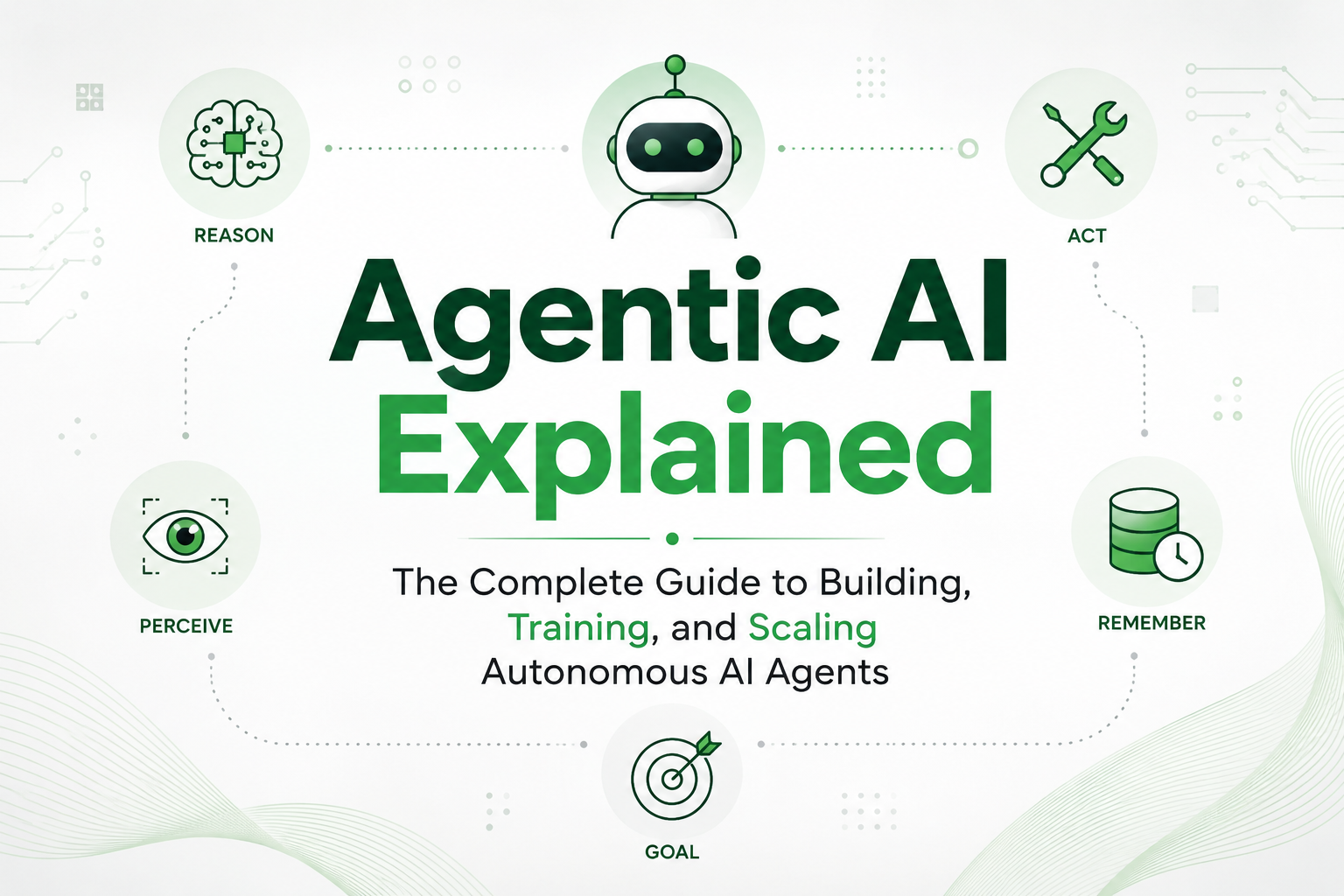
The arrival of agentic artificial intelligence fundamentally changes this paradigm. Rather than operating as text processors, language models now serve as the core cognitive engines within goal-directed software agents. Modern AI agents evaluate task requirements, construct structured sequential plans, invoke external tools through standardized interfaces, retain long-term memory across sessions, and autonomously iterate on intermediate outputs to achieve complex business outcomes.
Scaling autonomous software systems across an enterprise introduces significant engineering and organizational challenges. Uncoordinated pilot projects often result in architectural silos, mounting technical debt, security vulnerabilities, and uncertain return on investment. Moving from experimental prototypes to an autonomous enterprise operating model requires a repeatable engineering approach that aligns business goals, systems architecture, standardized protocols, and continuous operational governance.
The Architectural Evolution: From Prompting to Harness Engineering
The methods used to steer foundation models have advanced rapidly alongside model capabilities. Understanding modern autonomous agents requires examining the shift across three distinct control paradigms: prompt engineering, context engineering, and harness engineering.
The first phase of model application relied heavily on prompt engineering. Developers attempted to direct model output by formatting single-turn text instructions, assigning persona roles, and inserting inline few-shot examples directly into the immediate input prompt. While prompt engineering improved formatting quality for isolated text generation tasks, it proved fragile for complex operational workflows. It lacked persistent state management, real-time feedback from external systems, and standardized execution boundaries.
To solve these limitations, systems engineering shifted toward context engineering. Context engineering moves beyond text formatting to construct rich, real-time data environments around the foundation model. Instead of passing isolated user instructions, context engineering platforms assemble four distinct context layers prior to model inference:
- User Context: Captures user identity, access authorizations, operational domain, historical preferences, and business goals.
- Task Context: Defines exact functional requirements, target output schemas, execution rules, and domain constraints.
- Temporal Context: Incorporates time-sensitive variables, event orderings, system deadlines, and real-time transaction state.
- Environmental Context: Details available software tools, runtime application states, API health, and system security boundaries.
Context engineering uses technologies such as Retrieval Augmented Generation, vector embeddings, dynamic session stores, and enterprise metadata catalogs to ground model reasoning in verified enterprise data.
The current state of the art in autonomous software design is harness engineering. Harness engineering wraps the model and its engineered context inside an active runtime execution loop. In a harness-engineered system, the foundation model operates as a cognitive component within an automated loop. The software harness handles loop orchestration, monitors task completion criteria, manages tool execution exceptions, updates long-term state memory, and triggers automated evaluation pipelines. This enables the system to autonomously run multi-step workflows, inspect tool output errors, update its internal plan, and execute corrective steps without human intervention.
| System Attribute | Traditional Chatbots | Deterministic Automation Scripts | Autonomous AI Agents |
| Core Cognitive Engine | Rule-based matching or basic LLM | Hardcoded conditional code branches | Foundation model inside a reasoning loop |
| Operational Mechanics | Single-turn reactive responses | Predefined, rigid sequential steps | Self-directed multi-step task execution |
| Exception Handling | Falls back to static error messages | Throws unhandled system exceptions | Dynamic replanning and autonomous self-correction |
| Tool Access Method | Static, hardcoded API endpoints | Direct database and API scripts | Autonomous tool selection and parameter generation |
| State and Memory | Short-term session context | Transactional database records | Multi-layer short-term and vector long-term memory |
| Decision Execution | Fixed decision trees | Hardcoded business logic | Probabilistic cognitive planning |
Anatomy of Single and Multi-Agent Architectures
Designing production-ready agentic systems requires separating reasoning, memory, tool access, and safety controls into distinct system modules.
Core Functional Modules of an AI Agent
An enterprise AI agent comprises five foundational modules that operate together within the execution harness:
- The Reasoning Engine serves as the central cognitive unit, using foundation models to analyze incoming contexts, break complex objectives into sequential steps, and choose appropriate actions.
- The Context and Memory Management module implements a dual-layer architecture. Short-term memory holds active conversational context and intermediate reasoning steps in fast RAM session buffers. Long-term memory retains persistent knowledge across interactions using vector databases, relational stores, and enterprise knowledge graphs.
- The Tool Integration Interface maps natural language function calls to external software APIs, OpenAPI endpoints, database query engines, and cloud microservices.
- The Security and Safety Guardrail layer intercepts incoming inputs and outgoing execution requests. It enforces strict input schemas, redacts sensitive personal information, and blocks unauthorized tool calls.
- The Action Execution Runtime provides an isolated container environment where tools, code execution engines, and web scrapers run safely without endangering underlying enterprise infrastructure.
Multi-Agent Interaction Topologies
When business tasks exceed the context window or cognitive capacity of a single agent, systems deploy multi-agent topologies to distribute work across specialized agents. Modern multi-agent architecture relies on seven core design patterns:
- In a Coordinator or Dispatcher pattern, a central manager agent analyzes incoming user tasks and routes work to specialized sub-agents. This pattern is commonly applied in customer service routing, enterprise IT help desks, and shared service dispatch systems.
- In a Sequential Pipeline pattern, specialized agents operate in a fixed linear order, where the output of one agent becomes the context for the next. This topology excels at document processing, multi-step language translation, and regulatory compliance checks.
- In a Parallel Fan Out and Gather pattern, multiple agents execute independent subtasks simultaneously, sending their results to an aggregator agent that compiles the final response. This approach reduces processing latency in financial risk analysis, competitive intelligence gathering, and fraud detection workflows.
- In a Hierarchical Task Decomposition pattern, higher-level strategic agents recursively break down complex goals into subtasks and delegate them down a multi-tier tree of operational agents. This design handles large-scale applications such as supply chain rerouting, enterprise resource planning, and complex software development.
- In a Generator Critic pattern, a primary generation agent produces work products while a dedicated critic agent audits outputs against strict domain guidelines, quality metrics, or security constraints. This pattern is widely used for automated software generation, legal contract drafting, and regulatory filing preparation.
- In an Iterative Refinement pattern, agents operate within a continuous feedback loop, revising work products across multiple turns until specific quality thresholds are satisfied. This pattern is suited for data cleansing, mathematical optimization, and scientific data processing.
- In a Human-in-the-Loop pattern, autonomous loops pause at predefined operational boundaries to request explicit authorization from human managers. This safeguard is essential for high-value wire transfers, sensitive medical support decisions, and elevated system configurations.
Interoperability Protocols: Model Context Protocol and Agent-to-Agent Protocol
As enterprises expand from single-agent deployments to multi-agent ecosystems, custom point-to-point integrations create architectural complexity and maintenance overhead. Standardized open protocols are required to provide secure communication across agent frameworks, model providers, and enterprise data repositories.
Model Context Protocol (MCP)
Originally developed by Anthropic and donated to the Linux Foundation’s Agentic AI Foundation, the Model Context Protocol (MCP) defines a universal client-server architecture that connects foundation models to external tools, databases, and operational environments. MCP acts as a standard interface between an individual agent and its local software toolset.
MCP defines three primary functional primitives:
- Tools: Executable functions provided by an MCP server that allow the model to perform side-effect actions, such as running SQL queries, updating CRM records, or triggering API webhooks.
- Resources: Read-only endpoints exposed by an MCP server that feed data into the model context, such as local log files, system metrics, or database schemas.
- Prompts: Preconfigured prompt templates hosted on the server that standardize how agents interact with complex underlying tools and resources.
MCP uses JSON-RPC 2.0 over standard input and output for local process communication, and HTTP with Server-Sent Events (SSE) for network calls, making it easy to embed into existing development environments.
Agent to Agent (A2A) Protocol
Introduced by Google Cloud alongside enterprise partners, the Agent to Agent (A2A) protocol solves inter-agent communication. While MCP standardizes how a single agent interacts with tools, A2A defines how independent agents discover each other, negotiate subtasks, share execution state, and coordinate workflows across different cloud environments.
The primary operational mechanisms of A2A include:
- Capability Discovery via Agent Cards: Every A2A-compliant agent publishes an Agent Card, which is a JSON file located at a well-known URL endpoint. The Agent Card details the agent name, functional capabilities, supported input modalities, API schemas, and required authentication protocols.
- Standardized Task Execution: Client agents launch, monitor, pause, and cancel tasks on remote service agents using structured HTTP and JSON messaging that supports both real-time event streaming and asynchronous task completion callbacks.
- Security and Memory Isolation: Agents collaborate by exchanging clear task goals and structured results without exposing internal session logs, prompt instructions, or private tool logic.
In enterprise deployments, MCP and A2A function as complementary protocols. An orchestrator agent uses A2A to delegate tasks to specialist agents across different business departments, while each specialist agent uses MCP to interact with its local databases and operational software.
Comparing Enterprise Agent Development Frameworks
Selecting an agent software framework directly impacts state management, graph construction, developer productivity, and system maintainability. Organizations evaluate several leading frameworks based on architectural requirements:
| Framework | Primary Design Model | Key Enterprise Strengths | Optimal Use Cases |
| Google Cloud Agent Development Kit (ADK) | Code-first SDK | Deep Vertex AI integration, managed AgentOps, built-in distributed tracing, and cloud runtimes. | Production-scale cloud architectures and GCP ecosystem deployments. |
| LangGraph | Cyclic state graph engine | Fine-grained execution graph control, explicit state persistence, step rollback, and complex conditional branches. | Structured, deterministic, multi-step enterprise process automation. |
| CrewAI | Role-based team framework | Straightforward role assignment, automated delegation, and intuitive modeling of agent teams. | Multi-persona research, content generation, and collaborative operational teams. |
| AutoGen | Event-driven conversational framework | Dynamic multi-agent conversation flows, multi-agent negotiation, and code sandbox execution. | Complex collaborative problem solving, code generation, and research simulations. |
| LlamaIndex | Data-centric RAG orchestration | Advanced document index structures, custom data connectors, and optimized retrieval pipeline management. | Knowledge-heavy retrieval, semantic search, and document intelligence agents. |
| OpenAI Agent SDK | Lightweight function caller | Minimalist integration, direct model function calling, and rapid single agent prototyping. | Lightweight single agent applications inside OpenAI model environments. |
Enterprise Transformation Strategy and Implementation Lifecycle
Deploying autonomous agent systems successfully requires aligning software engineering with business strategy and organizational change management.
The Three Layers of Enterprise Transformation
Google Cloud’s Agentic AI Transformation Framework structures operational adoption into three interconnected layers:
- The Strategy, Ecosystems, and Value layer defines target business goals, prioritizes use cases based on expected return on investment, and tracks value realization across operational efficiency, cost reduction, customer satisfaction, and top-line revenue growth.
- The Reimagining Business Processes layer deconstructs legacy workflows to design dynamic human-agent collaboration models, avoiding the mistake of forcing autonomous software into rigid manual processes.
- The Horizontal and Foundational Capabilities layer provides shared enterprise infrastructure, including secure agent architectures, governed data platforms, zero trust security guardrails, and centralized AgentOps management platforms.
The Ten Phase Engineering Roadmap
Taking an enterprise AI agent from concept to production involves a ten-phase engineering lifecycle:
- Use Case Scope Definition: Formulating explicit operational goals, identifying task boundaries, establishing safety requirements, and defining target metrics.
- Architecture Blueprinting: Selecting reasoning foundation models, designing state representations, and mapping system deployment topologies.
- Instruction and Context Engineering: Writing initial system instructions, establishing persona parameters, defining output schemas, and selecting few-shot prompt sets.
- Single-Turn Prototyping: Building initial agent prototypes to test reasoning accuracy against Critical User Journeys (CUJs).
- Memory Integration: Configuring short-term session buffers and setting up persistent vector storage for long-term contextual recall.
- External Tool Wiring: Exposing secure API endpoints, database engines, and specialized OpenAPI interfaces to the agent environment.
- Harness Loop Orchestration: Linking reasoning logic, memory reads, tool execution, and error handling into an automated harness loop.
- Multi-Agent Setup: Setting up communication protocols (MCP/A2A), establishing delegation hierarchies, and configuring inter-agent task handoffs.
- Production Deployment and AgentOps: Packaging software into container runtimes, setting up automated CI/CD pipelines, configuring distributed tracing, and establishing token budgets.
- Auditing and Continuous Optimization: Implementing human review queues, monitoring trajectory quality, and refining prompts and model selection based on real-world operational data.
AgentOps, Telemetry, and Cloud Infrastructure
Operating autonomous systems in production requires specialized operational practices known as AgentOps. AgentOps extends traditional MLOps to handle non-deterministic execution loops, dynamic tool calling, and variable inference costs.
Specialized Evaluation Metrics
Standard model accuracy metrics cannot effectively measure multi-step, non-deterministic agent trajectories. Enterprise operations require specialized agent performance, reliability, and safety metrics:
| Metric Name | Operational Target | Technical Evaluation Method |
| Tool Utilization Efficacy (TUE) | Measures how accurately an agent selects tools and formats parameter payloads. | Percentage of error-free tool API calls over total tool execution attempts. |
| Memory Coherence & Retrieval (MCR) | Evaluates the accuracy of contextual memory storage and recall. | Precision and recall metrics of vector context retrieved across multi-turn sessions. |
| Strategic Planning Index (SPI) | Assesses agent efficiency in decomposing high-level tasks into execution steps. | Graph edit distance comparing generated execution paths against expert golden paths. |
| Component Synergy Score (CSS) | Measures coordination, handoff accuracy, and latency across multi-agent teams. | Successful task completion rate divided by inter-agent communication overhead. |
| Harmful Content Generation Rate | Tracks safety guardrail effectiveness across generated outputs. | Automated screening models evaluating outputs for toxicity, bias, or data leaks. |
Cloud Compute Runtimes
Selecting a compute runtime depends on requirements for infrastructure control, auto-scaling speed, and deployment simplicity.
Google Cloud Agent Engine provides a fully managed runtime designed specifically for enterprise AI agents. It offers managed session state, built-in evaluation tools, and automated tracing out of the box.
Google Cloud Run delivers a managed serverless container environment for standard HTTP microservices. It scales automatically to zero when idle, though developers must manage container web frameworks and external session storage.
Google Kubernetes Engine (GKE) provides container orchestration for complex distributed microservices. It provides fine-grained infrastructure control, custom GPU routing, and dedicated service mesh isolation.
Cost Optimization Strategies
Because autonomous agents run iterative loops that generate multiple model calls per task, unmonitored deployments can incur high compute and inference expenses. Managing costs requires disciplined engineering practices:
- Dynamic Model Routing directs simple, routine subtasks (such as text classification or summary formatting) to smaller, lower-cost models, reserving large foundation models for complex strategic planning steps.
- Token Input Optimization reduces input token counts by trimming redundant context history, selecting dynamic context windows, and refining system instruction templates.
- Response Caching stores deterministic outputs for common sub-queries, eliminating redundant model inference calls.
- Request Batching groups non-time-sensitive background operations into off-peak execution queues to take advantage of lower batch inference pricing.
Security, Governance, and Risk Management
Granting autonomous systems operational authority to execute software actions introduces unique security risks and operational exposure. Enterprise deployments require strict security frameworks and structured governance checkpoints.
Securing Autonomous Agents
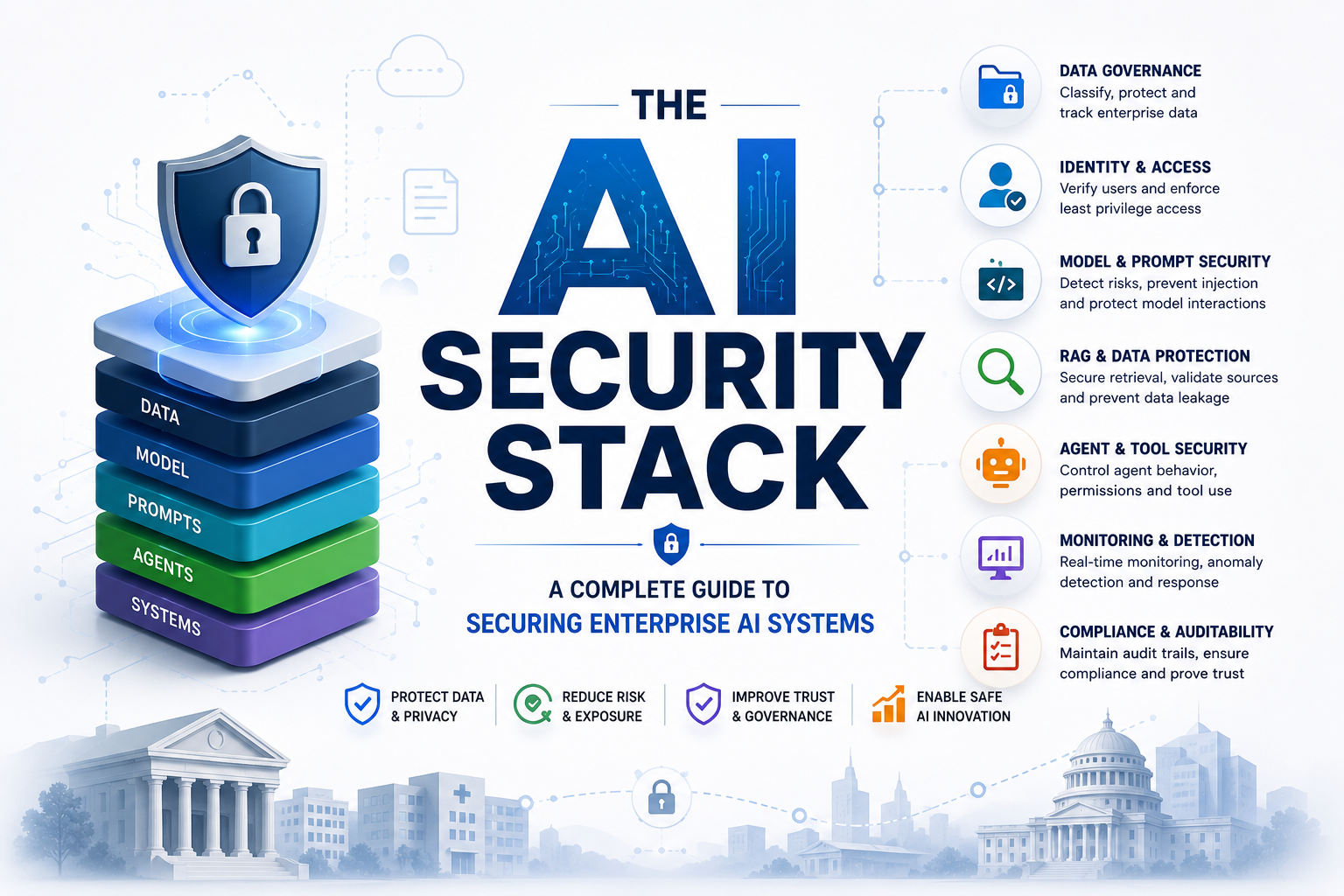
Securing agent architectures requires expanding traditional software security models to address non-deterministic AI behaviors, leveraging frameworks such as Google’s Secure AI Framework (SAIF). Key security vectors include:
- Direct and Indirect Prompt Injection occur when malicious user inputs or untrusted retrieval documents attempt to override system instructions and trigger unauthorized tool execution. Defense strategies include using dedicated input screening models, enforcing strict output schema validation, and isolating tool parameter generation.
- Rogue Actions and Unintended Tool Calls happen when ambiguous tool definitions or poor model reasoning result in unexpected software behavior. Mitigations rely on applying strict least-privilege Identity and Access Management (IAM) permissions to agent service accounts and requiring human approval for high-risk actions.
- Sensitive Data Leakage involves the accidental exposure of private customer data or internal intellectual property within prompt contexts or log files. Organizations prevent leaks by deploying automated Sensitive Data Protection (DLP) filters to inspect and redact sensitive data before context assembly.
Governance Checkpoints
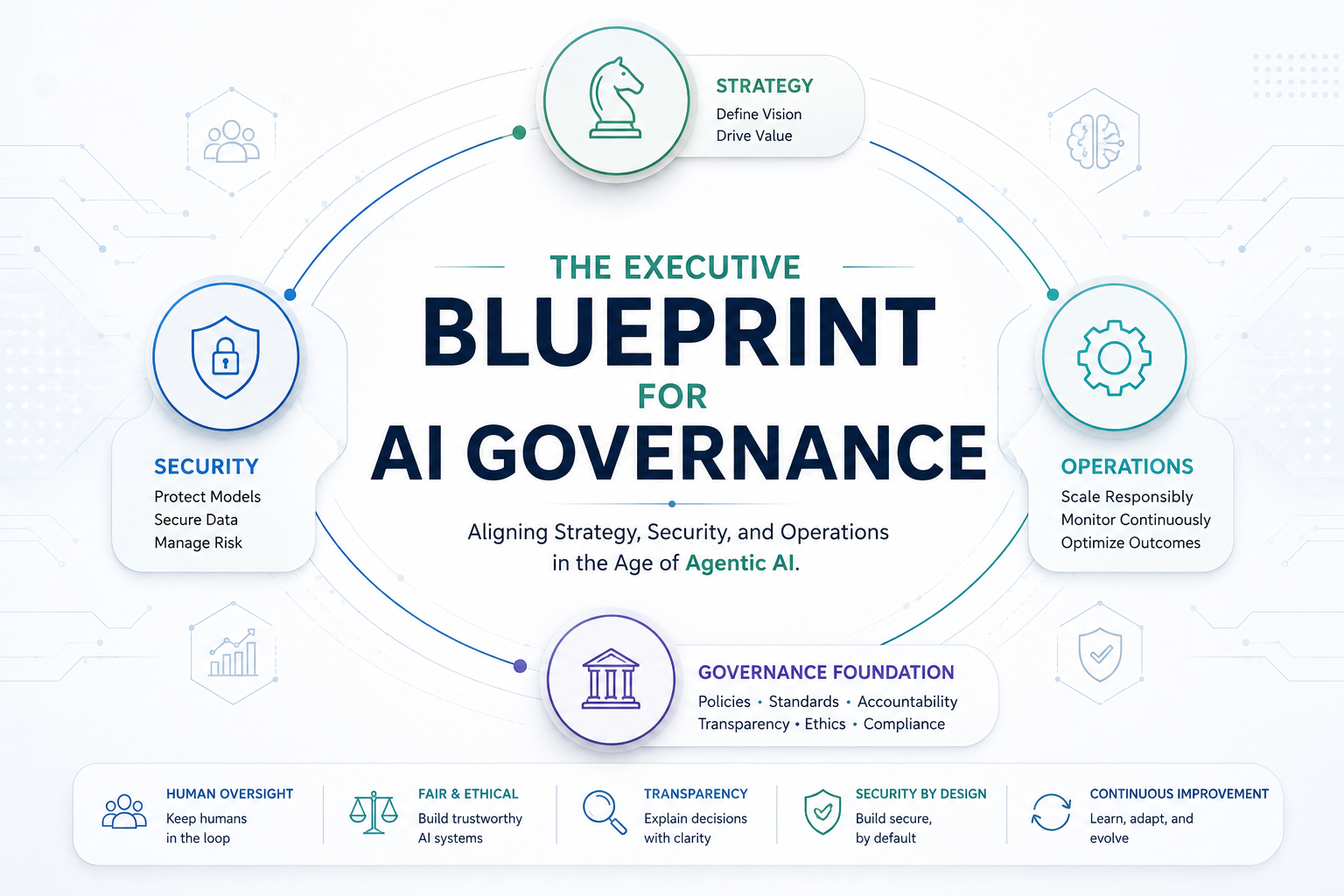
Enterprise governance models establish mandatory decision stage gates across the development lifecycle:
- Strategy Alignment Checkpoint: Reviews business viability, regulatory compliance, and expected ROI prior to committing technical resources.
- Architecture and Security Gate: Audits data flow maps, verifies least-privilege tool account access, and verifies input sanitization modules.
- Pre-Deployment Gate: Runs automated red teaming evaluations, tests safety guardrails, and verifies fallback mechanisms prior to production rollout.
- Production Auditing Gate: Continuously monitors runtime metrics, evaluates human intervention rates, tracks cost variances, and audits compliance logs on a scheduled cadence.
Recommended Readings
- Artificial Intelligence: A Modern Approach by Stuart Russell and Peter Norvig, the definitive academic foundation for understanding how AI reasoning, planning, and agents actually work under the hood.
- Hands-On Large Language Models by Jay Alammar and Maarten Grootendorst, a practical, visual guide to how modern LLMs function and how to build real applications with them.
- Human Compatible: Artificial Intelligence and the Problem of Control by Stuart Russell, an essential read on the safety and alignment questions that become far more urgent once AI systems can take autonomous action.
- The Alignment Problem by Brian Christian, a clear, well-researched look at why getting AI systems to do what we actually want is harder than it sounds.
- Prediction Machines: The Simple Economics of Artificial Intelligence by Ajay Agrawal, Joshua Gans, and Avi Goldfarb, a useful business-focused lens for anyone thinking about AI strategy, ROI, and product decisions rather than just the technology itself.
Frequently Asked Questions
What is the difference between prompt engineering and context engineering?
Prompt engineering focuses on optimizing the formatting, phrasing, and structure of natural language instructions passed directly within a user request. Context engineering is a broader data architecture methodology that dynamically gathers, structures, and manages the entire operational context surrounding the model prior to execution. It systematically injects user identity, task objectives, temporal constraints, system states, and retrieved enterprise documents into the model context window.
How do the Model Context Protocol (MCP) and Agent-to-Agent (A2A) protocol work together?
MCP and A2A operate at different layers of the software stack. MCP is an agent-to-tool standard that defines how an individual agent discovers, reads, and executes local or remote software tools and data repositories. A2A is an agent-to-agent collaboration protocol that allows independent agents across different cloud platforms to discover each other, delegate subtasks, and coordinate complex multi-step workflows. Multi-agent architectures use A2A for high-level agent delegation, while individual agents use MCP to execute specific tool calls.
How can organizations prevent autonomous AI agents from making unauthorized or damaging tool calls?
Preventing unauthorized actions requires applying zero trust security principles, strict Identity and Access Management (IAM) controls, and schema validation. Agents should operate using restricted service accounts that grant least-privilege access only to required tools. Additionally, operations that cross critical risk thresholds, such as financial payments, data modifications, or external communications, should require synchronous Human-in-the-Loop validation.
How should an enterprise choose between LangGraph, Google ADK, and CrewAI?
Framework selection depends on the target operational architecture. LangGraph is best suited for complex, deterministic workflows that require fine-grained state machine control, step rollback, and explicit branching rules. Google ADK is designed for enterprise cloud environments, offering direct integration with Google Cloud services, Vertex AI, built-in AgentOps tracing, and enterprise lifecycle management tools. CrewAI is ideal for modeling role-based collaborative teams during rapid prototyping.
Why are standard software test suites insufficient for evaluating AI agents?
Traditional software testing relies on deterministic assertions where specific inputs yield exact, static outputs. Autonomous AI agents exhibit non-deterministic behavior and run dynamic reasoning loops that vary based on environmental context. Evaluating agents requires specialized trajectory metrics, such as Tool Utilization Efficacy (TUE), Strategic Planning Index (SPI), and Memory Coherence & Retrieval (MCR), alongside automated judge models that evaluate execution quality against expert golden benchmarks.
How can engineering teams prevent runaway costs in autonomous execution loops?
Controlling execution costs requires dynamic model routing, response caching, token optimization, and explicit loop boundaries. Routine subtasks, such as simple text extraction or summary formatting, should be routed to smaller, low-cost models, reserving large foundation models for complex strategic reasoning. Engineering teams should also set strict iteration limits, token budgets, and response caching for common subqueries.
Conclusion
The evolution from passive generative models to autonomous agentic systems marks a significant shift in enterprise technology. By moving beyond text generation to deploy software agents capable of dynamic reasoning, multi-step planning, and secure tool execution, organizations can achieve meaningful improvements in operational efficiency and agility.
However, scaling autonomous software safely requires technical rigor. Success requires moving beyond isolated pilot projects to implement a cohesive enterprise engineering methodology. By adopting open communication standards like MCP and A2A, choosing appropriate orchestration frameworks, establishing robust AgentOps telemetry, and enforcing zero trust security governance, organizations can build secure digital workforces that collaborate effectively with human teams to deliver long-term business impact.







Leave a Reply