

- Home
- /
- Artificial Intelligence
- /
- Building the Enterprise AI Architecture:…
⏱️ Read Time:
Introduction
The enterprise computing landscape is undergoing a structural shift. Organizations are rapidly moving past isolated pilot projects and simple conversational interfaces toward comprehensive, system-wide artificial intelligence architectures. Early generative deployments relied primarily on direct model API calls wrapped in thin software interfaces. However, production environments require robust, multi-layered blueprints capable of handling multi-step reasoning, transactional safety, system integration, and strict regulatory compliance.
Deploying artificial intelligence across an enterprise introduces systemic engineering challenges that traditional software design patterns do not solve. Large language models operate probabilistically, enterprise data resides in heterogeneous silos, and autonomous multi-agent workflows risk compounding errors if intermediate context becomes corrupted. To establish operational reliability, enterprise systems require a decoupled architecture that enforces clear boundaries between ingress access, agent coordination, data retrieval, model routing, and system execution.
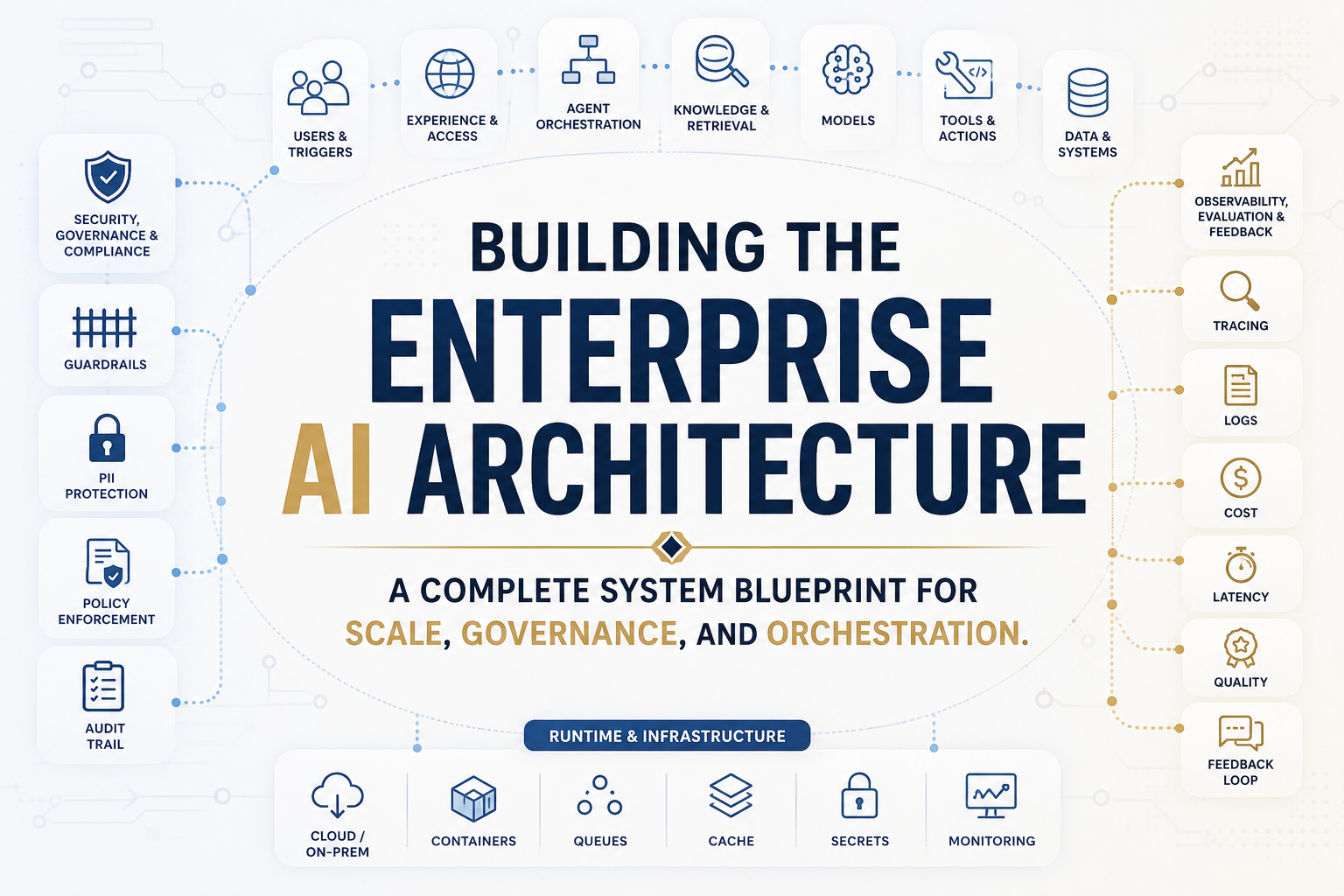
An enterprise-grade artificial intelligence platform must connect foundational systems of record with generative models while embedding operational governance directly into every execution layer. This report delivers an exhaustive analysis of the complete architectural blueprint required for production scale, systematically analyzing each layer from user ingress down to core runtime infrastructure.
The Experience and Access Layer: Managing Ingress and Identity
Enterprise platforms process requests from a wide variety of internal and external sources. These system triggers include employees working through internal copilots, external customers interacting with web applications, automated background scheduling hooks, real-time message queues, and external API events. Managing this high-volume, asynchronous traffic demands an access layer that decouples front-end user experience from downstream model execution pipelines.
API Gateways and Identity Integration
The access tier begins at an enterprise API Gateway tightly integrated with existing Identity and Access Management platforms. Incoming payloads must undergo token authentication, access entitlement validation, and rate limiting before hitting downstream services. Identity management ensures that an artificial intelligence agent operating on behalf of a specific user inherits only the permission bounds and document access rights granted to that individual.
Session Context and Prompt Management
Beyond perimeter access controls, this layer manages active session state and standardizes context construction. The prompt and context manager formats raw user queries into structured prompt templates, injects relevant conversation history, enforces target output schemas, and applies basic variable parameters. Separating prompt design from application source code allows development teams to adjust system instructions and context structures without requiring full microservice redeployments.
The Agent Orchestration Layer: Coordinating Autonomous Workflows
As business processes become more complex, single-prompt architectures prove insufficient. Modern enterprise applications rely on multi-agent systems where specialized artificial intelligence agents break down multi-step objectives into discrete tasks. Analysts project that by the end of 2026, approximately 40 percent of enterprise applications will embed task-specific agents. The agent orchestration layer serves as the centralized coordinator for these distributed execution networks.
Task Decomposition and Supervisor Coordination
When a trigger arrives at the orchestration layer, an agent router evaluates the intent and passes the payload to a planner or task decomposer. The decomposer splits broad business objectives into sequenced, actionable subtasks. A supervisor agent then assigns these subtasks to specialized execution nodes, such as dedicated research agents, data analysis agents, or system operation agents, while validating intermediate outputs for structural and semantic correctness.
A stateful workflow engine manages deterministic process flows, handling execution timing, retry strategies, and failure recovery branches when an execution agent produces an invalid response or encounters an external timeout.
Memory Engineering and Context Poisoning Mitigations
Agent orchestration platforms depend heavily on two specialized memory structures:
- Short-Term Working Memory: Temporarily stores active conversation turns, tool responses, and intermediate execution step logs for the duration of a single transactional workflow.
- Long-Term Experience Memory: Persists organizational knowledge, historical execution outcomes, user preferences, and agent behavioral logs across multiple sessions.
A major failure mode in multi-agent environments is context poisoning. In shared state architectures, an initial error or hallucination generated by an upstream agent can be written directly into the shared working memory. Downstream agents reading that workspace accept the contaminated output as ground truth, compounding the error across subsequent task handoffs. By the time the transaction finishes, the final output can completely diverge from actual facts.
Preventing context poisoning requires strict memory isolation boundaries, continuous output verification checkpoints, and explicit data provenance tracking. Every context payload written to shared memory must carry metadata that identifies its source, generation history, and verification score.
Human in the Loop Control Gates
To manage risk in sensitive operational or regulatory workflows, the orchestration layer implements human approval gates. When an agent proposes a high-impact operation, such as transferring funds or modifying customer profiles, the supervisor agent pauses execution, logs the current state, and routes an approval request to a human operator before initiating tool calls.
The Knowledge and Retrieval Layer: Grounding Models in Enterprise Reality
Generative models do not possess innate access to proprietary organizational data, internal documentation, or live transactional state. The knowledge and retrieval layer bridges this gap by feeding models verified enterprise context through Retrieval-Augmented Generation (RAG) frameworks.
The Enterprise Retrieval-Augmented Generation Lifecycle
A governed retrieval system operates through a continuous, seven-stage operational lifecycle designed to ensure data integrity from ingestion to response generation:
- Ingest: Aggregates unstructured documents, operational tickets, standard operating procedures, and relational data from enterprise systems.
- Embed: Converts raw textual content into high-dimensional vector representations using domain-adapted embedding models.
- Index: Organizes vector embeddings, relational schemas, and graph nodes across vector databases, document repositories, and relational storage.
- Retrieve: Executes hybrid search queries across dense vector indices and sparse keyword indices, using graph topologies to map entity relationships.
- Augment: Filters, reranks, and formats retrieved context passages into an optimized prompt payload, removing redundant or irrelevant information.
- Generate: Supplies the augmented prompt to the model, constraining its response generation strictly to the provided context passages.
- Govern: Evaluates the output against source documents to verify factual faithfulness before delivering the final response to the caller.
Multi-Model Storage Paradigms
Relying exclusively on vector similarity search often causes failures when handling precise numerical queries, structured transactional records, or complex hierarchical relationships. Modern enterprise platforms implement a multi-model storage paradigm to ensure complete coverage:
- Vector Databases: Handle semantic similarity matching across unstructured text documents, support tickets, and knowledge base articles.
- Knowledge Graphs: Explicitly model complex relationships, corporate structures, product hierarchies, and regulatory ontologies.
- Relational Warehouses and Document Stores: Provide exact keyword lookups, structured filtering, temporal querying, and deterministic storage for core operational records.
Anchoring retrieval networks to verifiable physical artifacts, such as signed contracts, laboratory reports, or calibrated sensor data, creates an external foundation that keeps autonomous agents aligned with real-world facts.
The Model Layer: Dynamic Routing and Specialized Model Arrays
The model layer houses the inference engines that power system intelligence. Architects must constantly balance response quality against compute costs, token rates, and latency limits across diverse business workloads.
Model Routers and Adaptive Selection
Routing every application request to a top-tier foundational language model introduces unnecessary latency and expense. Instead, enterprise architectures deploy intelligent model routers that evaluate query intent, context window requirements, and operational complexity in real time.
Routine tasks like sentiment classification, simple data extraction, or basic summarization are automatically routed to lightweight Small Language Models (SLMs). Complex multi-step reasoning, logical code generation, and sensitive policy decisions are directed to large foundation language models.
Embedding Models and Reranking Mechanisms
The model layer also hosts embedding generators and cross-encoder reranking services. Embedding models convert text into numerical vectors during ingestion and search. Cross-encoder rerankers serve as a secondary precision filter, analyzing candidate context passages against the user query to re-order search results by semantic relevance before populating the final prompt context.
The Tools and Action Layer: Translating Reasoning into Execution
An enterprise artificial intelligence architecture must do more than answer static questions; it must execute concrete operational actions across enterprise infrastructure. The tools and action layer provides safe interfaces that allow autonomous agents to interact directly with internal platforms and third-party services.
System Integration Interfaces
Tools are exposed to agents through strictly defined API contracts, such as OpenAPI descriptions or standardized integration protocols. Agents execute tasks across several primary environments:
- Enterprise Resource Planning (ERP) and CRM Systems: Retrieving account histories, updating sales pipelines, or issuing service tickets.
- Productivity Tools: Scheduling calendar invitations, sending notification emails, and updating internal communication channels.
- Data Environments: Generating and running database queries, reading analytical stores, or executing code within sandboxed environments.
- Robotic Process Automation (RPA): Triggering legacy user interface macros for software systems that lack programmatic APIs.
Tool Execution Safety Controls
Because tool execution mutates state within production databases and business applications, all tool calls pass through safety policy checks. The agent framework constructs proposed function payloads and submits them to an authorization engine. If an action exceeds pre-configured risk parameters, the system requires human intervention before committing the transaction.
Cross-Cutting Pillars: Security, Governance, and Full-Stack Observability
Flanking the execution layers are two vertical pillars that run throughout the entire architecture: Security, Governance & Compliance on the left, and Observability, Evaluation & Feedback on the right.
Security, Governance, and Compliance Pillar
Security services run continuously across every input payload, context assembly, model invocation, and tool call:
- Guardrails: Inspect incoming prompts and outgoing generations in real time to intercept jailbreak attempts, policy breaches, and toxic language.
- PII Protection: Identifies and redacts Personally Identifiable Information, proprietary code snippets, and confidential health data before records are transmitted to external model engines.
- Policy Enforcement: Evaluates systemic actions against regional data laws, regulatory standards like the EU AI Act, and corporate policies.
- Audit Trail: Maintains immutable, append-only records of complete transaction histories, including prompt states, retrieved context chunks, model parameters, and execution outcomes.
Observability, Evaluation, and Feedback Pillar
Because generative models produce variable outputs, conventional application performance monitoring must be augmented with artificial intelligence evaluation tools:
- Distributed Tracing: Tracks complex request paths across nested agent loops, retrieval pipelines, and external API calls to pinpoint operational bottlenecks.
- Cost and Latency Metrics: Logs token usage, model compute expenses, and response latencies across services to optimize operational spend.
- Quality Evaluation: Automatically evaluates generated responses for factual grounding, context relevance, and hallucination rates.
- Feedback Loops: Captures explicit user ratings and implicit downstream actions to continuously refine retrieval configurations and fine-tune specialized models.
Foundation Infrastructure and Runtime Systems
At the base of the enterprise architecture lies the runtime infrastructure tier. Modern artificial intelligence platforms rely on scalable, cloud-native deployments that efficiently distribute specialized compute resources.
Container orchestrators manage microservice scaling and hardware allocation across cloud environments and private data centers. Distributed caching platforms store frequent semantic queries and common embeddings, significantly reducing redundant compute calls. Async message queues process heavy background jobs, model evaluation pipelines, and complex agent interactions. Dedicated secrets managers safeguard database credentials, encryption keys, and external API tokens across container fleets.
Comparative System Metrics and Architectural Decisions
Designing an enterprise platform requires making trade-offs across storage, memory, routing, and governance tiers. The following tables outline key technical trade-offs to guide implementation decisions.
Memory Tier Functional Comparison
| Memory Tier | Persistence Scope | Underlying Storage Technology | Primary Operational Function | Key Architectural Vulnerability |
| Short-Term Memory | Transactional session | In-memory key-value stores | Holds working state, immediate tool returns, and task step logs | Context poisoning from unverified intermediate agent outputs |
| Long-Term Memory | Cross-session persistent | Vector stores, graph databases, relational databases | Maintains historical interaction patterns, agent experience, and domain knowledge | Context drift and accumulation of outdated operational state |
Data Retrieval Storage Comparison
| Storage Technology | Primary Strengths | Architectural Limitations | Recommended Enterprise Application |
| Vector Databases | Superior semantic search across unstructured textual data | Poor precision for exact keyword queries and structured numeric range filtering | Unstructured document discovery, knowledge base search, and open-ended Q&A |
| Knowledge Graphs | Maps entity relationships, hierarchies, and rules | High schema design overhead and complex graph management requirements | Governance frameworks, fraud analysis, and organizational mapping |
| Relational Data Warehouses | Deterministic accuracy, fast aggregations, strict transactional consistency | Inability to handle semantic similarity or unstructured narrative context | Financial accounting, inventory lookups, and transactional reporting |
Adaptive Model Routing Framework
| Model Classification | Resource and Compute Footprint | Relative Cost Metric | Response Latency Profile | Optimal Workload Assignment |
| Foundation LLMs | Massive compute requirements, specialized hardware hosting | High token cost | Moderate to high latency | Complex multi-step reasoning, strategic planning, and code generation |
| Small Models (SLMs) | Compact compute footprint, easily deployed on container clusters | Low token cost | Low latency | Sentiment classification, intent routing, and simple text extraction |
| Cross-Encoder Rerankers | Specialized microservice footprints | Negligible token cost | Low latency | Second-pass filtering and re-ordering of retrieved RAG contexts |
Governance and Security Control Matrix
| Architecture Layer | Security Control Mechanism | Operational Focus | Compliance Metric |
| Access Layer | Identity and Access Management integration | User permission propagation to downstream requests | Zero-trust identity enforcement |
| Orchestration Layer | Isolation boundaries and human-in-the-loop gates | Preventing context poisoning and unauthorized execution | Audit verification of sensitive operations |
| Knowledge Layer | Data masking and semantic governance rules | Redacting PII before embedding generation | Regulatory compliance with privacy laws |
| Model Layer | Real-time input and output guardrail inspections | Blocking prompt injection, toxic content, and policy breaches | Systemic threat mitigation and brand safety |
Recommended Readings
- AI Engineering: Building Applications with Foundation Models by Chip Huyen (O’Reilly Media, 2025).
- Applied AI for Enterprise Java Development by Alex Soto Bueno, Markus Eisele, and Natale Vinto (O’Reilly Media, 2025).
- Designing Machine Learning Systems: An Iterative Process for Production-Ready Applications by Chip Huyen (O’Reilly Media, 2022).
- Enterprise Generative AI Well-Architected Framework and Patterns by Suvoraj Biswas (2024).
- GenAI on Google Cloud: Enterprise Generative AI Systems and Agents by Ayo Adedeji, Lavi Nigam, Sarita Joshi, and Stephanie Gervasi (Shroff / O’Reilly Media, 2026).
Frequently Asked Questions
What causes context poisoning in multi-agent agentic architectures?
Context poisoning occurs when an artificial intelligence agent writes an inaccurate or hallucinated response into a shared working memory workspace. Subsequent downstream agents retrieve this corrupted state and treat it as verified ground truth, compounding the original error across successive task handoffs.
How does adaptive model routing optimize compute expenses?
Model routers inspect incoming execution requests for intent, context length, and logical complexity. The system automatically routes straightforward tasks, such as text classification or summary generation, to lightweight Small Language Models (SLMs) while reserving resource-intensive foundation models for complex reasoning, significantly reducing operational token expenses.
Why are vector databases insufficient as standalone enterprise retrieval engines?
Vector search excels at identifying conceptual similarity, but struggles with exact keyword lookups, explicit structural filtering, and complex entity relationship mapping. Enterprise retrieval architectures combine vector databases with knowledge graphs and relational data warehouses to guarantee complete, accurate retrieval.
How do human-in-the-loop approval gates mitigate operational risk?
Human-in-the-loop gates temporarily halt multi-agent workflows before high-impact tool operations are committed to production systems. The orchestration framework logs the proposed action payload and routes an authorization request to a human operator, ensuring that critical operations are explicitly verified before execution.
What governance mechanisms are required for enterprise regulatory compliance?
Enterprise architectures require inline prompt and output guardrails, automated Personally Identifiable Information (PII) redaction, policy enforcement engines, and append-only audit trails. These security controls ensure that all AI transactions comply with corporate guidelines, data privacy standards, and regional regulatory frameworks.
Conclusion
Enterprise artificial intelligence is advancing beyond simple model calls into structured, multi-layered architectures. Successfully scaling production systems requires integrated blueprints where access controls, agent orchestration, hybrid data retrieval, dynamic model routing, and action execution function as a cohesive ecosystem.
By decoupling core layers, applying rigorous multi-agent memory controls, grounding retrieval in verified enterprise systems, and establishing end-to-end security and observability pillars, engineering teams can deploy resilient, secure platforms that drive sustainable business value.









Leave a Reply