

- Home
- /
- Insights
- /
- Made in India
- /
- The Virtual Magnet: How Bengaluru’s…
⏱️ Read Time:
Introduction
Every electric vehicle on the road today owes something to a small chunk of metal you will never see. Tucked inside the motor, a ring of rare earth magnets spins the rotor and turns electricity into motion. Without it, there is no torque, no acceleration, no range. And almost all of it, whether it ends up in a scooter in Pune or a sedan in Stuttgart, traces back to processing plants in China.
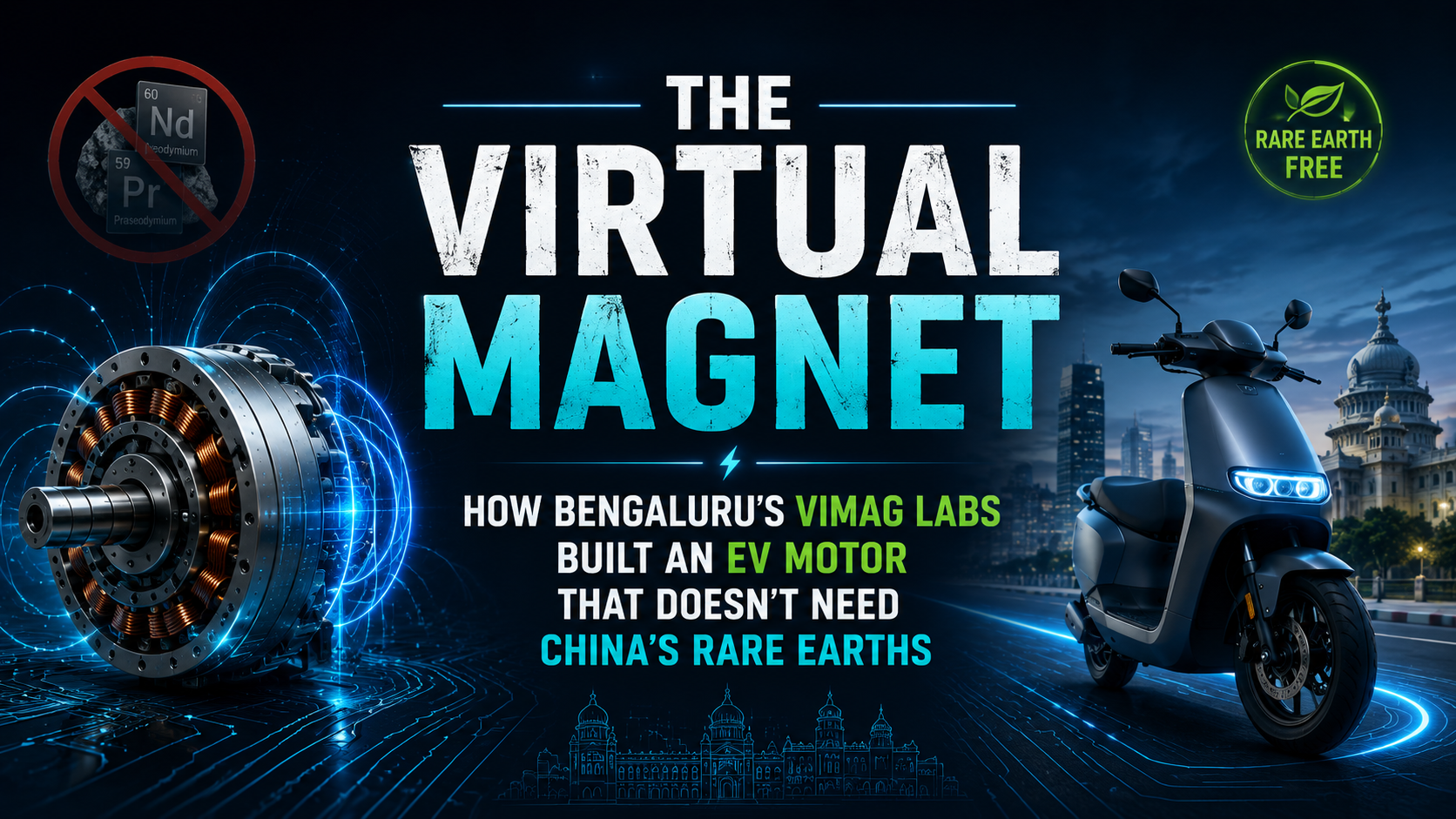
That single point of dependency has been quietly worrying automakers, defence planners and policymakers for years, and 2025 turned the worry into a genuine supply chain scare. Now a small, relatively unknown startup in Bengaluru says it has found a way around the problem entirely, not by mining rare earths somewhere else, but by removing them from the motor altogether.
Vimag Labs calls its invention the Virtual Magnet Synchronous Motor, or VMSM. Instead of a physical magnet, the rotor carries copper windings that are wirelessly energised to behave like one, with software deciding how strong that “magnet” needs to be at any given instant. It sounds almost too simple to work. Yet the company has five granted patents, a five million dollar Series A round, a manufacturing partnership, and pilot programmes running with vehicle makers who are, according to the founder, already testing physical units on the road. Here is the full story of how the technology works, why it matters, and how far it still has to go.
The Rare Earth Problem That Started It All
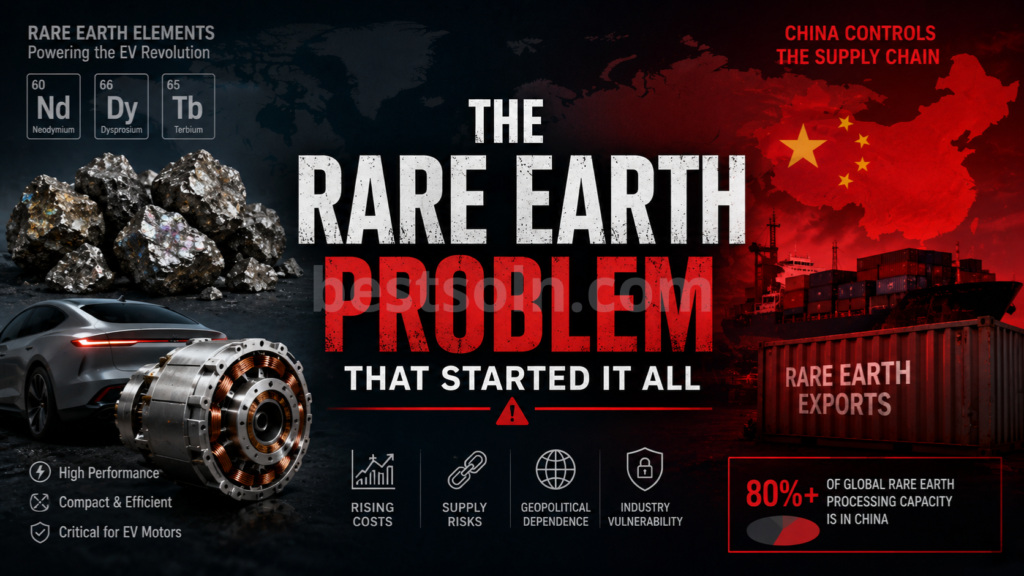
To understand why Vimag Labs exists, you first have to understand just how one-sided the rare earth trade has become. According to the International Energy Agency, China controls roughly 90 percent of the world’s rare earth minerals and about 94 percent of the neodymium iron boron magnets used in high-performance electric motors. Its dominance is less about geology and more about processing. China holds only around a third of the planet’s known reserves, but it refines and separates about 91 percent of the world’s rare earths, which is where the real bottleneck sits.
India feels this dependency acutely. Roughly 80 to 90 percent of the magnets and related materials it uses come from China. When Beijing tightened export controls on seven heavy rare earth metals in April 2025, automakers in the United States and Europe were forced to slow production while new licences were processed. A separate rule introduced later that year, which targeted any foreign-made product containing even a trace of Chinese rare earth content, was eventually suspended but never fully withdrawn, leaving importing nations acutely aware of how quickly the tap could be turned off again.
Prices reflect that fragility. Rare earth costs have swung by 30 to 80 percent within a matter of months, at one point touching close to a million Chinese yuan per tonne. And refining these elements is not a clean process either. It typically involves leaching raw ore in large volumes of acid, which produces thorium, a radioactive byproduct that requires long-term, specialised storage. That is a large part of the reason most countries have historically found it easier to simply buy magnets from China rather than build the messy refining infrastructure themselves.
It was against this backdrop, an industry racing to electrify while depending almost entirely on one country for its most critical component, that Vimag Labs began asking a different question. What if the motor simply did not need a permanent magnet at all?
A Pandemic, a Stuck Shipment, and an Idea

The origin story behind Vimag Labs is less boardroom strategy and more real-world frustration. In 2020, founder Manish Seth, an automotive engineer, had a consignment of magnets, essential for the prototype motors his earlier venture was building, stuck at a locked-down port in Shanghai. It sat there for three months while the pandemic paralysed global shipping.
Seth has since described that period as the moment the idea for a completely magnet-free, rare-earth-free motor took shape. Rather than look for a different magnet supplier or a workaround, he decided the entire dependency needed to disappear. Existing magnet-free alternatives, such as AC induction motors or switched reluctance motors, were already on the table, but they came with real compromises. They tend to be bulkier and less efficient, and ferrite magnets, a common substitute, simply cannot match the performance of rare-earth ones. As Seth has put it, you cannot substitute something as good as gold with something as ordinary as aluminium; global automotive and aerospace industries are not going to accept a performance downgrade just to solve a sourcing problem.
That conviction sent Vimag Labs back to first principles physics rather than toward incremental fixes.
What Exactly Is a Virtual Magnet?
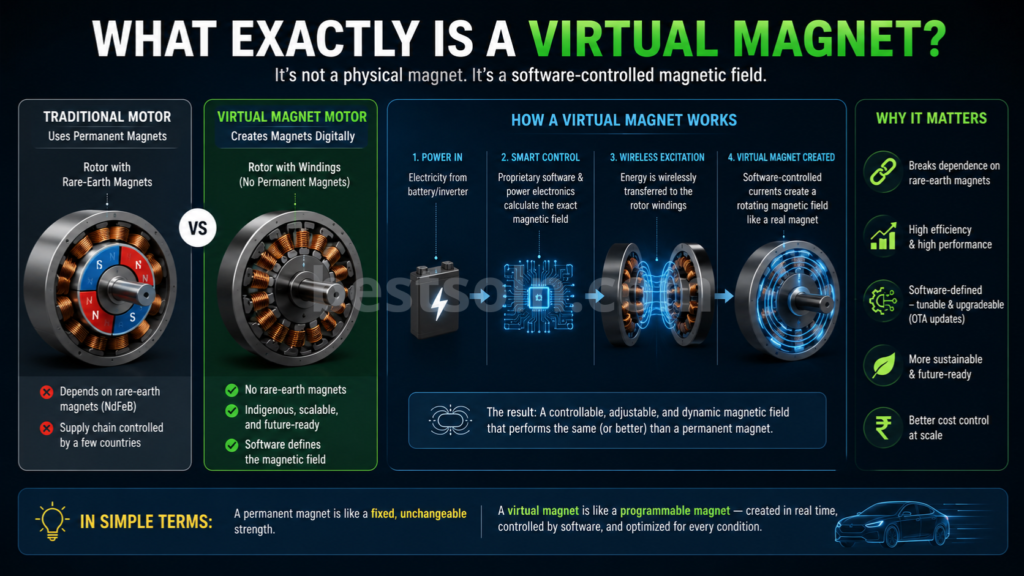
Almost every electric vehicle on sale today uses a Permanent Magnet Synchronous Motor, or PMSM. Fixed rare earth magnets sit inside the rotor and create a constant magnetic field, which the stator’s rotating field interacts with to produce torque. It is an efficient, compact, well-understood design, which is exactly why the industry has standardised around it, and exactly why the rare earth dependency has become so deeply embedded.
Vimag’s VMSM keeps the basic shape of that architecture but throws out the fixed magnet. In its place sit ordinary copper windings on the rotor. These windings are energised wirelessly, through inductive power transfer, essentially a rotating transformer built into the motor, so there is no physical electrical contact between the spinning rotor and the stationary parts around it. Once energised, the copper coil behaves as an electromagnet. Software then continuously adjusts how much current flows into that coil, effectively tuning the strength of the magnetic field in real time rather than living with whatever field a fixed magnet happens to produce.
This is not an entirely new category of motor. Externally excited synchronous machines, which also swap permanent magnets for electromagnets, already exist in production vehicles from manufacturers including BMW. The difference is in how the rotor gets its power. BMW’s version and similar designs typically use physical brushes and slip rings to carry current onto the spinning rotor, a method that works but introduces mechanical wear, electrical noise, and ongoing maintenance needs. Vimag Labs’ contribution was building a patented wireless power transfer system that removes those brushes entirely, energising the rotor with no physical electrical contact at all.
Under the Hood: How the Technology Actually Works
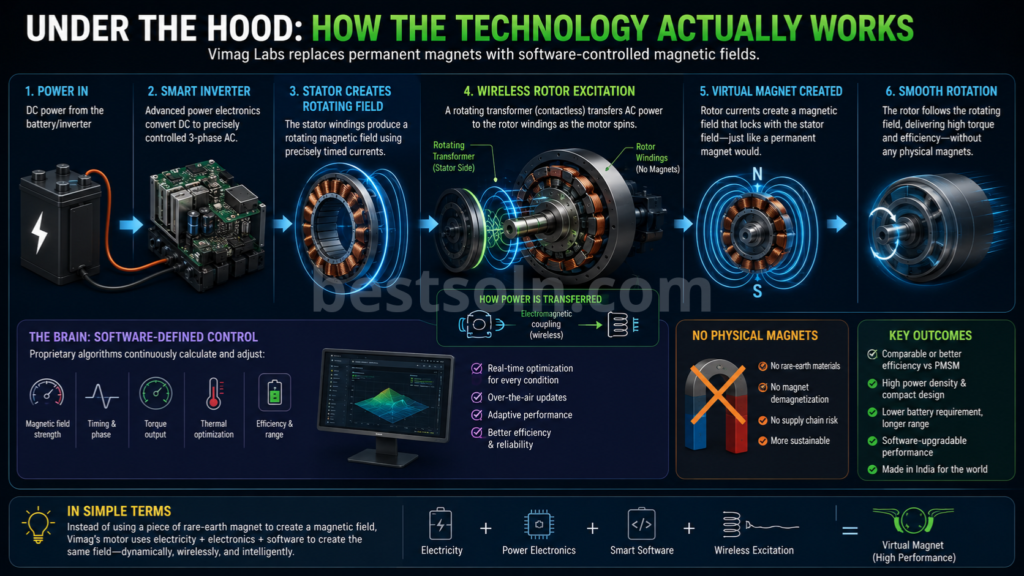
Externally, a VMSM looks close enough to a conventional PMSM that it can slot into existing vehicle platforms without major redesign. Power from the battery reaches a largely conventional stator, then gets transferred wirelessly to the rotor, where it energises the copper windings that stand in for a magnet. The company kept standard motor manufacturing methods intact and pushed nearly all the new complexity into the control electronics and software layer instead.
That software has a genuinely demanding job. It has to work out, many thousands of times a second, how much rotor excitation and how much stator current a given moment calls for. Climbing a slope needs more torque, so the system has to decide instantly whether to draw that extra torque from the stator or by strengthening the virtual magnet itself. These calculations run at update rates exceeding 20 kilohertz, blending rule-based logic with regression models and machine learning to continuously predict the most efficient split between magnetic field strength and stator current.
Building the tools to design and validate this kind of system was itself a challenge, since no commercial motor design software existed for this particular architecture. Vimag Labs’ engineering team had to build its own simulation and validation tools before it could produce a working prototype, which finally came together around 2021 or 2022. By Seth’s account, the first version looked nowhere near production-ready, but the moment it spun up and generated a genuinely strong magnetic force, it confirmed that the underlying physics held up.
On performance, the company has tested its motors against standard automotive benchmarks including the Worldwide Harmonized Light Vehicles Test Cycle. Vimag says drive cycle efficiency comes out comparable to, and in some cases slightly ahead of, conventional PMSMs, while allowing a smaller motor to deliver the same power output. Most of that efficiency advantage shows up at higher speeds, in what is called the field weakening region, where conventional permanent magnet motors typically lose the most efficiency because the controller has to actively fight the magnet’s own field to keep spinning faster. At lower speeds, patented control methods that manage current distribution and magnetic saturation reportedly deliver 20 to 30 percent more torque for the same current, alongside a control approach similar to maximum torque per ampere optimisation, constantly nudging the system toward its most efficient operating point.
Interestingly, the company treats its motor architecture and its control software very differently from an intellectual property standpoint. The physical designs are patented and made public through the filing process. The control algorithms, which Seth has called the real brain of the system, are deliberately kept as trade secrets rather than patented, since patenting them would require disclosing exactly how they work. Rather than relying on unusually powerful processors, the system runs on standard automotive motor control microcontrollers, with software optimised to keep memory use and computing time low, sometimes substituting machine learning approaches for deterministic calculations specifically to reduce the computational load.
| Technical Parameter | Permanent Magnet Synchronous Motor (PMSM) | Induction Motor (IM) | European Brushed EESM (BMW, Renault) | European Wireless EESM (Mahle, ZF) | Vimag Labs VMSM Platform |
| Rare-Earth Mineral Content | High (Neodymium, Dysprosium) | Zero | Zero | Zero | Zero |
| Rotor Field Excitation | Fixed Permanent Magnets | Induced Rotor Currents | Direct Current via Brushes/Slip Rings | Contactless Inductive Exciter | High-Frequency Rotating Transformer |
| Field Controllability | None (Fixed Magnetic Flux) | Indirect via Stator Slip | Direct Brushed Current Control | Direct Inductive Adjustment | Dynamic Real-Time Software Modulation |
| Mechanical Contact Components | None (Brushless) | None (Brushless) | Brushes and Slip Rings Present | None (Brushless) | None (Brushless and Slip-Ring Free) |
| High-Speed Efficiency | Lower due to Field-Weakening Drag | Moderate | High via De-excitation | High via Inductive Control | High via Real-Time Field Suppression |
| Supply Chain Vulnerability | High Risk (Monopolized Refining) | Low Risk (Standard Copper/Steel) | Low Risk (Standard Materials) | Low Risk (Standard Materials) | Low Risk (Standard Copper and Steel) |
Patents, Funding and the Business Behind the Physics
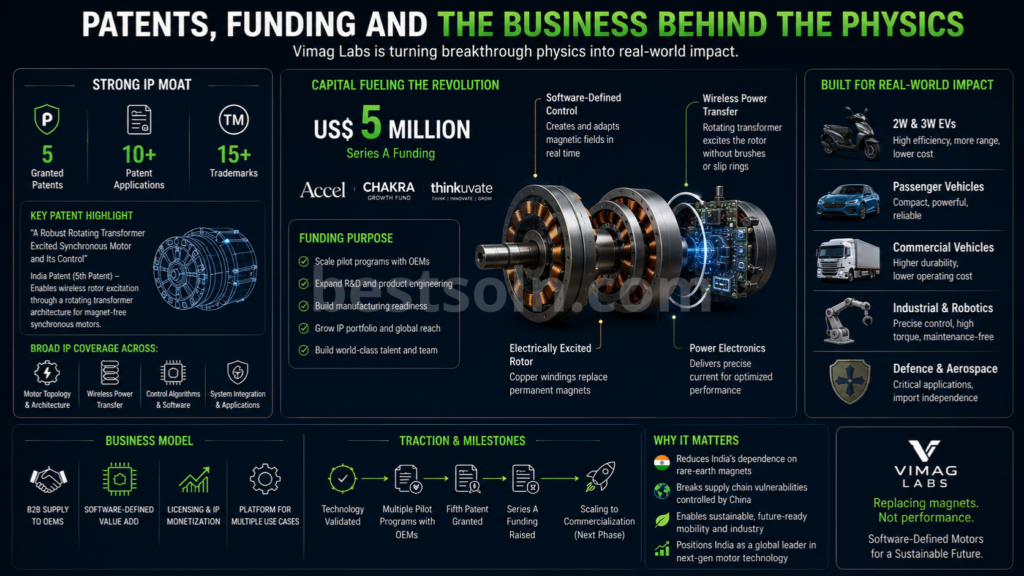
Vimag Labs’ intellectual property portfolio has grown steadily. Its most recent and fifth granted patent, titled “A Robust Rotating Transformer Excited Synchronous Motor and Its Control,” covers the core architecture of the VMSM platform and represents, according to the company, the product of more than 87,600 engineering hours. Ten more patents and fifteen trademarks are reportedly in the pipeline, covering motor architecture, software controls, power electronics, and application-specific implementations.
On the financial side, the company raised 5 million dollars in a Series A round led by Accel, with participation from Chakra Growth Fund and Thinkuvate. It has also signed a manufacturing memorandum of understanding with Jendamark to support scaling up production of the VMSM platform. Seth has estimated the technology sits at roughly Technology Readiness Level 8, meaning the design has been validated through extensive testing and is close to full deployment, with customer validation on actual road-going vehicles expected to begin within a few months of mid-2026.
The founding team’s background is worth noting too. Seth and his co-founder, Dr Piyush Desai, along with the company’s broader founding and advisory bench, collectively hold somewhere between 100 and 200 patents from earlier work across different motor technologies. That prior experience is part of why the team concluded existing architectures, whether reluctance motors, induction motors, or brushed externally excited designs, offered little further room for improvement, pushing them toward an entirely new approach instead.
| Strategy Pillar | Vimag Labs Approach | Key Details & Supporting Evidence |
| Intellectual Property | Comprehensive and layered protection | Secured 5th Indian patent (“A Robust Rotating Transformer…”); filed PCT international applications; holds 15 trademarks; portfolio spans motor architecture, software, and power electronics; |
| Funding | Significant Series A investment | Raised $5 million in a round led by Accel, with participation from Chakra Growth Fund and Thinkuvate. |
| Commercial Roadmap | Phased market entry targeting high-growth segments | Initial focus on 2W/3W EVs for rapid adoption; expansion into heavy trucks, defense, robotics, and industrial motors (up to 600 kW). |
| Manufacturing | Outsourced production via partnership | Signed an MoU with Jendamark for manufacturing services. |
| Long-Term Vision | Dominant IP licensing platform | Aims to license the VMSM platform to all other motor manufacturers, creating a software-defined ecosystem. |
From Lab Bench to Two-Wheelers and Beyond
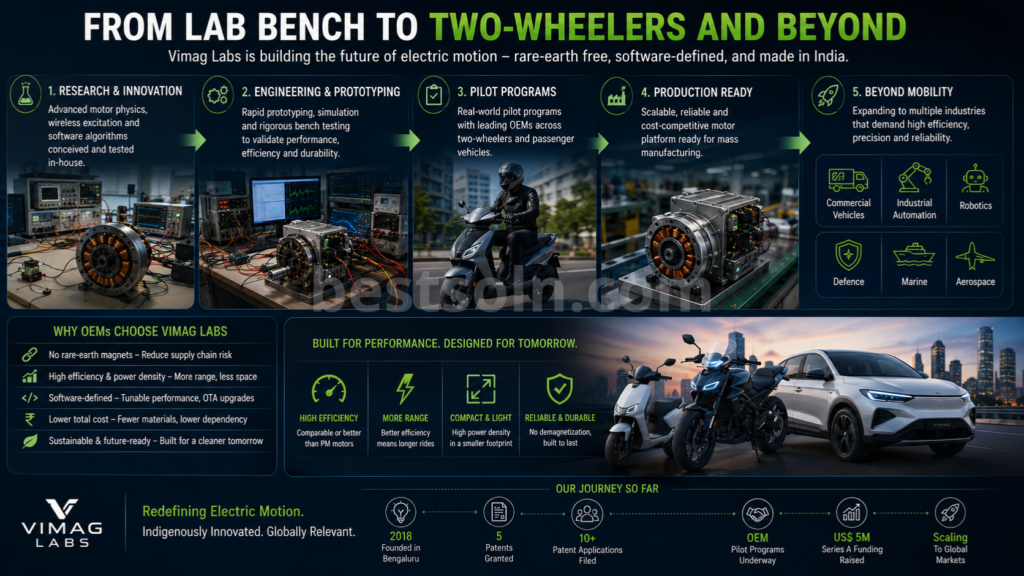
Vimag Labs markets its automotive products under the brand name Volektra, and the company has been careful to frame its ambitions broadly rather than narrowly. The same core hardware architecture is being adapted, through software calibration, housings, mounting arrangements and gearbox integration, for two- and three-wheelers, passenger cars, buses and trucks. Beyond road vehicles, the company is also targeting industrial systems in the 200 to 600 kilowatt range, along with robotics, defence and cooling applications.
On the commercial side, Vimag says it is running pilot programmes with one of India’s top five electric two-wheeler manufacturers and holding advanced discussions with a company that ranks in the top two. It has also partnered with what Seth describes as an iconic, premium Indian heritage brand that recently entered the EV space, alongside a powertrain supplier holding a sizeable share of the commercial three-wheeler market. On the passenger vehicle side, the company is working with one of India’s top two car makers to co-develop a next-generation EV platform, and separately collaborating with a European Tier 1 supplier to bring the magnet-free motor into premium European and American electric cars.
India remains the company’s primary production base for now, with programmes also underway in Europe and early-stage conversations in the United States. Seth has said the company expects to ship somewhere between 1,000 and 10,000 motors from its factory before the end of 2026, a deliberately cautious ramp given current supply constraints rather than a limit on demand.
Looking further ahead, Seth has suggested the company’s long-term competitive edge will increasingly come from its electronics rather than the motor itself, since as the hardware architecture matures, the real differentiation shifts to the semiconductor and control layer. Vimag Labs is reportedly evaluating custom system-on-chip designs, working through RTL implementation and FPGA validation stages, with proprietary silicon as an eventual goal.
| Aspect | Vimag Labs’ VMSM | Industry Benchmark (High-Performance PMSM) | Status/Gap |
| Core Principle | Software-defined, wirelessly excited virtual magnet | Fixed magnetic field from rare-earth permanent magnets | VMSM is patented; PMSM is mature and standardized. |
| Materials | Copper, steel, standard power electronics | Neodymium, Praseodymium, Dysprosium, Terbium | VMSM uses common materials; PMSM relies on critical REEs. |
| Field Control | Dynamic, real-time software control | Static, inherent property of the magnet | VMSM offers adaptive control; PMSM has a fixed field. |
| Efficiency Claim | Improved efficiency over PMSM | High, but with compromises across operating conditions | No independent verification of VMSM efficiency claims. |
| Validation | Static test validated by ZF; undergoing real-world vehicle testing | Decades of real-world deployment and optimization | VMSM lacks extensive real-world performance data. |
| Cost at Scale | Unproven; claimed to be manufacturable in India | Mature supply chain leads to economies of scale | Cost competitiveness of VMSM is a major unknown. |
| Market Stage | TRL-7, targeting 2W/3W commercialization first | Mass-market, dominant technology | PMSM is the incumbent leader; VMSM is a challenger. |
Why This Fits Into India’s Bigger Rare Earth Strategy
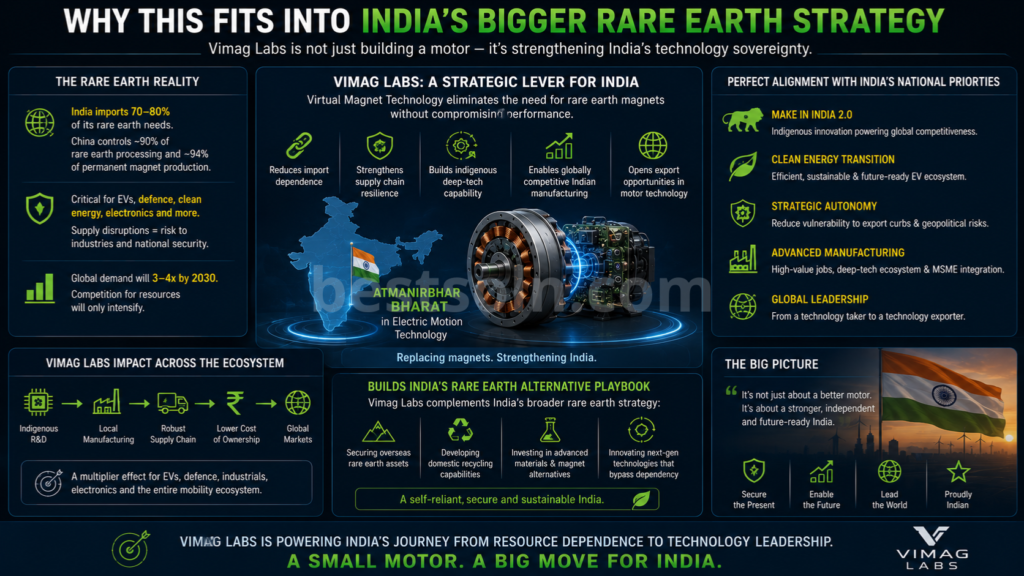
Vimag Labs is not operating in isolation. Its rise coincides with a much larger, coordinated push by the Indian government to reduce reliance on Chinese rare earths across the board. New Delhi has moved to roughly triple a production-linked incentive scheme worth 7,280 crore rupees aimed at building domestic rare earth magnet manufacturing capacity, with a target of producing 6,000 tonnes of permanent magnets annually within seven years to meet demand that officials expect to double over the next five years.
The Union Budget for 2026 to 2027 announced dedicated corridors for the mining, processing, research and production of rare earth permanent magnets across Odisha, Kerala, Andhra Pradesh and Tamil Nadu. Separately, the National Critical Mineral Mission, launched in January 2025 as a seven-year programme, is meant to secure long-term supply chains and strategic stockpiles of critical minerals more broadly. India has also been striking international partnerships, including an agreement to invest in rare earth permanent magnet, steel and nickel production in Indonesia, and domestic conglomerates including Reliance, Vedanta and Adani have expressed interest in setting up rare earth and titanium processing facilities in Andhra Pradesh, a push that state officials hope will draw around 500 billion rupees in investment over the next decade.
Seen against that backdrop, Vimag Labs represents a different but complementary strategy. Rather than competing with China at mining and refining, which requires years of infrastructure building and carries real environmental costs, the company is trying to make the underlying dependency irrelevant by redesigning the product that consumes rare earths in the first place. As Seth has pointed out, India’s growing investment in domestic chip manufacturing through the India Semiconductor Mission means the electronics that power a motor like his are only going to get cheaper over time, even as global rare earth supply grows more uncertain.
The Questions Still to Be Answered
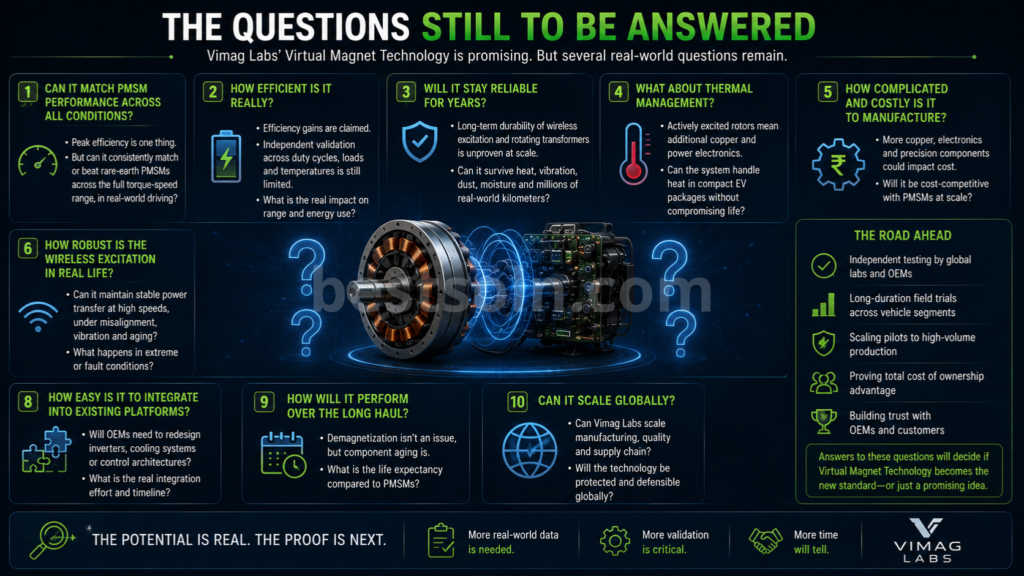
For all the promise, it is worth applying a healthy dose of scrutiny here too. Vimag Labs’ performance figures, the torque gains, efficiency comparisons and cost competitiveness, currently come primarily from the company itself and its own testing programmes rather than independent third-party benchmarking. That is common for an early-stage deep tech startup, but it also means the claims deserve to be treated as promising rather than proven until customer vehicles carrying VMSM motors have logged meaningful real-world mileage.
Manufacturing at scale is its own separate challenge from getting a prototype to work on a test bench. Wireless power transfer systems, high-frequency control loops, and machine-learning-based motor control all add engineering complexity that has to be manufactured reliably and affordably across thousands, and eventually millions, of units. The company’s own shipment target of 1,000 to 10,000 motors by the end of 2026 is a useful early marker to watch, since a smooth ramp through that range would be a meaningful signal that the technology is ready for genuine mass production rather than limited pilot runs.
There is also the matter of cost. Vimag has said its motors will be competitively priced against permanent magnet motors, but the actual bill of materials for a wireless power transfer system, plus the semiconductor content the company itself expects to grow, will need to hold up against a rare earth supply chain that, while volatile, still benefits from decades of manufacturing scale. None of this diminishes what looks like a genuinely inventive piece of engineering. It simply means the real test lies ahead, on the road, in customer vehicles, over the next year or two.
Recommended Readings
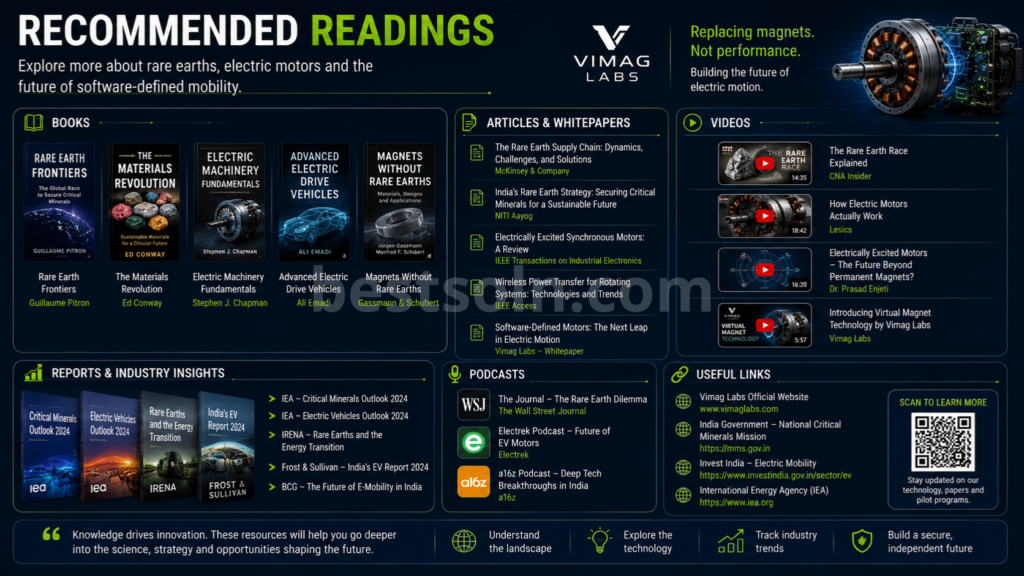
- The Elements of Power: Gadgets, Guns, and the Struggle for a Sustainable Future in the Rare Metal Age by David S. Abraham A deep look at the obscure metals, many of them rare earths, that quietly power modern electronics, weapons and clean energy technology. Abraham traces how a handful of countries, China chief among them, came to control these supply chains, and what that concentration means for global security and industry.
- The Rare Metals War: The Dark Side of Clean Energy and Digital Technologies by Guillaume Pitron A French investigative journalist’s account of the human and environmental cost behind the metals that make smartphones, wind turbines and electric motors possible. The book is especially good on the mining and refining side of the story, including the pollution and radioactive waste issues touched on in this article.
- Volt Rush: The Winners and Losers in the Race to Go Green by Henry Sanderson Written by a former Financial Times commodities editor, this book follows the global scramble for the raw materials, lithium, cobalt, nickel and rare earths, needed for the electric vehicle boom. It offers useful context on why companies and countries are so eager to reduce their dependence on any single material or supplier.
- Power Play: Tesla, Elon Musk, and the Bet of the Century by Tim Higgins A detailed, narrative driven history of Tesla’s rise, written by a Wall Street Journal reporter who covered the company closely. It is a good companion read for understanding how high stakes bets on unproven automotive technology, including motor and battery design choices, can reshape an entire industry.
- Design of Rotating Electrical Machines by Juha Pyrhönen, Tapani Jokinen, and Valeria Hrabovcová A rigorous, textbook level treatment of how electric motors and generators are actually designed and engineered, covering permanent magnet, induction and synchronous machine types in technical detail. Recommended for readers who want to go beyond the conceptual explanation in this article and understand the underlying electromagnetics.
Frequently Asked Questions
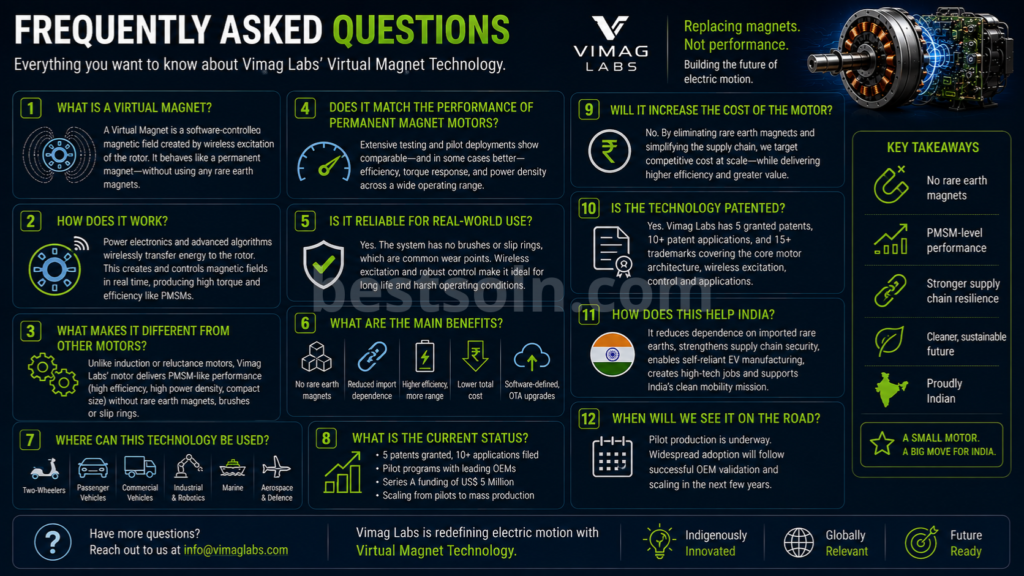
Q1: What is Vimag Labs’ Virtual Magnet technology?
A: It is a motor architecture called the Virtual Magnet Synchronous Motor, or VMSM, that replaces the rare-earth permanent magnets found in conventional EV motors with copper windings. These windings are wirelessly energised to act as an electromagnet, and software continuously adjusts the field strength in real time.
Q2: How is this different from motors that already use electromagnets, like some BMW models?
A: Existing externally excited synchronous motors typically use physical brushes and slip rings to power the rotor’s electromagnet, which causes wear and requires maintenance over time. Vimag Labs uses a patented wireless, inductive power transfer system instead, so there is no physical electrical contact with the spinning rotor at all.
Q3: Does the Virtual Magnet motor perform as well as a conventional magnet-based motor?
A: According to the company’s own drive cycle testing, the VMSM delivers efficiency comparable to or slightly better than a standard permanent magnet motor, with particularly strong gains at higher speeds and 20 to 30 percent more low-speed torque for the same current, though these figures have not yet been independently verified at large scale.
Q4: Why does China’s dominance in rare earth magnets matter so much for EVs?
A: China controls close to 90 percent of global rare earth mineral supply and around 94 percent of the magnets used in high-performance electric motors, largely because of its dominance in refining rather than mining. This concentration has led to periodic export restrictions and sharp price swings that leave EV manufacturers around the world, including in India, exposed to sudden supply disruptions.
Q5: When will Vimag Labs’ motors be available in vehicles people can buy?
A: The company says its technology has reached an advanced stage of readiness and is currently in pilot programmes with several vehicle manufacturers, with on-road customer validation expected soon. It has targeted shipping between 1,000 and 10,000 motors from its factory by the end of 2026, an early and deliberately controlled production run rather than full-scale commercial deployment.
Q6: Is Vimag Labs part of India’s broader push to reduce rare earth dependence?
A: While Vimag Labs is a private company operating independently, its work aligns with a wider Indian government effort that includes production incentive schemes, dedicated mineral processing corridors, and the National Critical Mineral Mission, all aimed at reducing the country’s reliance on Chinese rare earth supplies.
Conclusion
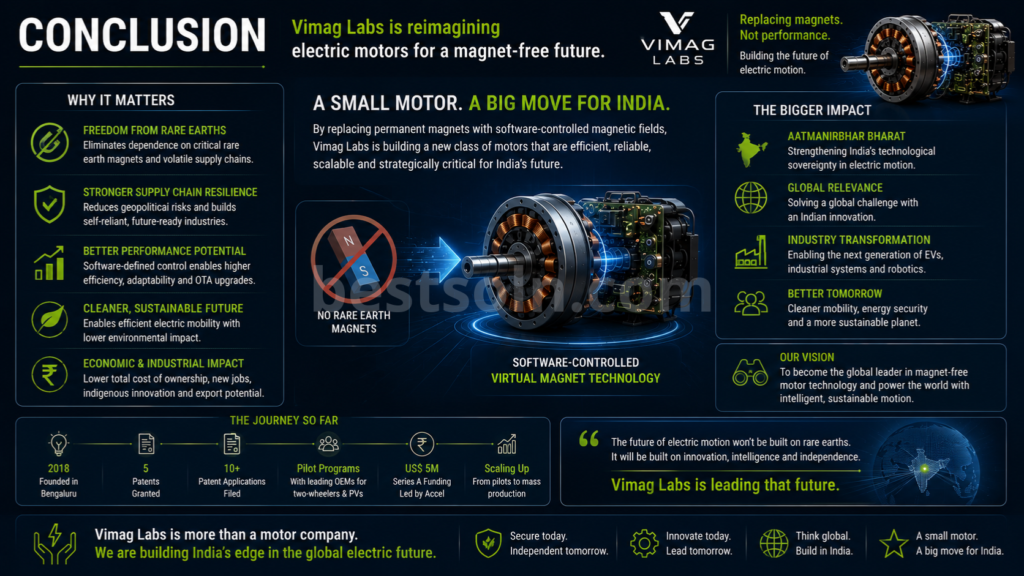
Vimag Labs’ Virtual Magnet Synchronous Motor is one of those rare technology stories where the pitch sounds almost implausible until you follow the physics through. Swap a fixed rare earth magnet for a wirelessly powered copper coil, hand the job of shaping the magnetic field over to software running tens of thousands of calculations a second, and you get a motor that, at least on the company’s own testing, matches or beats the industry standard while sidestepping the world’s single most concentrated supply chain risk.
Whether this becomes the moment India’s EV industry meaningfully loosens its dependence on Chinese rare earths, or simply one promising chapter in a much longer struggle for supply chain resilience, will depend on what happens over the next couple of years as Volektra motors move from pilot programmes into showrooms. But the underlying idea, that a problem decades in the making might be solved not by digging more rare earths out of the ground but by rethinking what a motor actually needs to work, is the kind of quietly radical engineering bet worth watching closely.












Leave a Reply