

- Home
- /
- Space Tech
- /
- Skyroot’s Vikram-1: How a Hyderabad…
⏱️ Read Time:
Introduction
On the morning of July 18, 2026, a 22-metre rocket built almost entirely by a private Indian company lifted off from the Satish Dhawan Space Centre in Sriharikota and did something no other privately built Indian rocket had ever done before. It reached orbit.
The rocket was Vikram-1, built by Hyderabad-based Skyroot Aerospace, and the mission carried the fitting name Aagaman, which means “arrival” in Hindi. Seventeen minutes after liftoff, mission control confirmed that all four stages had performed exactly as planned and that the satellites onboard had been placed precisely where they were supposed to go. With that, India became only the third country in the world, after the United States and China, to have a privately built rocket reach orbit on its own steam.
This is not a small achievement dressed up in big language. It is genuinely rare. Dozens of countries have national space agencies. Only a handful of private companies anywhere on the planet have managed to design, build, and fly an orbital-class rocket that actually worked on its first real attempt. Skyroot just joined that list, and it did so from a facility it built itself, using engines it designed itself, funded largely by Indian and international private capital rather than government money.
Here is the full story of what happened, why it matters, and what it means for the industry now.
What Exactly Happened on Launch Day
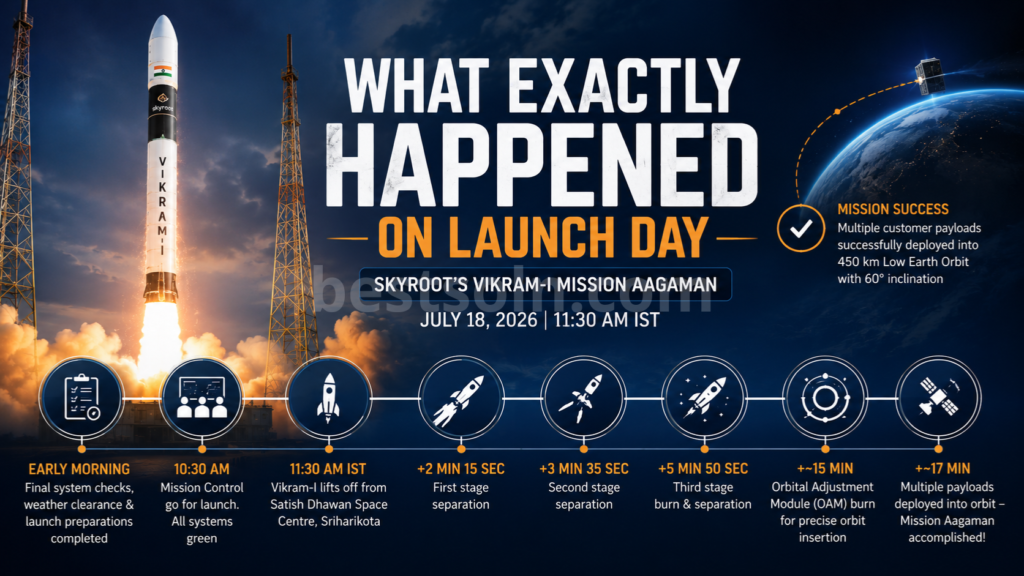
Vikram-1 lifted off from the First Launch Pad at Sriharikota at 12:05 p.m. India Standard Time on Saturday, July 18, after a countdown that had run smoothly for roughly 36 hours before a brief technical pause pushed the actual liftoff back by about 35 minutes. Once the automated sequence restarted, the rocket’s first-stage solid motor ignited and Vikram-1 rose off the pad trailing fire and smoke, watched by crowds at the spaceport and a much larger audience following Skyroot’s live webcast.
The vehicle weighed around 40 tonnes at liftoff and stood about 22 metres tall, roughly the height of a seven-storey building. It flew a three-stage solid fuel ascent followed by a liquid-fuelled upper stage used for final orbital adjustment, a configuration Skyroot had been testing in pieces for years before finally putting it all together for a live flight.
By the time the mission reached its seventeen-minute mark, every milestone had been ticked off. The rocket held a nominal trajectory throughout ascent, deployed its payloads on schedule, and settled its cargo into a low Earth orbit at an altitude of about 450 kilometres. Mission control’s declaration said it plainly: “The Vikram-1 Aagaman mission is a grand success.” Skyroot’s own post on social media was less formal and probably more honest about how the team felt in that moment: “Hello space, we have arrived.”
Pawan Goenka, who chairs the Indian National Space Promotion and Authorisation Centre, the government body that regulates and enables private space activity in India, said the outcome had gone “way beyond expectation for the very first orbital launch ever taken by an Indian private company.” Prime Minister Narendra Modi congratulated the team publicly, saying the achievement would “encourage countless youngsters to dream bigger and innovate fearlessly.”
Meet the Company Behind the Rocket
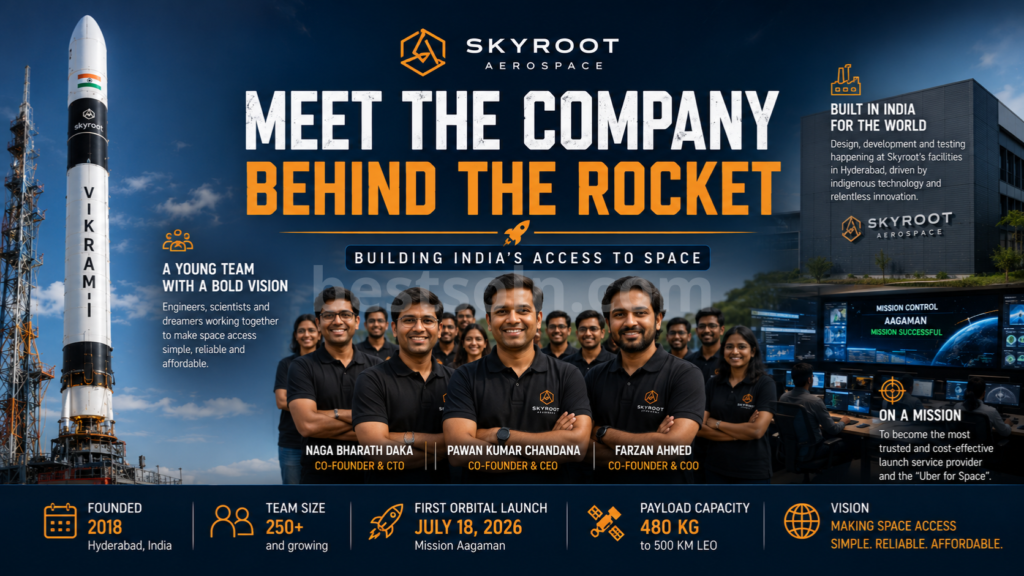
Skyroot Aerospace was founded in Hyderabad in June 2018 by Pawan Kumar Chandana and Naga Bharath Daka, both former ISRO engineers who left the space agency to try building rockets on their own terms. The company started with a team of about ten people, incubated at T-Hub, one of India’s better-known startup accelerators, and has since grown into an organisation of more than a thousand employees.
Chandana serves as chief executive and chief technology officer, while Daka runs operations as chief operating officer. Their pitch from the beginning was straightforward: launch vehicles built faster, cheaper, and more flexibly than what traditional government-run programmes could offer, aimed squarely at the booming global market for small satellite launches.
Skyroot’s first big public moment came in November 2022, when it launched Vikram-S, a smaller suborbital rocket, under a mission called Prarambh, meaning “the beginning.” That flight reached an altitude of roughly 89.5 kilometres and made history as the first privately developed rocket ever launched from India, though it never touched orbit. It was a proof of concept rather than an orbital delivery vehicle, and everyone involved knew that Vikram-1 was the real test still to come.
In the years between those two flights, Skyroot kept building. It test-fired a series of engines named after Indian scientists, including the solid-fuel Kalam motors named for A.P.J. Abdul Kalam and the Dhawan cryogenic engines named for Satish Dhawan, steadily working through the technical steps needed for an orbital-class vehicle. It opened what it called the largest private integrated rocket development facility in India near Rajiv Gandhi International Airport in 2023, and then, in November 2025, Prime Minister Modi personally inaugurated Skyroot’s much larger Infinity Campus, a 200,000-square-foot facility in Hyderabad designed to eventually turn out one orbital rocket a month.
| Stage Identification | Propulsion Type | Propellant Chemistry | Peak Thrust (kN) | Primary Control Mechanism | Casing and Shell Structure |
| Stage 1 (Kalam 1200) | Solid Motor | Solid Propellant | 1,000 | Passive Aerodynamics and Ground Guidance | Monolithic Carbon Fiber Composite |
| Stage 2 (Kalam 250) | Solid Motor | Solid Propellant | 250 | Active Thrust Vector Control | Carbon Fiber Composite Casing |
| Stage 3 (Kalam 100) | Solid Motor | Solid Propellant | 100 | Advanced Flex-Nozzle System | Carbon Fiber Composite Casing |
| Stage 4 (OAM) | Liquid Upper Stage | Earth-Storable Hypergolic | 3.4 | Onboard Inertial Guidance with Restartable RCS Thrusters | 3D-Printed Liquid Engine Components |
Money followed the milestones. By October 2023, Skyroot had raised about 27.5 million dollars in a funding round led by Temasek Holdings, pushing its total funding close to 95 million dollars. Then, in May 2026, just weeks before Vikram-1’s launch, the company raised roughly 60 million dollars more and crossed a valuation of 1.1 billion dollars, making it India’s first space-tech unicorn.
Inside the Rocket: What Makes Vikram-1 Different
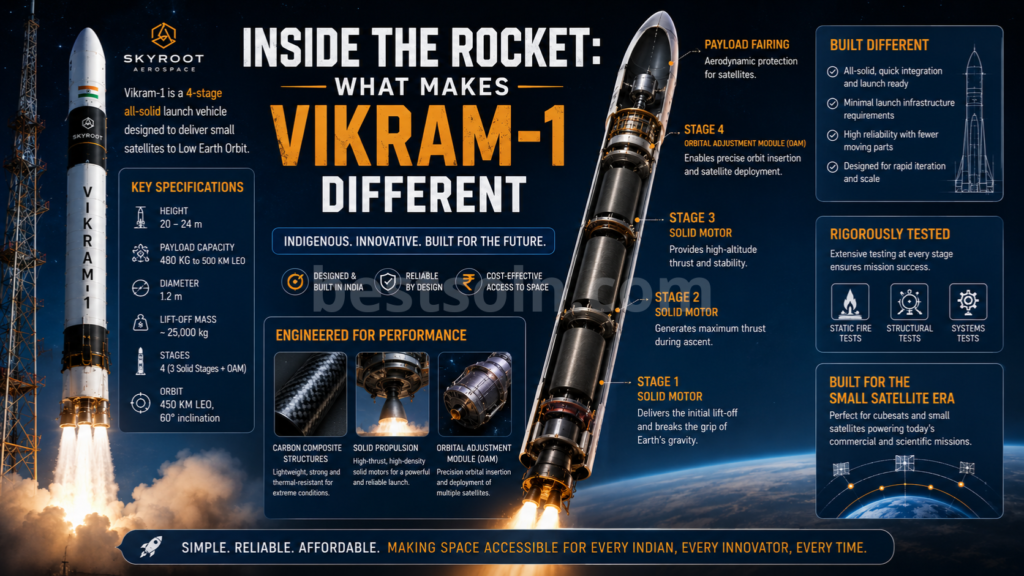
Vikram-1 is an expendable, four-stage small-lift launch vehicle designed to carry payloads of up to 350 kilograms into low Earth orbit. Its first three stages run on solid propellant, a deliberate choice by Skyroot’s engineers because solid motors are simpler to store, transport, and prepare for launch than liquid-fuelled stages, which cuts down on both cost and turnaround time. The fourth stage switches to liquid propulsion, used for the fine orbital adjustments needed to place multiple satellites precisely where customers want them.
The build itself leans heavily on materials and manufacturing techniques that are still relatively rare in the launch vehicle world. The airframe uses an all-carbon composite structure rather than traditional metal, which shaves weight without sacrificing strength. The liquid engine on the upper stage is 3D printed, a manufacturing approach Skyroot has been refining since it first unveiled its Dhawan-series engines back in 2020. The company says several of these technologies were flying for the first time in an Indian rocket.
Skyroot has also talked openly about designing Vikram-1 for rapid turnaround, aiming for a rocket that can be assembled and readied for launch within a short window rather than the months-long integration processes typical of larger government rockets. Whether that ambition holds up under real operational pressure is something only repeated flights will prove, but it is central to Skyroot’s pitch to future commercial customers who want predictable, fast access to orbit.
What Was Actually Riding on Top
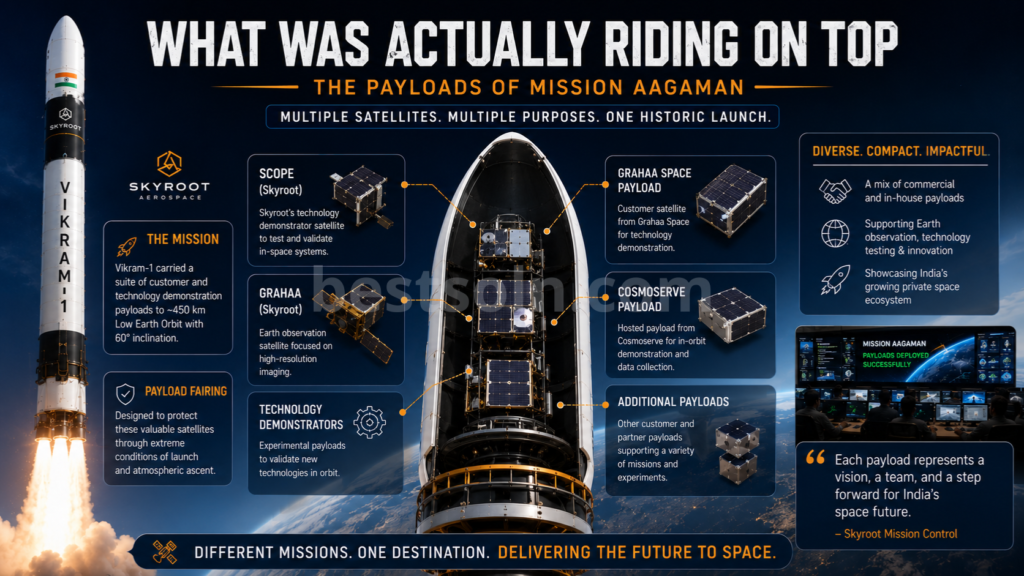
Mission Aagaman was not a bare technology demonstration flying empty. It carried a mix of commercial and symbolic payloads that say a lot about where Skyroot sees its business heading.
On the commercial side, the rocket deployed Skyroot’s own SCOPE satellite, a technology demonstration payload from Germany’s DCUBED, Grahaa Space’s SOLARAS S3 satellite, and an experimental robotic arm called Embrace, built by Cosmoserve Space and designed to eventually help capture orbital debris. Having customer payloads on a maiden flight is itself a statement of confidence, since most launch companies fly empty or with low-value test masses on a first attempt.
The symbolic cargo was, frankly, delightful. Skyroot flew a floral-shaped artwork called Cosmic Bloom alongside an 18-karat gold micro-rocket containing microscopic sculptures, each smaller than a grain of rice, of three towering figures in Indian science: C.V. Raman, Vikram Sarabhai, and A.P.J. Abdul Kalam. Reports also mentioned handwritten notes tucked aboard, including a message from the Prime Minister and notes from former ISRO chairmen, astronauts, and Skyroot’s own employees and investors. It was equal parts engineering test and public celebration, and the company clearly wanted the launch to feel like a moment the whole country could own.
Why This Matters Beyond One Successful Flight
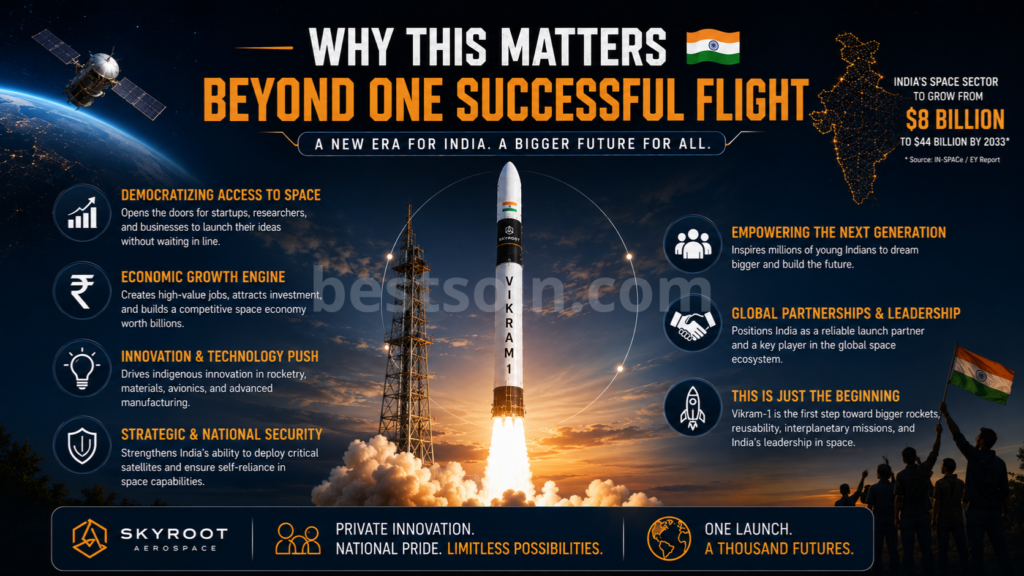
It is tempting to treat a rocket launch as a one-day story, but Vikram-1’s significance stretches well beyond the seventeen minutes it took to reach orbit.
For one, it validates years of policy work. India’s space sector operated as a near-total government monopoly for decades. That began changing meaningfully with the Indian Space Policy 2023, which opened the entire space value chain, from satellite manufacturing to launch services, to private companies. The government also liberalised foreign investment rules, permitting up to 74 percent automatic foreign investment in satellite manufacturing, 49 percent in launch vehicles and spaceports, and full automatic investment in component manufacturing. A new regulatory body, IN-SPACe, was set up to act as a single window for approvals, and by mid 2026 it had registered more than 4,500 organisations and issued well over a hundred authorisations.
Those reforms turned a sector with essentially one player, ISRO, into an ecosystem that now counts more than 400 space startups, up from a single startup in 2014. India’s space economy, valued at roughly 8.4 billion dollars today, is projected by the government to grow five-fold to somewhere between 40 and 45 billion dollars by 2030, with a longer-term ambition of reaching 100 billion dollars by 2040. Vikram-1’s success is the clearest proof yet that those numbers are not just wishful projections sitting in a policy document.
It also matters competitively. The global market for launching small satellites has become intensely crowded, dominated in large part by Elon Musk’s SpaceX, with a growing list of national and private players in Europe, Asia, and elsewhere racing to secure independent access to orbit for both commercial and defence reasons. A country having its own reliable, competitively priced private launch capability is no longer a nice-to-have. It has become a strategic asset, and India has just shown it can build one from scratch outside the usual government channel.
Finally, there is the simple fact of technical validation. Reaching orbit on a first attempt is genuinely uncommon. Many launch companies around the world, including some well-funded and well-known ones, have needed several attempts before their maiden orbital flight succeeded. Skyroot’s team validated propulsion, avionics, telemetry, and guidance and navigation systems all in one go, on the first real try.
Skyroot Was Not the Only One Racing to This Point
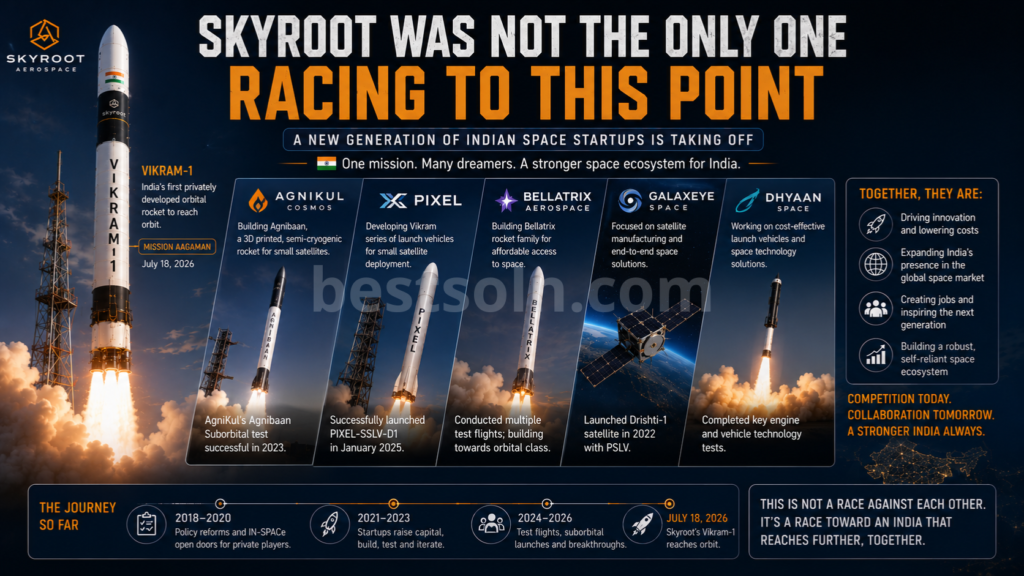
It is worth remembering that Skyroot has not had India’s private launch sector to itself. Agnikul Cosmos, another Indian startup, became the first private company to launch a rocket from an Indian private launch pad, called Dhanush, at Sriharikota in May 2024, and that mission featured what was described as the world’s first single-piece 3D-printed semi-cryogenic rocket engine. NewSpace India Limited, ISRO’s commercial arm, has meanwhile built up its own launch services business, having launched a total of 141 satellites by July 2026, the vast majority of them international customer payloads, including a landmark mission in October 2022 that placed 36 OneWeb satellites into orbit.
What sets Vikram-1 apart is scale and independence. It is the first fully orbital-class rocket built by an Indian private company from the ground up, engines, structure, avionics and all, rather than a smaller demonstration vehicle or a mission flown using shared government infrastructure.
| Launch Platform | Max LEO Payload | Est. Launch Cost | Est. Cost per Kilogram | Propulsion System |
| Vikram 1 (Skyroot) | 350 to 480 kg | $5 to $10 million | ~$15,000 | Hybrid: 3 Solid Kalam stages + 1 Liquid Raman upper stage |
| Electron (Rocket Lab) | 300 kg | $7.5 to $10 million | ~$25,000 | Liquid: Oxygen and Kerolox (RP-1) with electric-pump Rutherford engines |
| SSLV (ISRO & NSIL) | 500 kg | $4.2 million | ~$8,400 | Solid: 3 Solid stages + 1 Liquid Velocity Trimming Module |
| Alpha (Firefly Aerospace) | 1,000 kg | $15 million | ~$15,000 | Liquid: Oxygen and Kerolox (RP-1) |
| Falcon 9 (SpaceX Rideshare) | Up to 22,800 kg | ~$67 million (Dedicated) | ~$5,800 (Rideshare) | Liquid: Oxygen and Kerolox (RP-1) with Merlin engines |
The Harder Part Starts Now
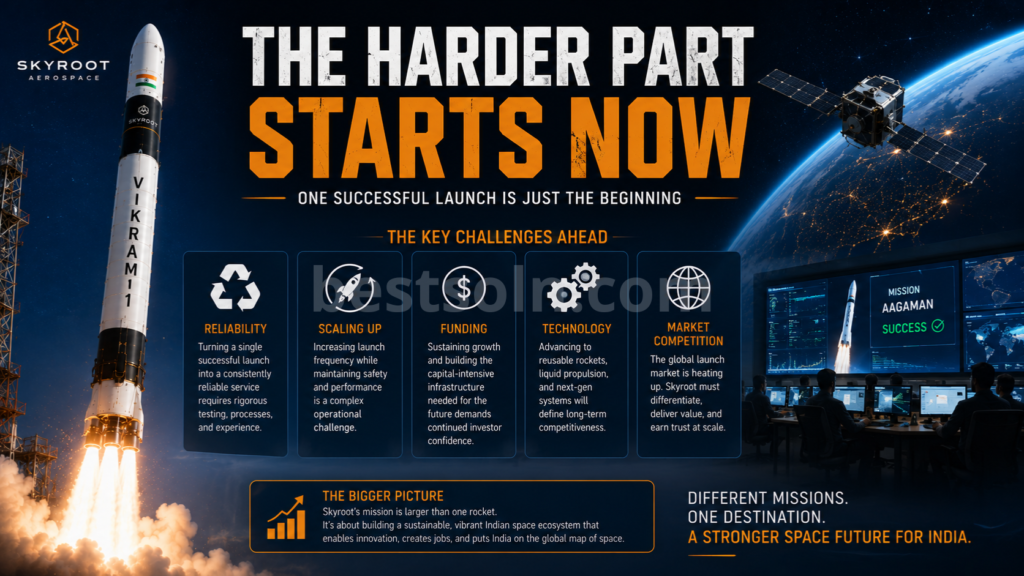
Here is the part that gets less attention in the celebratory headlines: reaching orbit once is an engineering triumph, but it is not the same thing as running a viable business. Industry analysts have been fairly blunt about this in the days since the launch. Building rockets requires continuous, heavy investment in research, testing, manufacturing, and highly specialised talent, and none of that spending stops just because one flight went well.
Skyroot’s next challenge is converting a successful test flight into a steady stream of paying customers. That means proving it can fly repeatedly and reliably, not just once. It means competing on price and turnaround time against established players and a fast-growing field of new entrants worldwide. It also likely means expanding beyond simply building rockets into adjacent services such as satellite deployment support, mission planning, and broader space logistics, all of which could help diversify revenue rather than relying purely on launch fees.
The company already has a next-generation vehicle in the works. Vikram-II, designed to carry heavier payloads of up to 600 kilograms using an upper-stage cryogenic engine, is targeted for its first flight in 2027. Skyroot has also signed partnership agreements that point toward a bigger long-term vision, including a memorandum of understanding with Axiom Space in mid 2025 to explore joint work on orbital systems and logistics tied to Axiom’s commercial space station under construction, and an agreement with Nibe Space and several other Indian firms to support a planned constellation of Earth observation satellites.
None of this guarantees success. Reuters, quoting officials close to the sector, has pointed out that future funding rounds will hinge heavily on Skyroot’s ability to lock in real commercial contracts rather than just technical credibility. But credibility is exactly what Vikram-1 bought the company, and in an industry where trust is everything, that is not nothing.
Recommended Reading
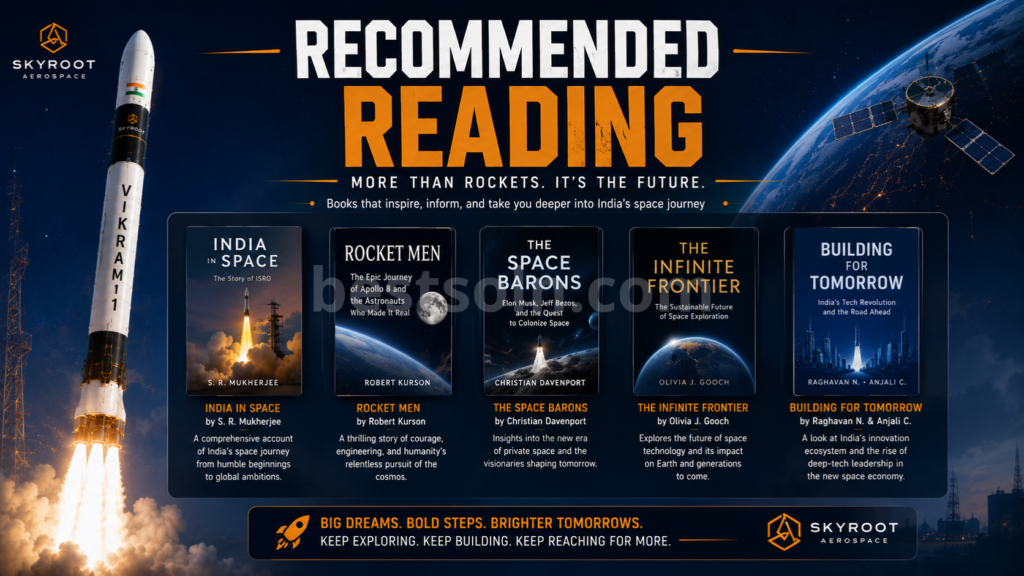
For readers who want to go deeper into the world of private spaceflight and the broader forces shaping it, these books offer useful context:
- “Liftoff” by Eric Berger – A detailed account of how SpaceX went from a struggling startup to a dominant force in commercial launch, offering useful parallels for understanding what Skyroot is attempting to build.
- “The Space Barons” by Christian Davenport – Explores how a handful of entrepreneurs reshaped the modern space industry and turned it into a genuine commercial frontier.
- “India’s Rise as a Space Power” by U.R. Rao – Written by a former ISRO chairman, this book traces the evolution of India’s space programme from its earliest days and provides essential background for understanding the environment Skyroot emerged from.
- “Rocket Men” by Craig Nelson – A well-researched look at the early days of orbital spaceflight that helps put the difficulty of what Skyroot achieved into historical perspective.
- “Ignition!” by John D. Clark – A classic, often entertaining account of the history of rocket propellant development, useful for readers curious about the chemistry and engineering choices behind vehicles like Vikram-1.
Frequently Asked Questions
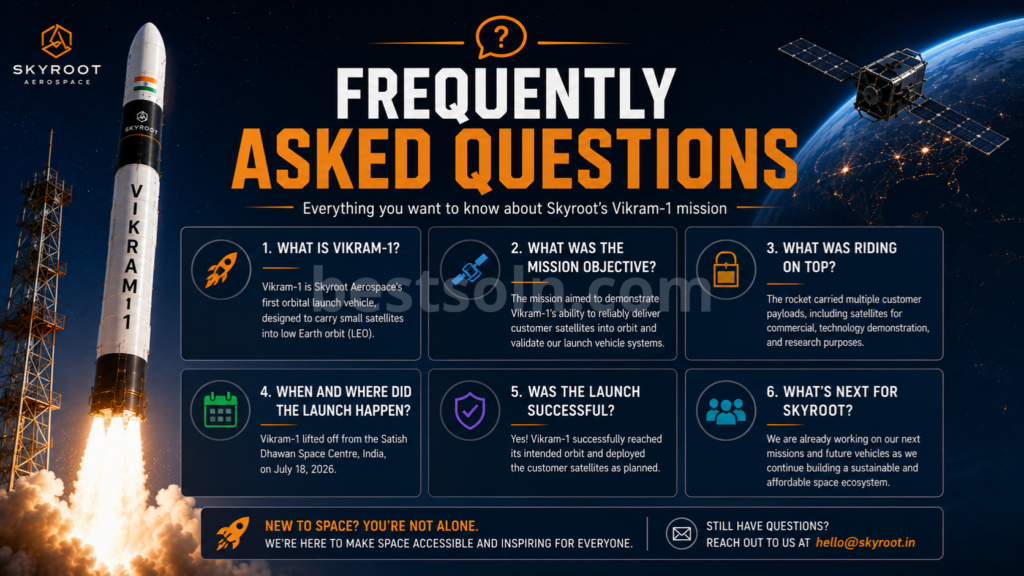
Q1: What is Vikram-1?
A: Vikram-1 is India’s first privately developed orbital-class rocket, built by Skyroot Aerospace. It is a four-stage, expendable small-lift launch vehicle capable of carrying payloads of up to 350 kilograms into low Earth orbit.
Q2: When did Vikram-1 launch, and was it successful?
A: Vikram-1 launched on July 18, 2026, at 12:05 p.m. India Standard Time from the Satish Dhawan Space Centre in Sriharikota, under a mission named Aagaman. The launch was fully successful, with all stages performing as planned and payloads deployed into a 450-kilometre low Earth orbit.
Q3: Who built Vikram-1?
A: Skyroot Aerospace, a Hyderabad-based private space company founded in 2018 by former ISRO engineers Pawan Kumar Chandana and Naga Bharath Daka, built and launched the rocket.
Q4: How is Vikram-1 different from Vikram-S?
A: Vikram-S, launched in November 2022, was a smaller suborbital rocket that reached space but did not place anything into orbit. Vikram-1 is a larger, more complex orbital-class vehicle designed to actually deliver satellites into stable orbits around Earth.
Q5: Why is this launch such a big deal for India?
A: It makes India only the third country, after the United States and China, where a privately built rocket has reached orbit. It also validates years of Indian government reform aimed at opening the space sector to private companies.
Q6: What did Vikram-1 carry into orbit?
A: The rocket carried several commercial and technology demonstration payloads, including Skyroot’s own SCOPE satellite, a payload from Germany’s DCUBED, Grahaa Space’s SOLARAS S3 satellite, and an orbital debris capture arm called Embrace from Cosmoserve Space. It also carried symbolic items, including an 18-karat gold micro-rocket with tiny sculptures of C.V. Raman, Vikram Sarabhai, and A.P.J. Abdul Kalam.
Q7: What is next for Skyroot Aerospace?
A: Skyroot is developing a larger vehicle, Vikram-II, targeted for its first flight in 2027, and is working to convert its technical success into a steady base of commercial launch contracts. The company has also signed partnerships with organisations like Axiom Space to explore future orbital logistics work.
Conclusion
Vikram-1’s flight on July 18, 2026, will likely be remembered as one of those quiet turning points that only look obviously historic in hindsight. A company that started with ten people and a shared conviction that India’s private sector could build rockets just proved it, on the first real attempt, with paying customers’ satellites onboard. It is a genuine milestone for Indian engineering, a validation of years of policy reform that opened space to private enterprise, and a signal to the rest of the world that India intends to be a serious player in the global commercial launch business, not just a spectator.
Whether Skyroot turns this single successful flight into a sustainable, repeatable business is the story that will play out over the next several years, through Vikram-II’s development, through new customer contracts, and through however many more launches it takes to build the kind of track record that turns a promising startup into a trusted launch provider. For now, though, the achievement stands on its own. India has a working, home-grown, privately built rocket that can reach orbit, and that fact alone changes what is possible for the country’s space ambitions going forward.











Leave a Reply