

- Home
- /
- Insights
- /
- Space Tech
- /
- Astrobase’s EVEREST Engine: How a…
⏱️ Read Time:
Introduction
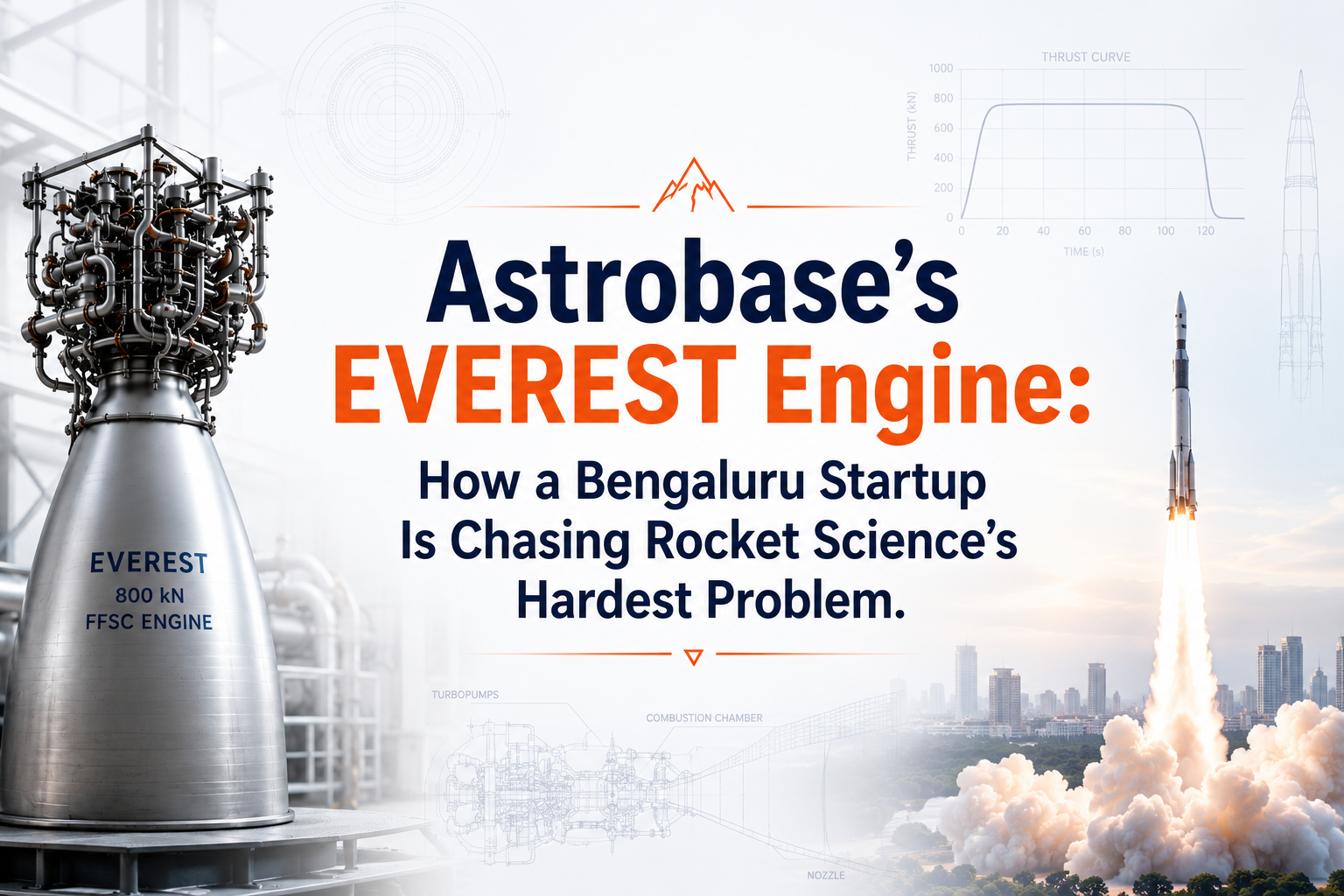
On a Friday morning in Bengaluru, a two year old startup put a rocket engine on a stage and, in doing so, quietly placed India in a conversation that only a handful of nations and companies have ever been part of. The engine is called EVEREST, and it belongs to Astrobase Space Technologies, a company most people outside the space industry had probably never heard of until this month.
What makes EVEREST worth writing about isn’t just its size or its thrust rating, though 800 kilonewtons is nothing to scoff at. It’s the engine cycle Astrobase chose to build it around: full flow staged combustion, widely regarded as the single hardest rocket propulsion architecture to get right. SpaceX spent close to two decades and a small fortune perfecting its version, called Raptor, before it ever flew. Astrobase wants to do something similar, faster, and largely with parts made in India.
This piece walks through what was actually unveiled, why the engineering behind it is so demanding, who is building it, and what it would mean for India’s private space sector if the company pulls it off. It also lays out, honestly, why that’s still a big if.
A Friday in Bengaluru: What Astrobase Actually Unveiled
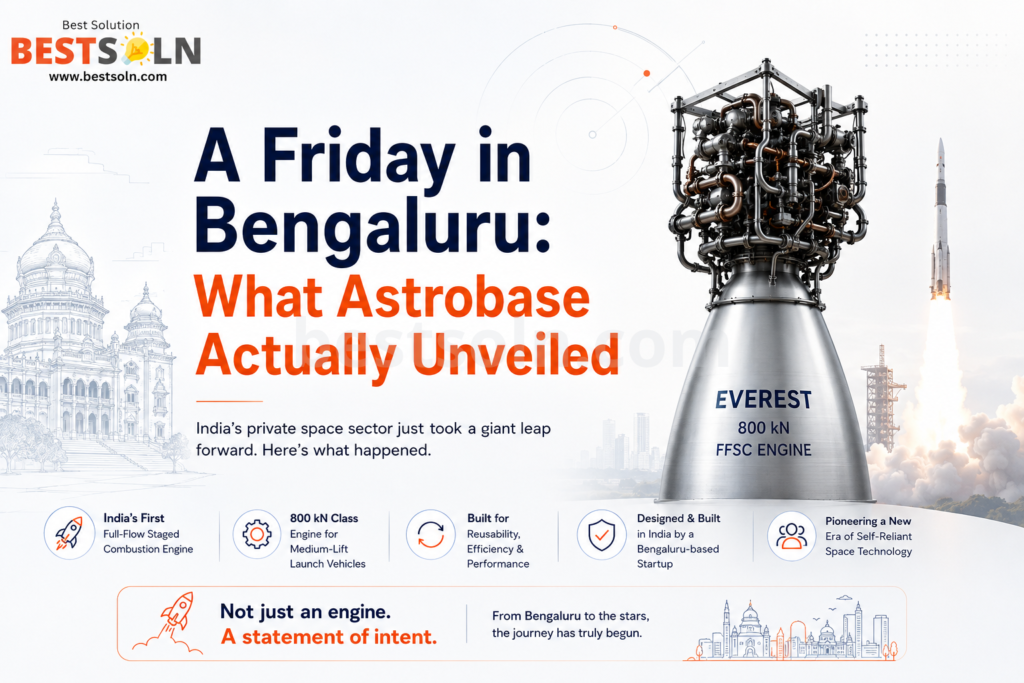
On 7 August 2026, Astrobase Space Technologies pulled the cover off EVEREST, an 800 kN class rocket engine that runs on liquid oxygen and liquid methane and uses the full flow staged combustion cycle, commonly shortened to FFSC. The company describes it as India’s first fully integrated FFSC engine built by a private firm, and independent reporting backs that framing up. It is an 80 tonne class engine, a way of describing thrust output in terms of the weight it could theoretically lift off a launch pad.
The event itself signaled how seriously the space establishment is taking this attempt. Rajeev Jyoti, a scientist and director at IN-SPACe’s Technical Directorate, attended as chief guest. Lt Gen A.K. Bhatt, Director General of the Indian Space Association, was present too, along with astronaut and Group Captain Shubhanshu Shukla, who has flown to orbit and spoke about why India needs a family of home grown launch vehicles.
One detail is worth sitting with before anything else: EVEREST has not been hot fired yet. What was unveiled is a fully built, fully integrated engine sitting at the pre test stage. Astrobase has completed sub scale hot fire tests back in September 2025 and high speed turbopump trials in January 2026, but the full engine test campaign, the moment that actually proves the design works under real combustion conditions, is still ahead of it, expected in the coming months.
Meet Astrobase Space Technologies: The People and the Bet
Astrobase was founded in 2024, which makes the pace of what it has shown so far genuinely unusual for the aerospace industry. It has two co-founders with very different backgrounds. Devakumar Thammisetty spent years at ISRO as a propulsion engineer before starting the company, and now serves as its Director. Neeraj Khandelwal, better known as a co-founder of the crypto exchange CoinDCX, is the CEO, bringing a fundraising and startup building background rather than an aerospace one.
That combination, a veteran ISRO propulsion engineer paired with a fintech entrepreneur, has apparently worked well enough to raise real capital and build real hardware. Public funding trackers put Astrobase’s seed round at roughly ten million dollars, led by the venture firm Banyan, with third party estimates placing its valuation somewhere around seventy million dollars. In June 2026, the company was also selected as one of just three firms, out of 43 applicants, to receive support under IN-SPACe’s Technology Adoption Fund, capped at Rs 25 crore.
The company runs two facilities that matter here. In Bengaluru, it operates a 46,000 square foot manufacturing plant equipped with what is reportedly India’s largest industrial metal 3D printer, used to produce the engine’s most intricate components. In Anantapur, Andhra Pradesh, it has built a 21.5 acre propulsion test site capable of handling thrust levels up to 200 tonnes, which gives it room to grow well beyond EVEREST’s current rating. According to the company, roughly 70 percent of EVEREST is designed and manufactured within India, with overseas sourcing limited mostly to specialised components like certain sensors that aren’t yet made domestically.
Full Flow Staged Combustion Explained: Why This Engine Cycle Is So Hard
To understand why this unveiling matters, it helps to understand what a rocket engine actually has to do, and why some ways of doing it are so much harder than others.
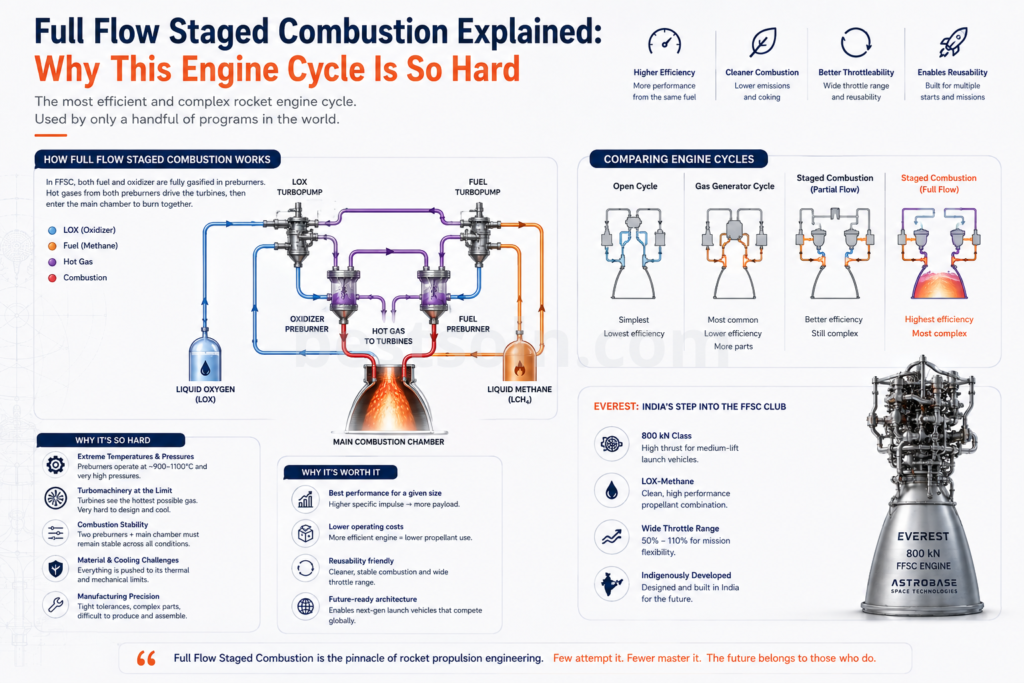
Every liquid fuel rocket engine needs to push huge volumes of propellant, fuel and oxidiser, into a combustion chamber at enormous pressure. That job falls to turbopumps, essentially very powerful, very compact pumps driven by their own small gas turbines. How an engine powers those turbopumps is what separates one engine cycle from another.
The simplest and most common approach is the gas generator cycle. A small amount of propellant is burned separately, off to the side, just to spin the turbopumps, and the exhaust from that process is usually dumped overboard rather than used for thrust. It’s a reliable design, but it wastes propellant and caps how efficient the engine can be.
Staged combustion cycles improve on this by feeding that turbopump exhaust back into the main combustion chamber instead of throwing it away, squeezing more performance out of the same propellant. ISRO’s own semi-cryogenic engine work follows a version of this thinking. But most staged combustion engines only run one of the two propellants, usually the fuel, through a preburner before the main chamber.
Full flow staged combustion goes a step further, and this is the part that makes it so difficult. Both propellants, the fuel and the oxidiser, are separately and fully gasified before they ever reach the main chamber. A fuel rich preburner drives the fuel turbopump, and a completely separate oxidiser rich preburner drives the oxidiser turbopump. Nothing is dumped overboard. Every bit of propellant that enters the engine eventually contributes to thrust.
The payoff is real. FFSC engines can run at extremely high chamber pressures, in EVEREST’s case reportedly above 300 bar, which translates into more thrust for a given engine size and better fuel efficiency. It also puts far less thermal stress on the turbine blades compared to older cycles, because neither preburner has to run at the scorching, metal eating temperatures that a single combined preburner would need.
The catch is that building a system with two separate gasification loops, both operating at ferocious pressure and temperature, both feeding a single main chamber in near perfect balance, is an engineering problem with almost no room for error. Get the balance wrong and you can destroy the engine in milliseconds. That is precisely why, decades after the concept was first proposed, only a small number of organisations worldwide have ever built a working FFSC engine, and fewer still have flown one. The Soviet Union attempted it with the RD-270 in the 1960s but never flew it. The United States tested a demonstrator engine in the 2000s that also never reached flight. SpaceX’s Raptor, which powers Starship, remains the only FFSC engine that has actually flown to date.
| Engine Thermodynamic Cycle | Propellant Handling | Mass Flow Across Turbines | Thermal and Chemical Stress | Operational Efficiency |
| Gas Generator (Open Cycle) | Partial propellant diverted and dumped overboard | Low fraction of total propellant flow | Moderate temperature in gas generator | Lower specific impulse due to dumped exhaust |
| Staged Combustion (Closed Cycle) | Single preburner routes exhaust to main chamber | Partial propellant flow through turbine | High thermal stress on single turbopump assembly | High chamber pressure and high efficiency |
| Full Flow Staged Combustion | Dual preburners route full gaseous flow to main chamber | 100% of both fuel and oxidizer pass through turbines | Reduced turbine temperatures due to maximum mass flow | Maximum overall efficiency and extended component life |
Why Liquid Oxygen and Methane
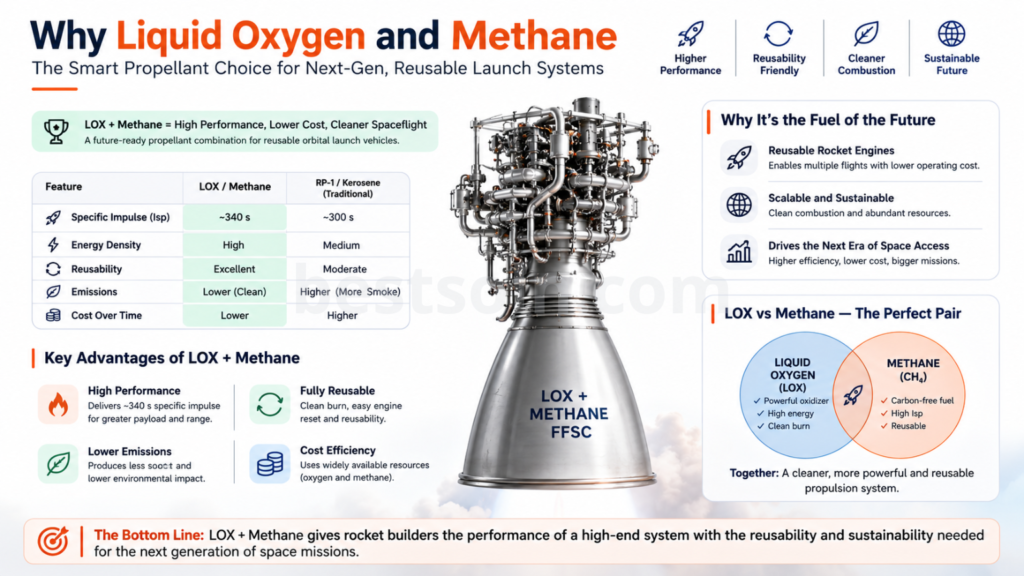
EVEREST’s choice of propellant, liquid oxygen paired with liquid methane, commonly called methalox, is the same combination Raptor uses, and that’s not a coincidence. Methane offers a real practical advantage for reusable rockets: unlike kerosene, the fuel most traditional rockets use, methane burns cleanly and does not leave behind the sooty carbon residue that clogs turbopump internals and combustion chamber walls after a flight.
For an expendable rocket, that residue barely matters because the engine is only ever used once. For a rocket designed to fly, land, and fly again, and again, it matters enormously. Less soot means faster, cheaper inspections between flights and less wear on the parts that are hardest to replace. Given that Astrobase has said it wants EVEREST to be reused more than a hundred times, methalox isn’t just a technical preference, it’s close to a prerequisite.
EVEREST by the Numbers
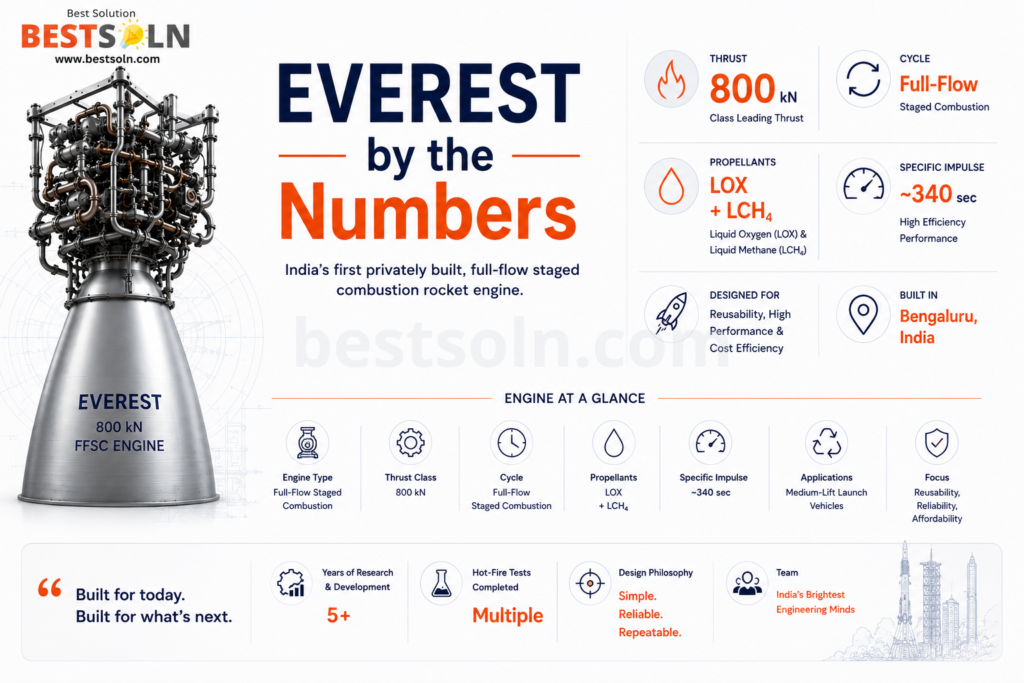
Pulling together the technical details Astrobase has shared publicly gives a fairly complete picture of what this engine is meant to do.
The engine produces a maximum thrust of 800 kN, placing it in the 80 tonne class, and runs on the full flow staged combustion cycle using liquid oxygen and liquid methane. Chamber pressure reportedly exceeds 300 bar, and specific impulse, the standard measure of how efficiently a rocket engine uses its propellant, is said to sit around 340 seconds, a respectable figure for a methalox engine. Astrobase has also indicated the engine can throttle across a wide range, from roughly 50 percent to 110 percent of rated thrust, a capability that matters enormously for controlling descent speed during a vertical landing, the kind SpaceX has made famous with Falcon 9.
On the manufacturing side, the company is setting up infrastructure to build as many as 50 EVEREST engines a year, with an eventual goal of producing and hot firing roughly one engine per week once operations are fully ramped up. It plans to test around 20 engines before ever attempting an orbital flight, a cautious, methodical approach that suggests the company understands exactly how unforgiving this technology can be.
| Engine Parameter | Value or Specification | Functional Objective |
| Engine Designation | EVEREST | India first privately built 80-tonne class engine |
| Developing Entity | Astrobase Space Technologies | Founded in 2024 in Bengaluru |
| Thermodynamic Cycle | Full Flow Staged Combustion (FFSC) | Maximizes performance while lowering turbine stress |
| Propellant Combination | Liquid Oxygen (LOX) / Liquid Methane | Clean burning for minimal engine refurbishment |
| Sea Level Thrust | 800 kilonewtons (80 tonnes force) | Main stage booster lift capability |
| Specific Impulse (Isp) | Approximately 340 seconds | High fuel efficiency during ascent |
| Throttle Modulation Range | 50% to 110% continuous control | Essential for landing burns and re-entry maneuvers |
| Target Service Life | 100 plus reusable flight cycles | Lowers amortized operational cost per launch |
From Test Stand to Orbit: What Happens Next
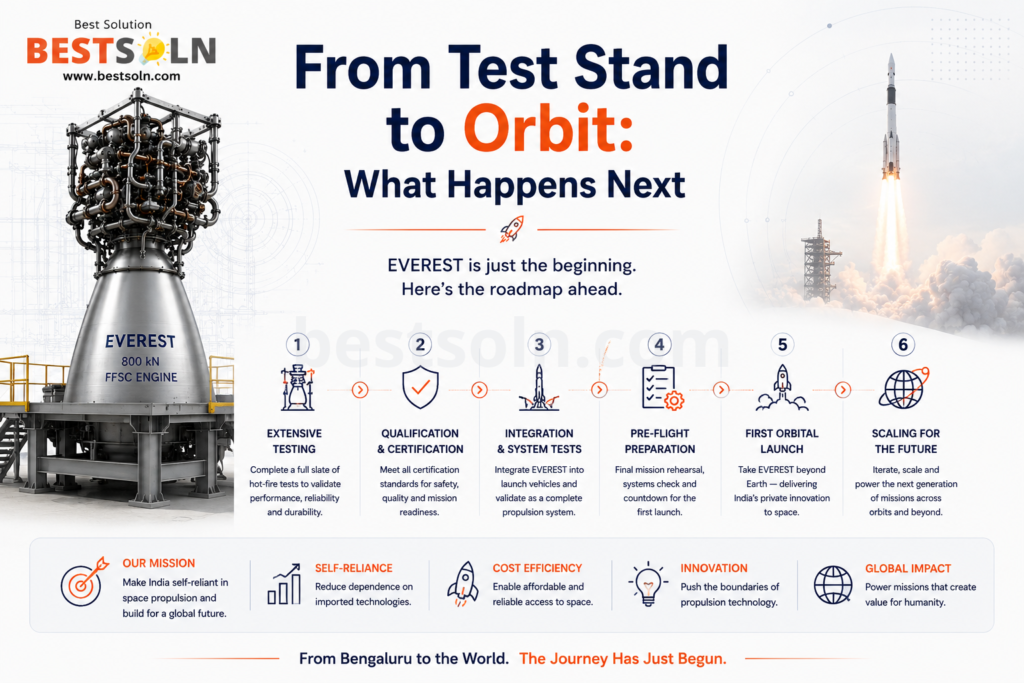
Astrobase’s roadmap, at least as the company has described it publicly, moves in fairly clear stages from here. The immediate next milestone is a full engine hot fire test, expected in the coming months of 2026, which will be the first real proof that the complete FFSC system works as designed under actual combustion conditions. From there, the plan moves to vehicle integration, mounting the engine, or a cluster of them, onto an actual rocket structure, followed by a broader qualification campaign.
Neeraj Khandelwal has said Astrobase is targeting its first vehicle launch by December 2028, with every milestone between now and then built backward from that date. According to earlier reporting, the company envisions clustering seven EVEREST engines under a partially reusable rocket for that debut flight, a configuration reminiscent of how Falcon 9 clusters nine Merlin engines, though on a smaller scale.
The company’s stated ambitions extend well past a single successful launch. It is targeting roughly 100 tonnes of annual launch capacity in an initial phase, enough, according to the company, to sustain a low Earth orbit satellite fleet in the range of 500 to 700 satellites, before scaling toward more than 1,000 tonnes annually in a later phase. Longer term, Astrobase has spoken about wanting to bring launch costs down toward 300 dollars per kilogram sometime in the 2030s, and about eventually offering launch on demand within roughly 15 days of a booking, a dramatic compression compared to the months long waitlists that dominate the launch industry today.
| Target Schedule | Development Stage | Engineering Objective |
|---|---|---|
| September 2025 | Sub-scale Hot-Fire Testing | Verify combustion stability and injector mixing dynamics |
| January 2026 | Turbopump Assembly Trials | Validate high pressure turbopump bearing and fluid performance |
| June 2026 | IN-SPACe TAF Support Award | Secure regulatory approval and technical grant funding |
| August 2026 | Public Unveiling of EVEREST | Present integrated hardware and manufacturing strategy |
| Late 2026 | Full Scale Ground Static Hot-Fire | Evaluate full engine integration at Anantapur test stand |
| 2026 to 2028 | Multi Engine Static Test Campaign | Hot-fire ~20 production engines for reliability qualification |
| December 2028 | Inaugural Orbital Flight Attempt | Launch reusable medium lift vehicle into Low Earth Orbit |
Where EVEREST Fits in India’s Crowded Private Space Race
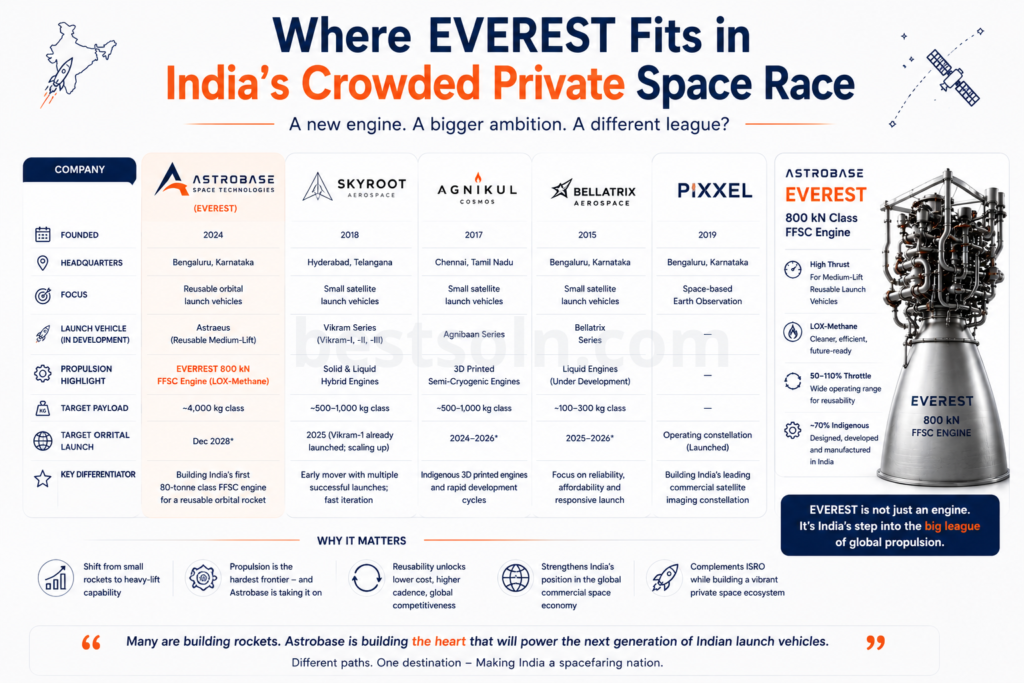
Astrobase isn’t operating in isolation. India’s private launch sector has had an eventful year. Skyroot Aerospace’s Vikram-1 became the country’s first privately developed rocket to reach orbit on 18 July 2026, a genuine landmark for the industry. Agnikul Cosmos, another well funded Indian rocket startup, is targeting its own orbital launch later this year and has reusability plans of its own down the line.
What separates Astrobase from most of its peers is the market it’s chasing. Much of India’s private launch industry, understandably, has focused on the small satellite launch market, essentially a rideshare or taxi model for getting compact payloads into orbit relatively cheaply. It’s a sensible place to start. Astrobase, by going straight for a high thrust, reusable, medium lift engine, is aiming at a different, considerably larger opportunity: the kind of launch capability that can support constellations, heavier payloads, and eventually crewed or lunar class missions, the same category SpaceX has come to dominate with Falcon 9.
That dominance is itself part of the argument for why India needs a serious domestic alternative. SpaceX currently accounts for more than 80 percent of global launch capability, and companies around the world routinely queue up and wait months for a launch slot. If India wants to grow its share of the global space economy from under 2 percent today toward the 8 to 10 percent target the government has set for 2033, it will need more players like Astrobase actually delivering, not just announcing plans.
| Enterprise / Organization | Engine System | Propellant Combination | Development Status |
|---|---|---|---|
| SpaceX (USA) | Raptor Series | Liquid Oxygen / Liquid Methane | Flight proven and operational on Starship launches |
| Astrobase (India) | EVEREST | Liquid Oxygen / Liquid Methane | Integrated engine prototype unveiled; ground hot-fire pending |
| Glushko Energomash (USSR/Russia) | RD-270 | Nitrogen Tetroxide / UDMH | Historical ground tested prototype (1960s); program canceled |
| Jiuzhou Yunjian (China) | Lingyun Series | Liquid Oxygen / Liquid Methane | Early development and sub-scale hot-fire testing |
The Bigger Picture: Why India Needs This
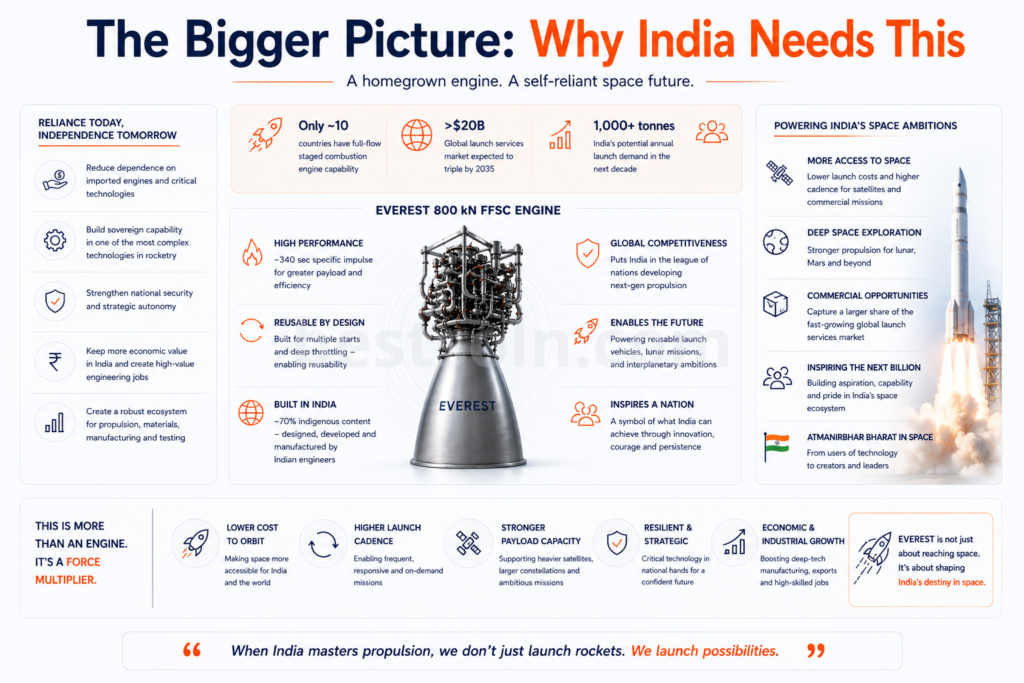
Khandelwal has been fairly direct about the strategic reasoning behind the company’s choices. India currently operates fewer than 100 active satellites, a tiny fraction compared to the United States’ fleet of more than 11,000 and China’s more than 1,500. Closing that gap, he has argued, requires rockets, and the hardest part of any rocket is its engine.
There’s also a national security dimension that gets less attention than the commercial one. Relying on foreign launch providers or foreign engine technology for critical satellite infrastructure, communications, navigation, and eventually defence related systems, creates dependencies that a country the size of India would rather not carry indefinitely. Building high thrust, reusable propulsion domestically, even if it takes years longer than importing the capability, is as much a sovereignty argument as an economic one. Khandelwal has called the ability to independently access and use space a civilisational imperative for the country, a framing that captures how the company is positioning this beyond a simple business opportunity.
Shubhanshu Shukla, speaking at the unveiling, put the point in more practical terms: any serious space programme rests on having reliable, on demand access to orbit through a family of launch vehicles with different payload capacities. Without that foundation, he noted, nothing else, not satellite constellations, not human spaceflight, not lunar ambitions, is really possible.
The Hard Part: What Could Still Go Wrong
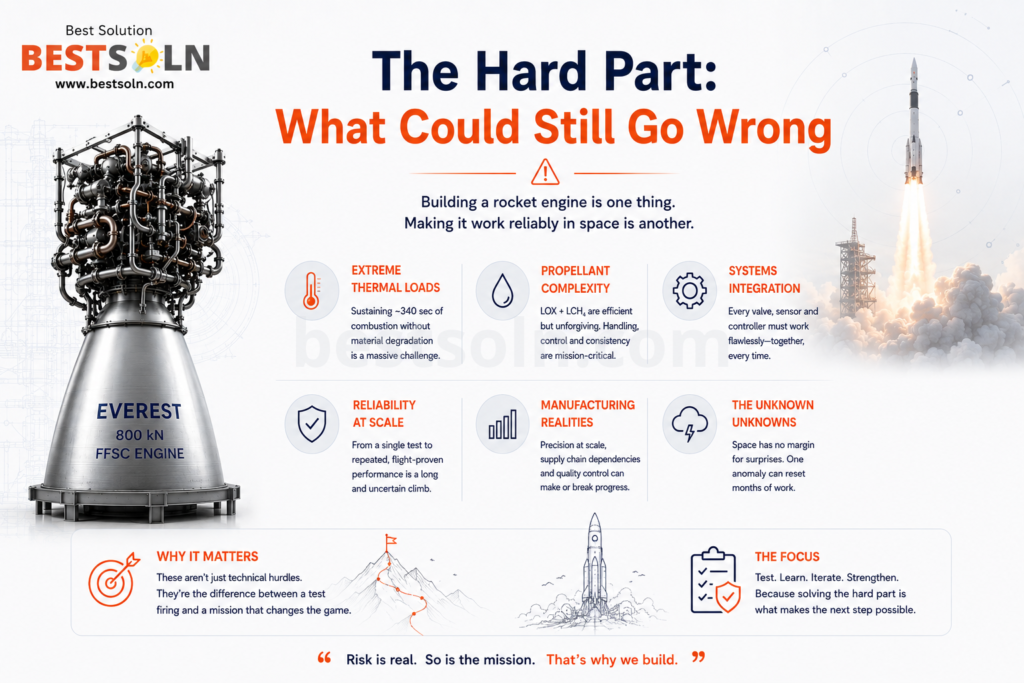
None of this should be read as a guarantee. Full flow staged combustion has humbled far larger, far better funded organisations than Astrobase before it succeeded anywhere. The Soviet Union’s RD-270 programme, backed by the full weight of a superpower’s aerospace industry, never got its engine to fly. Even SpaceX, with Elon Musk’s resources and a decade and a half of head start in reusable rocketry, took years of iteration and several very public engine failures before Raptor became reliable.
The specific engineering risks that make FFSC so unforgiving don’t go away just because a company has built an impressive looking engine and unveiled it on a stage. Managing two fully gasified propellant streams at chamber pressures north of 300 bar, keeping turbopumps that handle roughly 5 megawatts of power stable in a highly reactive, oxygen rich environment where metal itself can ignite, and doing all of this reliably enough to reuse the same hardware more than a hundred times, is an extraordinarily narrow engineering target. Astrobase’s own leadership has been candid about this. Khandelwal has pointed to the turbopump and its associated turbine and metallurgy challenges as among the hardest problems the team has had to solve, and there’s no reason to think the difficulty eases from here.
The company’s own testing plan, roughly 20 full engines before an orbital attempt, reflects an awareness that this is not a technology you get right on the first try. Whether Astrobase can execute that plan on schedule, secure the additional capital a programme like this inevitably requires, and hit its December 2028 launch target, remains genuinely uncertain. History suggests slippage is the norm rather than the exception in first of a kind rocket programmes, in India and everywhere else.
Recommended Reading

For readers who want to go deeper into the science, history, and business behind engines like EVEREST, these books offer solid starting points.
- “Ignition! An Informal History of Liquid Rocket Propellants” by John D. Clark. A classic, highly readable account of how rocket fuels and oxidisers, including the kind of propellant chemistry behind methalox engines, were developed through decades of trial and frequent, spectacular error.
- “Rocket Propulsion Elements” by George P. Sutton and Oscar Biblarz. The standard engineering textbook on how rocket engines actually work, covering combustion cycles, turbopumps, and performance calculations in detail for readers who want the real technical foundation.
- “Liftoff: Elon Musk and the Desperate Early Days That Launched SpaceX” by Eric Berger. A close, well reported account of SpaceX’s early struggles, useful context for understanding just how difficult it was to get Raptor and reusable rocketry working even with enormous resources behind it.
- “India’s Rise as a Space Power” by U.R. Rao. Written by a former ISRO chairman, this book traces the history and strategic thinking behind India’s space programme, offering useful grounding for understanding why efforts like Astrobase’s carry national significance beyond commercial ambition.
- “The Innovator’s Dilemma: When New Technologies Cause Great Firms to Fail” by Clayton M. Christensen: This book offers a theoretical framework for understanding disruptive technologies, which is highly relevant to analyzing how space-based AI might disrupt traditional geospatial data markets.
- “Space 2.0: How Private Spaceflight, a Resurgent NASA, and International Partners are Creating a New Space Age” by Rod Pyle: This book provides an excellent overview of the ongoing commercialization of space, covering the technological advancements and business models that are enabling private companies like Pixxel to thrive.
Frequently Asked Questions
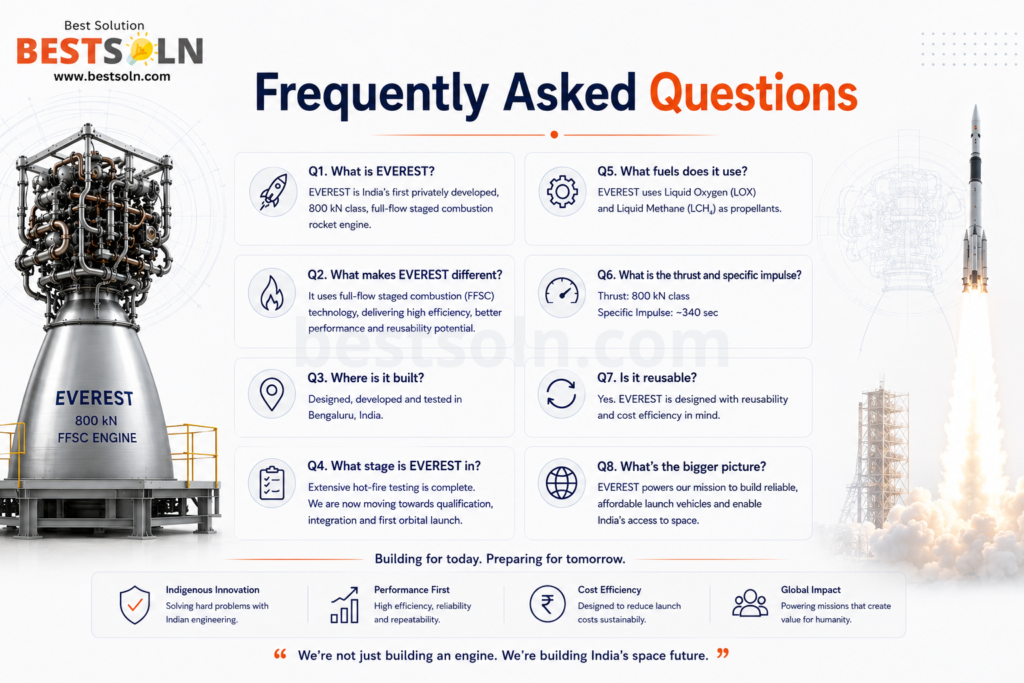
What is Astrobase’s EVEREST engine?
EVEREST is an 800 kN class rocket engine built by Bengaluru based startup Astrobase Space Technologies. It runs on liquid oxygen and liquid methane and uses the full flow staged combustion cycle, an advanced engine architecture designed for high efficiency and repeated reuse. It was unveiled on 7 August 2026 and has not yet undergone a full engine hot fire test.
What makes full flow staged combustion different from other rocket engine cycles?
In a full flow staged combustion engine, both the fuel and the oxidiser are completely gasified through two separate preburners before entering the main combustion chamber, so nothing is wasted. Most other engine cycles either dump some propellant overboard after using it to drive turbopumps, or route only one propellant through a preburner. FFSC allows for much higher chamber pressure and efficiency, but it is also considered the hardest engine cycle to engineer reliably.
Who founded Astrobase Space Technologies, and when?
Astrobase was founded in 2024 by Devakumar Thammisetty, a former ISRO propulsion engineer, and Neeraj Khandelwal, a cofounder of the crypto exchange CoinDCX. Thammisetty serves as Director and Khandelwal as CEO.
Why did Astrobase choose liquid oxygen and methane as propellants?
Methane burns without leaving the carbon soot that fuels like kerosene deposit inside an engine, which makes inspection and reuse much easier and faster. Since EVEREST is designed to be reused more than a hundred times, a clean burning propellant combination is essential rather than optional.
When will EVEREST actually fly?
Astrobase is targeting a full engine hot fire test in the coming months of 2026, followed by vehicle integration and a broader testing campaign involving roughly 20 engines. The company’s first orbital flight is targeted for December 2028.
Has any other country or company successfully built a full flow staged combustion engine?
Very few. The Soviet Union attempted it with the RD-270 engine in the 1960s but never flew it. The United States tested a demonstrator version in the 2000s that also never reached flight. SpaceX’s Raptor, which powers its Starship vehicle, remains the only FFSC engine to have actually flown. If Astrobase succeeds, India would join an extremely small group of nations to have tested this technology.
How does Astrobase compare to other Indian private space companies like Skyroot and Agnikul?
Skyroot Aerospace and Agnikul Cosmos have focused primarily on the small satellite launch market using relatively simpler engine cycles. Astrobase is targeting a considerably more difficult technical goal, a high thrust, fully reusable engine intended for medium lift missions, positioning it closer to what companies like SpaceX have achieved rather than the smaller rideshare style launchers most Indian startups have pursued so far.
Why does this matter for India’s space industry as a whole?
India currently operates fewer than 100 active satellites, compared to thousands for the United States and China, and depends heavily on a global launch market dominated by SpaceX. A reliable, domestically built, reusable high thrust engine would reduce that dependency, support India’s ambitions to grow its share of the global space economy, and strengthen the country’s strategic autonomy in an increasingly space reliant world.
Conclusion
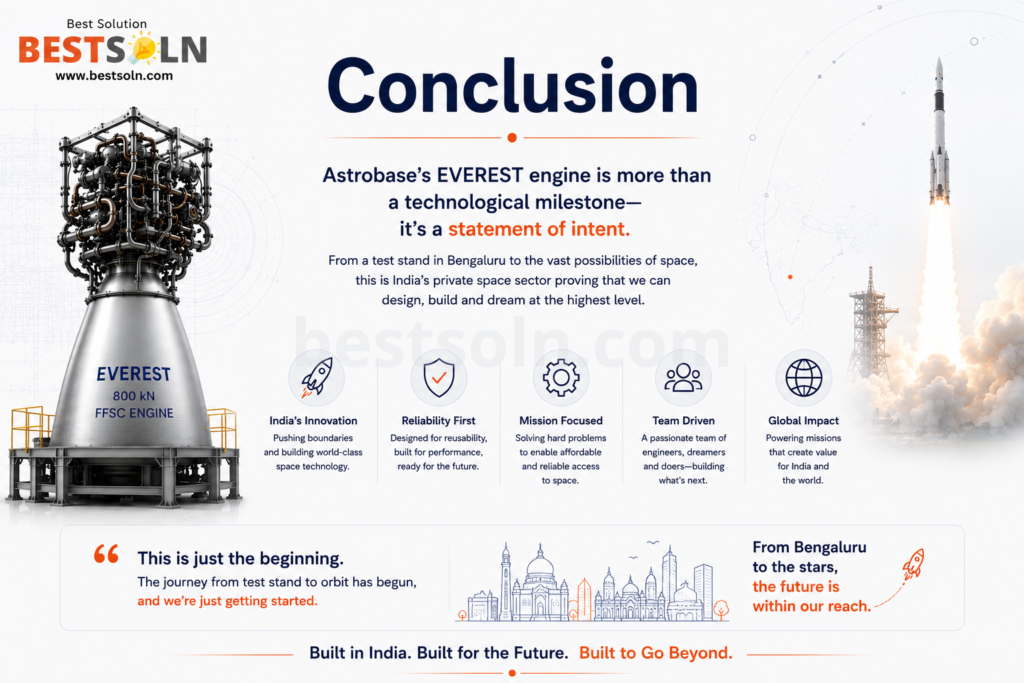
What Astrobase unveiled in Bengaluru this month is not, strictly speaking, a finished rocket engine yet. It’s an engine that exists, that has passed sub scale and turbopump level tests, and that is now waiting for the moment its full assembly gets lit for the first time. That distinction matters, and it’s worth remembering every time EVEREST gets described in superlatives.
But the ambition behind it is difficult to dismiss. A company founded only two years ago, cofounded by a fintech entrepreneur and a former ISRO engineer, has chosen to attempt one of the hardest problems in aerospace engineering rather than the safer, more incremental path most of its Indian peers have taken. If EVEREST fires successfully in the coming months and eventually carries a rocket to orbit by the end of 2028, India will have joined an extremely short list of nations and companies that have mastered full flow staged combustion, and it will have done so with a private company built largely on domestic engineering and manufacturing. If it stumbles, and there’s every reason to expect setbacks along the way given how unforgiving this technology has been for everyone who has attempted it, that won’t necessarily be a verdict on the effort itself. Few first attempts at frontier engineering go exactly to plan. What’s clear already is that Astrobase has decided India’s space industry shouldn’t just participate in the reusable rocket era, it should try to build the hardest part of it at home.











Leave a Reply