- Home
- /
- Courses
- /
- Fundamentals of AI, Machine Learning,…
- /
- J. The Agentic Enterprise: Collaboration…
⏱️ Read Time:
Introduction
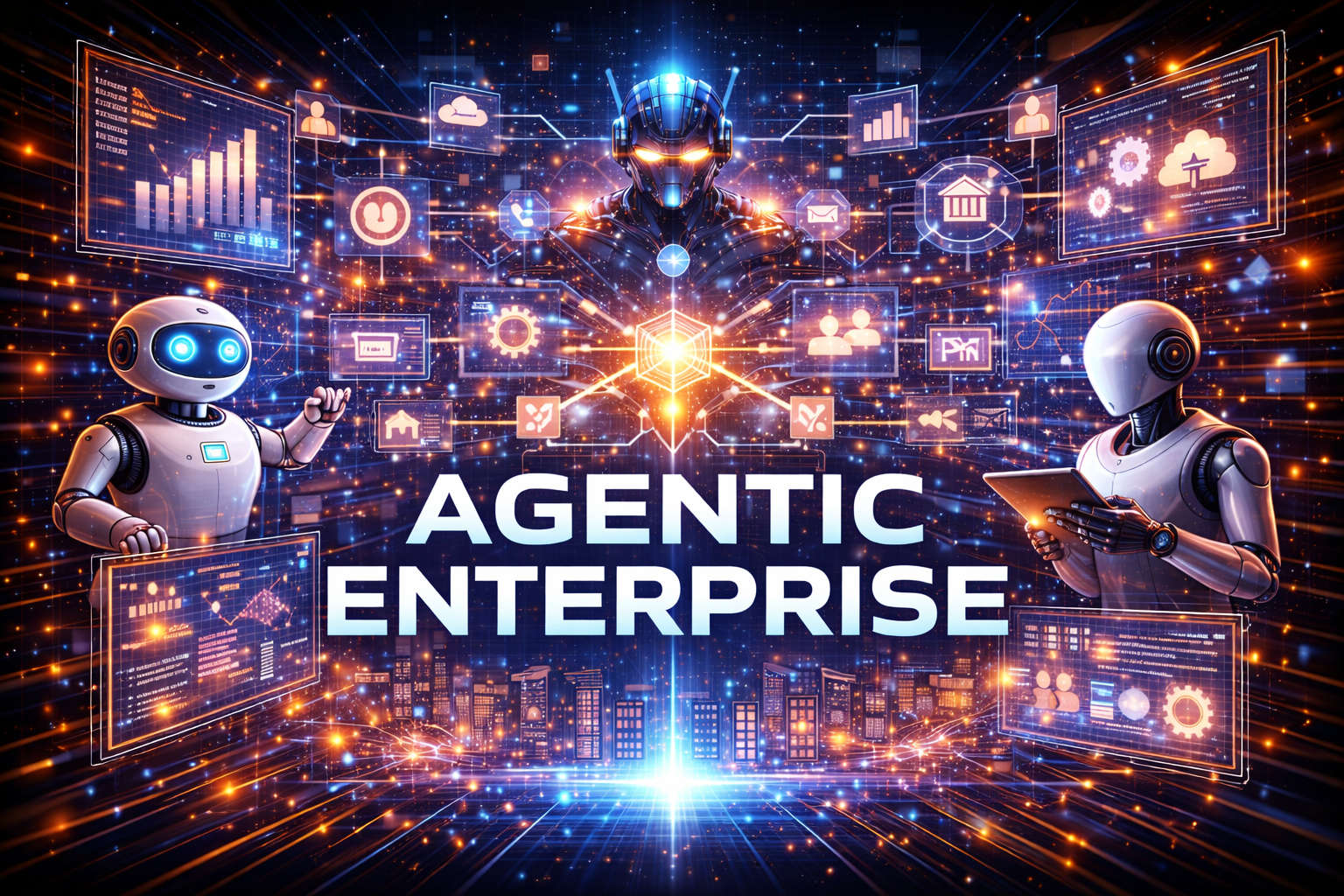
The ultimate objective of modern AI development is not merely to create powerful language models (LLMs) or even highly effective single-task agents. It is to build systems capable of achieving meaningful, high-level business goals that often span weeks or months. This final stage of the learning journey is defined by Agentic AI, the sophisticated orchestration of intelligent systems to “Automate entire processes with AI.”
Agentic AI represents the highest expression of machine autonomy, demanding seamless collaboration between multiple specialized agents, robust long-term persistence, and strict financial accountability. This chapter explores the critical architectural components that transform a capable planner into a trusted, resilient, and enterprise-ready automation partner.
System-Wide Automation and Persistence
The core distinction of Agentic AI is its capacity to move beyond isolated, short-term tasks and sustain a high-level objective over an extended duration. This requires dedicated architectural elements for continuity.
Long-term Autonomy and Goal Chaining
For a traditional single-task agent (Chapter 9), success is defined by executing one plan, like booking a single meeting. For Agentic AI, the objective might be “Increase quarterly customer retention by 5%.” Achieving this requires a series of interconnected, dependent tasks that must be executed sequentially over time, known as Goal Chaining.
Long-term Autonomy is the system’s ability to maintain and drive this chain of objectives with minimal human intervention over weeks or months. The agent must continuously:
- Monitor Progress: Track the completion status of the current sub-goal.
- Evaluate Outcome: Assess whether the completed sub-goal met the required performance metric.
- Initiate Next Step: Automatically trigger the next dependent sub-goal in the sequence (e.g., if “Draft new help documents” is complete, trigger “Deploy documents and measure usage”).
This persistence allows the AI to manage a complete business lifecycle, such as drafting a legal contract, circulating it for internal review, managing revisions based on feedback, and filing the final version, all autonomously.
Intent Preservation
A major risk in long-term, multi-step execution is Intent Preservation. The agent must ensure that the original, high-level objective is never lost or corrupted, even as it focuses on solving numerous small, tactical sub-goals.
If a sub-goal fails or a tool returns an unexpected error, the agent’s internal logic must always refer back to the primary intent to replan the next step. Without rigorous intent preservation, the system can suffer from “goal drift,” where it successfully completes every small, immediate task but drifts away from the desired strategic outcome, rendering the entire operation meaningless. This element is critical for aligning the machine’s actions with the strategic human preference.
Collaboration, Protocols, and Market Structure
Few enterprise problems are solvable by a single, monolithic agent. Modern business workflows require specialized expertise, which leads to the necessity of Multi-agent Collaboration.
Multi-agent Collaboration and Communication
In a complex scenario, different agents are assigned different responsibilities based on their fine-tuned expertise: a “Planner Agent” handles goal decomposition, a “Search Agent” handles information retrieval (RAG), and an “Execution Agent” handles tool calls and deployment.
Multi-agent Collaboration and Communication is the architecture that allows these specialized systems to work together, sharing information, observations, and delegated tasks seamlessly. This distributed intelligence approach ensures that the total system is highly scalable, more robust against single-point failures, and more efficient, as components can run in parallel.
Agent Protocols and Contracts
For diverse agents built by different teams or vendors to communicate reliably, interaction cannot be based on ad hoc messaging. It must be formalized through Agent Protocols and Contracts.
- Protocols: These are standardized communication formats and technical specifications that define exactly how one agent requests a service from another, the expected input parameters, and the guaranteed output format.
- Contracts: These define the non-technical, business-level expectations, often detailing service quality, security requirements, data ownership, and acceptable use constraints. These explicit agreements are foundational for building trust and reliability in machine-to-machine interactions, making the entire ecosystem auditable and predictable.
Agent Marketplaces and Financialization
The concept of standardized contracts leads naturally to the emergence of Agent Marketplaces. These are digital platforms where specialized agents can be accessed, traded, or dynamically ‘hired’ as modular, on-demand services. An enterprise can assemble a highly complex workflow not by building every component internally, but by integrating certified, specialized agents from a public or private marketplace.
This modular structure, governed by explicit Contracts, fundamentally changes the deployment model for AI, enabling faster development of complex systems and introducing economic principles into the internal workings of the enterprise AI system.
Resilience and Financial Control: The Enterprise Mandate
For Agentic AI to succeed in a business environment, it must meet the highest standards of operational resilience and financial accountability.
Failure Recovery and Rollback Mechanisms
Autonomy is meaningless without robustness. Despite the advanced planning of Chapter 9, real-world systems fail. Failure Recovery and Replanning is the active process where the agent, upon detecting a failed action (e.g., a tool call error, a network timeout, or a validation failure), uses its self-reflection capacity to dynamically adjust its internal policy and formulate an alternative path to the objective.
Critical to system-wide integrity is the Rollback Mechanism. When a failure is catastrophic (e.g., corrupted data, an accidental deployment), the agent must have the technical capacity to safely revert the entire system state, all associated databases, records, and execution states, to a previous, known-good point in time. This non-negotiable feature protects the enterprise against loss of data integrity and operational consistency.
Cost and Resource Management
In an autonomous system that continuously makes API calls, performs database lookups, and consumes significant computational resources, the financial overhead can quickly escalate. For an Agentic AI system to deliver measurable Return on Investment (ROI), it must integrate Cost and Resource Management.
This involves the agent constantly monitoring the execution cost of its autonomous actions (e.g., cost per token generated, cost per GPU hour consumed). If the perceived cost of completing a sub-goal exceeds a predefined financial threshold, the agent must be programmed to:
- Prioritize Low-Cost Paths: Select algorithms or tools that offer lower running costs.
- Trigger Human-in-the-Loop: Request human intervention to re-evaluate the task’s economic viability.
- Halt or Delegate: Pause the expensive part of the process or delegate it to a human team member.
This integration of financial awareness ensures that autonomy is not just technically possible, but economically justifiable for the enterprise.
Recommended Readings
- “The Age of AI and Our Human Future” by Henry A. Kissinger, Eric Schmidt, and Daniel Huttenlocher – Offers a high-level view of AI’s societal implications and strategic competition.
- “The Singularity Is Nearer: When We Merge with AI” by Ray Kurzweil – A futuristic perspective on the potential of highly complex, autonomous systems.
- “Building LLMs for Production: Enhancing LLM Abilities and Reliability with Prompting, Fine-Tuning, and RAG” by Louis-François Bouchard & Louie Peters – A practical resource focusing on the architectural design patterns necessary for multi-agent systems and goal orchestration.
FAQs
Q1: What is the difference between Multi-agent Collaboration and ensemble learning?
A: Ensemble learning (Chapter 3) combines the output of multiple homogeneous or heterogeneous models to improve a single prediction (e.g., averaging classifiers). Multi-agent collaboration involves multiple specialized, distinct systems coordinating sequential actions and sharing status updates to achieve a complex, long-running goal.
Q2: Why is Intent Preservation critical for long-running goals?
A: It prevents “goal drift.” Intent preservation ensures that, despite encountering tactical failures, planning detours, or necessary sub-goals, the agent always refers back to and maintains the original, high-level strategic objective set by the human user.
Q3: How do Rollback Mechanisms function in an agent system?
A: Rollback Mechanisms are technical procedures that revert the system state, including data, process history, and configurations, to a previous, stable point after a catastrophic failure. They are essential for protecting data integrity and ensuring operational consistency in complex, high-impact enterprise processes.
Conclusion
Agentic AI marks the final convergence of the disciplines we have studied: the predictive power of deep learning, the self-reflection of the agent structure, and the strategic planning of autonomous systems. By integrating formal protocols for collaboration, mechanisms for long-term persistence, and rigorous controls over resilience and cost, we move beyond individual applications to create truly integrated, self-managing enterprise automation. This system-wide transformation, however, necessitates a final, non-technical layer of control: rigorous governance, which we address in Chapter 11.