


Introduction: The Tinkerer from Greenfield
In a small farm workshop in Greenfield Township, Michigan, a young boy spent his free time taking watches apart and putting them back together. He was fascinated by mechanics, by the way small parts could come together to create precise, useful motion. That boy was Henry Ford. Decades later, this same tinkerer would not just build a car. He would build a system of manufacturing so powerful it would create the modern consumer economy, redefine the meaning of work, and fundamentally alter the landscape of the entire world.
Henry Ford did not invent the automobile. Dozens of others had already built them, but they were fragile, expensive toys for the rich. Ford’s genius was not in invention, but in vision. He dreamed of a car for the great multitude, a simple, durable, and affordable machine that would shrink distances and expand horizons for the average person. This is the story of how that dream, fueled by one of the most transformative ideas in history, became a reality.
The Early Years: An Engineer, Not a Farmer

From the beginning, Henry Ford disliked farm work. He was drawn to machines, not crops. At age 16, he left home for Detroit to become a machinist’s apprentice. He worked as an engineer for the Edison Illuminating Company, where his talent quickly earned him the role of chief engineer. This position gave him the time and resources to experiment in his own workshop.
In a small shed behind his home, often working late into the night, Ford built his first gasoline-powered vehicle, the Quadricycle, in 1896. It was a simple frame with four bicycle wheels and a tiller for steering. When it was finished, he realized it was too wide to fit through the shed door. With unwavering determination, he took an axe and knocked out the bricks to free his creation. It was a symbolic act; Ford was willing to break down any wall between him and his vision.
The Big Idea: A Car for the Great Multitude

After two failed companies, Ford founded the Ford Motor Company in 1903. His partners wanted to build expensive cars for a luxury market, but Ford had a different idea. He was obsessed with creating one model, a universal car that could be produced in massive numbers at low cost.
That car was the Model T, introduced in 1908. Ford called it “the car for the great multitude.” It was simple, easy to repair, and capable of handling the rough, unpaved roads of rural America. It was an instant success, but Ford faced a problem. He could not build them fast enough to meet the overwhelming demand. The craft-based production methods of the time were too slow. He needed a revolution on his factory floor.
The Moving Assembly Line: The Invention that Changed Everything
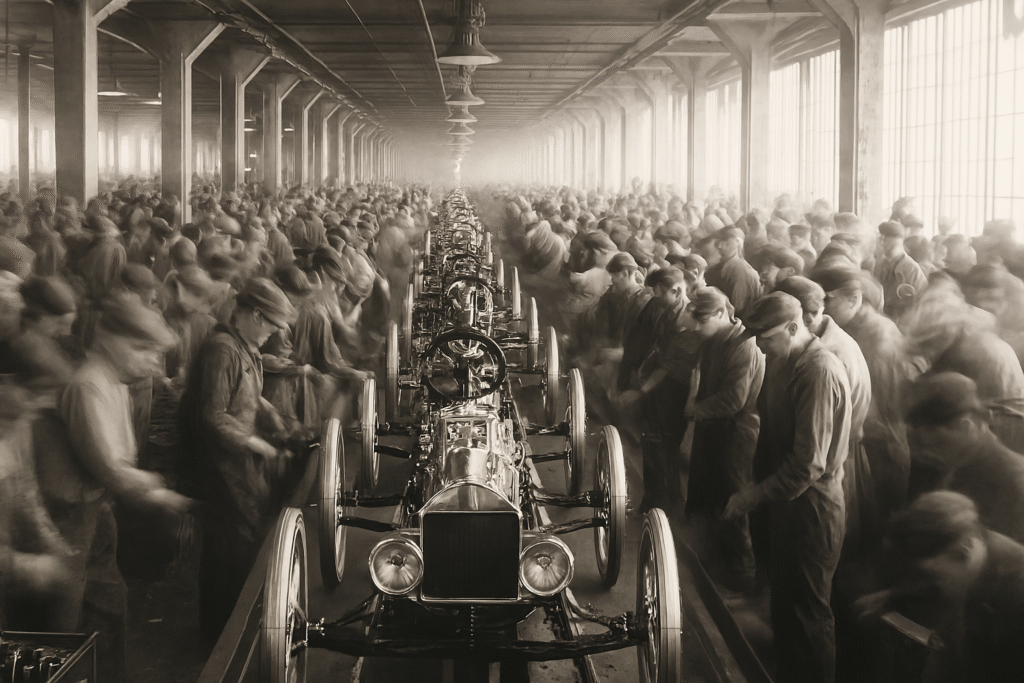
The breakthrough came in 1913 at Ford’s massive Highland Park plant. Inspired by the disassembly lines of Chicago slaughterhouses, Ford and his team installed the first moving assembly line for a complex manufactured product.
The innovation was breathtakingly simple. Instead of workers moving to the car, the car moved to the workers. Each employee performed a single, specialized task as the chassis passed by them on a conveyor. The effect was staggering. The time to build a Model T fell from over 12 hours to just 93 minutes. This was not just an improvement; it was a quantum leap in industrial efficiency.
This system, which Ford perfected and called “mass production,” allowed him to achieve his ultimate goal: driving down the price of the Model T year after year. At its peak, a Model T cost just $260, making it affordable for the farmers, teachers, and factory workers he had always sought to serve.
The Five Dollar Day: Rewriting the Social Contract
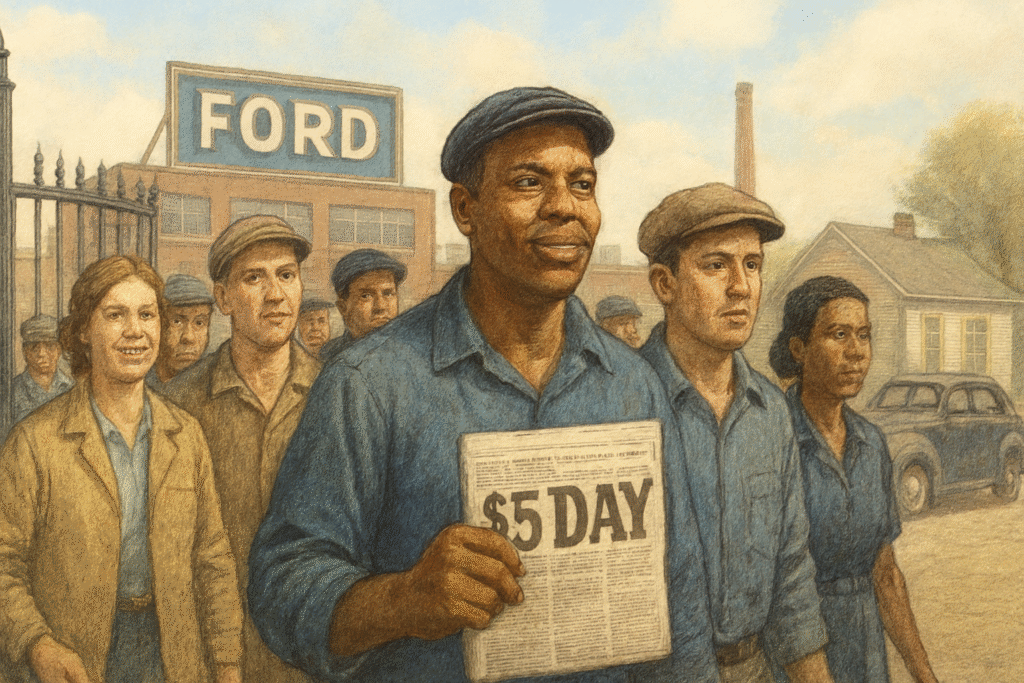
In 1914, Ford made another shocking announcement. He would more than double the pay of his workers to a minimum of $5 per day and reduce the workday from nine hours to eight.
Why would a man obsessed with lowering costs suddenly raise his biggest expense? It was not pure altruism; it was a brilliant business strategy. The grueling, repetitive work on the assembly line led to crippling employee turnover, costing the company a fortune in training. The $5 day stabilized his workforce overnight.
More importantly, it transformed his employees into his customers. By paying workers enough to buy the very products they made, Ford created a new economic cycle. He understood that mass production required mass consumption. The $5 day was a radical rewrite of the social contract and a key step in creating the American middle class.
The Later Years: Stubbornness and Decline

Ford’s success bred a stubbornness that nearly destroyed his company. He fell in love with the Model T, refusing to update it for nearly two decades. While competitors like General Motors began offering more stylish and powerful cars, Ford insisted his customers could have any color they wanted, “so long as it is black.”
By 1927, sales had plummeted, forcing Ford to shut down production for months to retool for the new Model A. This was a massive and costly undertaking from which the company never fully regained its dominant market share. His later years were also marred by his publication of antisemitic writings, a dark and lasting stain on his legacy.
Recommended Reading

To better understand the man and his machine age, consider these books:
- “The People’s Tycoon: Henry Ford and the American Century” by Steven Watts: A comprehensive and balanced biography that explores both his genius and his flaws.
- “My Life and Work” by Henry Ford: An autobiography that provides a direct look into Ford’s own philosophy and thinking.
- “The Machine That Changed the World” by James P. Womack, Daniel T. Jones, and Daniel Roos: While focused on the Toyota Production System, this book brilliantly traces the legacy of Ford’s original ideas in modern manufacturing.
Frequently Asked Questions (FAQ)
Q1. Did Henry Ford invent the car?
A: No, the automobile was developed by many inventors in Europe and America in the late 19th century. Ford’s monumental achievement was inventing the moving assembly line, which allowed him to mass-produce cars affordably.
Q2. What was so special about the Model T?
A: It was the first car designed for the average person. It was incredibly durable, simple to repair, and, thanks to the assembly line, became increasingly affordable. It truly put America on wheels.
Q3. Why did Ford pay his workers $5 a day?
A: The primary reason was to reduce the extremely high turnover rate caused by monotonous assembly line work. The secondary, and equally brilliant, reason was to enable his workers to become car buyers, creating a new market from within.
Q4. What is Henry Ford’s net worth?
A: At the time of his death in 1947, Henry Ford’s net worth was estimated between $500 million and $1 billion. In today’s dollars, that would make him a multi-billionaire. He and his son Edsel Ford bequeathed the vast majority of their wealth to the non-profit Ford Foundation.
Conclusion: The Complicated Architect of Modernity
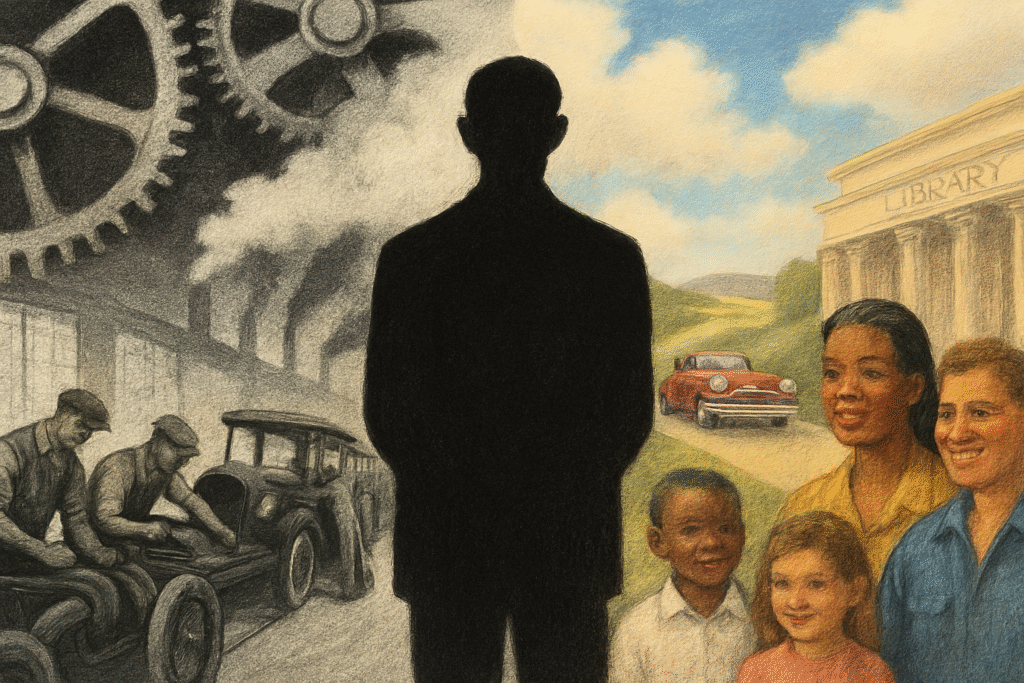
Henry Ford’s legacy is a paradox of breathtaking innovation and profound personal flaws. He was a visionary who shrank the world, yet he was also a stubborn man who could not see beyond his own creation. He helped create a prosperous middle class with one hand while spreading hateful ideas with the other.
But the scale of his impact is undeniable. He did not just sell cars; he sold freedom and possibility. The suburban landscape, the network of highways, and the very concept of a road trip are all part of his inheritance. His moving assembly line became the blueprint for 20th-century industry, influencing everything from toasters to tanks. More than a car maker, Henry Ford was an architect of the modern world, a man whose relentless drive for efficiency set the pace for our lives, for better and for worse.














Leave a Reply