


- Home
- /
- Made in India
- /
- ISRO’s Frugal Innovation Model
⏱️ Read Time:
Introduction: The Billion Dollar Results from a Million Dollar Budget
The narrative of modern technological competition is generally dominated by discussions of massive capital expenditure. Multi-billion dollar budgets are typically seen as prerequisites for success in high-stakes fields such as deep space exploration and cutting-edge artificial intelligence development. Yet, the Indian Space Research Organisation (ISRO) presents a compelling paradox to this rule, achieving global scientific and strategic preeminence through a deliberate strategy of efficiency and self-reliance, a philosophy often encapsulated by the term “frugal innovation.”
This distinctive approach has not led to compromised results; rather, it has fueled some of the world’s most successful and notably cost-effective missions. The Mars Orbiter Mission (MOM), or Mangalyaan, is globally recognized as the least expensive Mars mission ever undertaken, costing approximately $74 million (₹450 crore). This figure garnered international attention when it was compared favorably to the production budget of the 2013 Hollywood space film, Gravity. Former Prime Minister Narendra Modi famously quantified this efficiency by noting that the mission cost just ₹7 per kilometer, cheaper than a local auto-rickshaw ride in Ahmedabad.
More recently, the successful Chandrayaan-3 lunar landing underscored this continued commitment to frugality, costing only about $75 million, a sum cheaper than other major blockbusters like Interstellar. When missions from Western agencies like NASA or the European Space Agency (ESA) often cost hundreds of millions or billions of dollars, ISRO’s ability to land on the Moon’s challenging South Pole for a fraction of that price demonstrates that cost-effectiveness does not equate to a compromise on quality or scientific fidelity.
The core success of this methodology, which this report defines as the ISRO Model, stems from a strategic blueprint centered on radical efficiency, indigenous development, and resource optimization prioritized over high capital expenditure. The impact of this model extends far beyond the aerospace sector. It is now serving as a guiding philosophy for national development and technological competitiveness, particularly in the critical domain of Artificial Intelligence (AI) and the protection of linguistic data sovereignty. The principles refined over decades of launch vehicle and satellite development are being actively transferred to create globally competitive AI systems and secure India’s digital future.
The Philosophical Foundation: Jugaad and the Art of Strategic Resourcefulness

The ISRO Model is fundamentally rooted in a deep-seated cultural concept in India known as Jugaad. Historically, Jugaad referred to a resourceful, improvisational, and clever approach to problem-solving, often succeeding in the face of scarce investment. Over time, this concept has evolved from mere clever shortcuts to a sophisticated innovation mindset focused strategically on optimizing and economizing to make high-end technology accessible and affordable.
The Historical and Cultural Mandate
The spirit of Jugaad is not a modern reaction to limited governmental budgets; its intellectual lineage traces back centuries. Scholars often connect this resourcefulness to India’s historical contributions to mathematical thinking, specifically the concept of Shunya (Zero). Recognized by the Indian mathematician Brahmagupta in 628 AD, the concept of “nothingness” revolutionized mathematics by enabling complex calculations and large numbers, thereby laying the groundwork for modern computer science and technology. This historical context demonstrates that resourcefulness, the ability to derive maximum value from minimal input, is an established cultural trait that underpins current technological ambition.
Core Tenets of the ISRO Methodology
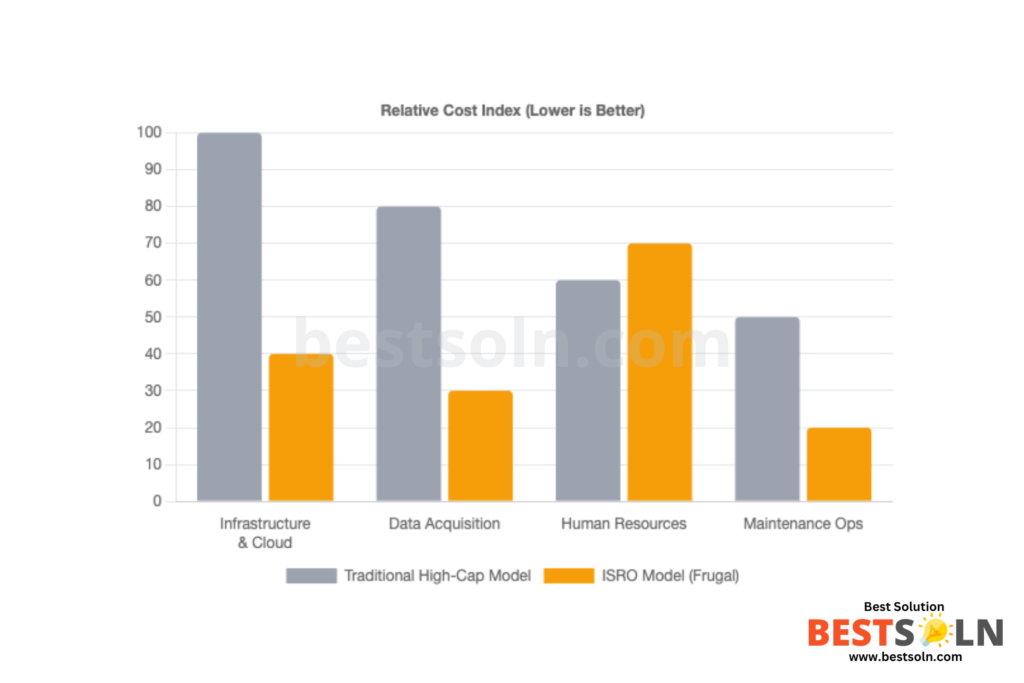
The organizational philosophy that enables ISRO’s achievements comprises several interlocking tenets that are highly valuable for any management organization seeking competitive advantage:
- Resource Optimization: This is a comprehensive effort to maximize the utility and lifespan of every component, facility, and operational cycle. For ISRO, this often means repurposing resources and ensuring that capital infrastructure, such as ground stations, is built with enough modularity to serve multiple missions, reducing the per-project cost burden.
- Simplicity in Focus: Frugality naturally demands simplicity, which often translates into superior reliability. Mission designs are streamlined to avoid unnecessary complexity. The Chandrayaan-3 mission, for example, succeeded by concentrating its efforts specifically on the lander-rover component, refining the objectives based on what was strictly necessary for the scientific goal.
- Iterative Learning (The “Fail Cheap, Learn Fast” Doctrine): ISRO embraces an iterative approach, viewing setbacks as essential, low-cost data collection opportunities rather than catastrophic financial losses. The experience gained from Chandrayaan-2, which faced a partial failure in its final stage, was meticulously leveraged to inform and refine the design and engineering of Chandrayaan-3. This ability to learn rapidly from previous endeavors minimizes the total research and development (R&D) cost for subsequent, related missions. This process effectively converts governmental expenditure on a single program into subsidized, accumulated institutional knowledge, creating a foundational advantage that accelerates future technological leaps.
By imposing financial and technical constraints, the organization is continuously driven toward innovations that are inherently lighter, simpler, and more optimized than those developed under unlimited budgets. This structural constraint serves as the primary engine for continuous innovation, positioning ISRO not just as a cost-saver but as a strategic disruptor in the global space race.
Engineering Miracles on a Shoestring Budget: Case Studies in Cost Efficiency

ISRO’s high-profile missions provide concrete, quantifiable proof that this frugal innovation mindset yields world-class results. The difference in expenditure compared to established agencies highlights a fundamental divergence in development strategy.
The Mars Orbiter Mission (MOM) Benchmark
The Mars Orbiter Mission, launched in 2013, cemented India’s reputation for cost-effective deep space exploration. The total project cost was approximately ₹454 crore, translating to about $73 million to $74 million at the time. Importantly, this total cost included satellite manufacturing (₹153 crore) and necessary ground station and relay upgrades that were designed to be used for other future ISRO projects, optimizing the overall investment.
This low cost, approximately one-eighth of the budget for NASA’s Mars Atmosphere and Volatile Evolution (MAVEN) orbiter, which was launched around the same time, was achieved through several tactical mechanisms. These included a modular approach to design, minimizing expensive physical ground tests by relying heavily on advanced simulations, and leveraging home-grown technologies and lower worker costs. The success of MOM, which achieved Mars orbit on its first attempt, demonstrated conclusively that streamlined design, forced by frugality, translates into increased system reliability and robustness, proving that efficiency is a true competitive edge in space exploration.
Chandrayaan-3: The Lunar Showcase
Chandrayaan-3, which successfully landed near the Moon’s South Pole, continued this legacy, costing only around $75 million. Achieving this complex feat for a price lower than many commercial media products emphasizes the profound nature of ISRO’s resource management.
The strategic optimization employed by ISRO involves treating its dedicated, educated workforce as a highly potent form of human capital that can substitute for scarce financial capital. Reports indicated that scientists often worked long hours, sometimes 18 to 20 hours a day. This dedication and availability accelerated project timelines while maintaining a relatively low operational cost base compared to nations where labor rates for comparable expertise are significantly higher. The inherent efficiency of the ISRO system is derived not only from material cost savings but also from maximizing the productivity and commitment of its personnel.
The following comparison illustrates the scale of ISRO’s achievement:
Cost Comparison: ISRO’s Missions vs. Global Benchmarks
| Mission | Agency | Target | Approximate Cost (USD) | Defining Achievement |
| Mangalyaan (MOM) | ISRO | Mars Orbit | $74 Million | Cheapest Mars mission; first attempt success |
| Chandrayaan-3 | ISRO | Lunar South Pole | $75 Million | The first nation to land near the Moon’s South Pole cost-effectively |
| MAVEN | NASA | Mars Orbit | $582 Million | Higher payload and complexity |
| LADEE | NASA | Lunar Exosphere | $280 Million | Considered cost-effective for NASA standards |
This demonstrated track record of low cost combined with high reliability, evidenced by the successful orbital insertion of MOM and the lunar landing of Chandrayaan-3, makes ISRO an exceptionally attractive and trusted partner in the burgeoning global commercial launch market. This commercial viability, founded on proven efficiency, is now a crucial component of India’s overall space strategy.
Strategic Independence: Indigenous Development and Autonomy
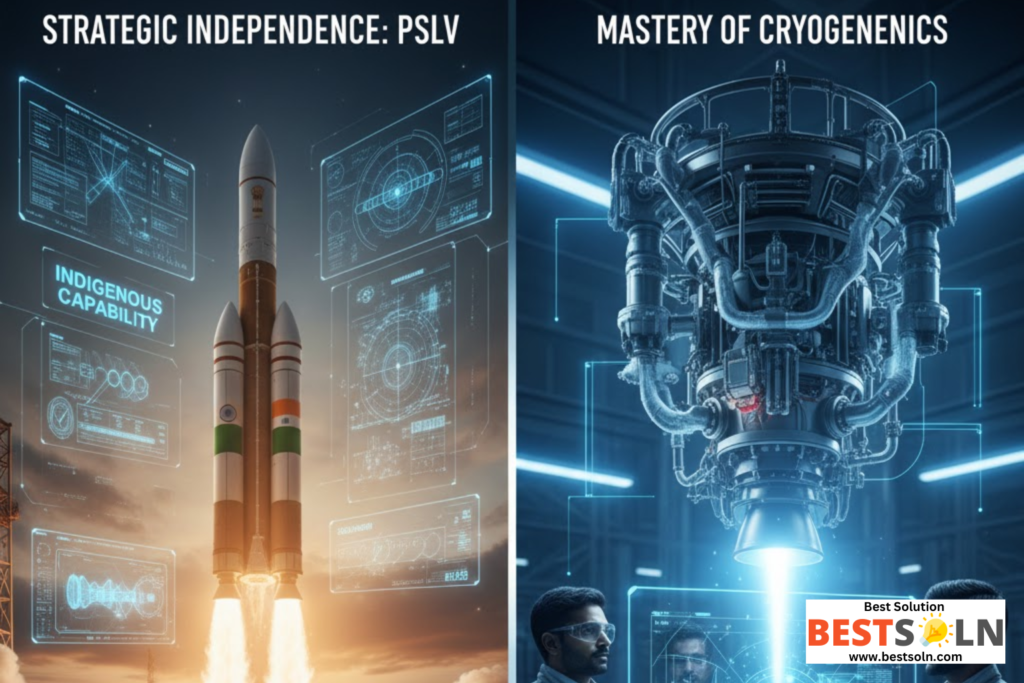
A defining feature of the ISRO Model, complementing its frugality, is the unyielding focus on indigenous development of core technologies. This strategy was born not only from a desire for cost control but from a strategic necessity to ensure national autonomy in accessing space.
The Rise of the PSLV
For many years, India relied on commercial services, predominantly from Russia, to launch its Indian Remote Sensing (IRS) satellites into Sun-synchronous orbits (SSO). This external reliance posed a strategic vulnerability, potentially subjecting India’s critical infrastructure to geopolitical constraints or technology embargoes. The solution was the indigenous development of the Polar Satellite Launch Vehicle (PSLV).
The PSLV, first flown in 1993, evolved into India’s workhorse launch vehicle, capable of placing IRS satellites into SSO and launching smaller satellites into Geostationary Transfer Orbit (GTO). Its proven reliability is evidenced by 59 successful launches out of 63 total flights. PSLV missions have carried payloads of immense national importance, including Chandrayaan-1 and the Mars Orbiter Mission. Today, the PSLV’s commercial launch cost ranges from approximately $18 million to $28 million, firmly establishing India as a leading low-cost, reliable launch service provider globally. Indigenous launch capability guarantees uninterrupted access to space for essential national functions, including strategic communication, telecommunications, and vital societal applications like Telemedicine and Disaster Management Support (DMS) programs.
Mastering the Cryogenic Engine: The Ultimate IP Asset
The struggle for true self-reliance culminated in the mastery of cryogenic engine technology. The Cryogenic Upper Stage Project (CUSP) was initiated to design and develop an indigenous cryogenic stage to replace those previously procured from Russia for use in the Geosynchronous Satellite Launch Vehicle (GSLV).
Cryogenic rocket stages are significantly more efficient than solid or earth-storable liquid propellant stages, providing greater thrust for the propellant consumed. This translates directly into a substantial payload advantage, which is essential for placing heavy communication satellites into GTO. The technical challenge is extreme: the system must pump propellants (liquid Oxygen and liquid Hydrogen) at temperatures as low as -183°C and -253°C, respectively, using turbo pumps running at high speeds (around 40,000 revolutions per minute).
The successful development of the CUSP secures crucial national Intellectual Property (IP). By achieving full indigenous control over this sophisticated heavy-lift launch capability, India eliminated its dependency on foreign powers for launching its largest satellites. This strategic self-sufficiency in core aerospace technology is not merely a matter of pride; it is a geopolitical hedging strategy against future instability, ensuring that the nation retains sovereignty over the evolution and deployment of its strategic space assets. Control over the launch vehicle is equivalent to controlling the critical infrastructure of the aerospace domain.
The Model Replicated: Frugality in the Age of Artificial Intelligence

The blueprint established by ISRO for achieving strategic objectives under stringent resource constraints has proven remarkably transferable to the high-stakes world of Artificial Intelligence. In the digital economy, computing power represents the largest capital expenditure, and the cost of training large foundational models is prohibitive for most non-state or non-major-corporation entities.
Bridging the Digital Divide with Jugaad
The ISRO Model provides a perfect strategic framework for lean innovators to compete against technology giants who possess functionally limitless compute and capital. The Bengaluru-based organization, Maya Research, provides a compelling case study, having been directly inspired by ISRO’s methodology.
Maya AI’s founding mandate was born from recognizing how mainstream technological systems often fail to serve individuals whose accents and languages are not readily captured by major international models. Their goal was to engineer globally competitive speech models using the same frugal methods that defined Mangalyaan’s success.
Tactical Frugality in Compute Strategy
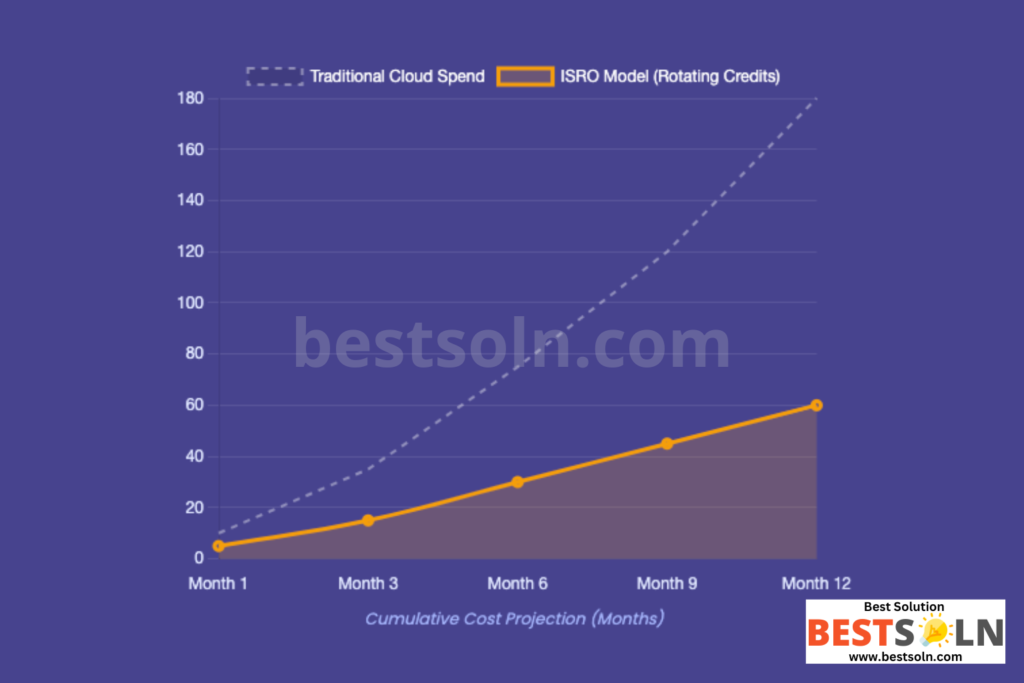
The translation of aerospace frugality into digital strategy is manifest in two critical areas:
- Rotating Cloud Credits and Strategic Leasing: Rather than investing colossal capital expenditure (CapEx) into building a dedicated supercomputing center, Maya AI treated leased cloud resources as modular components, mirroring ISRO’s reuse principles. They strategically leveraged and rotated resources across multiple major cloud providers, including Google, Amazon Web Services (AWS), and Microsoft Azure. This approach involved successfully convincing partners of the value of their mission, securing approximately $150,000 worth of cloud resources through startup programs like Microsoft Azure’s credit system. This constant rotation avoids vendor lock-in and maximizes the utility of subsidized or promotional compute time, effectively outsourcing the massive capital debt associated with infrastructure while the company retains control over its core intellectual property (the model architecture and proprietary data).
- Efficient Training Pipelines: The Maya team developed proprietary, in-house-designed architectures that were dramatically optimized for efficiency. These pipelines are capable of handling large datasets while requiring “minimal compute”. This demonstrates a fundamental principle of the ISRO Model applied to software: that optimization, clever engineering, and streamlined processes can effectively substitute for hardware brute force. This capability acts as the great equalizer in the global AI arms race, proving that technological sophistication and efficiency, not just massive financial backing, determine competitive success. If a smaller, leaner organization can achieve globally competitive results with a fraction of the traditional capital investment, the primary barrier to entry in foundational model development is significantly lowered.
| CASE STUDY: The Billion-Dollar Voice: How Maya Research Used Frugal Engineering and the ISRO Blueprint to Conquer the Indic Speech Gap
The Policy Imperative: Linguistic Data Sovereignty
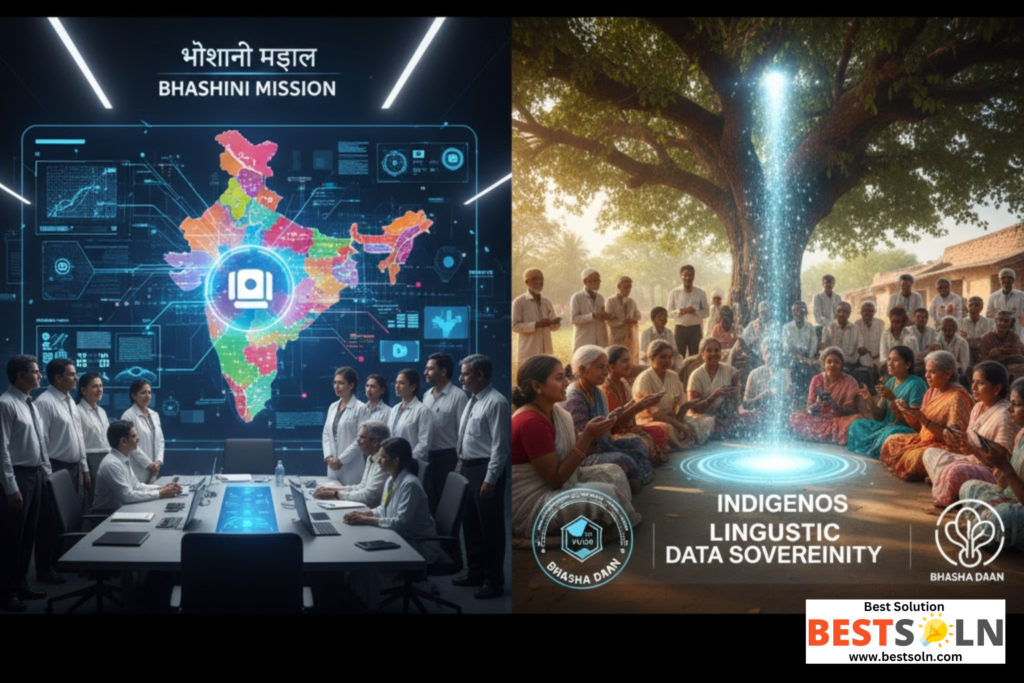
The strategic success of AI models is intrinsically linked to the quality, quantity, and cultural nuance of the data they are trained on. Maya AI’s genesis highlighted a critical national vulnerability: the lack of readily available, high-quality indigenous voice data necessary for training systems that understand India’s myriad languages and dialects.
Defining and Securing Digital Autonomy
This challenge directly addresses the rising global movement of Indigenous Data Sovereignty, which fundamentally asserts the right of a nation, or Indigenous community, to govern the collection, ownership, application, storage, and use of its own data. This principle is viewed as inherent to national sovereignty.
In the case of linguistic data, control is paramount. If foreign entities own the data and train the foundational models, they effectively control the narrative, economic value extraction, and security aspects of India’s digital future.
Indigenous Data Collection as Strategic R&D
Maya AI’s solution to this data gap exemplified the Jugaad mentality of resourceful, indigenous R&D. Since necessary data was scarce, the company undertook the arduous, methodical task of collecting its own voice data, recording conversations, and studying dialects “village by village”. This effort went beyond mere vocabulary, capturing regional conversation topics-such as the specifics of politics and real estate in Andhra Pradesh, or cinema and culture in Tamil Nadu. This proprietary, culturally nuanced dataset is considered Maya’s most significant edge, acting as a crucial defense against larger competitors.
This labor-intensive, ground-up data building is an essential act of securing digital autonomy, mirroring ISRO’s decades-long struggle to achieve aerospace autonomy through indigenous engineering.
National Policy Response: The Bhashini Mission
This private sector innovation is supported by a comprehensive government strategy to secure linguistic data at a national scale. The Bhashini Mission, or National Language Translation Mission, is the policy response.
Bhashini’s objectives are manifold, aiming to harness economies of scale in Indian language technologies, facilitate the adoption of Indian language technology for easier internet access, and promote the generation of indigenous Intellectual Property (IP). A core mechanism of this mission involves national-scale language data creation and crowdsourcing through the program known as Bhasha Daan.
Control over linguistic data is the critical infrastructure of the digital age, the digital equivalent of the cryogenic engine. By focusing on language models, India is not only fulfilling a societal mandate for inclusion, enabling better access to digital services for citizens across all strata, but is also implementing a vital economic strategy. Solving the language barrier unlocks vast, currently unserved domestic markets, ensuring that technological progress serves national development goals, continuing the ISRO tradition of using technology for societal upliftment (e.g., Tele-education and Telemedicine).
| CASE STUDY: India’s Atomesus AI: The Next Chapter in Global Artificial Intelligence Leadership
The table below summarizes the transferability of the core ISRO principles into the modern technological landscape:
Strategic Principles of the ISRO Innovation Model
| ISRO Principle (Space) | Strategic Application (Industry/AI) | Core Insight |
| Iterative Learning (Refining Chandrayaan-3) | Agile model development, rapid prototyping | Setbacks are embraced as subsidized, accumulated R&D knowledge that accelerates future cycles. |
| Resource Optimization & Modularity | Rotating cloud credits, efficient compute leasing | Maximize the utility of temporary resources; substitute software efficiency for high-cost hardware CapEx. |
| Indigenous Development of Core IP | Building proprietary data sets “Village-by-Village” | Guarantees national strategic autonomy and control over critical future infrastructure (digital or physical). |
| Societal Applications Focus | Enabling access through Indian language technology adoption | Ensures technology serves national development goals and unlocks vast, underserved domestic markets. |
Sustaining the Model: Commercialization, Scaling, and the Future
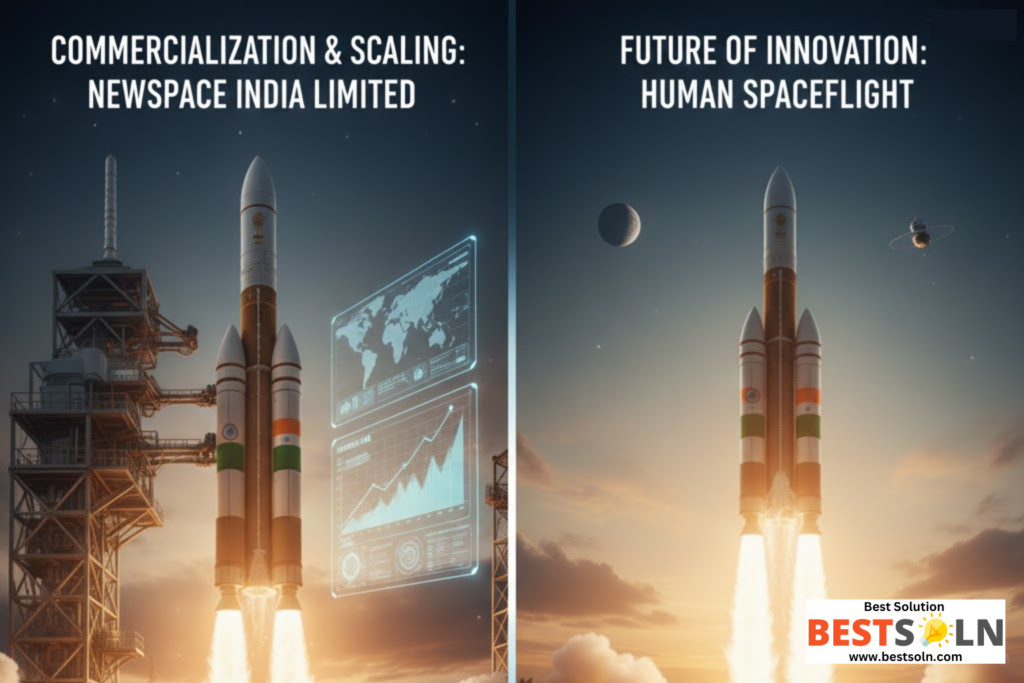
While the efficacy of the frugal innovation model is undeniable, questions have arisen about its long-term sustainability, especially as India prepares for missions of higher complexity (such as human spaceflight) and faces global competitors with escalating R&D budgets. The strategic answer is a measured pivot toward commercialization and private sector acceleration.
The Commercial Pivot and Externalizing Risk
India has set an ambitious target to significantly increase its share of the global space economy, aiming for $44 billion by 2033, up from $8.4 billion in 2022. Achieving this requires ISRO to transition from being a primary execution entity to becoming a catalyst and technology transfer enabler.
This strategic decentralization is achieved through key governmental organizations, notably NewSpace India Limited (NSIL) and the Indian National Space Promotion and Authorisation Centre (IN-SPACe). These bodies are responsible for facilitating private sector participation, commercializing proven launch vehicles like the Small Satellite Launch Vehicle (SSLV), and managing technology transfers.
By allowing the private sector (via NSIL) to handle routine launch services and commercial manufacturing, ISRO successfully externalizes the risk and immense capital investment associated with scaling operational capacity. This separation allows ISRO’s core governmental R&D budget to remain focused on high-risk, frontier projects that require the deepest level of indigenous mastery, such as the Gaganyaan human spaceflight program and deep space research like the Aditya-L1 solar observatory. This approach ensures that the spirit of frugal innovation continues to guide the public R&D agenda, while the private market bears the financial burden of scaling commercial services.
The Exportable Blueprint
The international acclaim for ISRO’s cost-effectiveness validates the model as a globally competitive strategic approach. India is now positioned not merely to sell launch capability, but to export a validated blueprint for high-tech strategic development under stringent constraints. This provides India with a unique niche on the global stage, especially among developing nations seeking technological independence without incurring crippling levels of capital debt. The shift to commercialization ensures the model’s sustainability, leveraging past frugal successes to fund exponential growth in future endeavors.
Recommended Readings

- ISRO: A Personal History by R. Aravamudan and Gita Aravamudan.
- From Fishing Hamlet to Red Planet – A comprehensive history of the Indian space program.
- The Leapfroggers: An Insider’s Account of ISRO by Ved Prakash Sandlas.
- Vikram Sarabhai, A Life by Amrita Shah – Focusing on the foundational vision and legacy.
- Touching Lives by S. K. Das – Focusing on the social and application side of ISRO technology.
Frequently Asked Questions (FAQ)

Q1: What is the meaning of Jugaad in the context of ISRO?
A: Jugaad is the Indian cultural concept for frugal innovation. In the context of ISRO, it represents a resourceful and improvisational approach to complex problem-solving, emphasizing the ability to achieve exceptional outcomes with minimal resources. It involves maximizing resource optimization, prioritizing simplicity in design, and using constraints to ignite innovative engineering solutions.
Q2: How does ISRO manage to conduct space missions so cost-effectively?
A: ISRO’s cost-effectiveness stems from several factors, including a deep-seated culture of frugal innovation, indigenous technology development, and optimized design. Tactical methods include using a modular approach, relying heavily on simulations instead of costly hardware testing, lower operational costs due to indigenous labor, and maximizing the use of ground infrastructure for multiple projects.
Q3: What are ISRO’s most significant achievements in space exploration?
A: ISRO has achieved several historic milestones, including successfully placing the Mars Orbiter Mission (Mangalyaan) into Mars orbit on its first attempt, becoming the first nation to land near the Moon’s South Pole with Chandrayaan-3, and launching a record 104 satellites in a single mission. ISRO is also developing the Gaganyaan program for human spaceflight and has initiated solar research with Aditya-L1.
Q4: What is the role of NSIL and IN-SPACe in the new ISRO model?
A: NewSpace India Limited (NSIL) and IN-SPACe are entities created to commercialize and accelerate India’s space economy. ISRO acts as a catalyst by transferring technology and facilitating private sector participation through these organizations, allowing the private industry to handle routine launch services and commercial applications, thereby freeing ISRO to focus its government budget on high-risk, frontier R&D projects.
Q5: How does the ISRO model apply to Artificial Intelligence development in India?
A: In the AI sector, the ISRO model translates into prioritizing efficiency and indigenous development over high compute capital expenditure. Startups like Maya AI use strategic methods such as rotating cloud credits across multiple providers to minimize costs and designing efficient training pipelines. This approach is also integral to national efforts, like the Bhashini Mission, focused on indigenous data collection and securing linguistic data sovereignty.
Conclusion: The ISRO Blueprint for Global Innovation

The ISRO Model represents a powerful and replicable strategic framework for any entity seeking technological leadership in environments defined by resource constraints. It is a philosophy that mandates achieving strategic resilience through uncompromising efficiency.
The success trajectory, moving from the philosophical foundation of Jugaad and indigenous development of launch vehicles (PSLV) and core technologies (CUSP), to the subsequent application of these principles in the high-stakes world of Artificial Intelligence (Maya AI’s compute optimization), demonstrates profound strategic coherence. In both the physical domain (aerospace) and the digital domain (data sovereignty via Bhashini), the central objective remains the same: the secure and autonomous control of critical national infrastructure.
The model conclusively proves that resourcefulness, supported by highly dedicated personnel and a strategic approach to incremental innovation, can successfully overcome the raw financial advantages held by established global players. As ISRO transitions toward accelerating the private space economy, it is leveraging its frugal history to fund ambitious future goals, ensuring that the foundational efficiencies built over decades of Jugaad will continue to fuel India’s ascent as a global technological powerhouse.











Leave a Reply