


⏱️ Read Time:
Introduction: The Core of the Blockchain Ideal
When the world first discovered blockchain technology, the promise was simple yet revolutionary: coordination without requiring trust in intermediaries. This fundamental concept, known as trustlessness, is the very soul of the Web3 movement. Yet, as the ecosystem has matured, chasing efficiency, speed, and sleek user experiences, many developers and projects have quietly compromised this core ideal.
Enter the Trustless Manifesto, a foundational document published in late 2025 by key figures from the Ethereum Foundation, including co-founder Vitalik Buterin and researchers Yoav Weiss and Marissa Posner. The manifesto is an urgent wake-up call, asserting that trustlessness is not a feature to be added later, but the purpose itself. It is a bold, philosophical, and practical guide designed to halt what its authors call the “drift toward dependence on trust” and steer the decentralized world back to its foundational principles.
The Crisis of Convenience: The ‘Drift Toward Dependence’

The central thesis of the Trustless Manifesto is that decentralization erodes not through direct attack, but through convenience. This concept, the “drift toward dependence,” describes the cumulative effect of small, seemingly harmless centralized shortcuts that developers take to improve performance or user experience.
The document warns of a slippery slope: “A hosted node here, a whitelisted relayer there… gateways become platforms. Platforms become landlords.” Every time a project relies on a single external entity for simplicity, it introduces a potential point of failure, censorship, or control.
This risk became acutely clear following real-world events, such as a major cloud provider outage that demonstrably crippled the transaction capacity of several blockchain-based projects reliant on centralized infrastructure. The manifesto forcefully argues that an easy-to-use system built on a fragile, centralized core is merely “decoration,” and the system’s long-term resilience is sacrificed for short-term efficiency.
Redefining Decentralization: Core Principles of the Manifesto
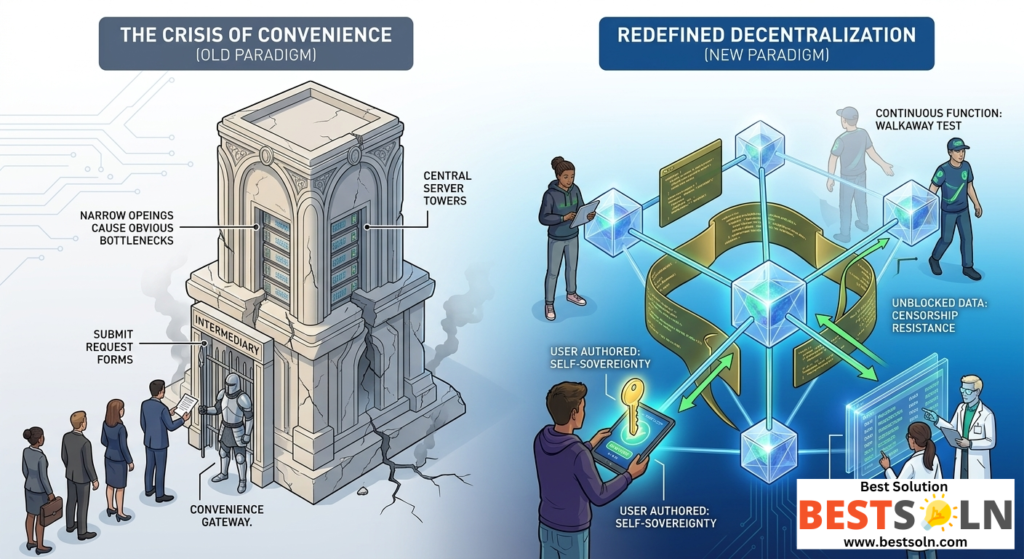
To combat this drift, the manifesto provides a clear, actionable framework for evaluating and building genuinely trustless systems.
Trustlessness: The Foundational Purpose
A system is defined as truly trustless when its correctness and fairness rely entirely on mathematics and consensus, not on the goodwill of intermediaries. The litmus test is simple: any honest participant must be able to join, verify, and act without permission and without fear of interference.
The Six Pillars: Requirements for a Trustless System
The manifesto outlines six non-negotiable requirements for any system claiming to be trustless:
- Self-Sovereignty: Users must authorize all their actions directly. No other entity can act on a user’s behalf without explicit consent.
- Verifiability: Any participant must be able to independently confirm the system’s state and history using only publicly available data.
- Censorship Resistance: Any valid action must be capable of being included in the system within a reasonable timeframe and at a reasonable cost.
- Walkaway Test: If any major operator disappears or acts maliciously, another operator must be able to replace them and resume operations without needing permission from a central authority.
- Accessibility: Participation in the system must be practically achievable for ordinary users, not just experts with massive capital or specialized hardware.
- Transparency of Incentives: The system’s reward and rule mechanisms must be governed by the protocol itself and be publicly visible, not by opaque off-chain processes.
The Three Laws of Trustless Design
For protocol designers, the manifesto proposes three “harsh” laws intended to eliminate single points of failure:
- No Critical Secrets: The protocol’s operation cannot depend on private information held by a single entity (beyond a user’s private keys).
- No Indispensable Intermediaries: Any critical participant (like a sequencer or relayer) must be replaceable by any willing participant following the protocol rules.
- No Unverifiable Outcomes: Every state change must be fully reproducible and verifiable from public data, removing any reliance on trusting the outcome on faith.
Centralized Choke Points: The Manifesto’s Key Targets

The manifesto doesn’t shy away from pointing out existing centralization risks within the current ecosystem:
- Cloud Reliance: The vast majority of decentralized applications and hosted nodes rely on a small number of centralized cloud services like Amazon Web Services (AWS) or Google Cloud Platform (GCP). This systemic dependency introduces a single point of failure that undercuts the entire ethos of distributed infrastructure.
- Layer 2 Sequencers: Many critical Layer 2 scaling solutions, designed to help Ethereum, initially launched with a single, centralized sequencer controlling transaction ordering. This creates a potential chokepoint for censorship, manipulation, or downtime.
- Persistent Upgrade Keys: The continued use of administrative keys to upgrade smart contracts, often justified as “temporary” during early development, is criticized as an indefinite delay of decentralization, allowing centralized control to persist long after it is needed.
- Centralized Interoperability: Cross-chain solutions that reintroduce trusted “solvers” or “relayers” as gatekeepers recreate the very intermediary model that blockchain was meant to overcome.
Making an On-Chain Stand: The Public Pledge
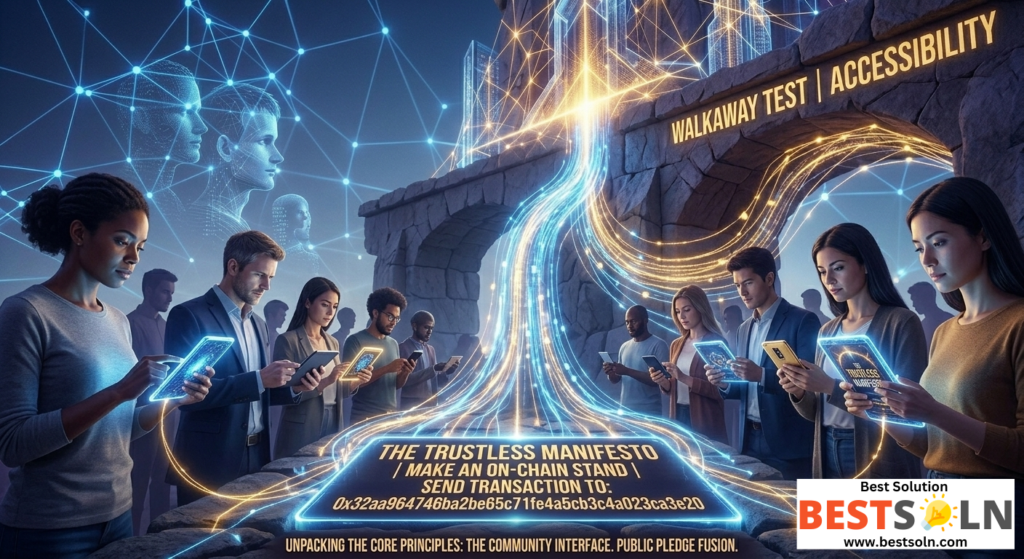
A unique element of the Trustless Manifesto is its interactive, on-chain call to action. Supporters are encouraged to “sign” the document by sending a transaction to a specific Ethereum smart contract (0x32aa964746ba2be65c71fe4a5cb3c4a023ca3e20).
This action creates a permanent, immutable, and public record of the signer’s Ethereum address, signaling their public commitment to upholding the manifesto’s principles in their own work and participation within the ecosystem. It transforms a philosophical document into an active, verifiable community commitment.
Recommended Readings

For those interested in delving deeper into the philosophy and technical challenges of decentralized systems, here are some recommended books:
- “The Bitcoin Standard: The Decentralized Alternative to Central Banking” by Saifedean Ammous
- “Digital Gold: Bitcoin and the Inside Story of the Misfits and Millionaires Trying to Reinvent Money” by Nathaniel Popper
- “Mastering Bitcoin: Programming the Open Blockchain” by Andreas M. Antonopoulos (Focuses on technical foundations of trustless systems)
Frequently Asked Questions (FAQ)

Q1: Who authored the Trustless Manifesto?
A: The manifesto was co-authored by Ethereum co-founder Vitalik Buterin and Ethereum Foundation researchers Yoav Weiss and Marissa Posner.
Q2: When was the manifesto published?
A: The document was officially published on November 11, 2025.
Q3: What is the core problem the manifesto addresses?
A: It addresses the “drift toward dependence on trust” where projects sacrifice fundamental decentralization for short-term gains in efficiency, speed, or user convenience, thereby introducing systemic risks and single points of failure.
Q4: What does “trustlessness” mean in this context?
A: Trustlessness means the system’s correctness and fairness are guaranteed by publicly verifiable mathematics and code, not by trusting the integrity or goodwill of any central operator or intermediary.
Q5: Is the Ethereum Foundation mandating these principles?
A: While the manifesto was co-authored by EF staff, it is primarily a philosophical guide and call to action for the entire ecosystem. The on-chain pledge is a voluntary commitment for individuals and teams to reaffirm their dedication to these ideals.
Conclusion

The Trustless Manifesto is more than just a set of principles; it is a critical course correction for the Web3 movement. In a world where the lines between decentralized ideals and centralized practicality are increasingly blurred, Buterin and his co-authors have provided a clear, uncompromising metric for success.
The message is unambiguous: the long-term viability of decentralized systems rests on the rigor of their trustless design. By demanding transparency, verifiability, and true self-sovereignty, the manifesto challenges every developer, operator, and user to prioritize the essential purpose of the technology over the fleeting appeal of convenience. It serves as an enduring reminder that if we lose trustlessness, we lose everything that makes blockchain technology worth building in the first place.












Leave a Reply