

- Home
- /
- Artificial Intelligence
- /
- The AI Security Stack: A…
⏱️ Read Time:
Introduction
Enterprise adoption of artificial intelligence in regulated sectors such as banking, healthcare, insurance, and government has reached a pivotal operational turning point. Early deployments focused primarily on isolated conversational prototypes, but modern production systems operate as integrated decision engines embedded deeply within mission critical workflows. These advanced software environments retrieve proprietary documents, evaluate user identities, invoke internal application programming interfaces, execute automated financial transactions, and directly influence clinical or regulatory decisions.
This rapid operational transition exposes a fundamental security oversight: evaluating model safety in isolation is inadequate for enterprise risk management. A large language model isolated from external tools simply processes text strings, but an enterprise artificial intelligence system operates inside a complex software harness. When a security failure occurs in a production environment, it rarely stems from a frontier model suddenly developing malicious intent. Instead, it occurs when a retriever pulls an unauthorized contract, a prompt gateway fails to redact personal identifiers, an autonomous agent executes an unvalidated tool call, or an audit logging system fails to record the decision chain.
Traditional cybersecurity frameworks focused on protecting static IT systems by maintaining confidentiality, integrity, and availability. Modern artificial intelligence security requires a paradigm shift toward protecting automated decisions. The model serves merely as the reasoning engine within a broader framework, whereas the surrounding architecture acts as the control plane that establishes boundaries, monitors execution, enforces regulatory compliance, and provides verifiable auditability.
From System Protection to Decision Protection: The Enterprise Reality Shift
The historical focus of corporate information security centered on system perimeter protection. Information security teams deployed identity and access management controls, multi-factor authentication, storage encryption, network firewalls, vulnerability scanners, and security operations centers to safeguard underlying infrastructure. While these foundational controls remain necessary, the introduction of probabilistic language models creates an entirely new risk surface centered on decision integrity.
When an enterprise deploys artificial intelligence across core operational functions such as fraud detection, anti-money laundering monitoring, credit underwriting, customer onboarding, and operational automation, risk shifts from static system access to dynamic algorithmic action. A well secured database can still be compromised in effect if an authenticated user employs an artificial intelligence assistant to retrieve context chunks they are not authorized to view.
Security research demonstrates that computational capability and operational risk emerge primarily from the system scaffold surrounding a model rather than the model weights alone. Small, open weight models, when orchestrated through structured scaffolding involving shared memory, specialized role prompts, parallel planning, and external verification tools, can perform sophisticated workflows that far exceed the standalone capabilities of unassisted frontier models. This systemic capability amplification can be expressed mathematically:
System Capability and Risk = Model Capability X Orchestration Scaffolding
While an attacker can leverage system scaffolding to amplify exploit vectors, enterprise security teams must use architectural scaffolding to contain, filter, and verify model behavior. Expecting a large language model to maintain perfect policy compliance through system prompts alone is an unreliable defense strategy. System prompts can be bypassed through indirect prompt injection, jailbreaks, or context window confusion. Deterministic control mechanisms must sit entirely outside the probabilistic model to evaluate requests, restrict data access, and validate outputs before execution.
| Architectural Component | Probabilistic Model Role | Deterministic Control Plane Role |
| Access Control | Interprets user context and intent | Enforces identity assertion and document permissions |
| Knowledge Retrieval | Summarizes and synthesizes context | Filters vector database queries via access metadata |
| Tool Execution | Recommends API parameters and actions | Enforces tool allowlists, sandboxing, and approval gates |
| Data Protection | Attempts policy adherence via prompt rules | Scans and masks sensitive entities in inputs and outputs |
| Auditability | Generates textual reasoning steps | Generates immutable trace logs and compliance evidence |
In regulated environments, proof of control is as vital as functional utility. An assistant that generates an accurate response but lacks an immutable trace showing which data sources were accessed, which access controls were checked, and which user requested the information fails to meet basic enterprise compliance requirements. Prompting delivers demonstrations, but rigorous architecture delivers production readiness.
Deconstructing the Enterprise Threat Surface across the AI Lifecycle
Expanding artificial intelligence capabilities introduces dynamic threat vectors that legacy application security frameworks were not designed to mitigate. The Open Web Application Security Project Top 10 for Large Language Models highlights critical vulnerability categories, but multi-tenant enterprise deployments amplify these risks across complex trust boundaries. Securing these workflows requires mapping vulnerabilities across every phase of the artificial intelligence lifecycle, including data ingestion, model development, validation, deployment, runtime monitoring, and continuous improvement.
Indirect Prompt Injection and Corpus Poisoning
Direct prompt injection occurs when an end user submits adversarial text designed to override system instructions. Indirect prompt injection is significantly more dangerous in enterprise Retrieval Augmented Generation pipelines. In an indirect attack, malicious instructions are hidden inside third party documents, vendor invoices, or public repository updates. When the retriever ingests and indexes these files, the untrusted text enters the context window as retrieved knowledge, tricking the model into executing unauthorized commands, exfiltrating context, or altering transaction parameters.
Unauthorized Retrieval and Cross Tenant Data Leakage
Vector databases convert textual information into high dimensional semantic embeddings. Standard semantic search retrieves content based strictly on conceptual similarity rather than access permissions. If an enterprise indexes internal files into a central vector store without embedding granular access control lists directly into the vector metadata, semantic queries will pull restricted documents. For example, a lower level employee querying standard operating procedures might unknowingly receive context chunks containing confidential executive pricing or proprietary deal terms.
Agent Tool Misuse and Privilege Escalation
Autonomous agents transition language models from passive text generators into active decision makers. When an agent is granted access to system tools such as email gateways, ticketing systems, or database endpoints, a failure in context interpretation or a prompt injection attack can lead to unauthorized API invocation. Unrestricted agent tooling creates severe financial and operational exposure if an agent modifies supplier bank details, issues unauthorized refunds, or releases restricted records without human review.
Ungoverned Memory Persistence
Long term and session based memory stores allow assistants to retain context across user interactions. Without explicit governance, memory modules can accidentally store sensitive personal identifiers, privileged legal strategies, or authentication secrets. If context from one user session bleeds into a shared organizational memory index, unauthorized users in subsequent sessions can query that sensitive data.
Supply Chain and Dependency Attacks
Model weights sourced from external repositories, third party embeddings APIs, or open source inference servers introduce subtle supply chain risks. A compromised model checkpoint or tampered dependency is functionally equivalent to a backdoored binary executable. Enterprise architectures must enforce Software Bill of Materials verification, model weight signing, and cryptographic hash checks before loading model files into production runtimes.
| Threat Category | Primary Attack Vector | Target Architectural Layer | Primary Mitigation Strategy |
| Direct Prompt Injection | Adversarial user inputs attempting system override | Prompt Gateway and Input Validator | Semantic input classification, prompt isolation |
| Indirect Prompt Injection | Malicious text embedded in ingested documents | RAG Ingestion and Context Assembler | Untrusted data tagging, secondary response validation |
| Corpus Poisoning | Ingestion of manipulated or unverified data sources | Data Pipeline and Ingestion Engine | Document provenance hashing, cryptographic signatures |
| Unauthorized Retrieval | Semantic search pulling restricted context chunks | Vector Store and RAG Orchestrator | Access control list pre-filtering, entitlement validation |
| Agent Tool Misuse | Hijacked agent calling restricted APIs | Tool Execution Sandbox | Strict tool allowlists, scoping, human approval gates |
| Memory Context Leakage | Persistence of sensitive data across sessions | Long Term Memory Store | Time-To-Live enforcement, category blocking |
| Supply Chain Compromise | Tampered base weights or third party libraries | Infrastructure and Model Registry | Model signing, Software Bill of Materials scanning |
The Multi-Layer Control Plane: Building Defense in Depth
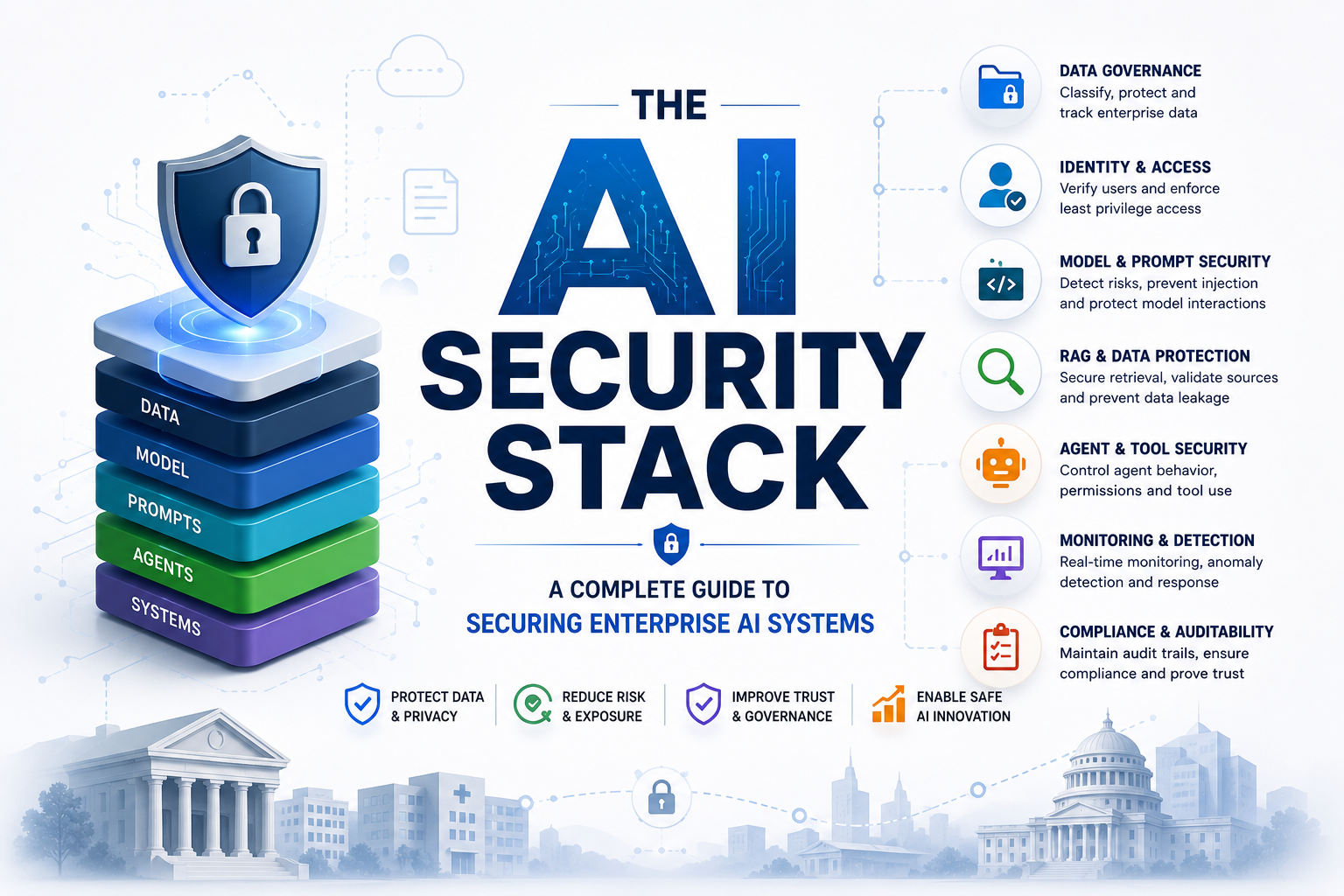
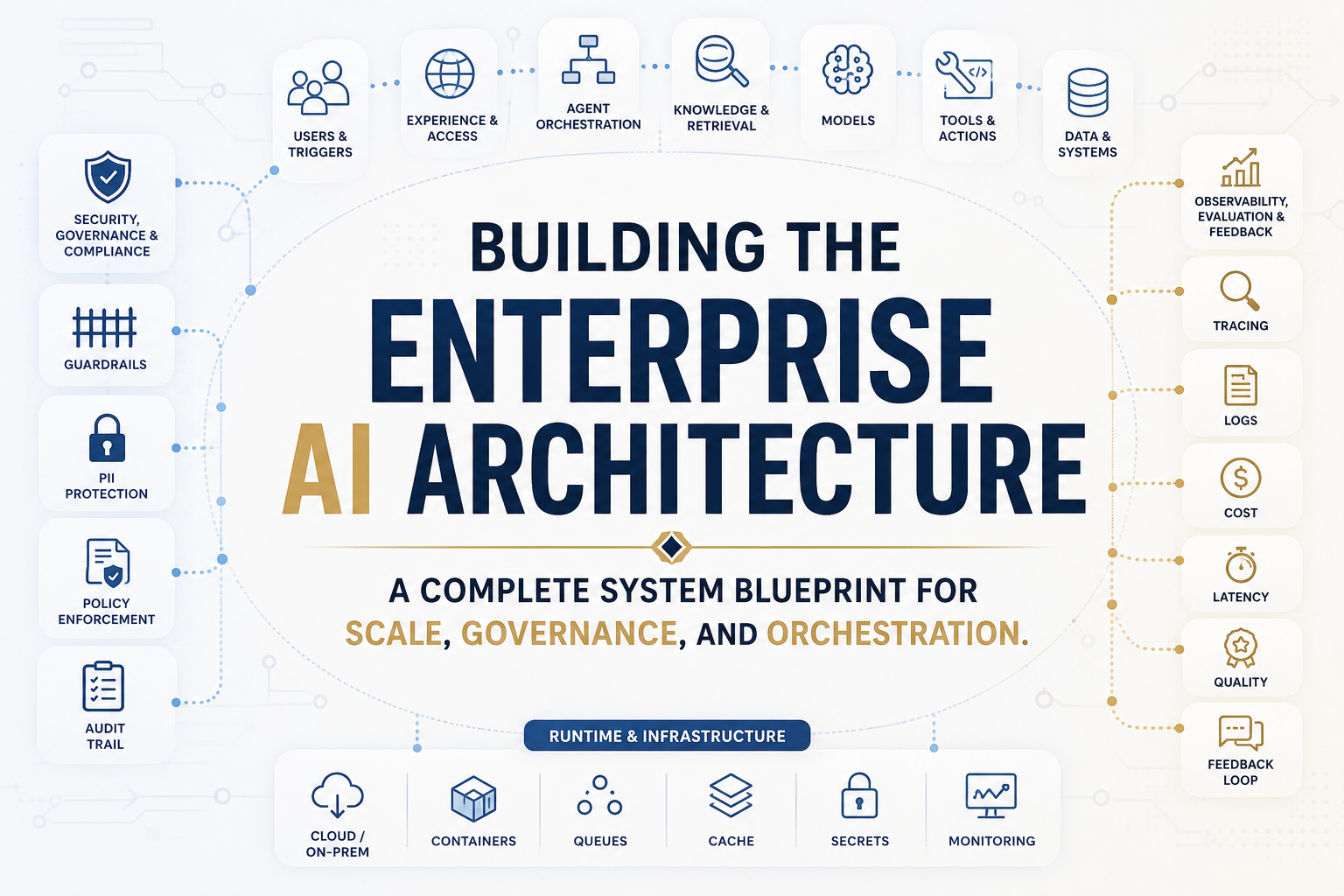
To mitigate enterprise threats, technology leaders must deploy a multi-layered defense in depth framework around the language model. Security controls must evaluate and transform data at every step in the execution lifecycle, ensuring that unvalidated user requests or unsafe context never reach production endpoints without deterministic oversight.
The transaction path begins when an authenticated user submits a request through the user interface. The request passes through an Enterprise Single Sign-On and Identity Layer, which attaches verified user claims to the request context. Next, the request enters a Policy Engine and Prompt Gateway. The gateway scans the payload for sensitive data, masks protected attributes, enforces rate limits, and validates the input schema.
Once sanitized, the request reaches the RAG Orchestrator. The orchestrator queries a Secure Vector Database using entitlement pre-filters derived directly from the user identity claims. The retrieved chunks are scanned for indirect prompt injection and compiled into a grounded prompt template. This template is transmitted via an LLM Gateway to an approved model endpoint, which routes high risk workloads to private regional clouds.
If the model response requires taking an action, the proposal is passed to an Agent Orchestrator operating inside a sandboxed environment. High risk tool executions are held in a dry-run state until passed to a Human Approval Layer. Once approved and executed, the output is verified by an Output Guardrail, while the full execution chain is written to an Immutable Audit Store and displayed on a real time Governance Dashboard.
Identity and Access Control Layer
Identity forms the primary boundary of enterprise security. Every incoming interaction must be authenticated via enterprise single sign-on protocols such as SAML or OpenID Connect. The user token must convey granular authorization claims including role based access control groups, attribute based access control flags, geographic location, and organizational unit designations. Service accounts used for internal component communication must follow the principle of least privilege, preventing back end services from executing actions beyond the scope of the initiating user.
Prompt Gateway and Input Protection
The prompt gateway functions as an API firewall for language model interactions. It inspects incoming payloads before they reach model endpoints. This layer validates request schemas, enforces token quotas, applies structural prompt templates, and runs deterministic classifiers to detect adversarial prompt injection patterns. Crucially, the gateway includes a sensitive data filtering module that intercepts text, detects personally identifiable information or protected health details, and replaces those tokens with anonymized placeholders.
Access Control Aware Retrieval Augmented Generation
In a secure retrieval architecture, document permissions must be preserved during ingestion and actively enforced during retrieval. When documents are processed, the ingestion engine extracts native file permissions from source systems such as SharePoint, Confluence, or custom object stores. These permissions are attached as immutable metadata tags to every individual text chunk stored in the vector database.
During a search query, the retrieval orchestrator transforms the authenticated user identity claims into a mandatory metadata filter. The vector database executes this access filter prior to running semantic vector calculations. This pre-filtering step guarantees that unauthorized chunks are excluded from similarity scoring entirely, eliminating the risk of accidental data exposure.
Model Gateway and Context Driven Routing
Direct application connections to external model endpoints introduce severe compliance risks. An LLM gateway centralizes all outbound inference calls. The gateway reads the data classification tier determined by the policy engine and routes the prompt accordingly. Standard, low risk requests can be routed to cost efficient commercial endpoints, whereas requests containing confidential financial context are redirected to private, enterprise dedicated model instances hosted within air gapped regional virtual private clouds.
Memory Lifecycle Governance
Artificial intelligence memory components must be treated as governed data stores subject to strict retention policies. Memory architectures must strictly segregate short term conversational context from long term factual indices. High risk categories such as system credentials, payment details, clinical notes, and privileged legal communications must be explicitly blocked from persisting in long term memory stores. All stored context items require cryptographic encryption at rest, explicit user consent flags, owner tags, and automated Time To Live expiration schedules.
Immutable Observability and Traceability
Traditional software logs capture basic HTTP status codes and endpoint latencies, but artificial intelligence auditability demands full reasoning context. The observability layer assigns a unique global trace identifier to every interaction. This trace records the full chain of execution: user identity context, input prompt hash, retrieved document identifiers with similarity scores, policy decision flags, raw model outputs, tool invocation parameters, and human approval signatures. Log stores must be immutable, encrypted, and integrated directly into enterprise Security Information and Event Management platforms.
Agent Governance, Permission Matrices, and Human Oversight
Unlike passive search applications, autonomous agents execute multi-step planning loops, select external tools, and modify live database systems. To mitigate operational risk, agent interactions must be governed by an explicit Permission Matrix that dictates precise execution bounds.
When an agent proposes an action, the plan is evaluated by an Agent Orchestrator. The orchestrator checks the action against the Permission Matrix and Policy Engine. If the action is permitted and categorized as low risk, it executes directly. If the action is medium risk, it requires user confirmation. If the action is high risk, the agent generates a dry-run execution summary and pauses execution until a human supervisor approves the request. Critical or forbidden actions are hard-blocked immediately.
Risk tiering determines whether an agent can act autonomously or must pause for explicit human review:
- Low Risk (Automated Execution): Read-only operations, such as querying public policy guidelines or retrieving user-owned document summaries.
- Medium Risk (User Confirmation): Non-destructive draft actions, such as generating an email draft or composing a ticketing update that requires the end user to review and manually confirm.
- High Risk (Manager Approval): Actions that modify business records, such as updating vendor status codes or adjusting credit limits, requiring secondary authorization from a manager.
- Critical Risk (Blocked or Multi-Signer Approval): Irreversible or highly consequential actions, such as executing wire transfers, releasing claims payments, or deleting database tables. These actions are either hard-blocked or require multi-party cryptographic sign-off.
| Agent Role | Permitted Actions | Hard-Blocked Actions | Approval Requirement | Required Audit Scope |
| Policy Q&A Assistant | Search public guidelines, summarize approved documents | Modify policy text, access restricted personnel files | Fully Automated for low risk Q&A | Query text, retrieved document IDs, generated answer |
| Procurement Agent | Search supplier records, draft vendor evaluation summaries | Alter master vendor bank details, issue purchase orders | Manager sign-off for status changes | Supplier ID, risk evaluation score, approver identity |
| Clinical Summarizer | Parse patient notes, draft clinical encounter summaries | Update diagnosis codes, issue prescriptions, export records | Clinician review prior to medical record entry | Patient context ID, clinician badge ID, trace ID |
| Financial Operations Agent | Identify invoice discrepancies, draft exception memos | Release ledger payments, approve loan applications | Multi-signer approval for financial transfers | Transaction ID, line item variances, approval signatures |
Before executing high risk tool calls, agents must enter a dry-run state. The agent generates a structured payload displaying the proposed target API, specific parameter values, impacted record IDs, underlying rationale, and an automated rollback plan. The human reviewer inspects this dry-run summary to verify intent before authorizing execution. Furthermore, agent platforms must incorporate an emergency kill switch capable of instantly revoking tool execution permissions and terminating active agent sessions across the enterprise.
Regulatory Alignment and Continuous Compliance by Design
Operating artificial intelligence within regulated sectors requires aligning operational software architecture with international standards and legislative directives. Key governance frameworks include the ISO/IEC 42001 Artificial Intelligence Management System standard, the National Institute of Standards and Technology AI Risk Management Framework 1.0, and the European Union AI Act.
These frameworks mandate that risk management must operate across the full application lifecycle, from data selection through continuous post-deployment monitoring.
| Governance Domain | NIST AI RMF Alignment | ISO/IEC 42001 Reference | EU AI Act Compliance Requirement | System Control Implementation |
| System Inventory | Govern 1.1 | Clause 6.1 | High Risk System Registration | Automated model catalog and API endpoint discovery |
| Data Governance | Map 1.2 | Annex A.8 | Data Quality and Lineage Rules | Provenance tracking, sensitive data masking |
| Risk Management | Map 2.1 | Clause 8.2 | Continuous Risk Assessment | Automated pre-deployment red teaming |
| Human Oversight | Manage 2.2 | Annex A.6 | Human in the Loop Safeguards | Action approval workflows and risk thresholds |
| Traceability | Measure 2.3 | Annex A.9 | Automated Logging Mandates | Global trace ID generation and log hashing |
| Model Validation | Measure 1.1 | Clause 9.2 | Post-Market Performance Monitoring | Automated concept drift and accuracy tracking |
An enterprise governance dashboard operationalizes these regulatory requirements by aggregating real time performance indicators, security posture metrics, and compliance evidence. Key operational indicators tracked on the dashboard include:
- Model Accuracy: Measured continuously against baseline benchmarks, maintaining targets above ninety percent.
- Bias Risk: Evaluated across demographic and operational variables, maintaining low risk thresholds.
- Concept Drift Status: Tracked via distribution distance metrics on incoming prompts and outputs, flagging abnormal variance.
- Audit Coverage: Maintained at one hundred percent trace capture across all production requests.
- Adversarial Attack Telemetry: Real time counting of prompt injection attempts, blocked requests, unauthorized retrieval events, and policy violations.
Continuous monitoring ensures that when model drift occurs or anomalous retrieval patterns emerge, alerting mechanisms trigger automated containment actions, such as reverting to fallback models or pausing agent tool execution.
Cloud Architecture Deployment Models
Implementing a compliant system requires translating architectural principles into provider specific cloud infrastructure. While individual managed service names differ across public cloud providers, the security topography remains identical: private network boundaries, managed identity authentication, secret vault management, isolated vector storage, and centralized logging.
| Architectural Layer | Microsoft Azure Pattern | Google Cloud Platform Pattern | Amazon Web Services Pattern |
| Identity and Access | Entra ID, Managed Identities | Cloud Identity, IAM Workflows | IAM Identity Center, Roles |
| Ingress Security | Azure Front Door, Web Application Firewall | Cloud Armor, Cloud Load Balancing | AWS WAF, CloudFront Gateway |
| Application Runtime | Azure Container Apps, AKS | Cloud Run, Google Kubernetes Engine | Amazon ECS, EKS Private Subnets |
| Policy Engine | Open Policy Agent on AKS | Open Policy Agent on Cloud Run | AWS Verified Permissions |
| Vector Database | Azure AI Search with ACL Filters | Vertex AI Search, AlloyDB | OpenSearch Serverless, Aurora |
| Model Endpoints | Azure OpenAI Private Endpoints | Vertex AI Dedicated Endpoints | Amazon Bedrock VPC Endpoints |
| Secrets and Keys | Azure Key Vault | GCP Secret Manager, Cloud KMS | AWS Secrets Manager, KMS |
| SIEM and Logging | Microsoft Sentinel, Log Analytics | Chronicle SIEM, Cloud Logging | AWS Security Hub, CloudTrail |
Regardless of cloud provider choice, public network access to model endpoints and vector databases must be strictly disabled. All intra-system network traffic must flow through isolated virtual network subnets, private endpoints, and encrypted transport channels.
Adversarial Red Teaming and Production Readiness Gates
Validating an enterprise artificial intelligence system requires moving beyond conventional software unit testing to continuous adversarial red teaming. System red teaming systematically evaluates how the end-to-end architecture responds to intentional probing, evasive prompt formulations, corrupted retrieval sources, and unexpected agent state changes.
Red teaming protocols evaluate system responses across critical operational dimensions:
- Context Boundary Verification: Testing whether specific query phrasing can trick the vector retriever into bypassing identity metadata filters.
- Instruction-Data Separation: Verifying that indirect prompt instructions buried in retrieve and summarize tasks are treated strictly as passive data rather than executable code.
- Guardrail Evasion Resistance: Attempting to bypass input and output filters using obfuscated encodings, foreign language translation, or multi-turn persona simulation.
- Tool Scope Containment: Injecting malicious parameters into agent planning steps to verify that sandbox boundaries block unauthorized API requests.
- Memory Leakage Probing: Probing multi-turn chat sessions to verify that restricted user details from prior conversations do not leak across session boundaries.
Continuous evaluation metrics can be calculated quantitatively during testing runs:
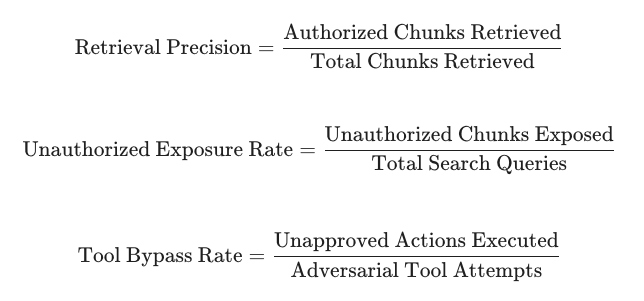
Red teaming must evaluate realized risk rather than superficial model formatting errors. If an adversarial prompt tricks a model into producing an unusual output structure, but the system gateway catches the anomaly, blocks the payload, and logs the attempt, the control plane successfully protected the organization.
Before deploying an artificial intelligence system into a regulated production environment, enterprise architecture boards must evaluate platform readiness against a strict verification gate:
- User Interface: Clear artificial intelligence usage notices displayed, data entry warnings active, and session timeouts enforced.
- Identity Layer: Single sign-on integrated, user entitlement claims passed to retriever, and service accounts limited to least privilege.
- Prompt Gateway: Input validation active, sensitive data masking operational, prompt templates versioned, and rate limits configured.
- Retrieval Architecture: Document provenance verified, metadata ACL filters enforced, and retrieval traces logged.
- Vector Database: Encryption at rest enabled, private networking enforced, and index tenant isolation verified.
- Model Gateway: Approved model allowlist configured, regional data residency enforced, and output guardrails active.
- Agent Governance: Permission matrix approved, tools sandboxed, dry-run mode active for high risk actions, and emergency kill switch tested.
- Memory Governance: Sensitive categories blocked, scope boundaries enforced, Time To Live expiration set, and user deletion APIs functional.
- Observability: Global trace IDs generated, full execution path captured, and SIEM integration verified.
- Compliance Evidence: Automated evidence store configured, risk assessments completed, and incident runbooks tested.
Recommended Readings
- Principles of AI Governance and Model Risk Management: Master the Techniques for Ethical and Transparent AI Systems by James Sayles (Springer Nature, 2024) – Provides comprehensive guidance on aligning artificial intelligence strategy with model risk management, establishing internal oversight structures, integrating governance with enterprise architecture, and managing global regulatory compliance.
- AI Security by Mayank Mishra (BlueRose Publishers, 2026) – An architecture-driven guide detailing runtime artificial intelligence security, agentic workflow containment, security entry points, observability, and operational defense strategies for enterprise infrastructure.
- The Developer’s Playbook for Large Language Model Security: Building Secure AI Applications by Steve Wilson (O’Reilly Media) – A practical framework for understanding language model threat landscapes, managing critical trust boundaries, mitigating OWASP vulnerabilities, and engineering secure execution environments for intelligent software.
- Architectures of Global AI Governance: From Technological Change to Human Choice by Matthijs M. Maas (Oxford University Press, 2025) – An in-depth scholarly analysis examining institutional governance frameworks, regulatory regimes, regime complexity, and structural policies required to manage transformative technology developments.
- AI Governance: Secure, Privacy-preserving, Ethical Systems by Engin Bozdag and Stefano Bennati (2026) – A detailed exploration of technical and organizational approaches to building privacy-preserving, auditable, and ethically aligned artificial intelligence systems within corporate environments.
Frequently Asked Questions
Why is model safety alone insufficient for enterprise AI security?
Model safety focuses on the internal alignment and training of the large language model itself. In an enterprise context, the model is only one component of a larger software system. Security failures in production usually stem from the surrounding harness, such as loose vector database permissions, unmasked inputs, unmonitored API hooks, or broken logging systems. Protecting enterprise decisions requires securing the entire system architecture around the model.
How does ACL-aware retrieval prevent data leakage in RAG applications?
ACL-aware retrieval ensures that document permissions from source systems are extracted during ingestion and attached as metadata to individual vector chunks. When a user submits a search query, the user authenticated identity claims are converted into mandatory metadata filters. The vector database applies these filters before calculating semantic search scores, ensuring that unauthorized document chunks are never pulled into the context window.
What is the difference between direct and indirect prompt injection?
Direct prompt injection occurs when an end user submits adversarial text directly into a chat interface to override system instructions. Indirect prompt injection occurs when malicious commands are hidden inside external files, web pages, or vendor documents. When an artificial intelligence system ingests and processes these documents through a retrieval pipeline, the embedded commands execute automatically, posing a significant threat to automated enterprise workflows.
How do dry-run modes improve agent security in production environments?
Dry-run modes make an agent internal execution plan visible before any live action takes place. When an agent selects a tool to execute a high risk operation, it generates a structured proposal displaying the target API, parameter inputs, affected record IDs, business rationale, and a rollback plan. This payload is routed to a human supervisor who reviews and approves the transaction before actual database modifications occur.
How do identity claims propagate from end users to vector search queries?
When a user authenticates via enterprise single sign-on, an identity token is issued containing specific authorization claims, such as role groups, department codes, and clearance levels. The application API extracts these claims and passes them to the retrieval orchestrator. The orchestrator constructs an explicit search filter using these claims, forcing the vector database to restrict its similarity search exclusively to document chunks that match the user explicit entitlements.
What strategies prevent AI agents from exceeding their operational authority?
Agent execution is constrained using a combination of tool allowlists, parameter schema validation, sandboxed execution environments, and risk-tiered approval workflows. Agents are given access only to explicitly permitted APIs with tightly defined input schemas. Actions that alter financial records, send external communications, or change system access states are assigned high risk tiers that require human approval or multi-signer authorization before execution.
How can enterprise AI systems maintain compliance with the EU AI Act and NIST AI RMF?
Compliance is achieved by embedding governance controls directly into the system architecture. This includes establishing automated model inventories, enforcing data lineage tracking, applying sensitive data masking, implementing risk-tiered human oversight, and logging comprehensive runtime traces. By automatically capturing audit evidence during normal system operation, organizations can meet regulatory requirements continuously without relying on manual documentation reviews.
Conclusion
Securing artificial intelligence across regulated enterprises demands a complete shift from evaluating standalone models to architecting resilient control planes. While foundational language models deliver remarkable reasoning capabilities, they are inherently probabilistic engines operating within strict enterprise environments. Relying solely on prompt engineering or base model alignment to guarantee security, data privacy, and regulatory compliance is an incomplete strategy.
Enterprise resilience relies on the surrounding system architecture. Technology leaders can successfully deploy artificial intelligence in high-stakes environments by implementing identity-aware retrieval pipelines, centralized prompt and model gateways, strict agent permission matrices, governed memory lifecycles, and immutable audit logging. Prompting delivers demonstrations, but robust system architecture delivers safe, compliant, and production-ready enterprise execution.









Leave a Reply