

Introduction: Charting a Course for Chip Independence
In a significant stride towards technological sovereignty, India has officially unveiled Dhruv64, its first homegrown 1.0 GHz, 64-bit dual-core microprocessor. This launch marks a pivotal moment in the nation’s ambitious journey to establish a secure and self-reliant semiconductor ecosystem, reducing its long-standing dependence on imported chips. Developed by the Centre for Development of Advanced Computing (C-DAC) under the government’s Microprocessor Development Programme (MDP), Dhruv64 is more than just a piece of silicon; it represents India’s growing capability in advanced chip design and its commitment to the “Make in India” initiative.
Microprocessors are the “brains” of nearly every electronic device we interact with daily, from smartphones and computers to critical infrastructure like 5G networks, automotive systems, and defense platforms. For a rapidly digitizing nation like India, which consumes approximately 20% of the world’s microprocessors, reliance on foreign suppliers has always posed strategic vulnerabilities. The advent of Dhruv64 directly addresses this concern, positioning India to control a vital component of its digital future. This homegrown processor is a testament to years of dedicated research and development, setting the stage for a new era of indigenous innovation.
The Genesis and Development of Dhruv64

The journey to Dhruv64 is deeply rooted in national programs like the Microprocessor Development Programme (MDP) and the Digital India RISC-V (DIR-V) Programme, both guided by the Ministry of Electronics and Information Technology (MeitY). C-DAC, a premier R&D organization, spearheaded the design and development, leveraging the open-source RISC-V instruction set architecture. The choice of RISC-V is strategic: it is royalty-free and open, fostering wider adoption, shared innovation, and collaboration among Indian startups, academia, and industry without the burden of licensing costs.
Dhruv64 is not an isolated achievement but builds upon a lineage of indigenous processors. Earlier efforts include SHAKTI (IIT Madras), AJIT (IIT Bombay), VIKRAM (ISRO–SCL), and THEJAS64 (C-DAC). These foundational projects collectively contributed to nurturing an Indian processor ecosystem, providing valuable experience and skilled manpower for the current milestone.
| Processor | Developer | Key Focus | Year |
|---|---|---|---|
| Dhruv64 | C-DAC | General/Industrial/IoT | 2025 |
| Thejas64 | C-DAC | Automation | 2025 |
| Shakti | IIT Madras | Defense/Space | 2018 |
| Ajit | IIT Bombay | Robotics | 2018 |
| Vikram | ISRO-SCL | Space | 2025 |
| Dhanush | C-DAC | Upcoming SoC | In Dev. |
Technical Capabilities and Applications
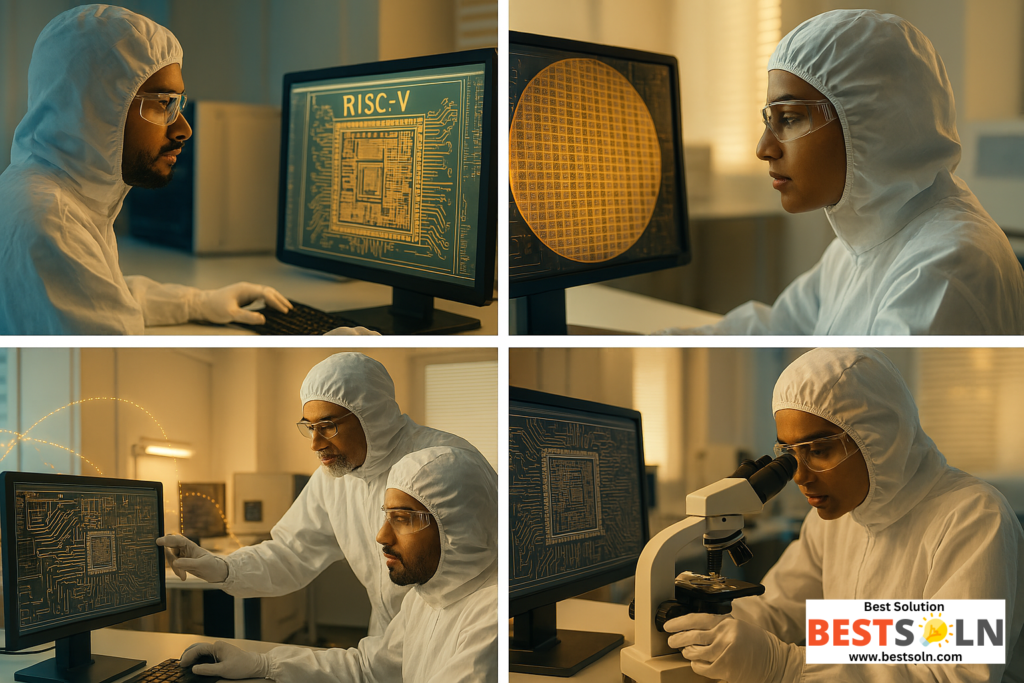
Dhruv64 is engineered with modern architectural features designed to deliver enhanced efficiency, improved multitasking capabilities, and superior reliability.
- Processor Core & Speed: It is a 64-bit dual-core processor operating at a clock speed of 1.0 GHz. This configuration allows it to handle complex computing tasks and larger datasets efficiently.
- Architecture: Built on the open RISC-V architecture, it supports superscalar execution, enabling the processor to execute multiple instructions simultaneously for better speed. It also supports out-of-order processing, further enhancing efficiency.
- Fabrication: The processor is fabricated on a 28nm node, demonstrating contemporary fabrication technologies typically associated with high-performance chips. This allows seamless integration with a wide range of external hardware systems.
The versatility of Dhruv64 makes it suitable for a broad spectrum of applications across both strategic and commercial sectors. These include:
- 5G Infrastructure: Providing reliable and secure processing for advanced communication networks.
- Automotive Systems: Powering the increasingly complex embedded computing in modern vehicles.
- Consumer Electronics: Enhancing various smart devices and gadgets.
- Industrial Automation: Critical for the backbone of modern manufacturing and industrial control systems.
- Internet of Things (IoT): Serving as a robust processing unit for connected devices and gateways.
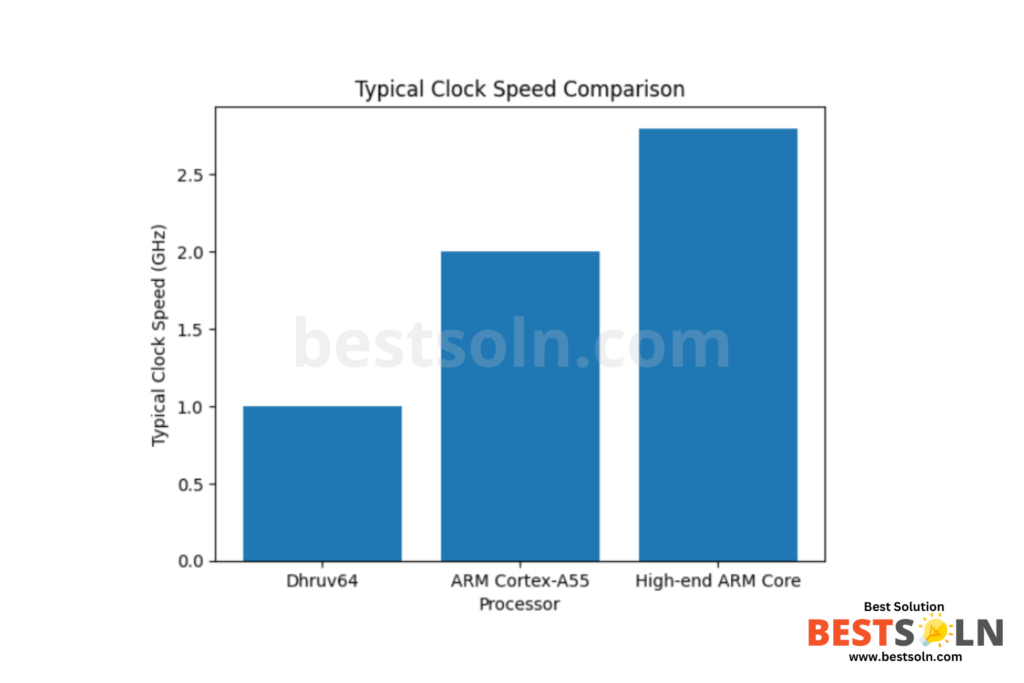
While its 1.0 GHz clock speed might not compete with the raw speeds of cutting-edge smartphone processors, the strategic importance of Dhruv64 lies in control, reliability, and long-term availability for critical infrastructure rather than benchmark supremacy.
Technical Comparison with ARM Cortex-A55 and ARM Cortex-A725
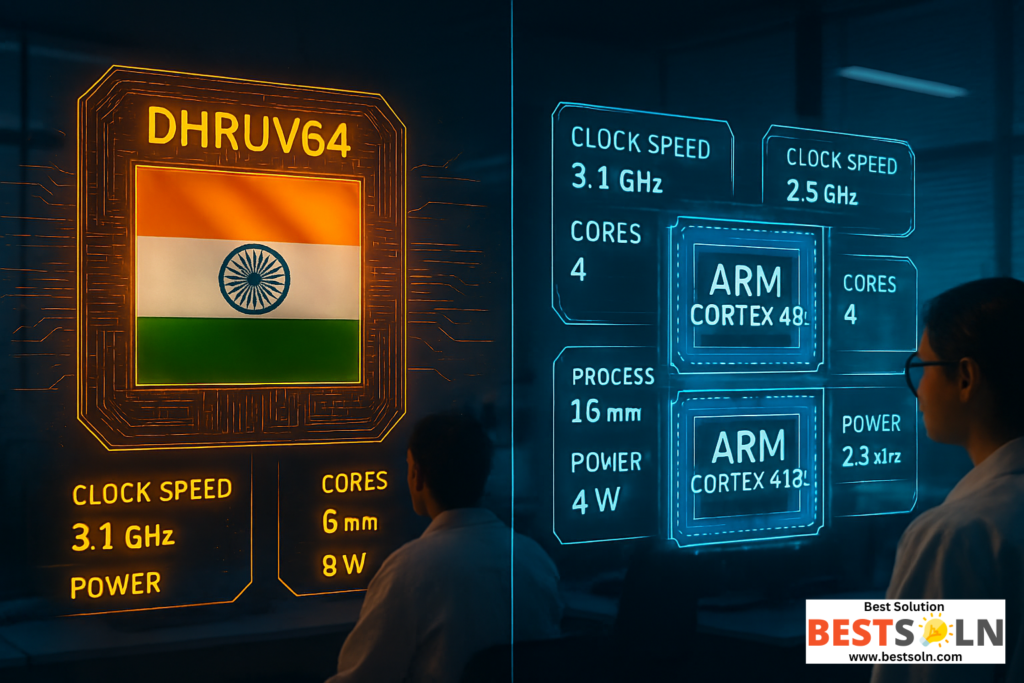
Dhruv64 is not meant to compete directly with high-end ARM smartphone or laptop processors. Its role is strategic: build domestic capability, enable customised hardware for industry or infrastructure, and reduce dependence on imported silicon. ARM cores, especially newer ones like Cortex-A725-derived designs, focus on mass consumer performance and integrated ecosystems.
| Feature / Specification | Dhruv64 (India’s Indigenous RISC-V) | ARM Cortex-A55 (Typical Midrange ARM) | ARM Cortex-A725 / High-end ARM-class |
|---|---|---|---|
| Instruction Set | RISC-V open source | ARMv8.2-A 64-bit | ARMv9.2-A 64-bit |
| Cores | Dual-core | Multi-core clusters (up to 8) | Multi-core clusters (paired with X-series) |
| Clock Speed | 1.0 GHz | 1.25 GHz to ~2.3 GHz typical | ~2.5 GHz+ (in silicon designs) |
| Pipeline Type | Superscalar with out-of-order support | In-order / simple superscalar | Advanced out-of-order pipelines |
| Fabrication Node | 28 nm process | Varies widely (from 7 nm to 5 nm and smaller in modern SoCs) | State-of-the-art (3 nm class in current flagship SoCs) |
| Target Use Cases | Embedded systems, industrial, IoT, 5G infrastructure | Smartphones, tablets, consumer devices | Premium mobile, compute-heavy tasks |
| Typical Application Performance | Entry / embedded class | Midrange mobile performance | High-performance mobile / compute |
| Licensing Cost | Open, royalty-free | Licensed from Arm | Licensed from Arm |
| Integration Complexity | Basic CPU core only | Core with ecosystem support (GPU, DSP, AI blocks) | Core with ecosystem support (advanced GPU, AI, caches) |
Dhruv64 vs. Entry-Level Processors
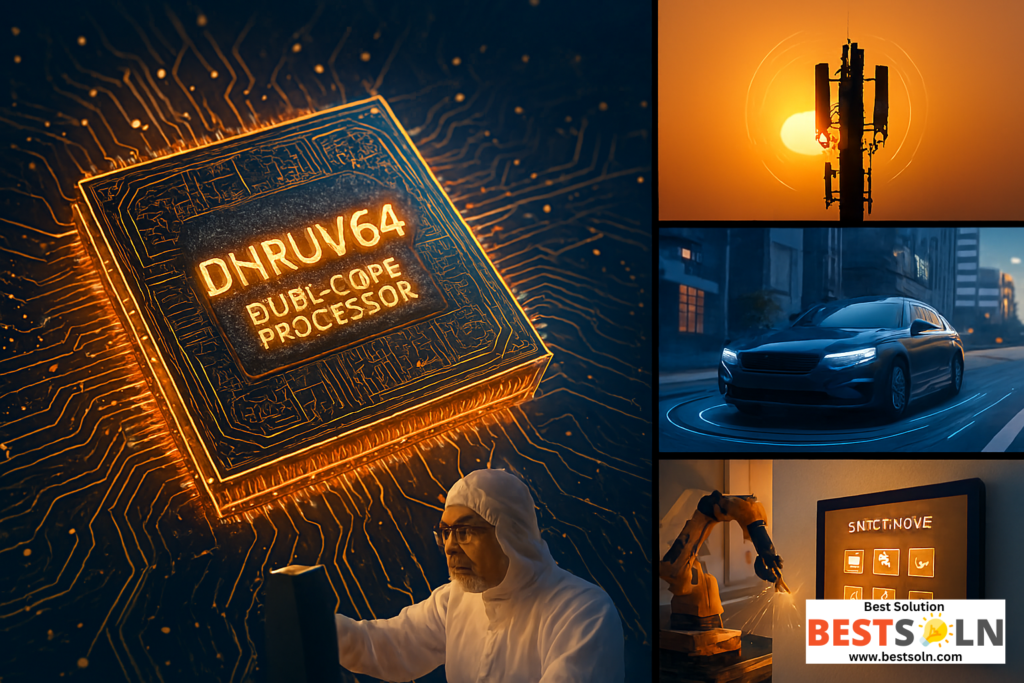
To provide a clearer picture of where Dhruv64 stands in the global silicon hierarchy, it is helpful to compare it with other entry-level and embedded processors. While high-end consumer chips (like Apple’s M-series or Intel’s i9) operate in a different league of raw power, Dhruv64 competes in the “Workhorse” category, prioritizing security, reliability, and power efficiency for industrial and strategic use.
| Feature | Dhruv64 (C-DAC) | Raspberry Pi 3 (Broadcom) | Intel Celeron N4000 | ARM Cortex-A53 (Reference) |
| Instruction Set | RISC-V (Open Source) | ARMv8 (Proprietary) | x86 (Proprietary) | ARMv8-A (Proprietary) |
| Clock Speed | 1.0 GHz | 1.2 GHz | 1.1 GHz (Base) | 1.2 – 1.5 GHz |
| Cores | Dual-core | Quad-core | Dual-core | Single/Quad-core |
| Process Node | 28nm (Mature/Stable) | 40nm / 28nm | 14nm | 28nm / 14nm |
| Sovereign Design | Yes (Fully Auditable) | No (Closed Binary) | No (Closed Firmware) | No (Licensed IP) |
| Multitasking | Out-of-Order (OoO) | In-Order | Out-of-Order | Usually In-Order |
| Licensing Fees | Zero (Royalty-Free) | High (ARM Royalties) | None (Internal) | High (ARM Royalties) |
| Primary Focus | Secure Gov/IoT/Industrial | Education & Prototyping | Budget Laptops | Mobile/Embedded |
Strategic Importance for India’s Semiconductor Ambitions
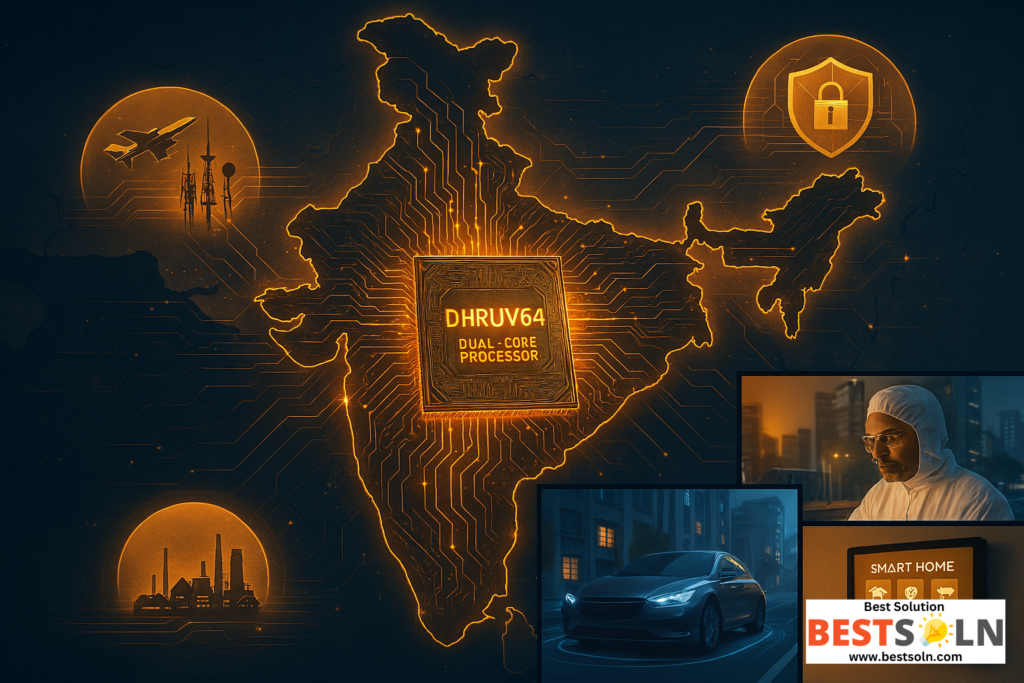
Dhruv64 represents a significant strategic victory for India.
- Reduced Foreign Dependency: It directly addresses India’s reliance on imported microprocessors, enhancing national security and mitigating risks associated with supply-chain disruptions and external controls.
- Trusted Platform: It offers a secure, domestically controlled platform for sensitive applications where data integrity and system security are paramount.
- Ecosystem Development: By providing a homegrown processor technology, Dhruv64 empowers startups, academia, and industry to design, test, and scale indigenous computing products. It supports cost-effective prototype development for new system architectures and strengthens the pipeline of skilled semiconductor professionals in India, which already accounts for about 20% of the world’s chip design engineers.
- Foundation for Future Innovations: The success of Dhruv64 accelerates the roadmap for next-generation RISC-V processors, with C-DAC already working on Dhanush and Dhanush+ SoCs. These future chips are expected to further expand India’s indigenous options for both strategic and commercial applications.
Challenges and Reality Check
Despite the significant achievement that Dhruv64 represents, industry observers note several challenges ahead. The processor enters markets where established chipmakers already offer mature products with extensive software and hardware development ecosystems. Leading chips today use process nodes far smaller than 28 nm, which limits power efficiency and raw speed. Scaling to more advanced nodes and mass production will require sustained investment and partnerships.
Several key technical details remain unspecified in public announcements, including the chip’s power consumption, specific benchmark performance, cache sizes, memory controller features, and input/output capabilities. For industrial customers considering adoption, these details are essential for evaluating the processor’s suitability for their applications.
The government’s claim that Dhruv64 is “fully indigenous” also requires clarification. The term could potentially refer to different aspects of the design and manufacturing process, including the instruction set architecture, core microarchitecture, system-on-chip integration, toolchain development, fabrication, or ownership of intellectual property blocks. While the use of open-source RISC-V architecture addresses some of these elements, the complete supply chain implications remain to be fully detailed.
From Labs to Laptops: The Road Ahead
The real test for Dhruv64 will be its commercial adoption. Designing a chip is one thing; getting it into the hands of consumers is another. The government is already looking at ways to integrate these processors into educational tablets and low-power laptops aimed at the domestic market.
However, challenges remain. Fabrication (the actual printing of the chips onto silicon wafers) is still largely done at international foundries or the SCL (Semiconductor Laboratory) in Mohali, which is undergoing upgrades. To truly compete, India will need to continue its push toward high-end domestic fabrication facilities.
Furthermore, the software ecosystem must keep pace. A processor is only as good as the applications it can run. Ensuring that Linux distributions and other essential software run seamlessly on Dhruv64 will be the next major hurdle for the C-DAC team.
Recommended Readings

- “The Chip: How Two Americans Invented the Microchip and Launched a Revolution” by T.R. Reid – Explores the history and profound impact of the integrated circuit on modern society.
- “Silicon Valley of Dreams: Environmental Injustice, Politics, and the High-Tech Global Economy” by David Naguib Pellow and Lisa Sun-Hee Park – Offers insights into the global semiconductor industry’s broader implications.
- “The Idea Factory: Bell Labs and the Great Age of American Innovation” by Jon Gertner – Provides a historical perspective on technological breakthroughs and the ecosystems that foster them, relevant to understanding national innovation efforts.
- “The Sovereign Individual: Mastering the Transition to the Information Age” by James Dale Davidson and Lord William Rees-Mogg – While broader in scope, its discussions on technological shifts and sovereignty offer valuable context to the drive for national self-reliance in critical technologies.
Frequently Asked Questions (FAQ)

Q1: What is Dhruv64?
A: Dhruv64 is India’s first fully indigenous 1.0 GHz, 64-bit dual-core microprocessor, developed by the Centre for Development of Advanced Computing (C-DAC) under the Microprocessor Development Programme.
Q2: Who developed Dhruv64?
A: The Centre for Development of Advanced Computing (C-DAC), under the guidance of the Ministry of Electronics and Information Technology (MeitY), developed Dhruv64.
Q3: What are the key features of Dhruv64?
A: Dhruv64 is a 64-bit dual-core processor with a 1.0 GHz clock speed, built on the open-source RISC-V architecture. It offers high efficiency, enhanced multitasking, and robust reliability.
Q4: What are the primary applications of Dhruv64?
A: It is suitable for strategic and commercial applications, including 5G infrastructure, automotive systems, consumer electronics, industrial automation, and the Internet of Things (IoT).
Q5: Why is Dhruv64 important for India?
A: It significantly boosts India’s self-reliance in the semiconductor sector, reduces dependence on foreign chips, strengthens national security by providing a trusted platform for critical infrastructure, and fosters a robust domestic ecosystem for chip design and manufacturing.
Q6: What is the Digital India RISC-V (DIR-V) Programme?
A: The DIR-V Programme is a government initiative to advance the vision of “Aatmanirbhar Bharat” by developing a complete portfolio of RISC-V-based microprocessors in India, making India a global hub for Electronics System Design and Manufacturing (ESDM). Dhruv64 is the third chip fabricated under this program.
Q7: What comes after Dhruv64?
A: C-DAC is already working on the next generation of RISC-V processors, named Dhanush and Dhanush+, which are expected to further expand India’s indigenous processor capabilities.
Conclusion: A Stepping Stone to a Self-Reliant Digital Future

The launch of Dhruv64 is a defining moment, solidifying India’s position as a serious contender in the global semiconductor landscape. It symbolizes a crucial step towards “Aatmanirbhar Bharat” (Self-Reliant India) in the critical domain of microelectronics. This indigenous microprocessor underscores India’s capability to innovate and produce advanced computing hardware, fostering a robust domestic ecosystem for design, testing, and manufacturing. While the journey towards complete semiconductor self-sufficiency is ongoing and complex, Dhruv64 stands as a beacon of progress, ensuring that India can increasingly own the fundamental technologies that power its digital future.








Leave a Reply