

- Home
- /
- Venture Capital
- /
- IPO vs. Direct Listing vs….
⏱️ Read Time:
Understanding the Basics: Markets, Regulation, and the Goal of Going Public
Before delving into the specific mechanics of how companies enter the public markets, it is essential to establish a foundational understanding of several core concepts. These principles, going public, the distinction between primary and secondary markets, and the crucial role of government regulation, form the bedrock upon which all pathways to becoming a publicly traded company are built. For any aspiring investor or business leader, grasping these fundamentals is the first step toward navigating the complex world of capital markets. This section will demystify these key ideas, providing the necessary vocabulary and context to fully appreciate the nuances of Initial Public Offerings (IPOs), direct listings, and Special Purpose Acquisition Companies (SPACs). We will explore what it truly means for a company to become public, the critical difference between where new shares are created versus where they are traded, and the vital function of regulatory bodies like the U.S. Securities and Exchange Commission (SEC) in ensuring a fair and transparent system for all participants.
The act of “going public” is a significant milestone for any private company. It fundamentally transforms the company’s structure and relationship with its owners. At its core, going public occurs when a private company decides to sell its ownership shares to the general public for the very first time. This process typically happens on a formal stock exchange, such as the New York Stock Exchange (NYSE). By doing so, the company transitions from being privately owned by a small group of founders, employees, and early-stage investors to being publicly owned, with thousands or even millions of shareholders from around the world. When an individual buys shares in a company’s public offering, they are not just purchasing a piece of paper; they are becoming a part-owner of that business, entitled to a portion of its profits through dividends and a say in its governance through voting rights. Companies pursue this path for several reasons, but the most common motivation is to raise substantial amounts of new capital to fund growth initiatives, pay off debt, or finance acquisitions. Beyond financing, going public also provides a way to value the company based on market demand and offers existing shareholders, particularly founders and venture capitalists, a valuable exit strategy to realize the value of their investments.
To understand the different ways a company can go public, it is indispensable to grasp the distinction between two fundamental types of financial markets: the primary market and the secondary market. These are not just two separate exchanges but represent two distinct functions within the financial ecosystem. The primary market is where securities are created and sold for the first time. This is the exclusive domain of new issues. When a company goes public via a traditional IPO, it is engaging in a primary market transaction. In this scenario, the company itself authorizes the creation of a specific number of new shares and sells them directly to investors. The proceeds from these sales flow directly to the company, increasing its cash reserves and equity base. Any subsequent sale of these same shares among investors is no longer a primary market transaction. The secondary market is precisely where those trades occur. Once shares are issued in the primary market and begin trading on an exchange, they can be bought and sold freely by any investor, including individuals, mutual funds, and other institutions, to other investors. The company itself does not receive any money from these secondary market transactions; the sale is purely between buyers and sellers. This distinction is the single most important factor in differentiating the three main paths to going public. A traditional IPO is a primary market event designed to raise capital for the company. A direct listing is primarily a secondary market event that facilitates shareholder liquidity. A SPAC merger is a unique hybrid that results in a primary issuance of shares for the newly combined public company.
The entire process of taking a company public, regardless of the chosen pathway, operates under the watchful eye of a powerful regulatory body: the U.S. Securities and Exchange Commission (SEC). The SEC’s mission is to protect investors, maintain fair, orderly, and efficient markets, and facilitate capital formation. Its role is pivotal in every public offering, ensuring that companies provide full and transparent disclosure of all material information so that investors can make informed decisions. The SEC enforces a strict set of rules and regulations governing everything from how companies file their registration documents to how they communicate with the public. One of its most critical functions is overseeing the registration process. Before a company can sell its securities to the public, it must file a registration statement with the SEC. This document, often filed on forms like Form S-1 for operating companies or Form F-1 for foreign private issuers, is a comprehensive package detailing the company’s business model, financial health, management team, and the specific terms of the offering. This filing undergoes a rigorous review process known as “due diligence,” where SEC staff scrutinize the information provided, ask clarifying questions, and may require amendments to ensure accuracy and completeness. This process can take many months and requires significant resources from the company. To make this complex legal and financial information more accessible to the average investor, the SEC has long advocated for and implemented rules requiring that disclosures be written in “plain English”. This initiative, detailed in publications like the “Plain English Handbook,” aims to cut through the jargon so that investors can clearly understand the risks and opportunities involved in an investment. The SEC’s authority extends beyond the initial offering. It continues to regulate the company once it is public, enforcing ongoing reporting requirements (like quarterly 10-Q filings and annual 10-K reports) and prohibiting fraudulent activities in the trading of securities. The agency’s influence is ever-evolving; recent years have seen increased scrutiny and rule-making specifically targeting the rise of SPACs, aimed at enhancing disclosure and protecting investors from potential asymmetries in protection compared to traditional IPOs. Understanding the SEC’s role is crucial because it sets the non-negotiable framework within which all legitimate paths to going public must operate, balancing the need for innovation with the paramount importance of investor protection.
The Traditional IPO: The Established Route to Raising Capital

For decades, the traditional Initial Public Offering (IPO) has been the quintessential and most conventional method for a private company to become a publicly traded entity. Often associated with large, mature corporations seeking a substantial infusion of capital for expansion, research and development, or strategic acquisitions, the IPO process is a well-established, albeit complex, journey. It represents a partnership between a company and a team of specialized financial intermediaries, primarily investment banks, who guide the firm through a series of meticulous steps to prepare it for life in the public markets. While the process is demanding in terms of time, cost, and preparation, its primary and enduring advantage remains the ability for the issuing company to raise significant new capital directly from the public. This section will deconstruct the traditional IPO process stage by stage, illuminate the critical roles played by underwriters and other gatekeepers, explain the mechanics of share pricing, and provide a balanced assessment of the strategy’s considerable benefits and notable drawbacks.
The journey to a traditional IPO begins long before the first share is priced or traded. The first and most crucial phase is preparation and readiness analysis. An ambitious company must conduct a thorough self-audit to determine if it is truly prepared for the rigors of being public. This involves assessing its financial health, ensuring its reporting integrity is impeccable, and confirming its operational maturity can handle the demands of public scrutiny. A company must then assemble a highly experienced IPO team, which typically includes external advisors like law firms specializing in securities law, accounting firms to perform audits, and investor relations experts. A central task during this phase is developing a compelling “equity story,” a clear and persuasive narrative about the company’s business model, competitive advantages, growth prospects, and management team, that will be used to attract and convince potential investors.
Once the company feels ready, the next formal step is to select and engage investment banks, also known as underwriters. This choice is arguably one of the most critical decisions in the entire IPO process. Underwriters serve as the principal intermediaries between the company and the investing public. They are not passive observers; they are active partners who provide a suite of essential services. Their primary role is to help the company determine how much capital to raise and the type of securities to issue. Most importantly, they purchase the newly issued shares from the company and then resell them to the public, effectively assuming the risk of selling the entire issue. This act of buying the shares upfront is a significant undertaking, and in return, the underwriters charge a fee, often referred to as a “spread,” which can be a substantial percentage of the total offering amount. The lead underwriter, sometimes called the bookrunner, takes the lead in managing the deal and coordinating the rest of the underwriting syndicate, which can include multiple banks working together to distribute the shares.
With underwriters on board, the company formally begins the regulatory process by filing a registration statement with the SEC. For a typical domestic operating company, this is done using Form S-1, while foreign companies might use Form F-1. This document is the cornerstone of the offering, containing a wealth of information required by law, including audited financial statements, details about the business and industry, information about management and directors, and a prospectus that describes the shares being offered and the risks of investing. Upon filing, the SEC enters a review period, during which its staff conducts a detailed examination of the registration statement. This process, known as due diligence, involves sending a series of questions to the company and its counsel, a back-and-forth dialogue that can last for weeks or even months. The goal is to ensure that all material information has been disclosed and that the document is free from misleading statements. Only after the SEC declares the registration statement “effective” can the company proceed with marketing the shares to the public.
Following the SEC’s clearance, the focus shifts to pricing and roadshow. Determining the right price for the shares is a delicate balancing act. The underwriters lead this effort, leveraging their deep knowledge of the market and relationships with institutional investors. A common method is a process called “book building,” where the underwriters gather indications of interest from large potential buyers (like pension funds and mutual funds) to gauge demand at various price points. Based on this feedback, they work with the company’s leadership to set a final offer price. This culminates in a “roadshow,” a whirlwind tour where the company’s executives travel to major financial centers to pitch the company directly to institutional investors and analysts, answering questions and generating excitement for the offering. Finally, once the price is set and the roadshow is complete, the shares are listed and begin trading on a stock exchange like the NYSE or NASDAQ.
A critical feature of a traditional IPO is the lock-up period. Immediately following the IPO, a significant number of shares held by existing shareholders, such as founders, early employees, and venture capitalists, are frozen. These shareholders are subject to a legally binding agreement that prohibits them from selling their shares for a predetermined period, typically 180 days. The purpose of the lock-up is to prevent a massive wave of selling from hitting the market on day one, which could overwhelm buyer demand and cause the stock price to plummet. Once the lock-up period expires, these insiders are free to sell their shares, and the supply of available stock increases significantly.
The advantages of the traditional IPO are clear and compelling for the right kind of company. The foremost benefit is the ability to raise substantial new capital. Unlike other methods, the IPO process allows the company itself to collect the proceeds from the sale of new shares, fueling its future growth. Another major advantage is that it is a proven and established process. With decades of precedent, there is a predictable framework, a clear set of regulatory requirements, and a well-understood playbook for both companies and investors. Furthermore, the involvement of underwriters provides a layer of price discovery and stability. The extensive research, roadshow, and book-building process helps anchor the initial share price to genuine market demand, providing a degree of fairness and valuation certainty that other methods may lack.
However, the traditional IPO is not without significant downsides. The most frequently cited disadvantage is its high cost. The fees paid to underwriters can be substantial, often amounting to around 7% of the total capital raised, plus significant legal, accounting, printing, and other professional expenses. This can amount to tens of millions of dollars for a large offering. Secondly, the process is notoriously time-consuming. From preparation to listing, a traditional IPO can take many months, requiring immense time and attention from the company’s senior management, pulling them away from running the day-to-day business. Finally, taking a company public means facing the realities of increased scrutiny and loss of control. The company becomes subject to intense public and media scrutiny, and its leaders must answer to a broader base of shareholders. It must also comply with a host of stringent and ongoing regulatory requirements, such as filing quarterly and annual reports with the SEC, which can be burdensome and expensive. In essence, the traditional IPO is a powerful tool for mature companies that need to grow and are prepared to embrace the responsibilities and costs that come with public ownership.
The Direct Listing: A Shareholder-Centric Alternative for Liquidity

In contrast to the capital-raising machinery of a traditional IPO, the direct listing presents a fundamentally different approach to entering the public markets. This alternative pathway allows a private company to become public not by selling new shares to raise capital, but by enabling its existing shareholders, such as founders, employees, and early investors, to sell their current holdings directly to the public on a stock exchange. Think of it as a transition from a private “members-only” club to a public marketplace where the assets already belong to the members, and they are now free to sell them openly. This model prioritizes shareholder liquidity and market-driven price discovery over immediate corporate fundraising. High-profile technology companies with strong brand recognition and a large base of employee shareholders, such as Spotify, have successfully utilized this route. This section will explore the mechanics of a direct listing, its key advantages like cost savings and transparency, and its notable risks, such as unpredictable pricing, providing a clear picture of why it serves as a compelling option for certain types of mature businesses.
The core principle of a direct listing is that the company itself does not issue new shares or raise fresh capital in the process. Instead, it applies to a stock exchange to have its existing shares authorized for public trading. On the day of the listing, the shares of these existing shareholders become available for purchase by anyone in the public market. This immediately grants liquidity to private shareholders who may have been waiting years to convert their equity into cash. A crucial aspect of this process is how the initial share price is determined. Unlike a traditional IPO, where underwriters meticulously build a book of orders to set a fixed price, a direct listing relies on a pure open market auction. The trading price is not set by any single entity but emerges organically from the collective buy and sell orders placed by market participants on the first day of trading. This means that individual investors, alongside institutional ones, have a greater direct influence on establishing the stock’s opening value. This market-based pricing mechanism is one of the strategy’s defining features.
This approach comes with a distinct set of advantages. The most significant benefit is cost savings. Because a direct listing bypasses the traditional IPO process, it eliminates the need to pay expensive underwriter fees. This can save the company and its shareholders millions of dollars in commissions and other related expenses. Another major advantage is speed. Without the lengthy SEC review and roadshow process characteristic of an IPO, a direct listing can generally be executed much faster, allowing the company to capitalize on favorable market conditions more quickly. Furthermore, the direct listing model promotes transparency and shareholder empowerment. By removing the intermediary underwriter, it offers a more direct and unfiltered view of the company’s value as determined by the market’s actual supply and demand dynamics. It also allows the company’s existing stakeholders, particularly its employees who were granted stock options, to achieve liquidity without causing the company to dilute its equity base by issuing new shares.
However, the direct listing model is not without its perils and disadvantages. The most prominent risk is unpredictable pricing and volatility. Since there is no underwriter to support the stock price and manage supply, the shares can experience significant price swings on the first day of trading, depending entirely on market sentiment and the balance of buy and sell orders. This creates uncertainty for both sellers looking to exit and buyers trying to get in at a fair price. Another critical limitation is that, in its purest form, a direct listing does not allow a company to raise new capital. This makes it unsuitable for businesses that need to infuse fresh cash into the operations to fund growth, pay down debt, or invest in new projects. For these companies, a direct listing would only serve to unlock value for existing shareholders, leaving the company’s balance sheet unchanged. Additionally, the process exposes investors to some unusual risks not typically encountered in a traditional IPO. For instance, without the underwriter’s stabilizing presence, the market can be more susceptible to practices like naked shorting, where traders sell shares they do not own, potentially creating an artificial imbalance of sell orders and leading to “fails-to-deliver”. Research suggests that firms that choose this path tend to be larger, more profitable, and less leveraged than their IPO counterparts, indicating that the strategy is better suited for well-established, financially sound brands with strong market positions.
Recognizing the growing interest in this format, the SEC has taken steps to modernize its rules. Historically, the agency had permitted direct listings primarily as a vehicle for secondary sales where no new capital was raised. However, in a significant development, the SEC adopted a new listing standard that explicitly allows companies to conduct primary direct listings, meaning they can now raise new capital through this mechanism outside of the traditional IPO framework. This change expands the utility of the direct listing, making it a viable option for companies that have both a need for liquidity for existing shareholders and a desire to raise new funds, all while avoiding the high costs and complexities of a full-blown IPO. This evolution underscores the dynamic nature of the capital markets and the regulatory response to innovative financing strategies. In summary, the direct listing is a powerful, efficient, and cost-effective tool for mature companies that prioritize shareholder liquidity and market-driven valuations over the immediate need to raise new capital.
The SPAC: The Fast Track to Public Ownership

Among the various pathways to the public markets, the Special Purpose Acquisition Company (SPAC) stands out as a unique and increasingly popular alternative to the traditional IPO. Often dubbed a “blank check” company, a SPAC is essentially a shell corporation formed by a group of experienced investors or sponsors with a specific mandate: to raise capital from the public through its own initial public offering and then use that money to acquire a private operating company. Once the acquisition is completed in a transaction known as a “de-SPAC merger,” the target private company becomes a publicly traded entity without having gone through the conventional IPO process. This method gained immense popularity in the late 2010s, offering a faster and more certain route to going public, particularly for companies that might face challenges securing a favorable valuation in a volatile IPO market. However, this speed and flexibility come at a significant cost and have attracted considerable scrutiny from regulators and critics concerned about potential conflicts of interest and weaker investor protections. This section will detail the step-by-step process of a SPAC merger, analyze its compelling advantages and serious disadvantages, and examine the evolving regulatory landscape surrounding these entities.
The SPAC lifecycle begins with its formation. A team of seasoned sponsors, often comprising individuals with deep industry expertise or a track record in private equity, comes together to create the SPAC. These sponsors typically contribute a small amount of seed capital in exchange for a large stake in the SPAC, known as the “promote,” which gives them a significant incentive to consummate a successful deal. Once the SPAC is structured, it files for its own IPO, typically using Form S-1. During this IPO, the SPAC raises a substantial amount of capital from public investors, often described as a “pile of cash”. Critically, this capital is not used to run the SPAC’s own operations. Instead, it is placed into a trust account, where it sits idle, usually invested in low-risk instruments, while the sponsor searches for a suitable private company to acquire. The SPAC is given a limited timeframe, typically two years, to find and complete a business combination, or else the trust funds must be returned to investors.
When the sponsor identifies a promising private target company, the next phase involves negotiation and due diligence. The sponsor and the target company’s management negotiate the terms of the merger, including the valuation of the target and the amount of consideration to be paid, which typically consists of newly issued shares of the combined public company. Once a definitive agreement is reached, the proposed de-SPAC transaction is put to a vote by the SPAC’s public shareholders. Shareholders can vote to approve or disapprove the deal. If approved, the SPAC merges with the private company. As part of this transaction, a Private Investment in Public Equity (PIPE) is often arranged. A PIPE involves bringing in new, committed capital from third-party investors, such as hedge funds or other institutions, to bridge any remaining funding gap and provide additional capital to the newly public entity. After the merger is finalized and the PIPE is closed, the surviving company begins trading on a stock exchange under a new ticker symbol, completing its transformation from a private entity to a public one.
The appeal of the SPAC route lies in several key advantages. The most touted benefit is speed and certainty. The entire process, from announcement to completion, can be significantly faster than a traditional IPO, often taking only a few months. More importantly, it offers certainty of funding. Unlike an IPO, where the final valuation is subject to fluctuating market demand on a volatile first day of trading, the SPAC merger locks in a pre-negotiated enterprise value for the target company. This predictability is highly attractive to sellers and founders. Another advantage is access to capital. For private companies, especially in sectors like technology or space exploration, that may find it difficult to attract public market interest during periods of market downturn or for reasons related to valuation compression, a SPAC can provide a reliable and timely exit route. Furthermore, the process offers transaction flexibility. The merger terms are negotiated directly between the SPAC sponsor and the target company’s management, allowing for more customized deal structures than the standardized process of an IPO.
Despite these attractions, the SPAC model is fraught with disadvantages and criticisms. The most significant drawback is its high cost. Studies have shown that going public via a SPAC merger is substantially more expensive than a traditional IPO. This is largely due to the high fees paid to underwriters and, most notably, the lucrative “promote” received by the SPAC sponsors, which can represent a significant portion of the final enterprise value. Another major concern revolves around potential conflicts of interest. The incentives for SPAC sponsors may not always align perfectly with those of the public shareholders. There is a risk that sponsors may feel pressured to merge with a target even if the deal is not in the best long-term interest of all parties simply to meet their deadline and earn their promotion. Investors in SPAC deals can also face multiple layers of dilution, which can disproportionately impact retail investors. Perhaps the most serious criticism relates to weaker investor protections. There have been longstanding concerns that investors in SPAC mergers do not receive the same level of protection regarding forward-looking statements as those in traditional IPOs. Studies have found that, on average, SPACs tend to underperform matched groups of traditional IPOs in subsequent stock market performance. In response to these concerns, the SEC has ramped up its regulatory scrutiny of SPACs. Recent rulemakings have aimed to enhance disclosure requirements and, notably, made it harder for SPAC transactions to rely on reduced liability for forward-looking statements, signaling a clear intent to level the playing field and bolster investor safeguards. This heightened oversight reflects a broader debate about whether the perceived benefits of the SPAC fast track justify its higher costs and unique risks.
Choosing Your Path: A Comparative Analysis of IPOs, Direct Listings, and SPACs

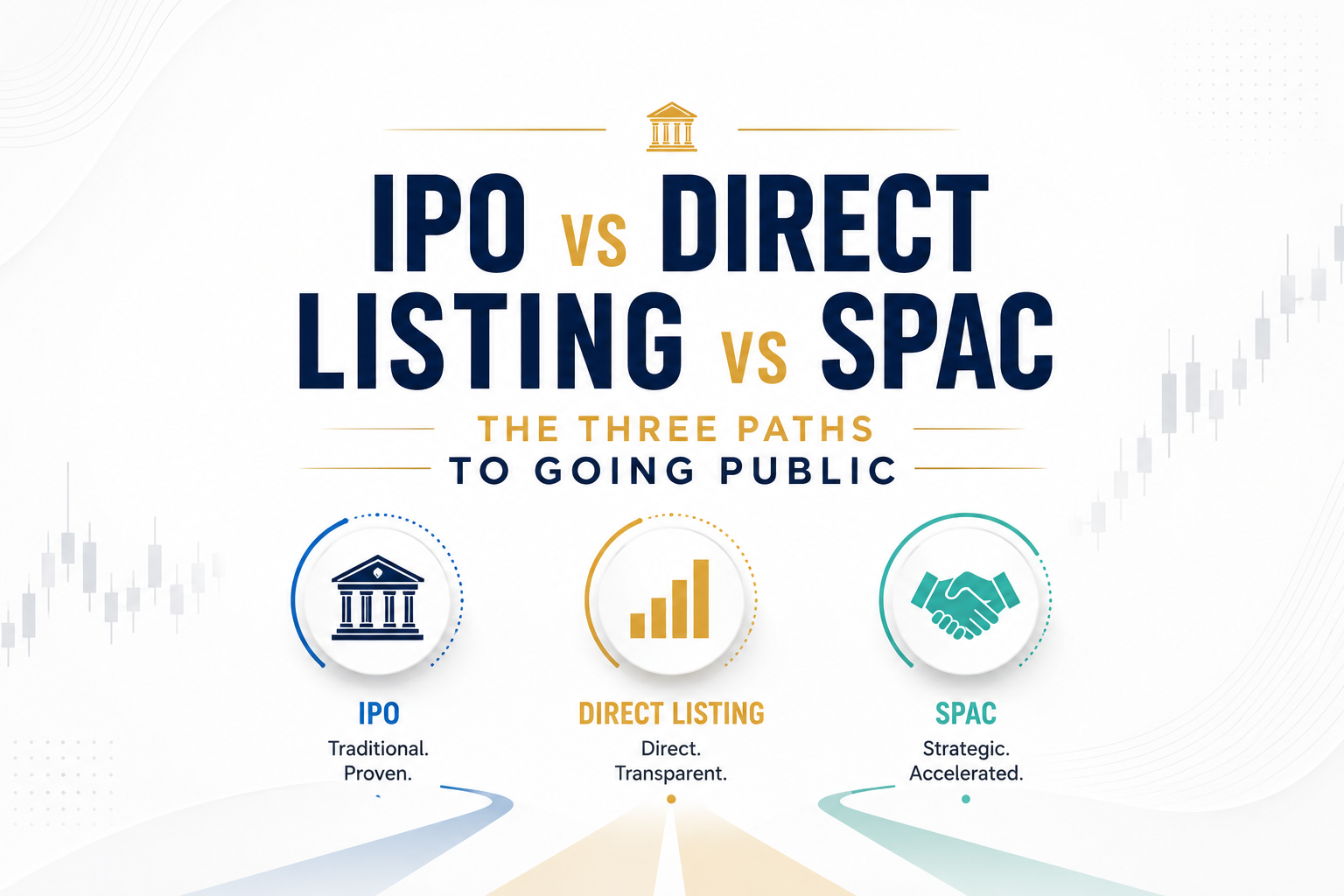
As demonstrated, the decision of how to go public is not a matter of finding a single “best” method, but rather selecting the optimal strategy that aligns with a company’s specific goals, financial situation, and maturity level. Each of the three primary pathways, the Traditional IPO, the Direct Listing, and the SPAC merger, offers a distinct set of advantages and disadvantages, making them suitable for different types of companies at different stages of their lifecycle. A startup accelerator that needs a massive injection of capital for global expansion would likely find the traditional IPO indispensable. A mature, profitable tech giant with a loyal user base and a large pool of employee-shareholders might prefer the cost-efficiency and shareholder-centric nature of a direct listing. Meanwhile, a promising but unproven company struggling to secure a favorable valuation in a challenging market might see a SPAC as its most viable and certain path to public ownership. This section provides a comprehensive, side-by-side comparison of these three strategies and concludes with a strategic guide to help companies navigate this critical decision-making process.
The table below summarizes the key differences across several critical dimensions, providing a clear framework for comparison.
| Feature | Traditional IPO | Direct Listing | SPAC Merger |
|---|---|---|---|
| Primary Objective | Raise new capital for the company’s growth and operations. | Provide liquidity for existing shareholders; the company raises no new capital. | Acquire a private company quickly and provide it with public market access and capital. |
| Capital Raised by Company | Yes, the company issues and sells new shares, receiving the proceeds. | No, in a pure secondary listing, the company does not issue new shares or receive proceeds. | Yes, the merged company receives the net proceeds from the SPAC’s trust account and often a PIPE investment. |
| Share Price Determination | Set by investment bank underwriters based on investor demand gathered during the roadshow. | Discovered via an open market auction on the first day of trading, based on public buy and sell orders. | Pre-negotiated between the SPAC sponsor and the target company’s management. |
| Key Intermediary | Investment Bank (Underwriter). | None (broker-dealers execute trades on the exchange). | SPAC Sponsor. |
| Cost Structure | High. Includes substantial underwriter fees (spreads), legal fees, and accounting fees. | Low. Avoids expensive underwriter fees, though other listing and legal costs still apply. | Very High. Includes high underwriter fees, sponsor “promote,” and PIPE-related costs |
| Typical Timeline | Long. Can take many months, from preparation to listing. | Shorter. Generally faster than an IPO, as it bypasses the SEC review and roadshow. | Fast. Typically completes in 3-4 months, offering speed and certainty. |
| Suitability | Mature, large companies needing to raise significant capital for expansion. | Well-known, profitable companies with existing shareholders needing liquidity; no new capital needed. | Private companies seeking speed, certainty of funding, and access to public markets, especially in volatile conditions. |
| Investor Protections | Strong, governed by extensive SEC regulations and disclosure requirements. | Similar to a regular stock trade; protections depend on the company’s post-listing disclosures. | Historically viewed as having weaker protections, especially for forward-looking statements, though this is changing with new SEC rules. |
Synthesizing this data reveals clear strategic profiles for each path. The Traditional IPO is the classic, capital-intensive route. Its strength lies in its proven ability to generate a large influx of new cash for the company. It is the ideal choice for an established, often large-cap, company that is scaling its operations and needs public market capital to do so. The involvement of underwriters provides a measure of stability and valuation guidance, but this comes at a high price and requires a significant time commitment from the company’s leadership. A company pursuing an IPO must be prepared for the intense public scrutiny and regulatory burden that follows.
The Direct Listing is the lean, efficient alternative. Its core purpose is not to raise capital but to unlock value for existing shareholders by giving them access to the public market. This makes it perfect for companies that are already profitable and self-sufficient, with no pressing need for new funds. The primary drivers for choosing this path are cost savings and speed. It empowers the market to determine the stock’s value, which can be appealing for well-known consumer brands whose market position is already strong. However, the absence of an underwriter means the company must accept the risk of potentially volatile opening prices and cannot use the platform to raise new money. The recent SEC allowance for primary direct listings adds a new dimension, but the strategy’s fundamental identity remains tied to shareholder liquidity.
The SPAC is the strategic shortcut. It is not merely an alternative to an IPO but a distinct business model designed to solve specific problems in the traditional IPO market. Its main attractions are speed and certainty. For a private company, a SPAC offers a guaranteed path to becoming public with a pre-determined valuation, shielding it from the unpredictability of market sentiment on IPO day. This makes it particularly attractive for innovative but unproven companies or those in industries that may be overlooked by traditional institutional investors. However, this convenience comes at a steep price, borne by the shareholders of the merged entity, and introduces structural complexities and potential conflicts of interest. A company considering a SPAC must weigh the undeniable benefits of a quick, certain exit against the high cost and the need to navigate a more complex transaction structure.
Ultimately, the choice is a deeply strategic one. A company’s leadership must honestly assess its own needs: Is our priority raising capital to fuel growth (IPO)? Is it providing our team and early backers with liquidity (Direct Listing)? Or is it securing a reliable and rapid path to public markets despite market headwinds (SPAC)? The answer to this question dictates which of these three powerful tools is the right fit for their journey.
Recommended Readings

For those wishing to delve deeper into the subjects of corporate finance, capital markets, and the intricacies of going public, the following books provide a solid foundation:
Valuation: Measuring and Managing the Value of Companies by McKinsey & Company. This book is considered a definitive guide to the art and science of business valuation, covering the methodologies and frameworks used by professionals to assess a company’s worth, a critical skill for anyone involved in IPOs or M&A.
The Intelligent Investor by Benjamin Graham. A timeless classic that provides the philosophical and practical foundation for value investing. It teaches readers how to think critically about investments, assess risk, and avoid common behavioral pitfalls, making it essential reading for any investor.
Initial Public Offerings: A Practical Guide to Going Public by David A. Westenberg. This book offers battle-tested, real-world advice specifically on navigating the IPO process, covering everything from preparing for an offering to post-IPO compliance.
Corporate Finance: A Focused Approach by Douglas R. Emery, John D. Finnerty, and John D. Stowe. This textbook provides a comprehensive overview of corporate finance principles, including capital raising, investment decisions, and capital structure, serving as an excellent academic resource.
A Beginner’s Guide to Charting Financial Markets by Michael Kahn. While focused on technical analysis, this book offers practical guidance on interpreting market data and understanding price action, which can be useful for analyzing a company’s stock performance after it goes public.
Frequently Asked Questions

Q1: What is the main difference between a primary market and a secondary market?
A: The primary market is where companies issue new shares for the first time to raise capital directly from investors. The secondary market is where those already-issued shares are traded among investors. A company receives money in the primary market but not in the secondary market.
Q2: Who is the SEC, and what do they do?
A: The U.S. Securities and Exchange Commission (SEC) is a government agency responsible for regulating the securities industry. Its main jobs are to protect investors, ensure markets are fair and efficient, and oversee the registration of new stocks to make sure companies disclose all important information.
Q3: Why would a company want to go public?
A: Companies primarily go public to raise a large amount of capital for growth, such as expanding operations, funding research, or paying off debt. Other reasons include providing an exit strategy for early investors and founders, and increasing the company’s visibility and credibility.
Q4: Can a company raise new money in a direct listing?
A: Traditionally, no. A pure direct listing is for existing shareholders to sell their shares without the company issuing new ones or raising capital. However, the SEC recently changed its rules to allow companies to raise new capital through a “primary direct listing,” expanding its original purpose.
Q5: Is a SPAC a good investment?
A: Investing in a SPAC carries significant risks. While it offers a fast way to invest in a private company, studies show that SPACs often underperform traditional IPOs. Concerns include high costs, potential conflicts of interest with the SPAC sponsors, and historically weaker investor protections. It’s a speculative investment that requires careful due diligence.
Q6: How long does it take to go public?
A: The timeline varies greatly by method. A traditional IPO is the longest, often taking many months. A direct listing is generally quicker. A SPAC merger is the fastest, typically taking around 3-4 months from announcement to completion.
Conclusion: Navigating the Modern Landscape of Public Offerings

The journey from a private enterprise to a publicly traded company has evolved far beyond the singular path of the traditional Initial Public Offering. Today, companies and their founders possess a sophisticated toolkit of three distinct strategies, each with its own unique architecture, advantages, and inherent trade-offs. The Traditional IPO remains the gold standard for raising substantial new capital, offering a proven, regulated process backed by the formidable machinery of investment banking, albeit at a high cost and with significant time commitments. The Direct Listing has emerged as a lean and efficient alternative, empowering existing shareholders with liquidity and allowing market forces to dictate a company’s initial valuation, making it an ideal choice for established, profitable brands that have no need to raise new funds. Finally, the Special Purpose Acquisition Company (SPAC) has carved out a niche as a strategic fast track, providing a swift and certain route to the public markets, which is invaluable for innovative companies seeking to bypass the uncertainties of the IPO window.
Understanding these pathways is no longer just the purview of seasoned financiers and corporate executives. For any beginner looking to comprehend the modern economy, recognizing the motivations behind these choices is key. The decision of how to go public is a reflection of a company’s maturity, its financial objectives, and its vision for the future. A sprawling industrial conglomerate eyeing a global expansion will naturally gravitate towards the capital-raising power of an IPO. A beloved technology platform with a large workforce of equity-holding employees may find the direct listing to be the most equitable way to reward its contributors. And a cutting-edge biotech firm with a breakthrough drug might turn to a SPAC to secure the funding needed for clinical trials without waiting for a potentially unfavorable IPO environment.
The landscape is continuously shaped by market dynamics and regulatory oversight. The U.S. Securities and Exchange Commission plays a constant role in balancing innovation with investor protection, adapting its rules to address the unique risks posed by new formats like the SPAC while also expanding the possibilities of others, such as the direct listing. As a result, there is no permanent “winner” among these strategies. Their popularity ebbs and flows with economic cycles, technological trends, and shifts in investor appetite. The crucial takeaway for any novice is that these are not interchangeable terms but distinct strategic decisions. The path a company chooses reveals as much about its character and ambitions as the decision to go public itself. By demystifying these three main routes, we gain a clearer lens through which to view the forces that shape the public markets and drive the growth of the modern economy.











Leave a Reply