


- Home
- /
- Venture Capital
- /
- Private Equity Explained: The Complete…
⏱️ Read Time:
Introduction
Say the words “private equity” at a dinner party and you’ll usually get one of two reactions. Some people picture ruthless dealmakers stripping companies for parts. Others picture pension funds quietly earning steady, market-beating returns for teachers and firefighters. Both pictures have some truth in them, which is exactly why private equity is worth understanding properly rather than through headlines alone.
At its core, private equity is a simple idea dressed up in complicated clothing. Investors pool money, hand it to a manager they trust, and that manager buys stakes in companies that aren’t listed on any stock exchange. The manager then tries to make those companies more valuable over several years before selling them and returning the proceeds, hopefully with a healthy profit attached.
That simple idea now commands a global market worth trillions of dollars. Industry estimates put private equity assets under management somewhere around 7 trillion dollars in 2025, with forecasts from research firms suggesting the broader private equity market could keep growing at a double digit pace for the rest of the decade. Pension funds, insurance companies, sovereign wealth funds, university endowments, and increasingly even individual investors through new retail-friendly fund structures, are all placing bigger bets on this asset class than they did a generation ago.
This guide walks through the fundamentals: who the players are, how a private equity deal actually gets done, how the money flows, how performance is measured, and what risks and rewards come attached. Whether you are an entrepreneur considering a buyout offer, a finance professional preparing for interviews, or simply someone curious about where a big chunk of the world’s capital actually goes, this is the grounding you need.
The Alternative Investment Landscape

When people talk about “alternative investments,” they usually mean anything outside of stocks and bonds bought through a regular brokerage account. Investment banks, private equity firms, and hedge funds all sit inside this broader world, but they play very different roles within it. People tend to lump them together since they all deal in large sums of money and complex deals, but understanding what actually separates them helps make sense of how the alternative investment landscape really works.
Three Different Roles in the Same Landscape
Investment banks are the dealmakers and matchmakers of this landscape. They advise companies on mergers and acquisitions, help businesses raise money by issuing stocks and bonds, and earn fees for putting these transactions together. They don’t usually own the companies involved. They just help move the deal along.
Private equity firms occupy a different corner of the alternative investment world entirely. Instead of advising on deals, they become owners. They buy controlling stakes in businesses, get directly involved in running them, and aim to sell those stakes later for a profit. Their return comes from actually improving a business over several years, not from a one-time advisory fee. This is what makes private equity a genuine alternative asset class rather than just a financial service.
Hedge funds represent yet another piece of the landscape. They trade in public markets, often moving in and out of positions quickly, and they can bet on both rising and falling prices. Their edge comes from spotting pricing gaps or mismatches in liquid markets, not from owning and operating businesses. Even though they trade public securities, their strategies and structures place them firmly within the alternative investment category alongside private equity and other less liquid asset classes.
The table below outlines the core operational and strategic differences between these alternative financial institutions.
| Aspect | Investment Banking | Private Equity | Hedge Funds |
| Primary Role | Transaction Advisor | Active Owner and Builder | Market Trader |
| Core Focus | Capital market deals and transactions | Direct corporate equity and operations | Liquid financial markets and trading |
| Investment Horizon | Short-term and transaction-specific | Medium to long term, typically three to ten years | Very short to medium term, from seconds to months |
| Primary Driver of Returns | Advisory and underwriting fees | Business value creation and operating growth | Capitalizing on market inefficiencies and price movements |
| Inherent Risk Level | Low to medium risk | High risk due to direct ownership and capital placement | Very high risk driven by leverage and market volatility |
| Key Professional Mindset | How to structure and execute the transaction | How to increase corporate value over three to seven years | Where to generate active alpha in the market right now |
| Leading Global Organizations | Goldman Sachs, JPMorgan Chase, Morgan Stanley, Citi, Bank of America, Barclays | Blackstone, KKR, The Carlyle Group, TPG, Bain Capital, Apax Partners | Bridgewater Associates, Renaissance Technologies, Citadel, D.E. Shaw, Point72, Tiger Global |
How They Actually Work Together
Even though these three types of firms have different jobs, they cross paths constantly across the alternative investment landscape.
When a private equity firm wants to buy a company, it often calls in an investment bank to help structure the deal and arrange the debt needed to finance it. When that private equity firm is finally ready to sell a company years later, an investment bank frequently leads the IPO or manages the sale process.
Hedge funds show up in this picture too. They sometimes buy up the debt of a private equity-owned company that’s struggling financially, hoping to profit if it recovers or if they gain leverage in a restructuring. They also participate in the syndicated loans that banks put together to help finance buyouts in the first place.
So rather than three separate silos, think of it more like a relay running through the alternative investment landscape. Investment banks originate and advise, private equity firms own and build, and hedge funds trade around the edges of it all. Each one depends on the others to keep capital moving through the system, and together they form a big part of what makes alternative investing such a distinct and interconnected corner of finance.
What Private Equity Actually Means
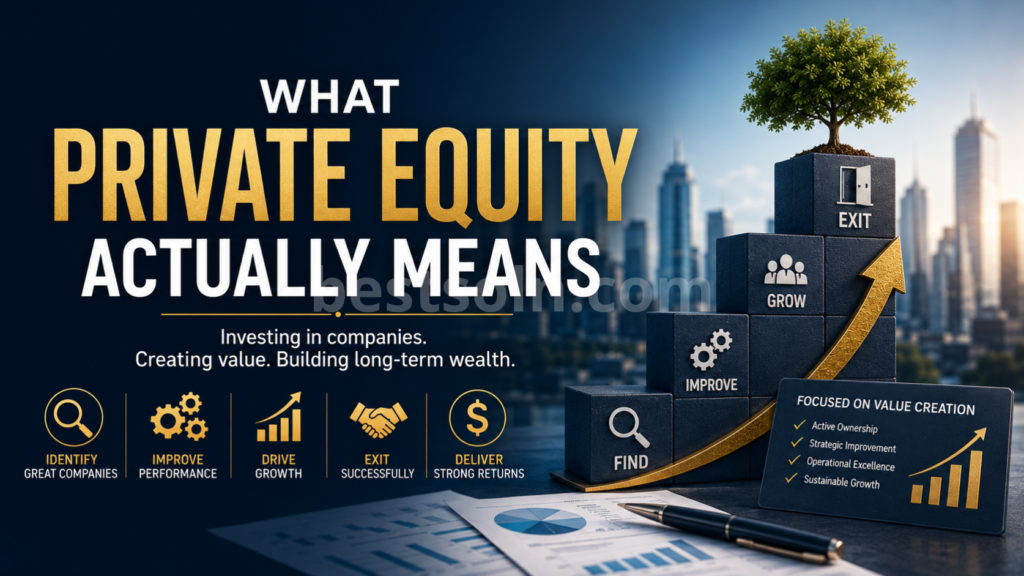
Private equity refers to ownership stakes in companies that are not publicly traded on a stock exchange. Instead of buying shares through a brokerage account, private equity investors negotiate directly with a company’s owners or board, often taking a controlling or highly influential position in the business.
This is fundamentally different from investing in the stock market. When you buy shares of a public company, you’re one of thousands or millions of shareholders with essentially no say in day to day decisions. Private equity investors, by contrast, frequently sit on the board, help hire and fire executives, and actively shape strategy. That hands-on involvement is the whole point. It’s how they try to grow the value of a company enough to justify the eventual sale.
Private equity spans a wide range of company types and stages. It can mean funding a two-person startup with nothing but an idea, or it can mean buying a mature industrial company that has existed for decades and loading it with new debt to boost returns. The common thread is negotiated, illiquid ownership rather than the anonymous, liquid ownership you get in public markets.
The Key Players in Every Private Equity Deal

Every private equity transaction, no matter how complex it looks on paper, revolves around a handful of core participants.
General Partners (GPs) are the investment professionals who actually run the show. They find deals, perform due diligence, negotiate terms, manage the companies after acquisition, and eventually decide when and how to exit. Their reputation, network, and past performance are what attract capital in the first place.
Limited Partners (LPs) are the people and institutions that supply the money. Pension funds, insurance companies, sovereign wealth funds, university endowments, family offices, and wealthy individuals typically fill this role. LPs hand over capital and trust the GP to invest it wisely, but they have no say in individual investment decisions and their financial exposure is limited to what they’ve committed.
Portfolio companies are the businesses the fund actually owns a piece of. These range from early-stage tech startups to struggling manufacturers to well-established but underperforming firms.
Service providers round out the ecosystem. Investment banks, law firms, accounting firms, and management consultants get pulled into nearly every deal to handle financing, legal structuring, and operational diagnostics.
The Limited Partner Landscape

Every private equity fund needs money, and that money has to come from somewhere. The people and institutions who supply it are called Limited Partners, or LPs. Understanding who these LPs actually are, and what drives them, tells you a lot about how the private equity world really runs.
Who Actually Funds Private Equity
LPs commit capital to a fund, but they don’t get involved in running it. That job belongs entirely to the General Partner, or GP, who makes every investment decision and handles the day to day work of managing the portfolio. This arrangement isn’t just a handshake deal. It’s spelled out in a Limited Partnership Agreement, a binding contract that sets the fund’s terms, fees, and the boundaries of what the GP can and can’t do with investor money.
Why Different LPs Show Up for Different Reasons
Not every LP is chasing the same goal. A wide mix of institutions and individuals back private equity funds, and each one has its own reasons for doing so.
Pension funds, for example, are trying to match their investments to decades of future retirement payouts, so they lean toward long-term capital that can grow steadily over many years. Endowments think a little differently. They’re often trying to fund a university’s operations forever, so they look for capital that keeps growing indefinitely rather than needing to be cashed out on any particular schedule.
Beyond these two groups, the list of LPs is genuinely long and varied, spanning insurance companies, sovereign wealth funds, family offices, fund of funds managers, and more. There are actually about thirteen distinct types of investors who regularly back private funds, each with its own appetite for risk, liquidity, and time horizon.
The table below provides a comprehensive breakdown of the thirteen primary types of limited partners that back alternative asset funds.
| Limited Partner Type | Source of Investment Capital | Core Objective of Capital Allocation |
| Single Family Office | Capital from a single wealthy family | To preserve and grow multi-generational family wealth |
| Multi-Family Office | Pooled capital from multiple wealthy families | Diversified long-term alternative asset investing |
| Fund of Funds | Aggregated commitments from institutional allocators | To spread risk across multiple venture capital and private equity managers |
| Pension Fund | Retirement contributions from public or private sector employees | To generate stable, long-term returns to match multi-decade liabilities |
| Foundation | Philanthropic donations and legacy endowments | To grow capital assets steadily to support institutional missions |
| Endowment or Trust | Assets of universities, healthcare systems, or historical estates | To fund future institutional obligations and operating budgets in perpetuity |
| Sovereign Wealth Fund | National capital reserves and state commodity revenues | To diversify state wealth and preserve capital for future generations |
| Corporate | Corporate balance sheets and excess cash reserves | To capture both strategic alignment and direct financial returns |
| Bank or Insurance Company | Commercial customer deposits and policyholder premiums | Long-term portfolio asset allocation under regulatory capital constraints |
| Development Finance Institution | Public sector capital and state development budgets | To foster economic development, local employment, and market expansion |
| Wealth Manager | Aggregated private client assets | Comprehensive portfolio diversification and capital appreciation |
| Retail Platform | Pooled capital from individual self-directed investors | To democratize access to venture capital and private equity returns |
| High Net Worth Individual | Personal wealth from business success or liquidation events | To capture high-growth and asymmetric investment opportunities |
How This Mix Shapes the Industry
The sheer variety of LPs has a real effect on how private equity deals get structured. Big players like pension funds and sovereign wealth funds bring enormous scale to the table, and that scale gives them leverage to negotiate their own custom terms, often through side letters that give them slightly different treatment than smaller investors in the same fund.
At the same time, a newer group of investors is starting to change the picture. Retail platforms are opening the door for individual accredited investors to get into private equity, something that used to be reserved almost entirely for massive institutions. Through semi-liquid evergreen funds and feeder structures, everyday wealthy investors can now put money into deals that once required a multi-billion-dollar balance sheet just to get in the room.
How a Private Equity Fund Is Built and Runs
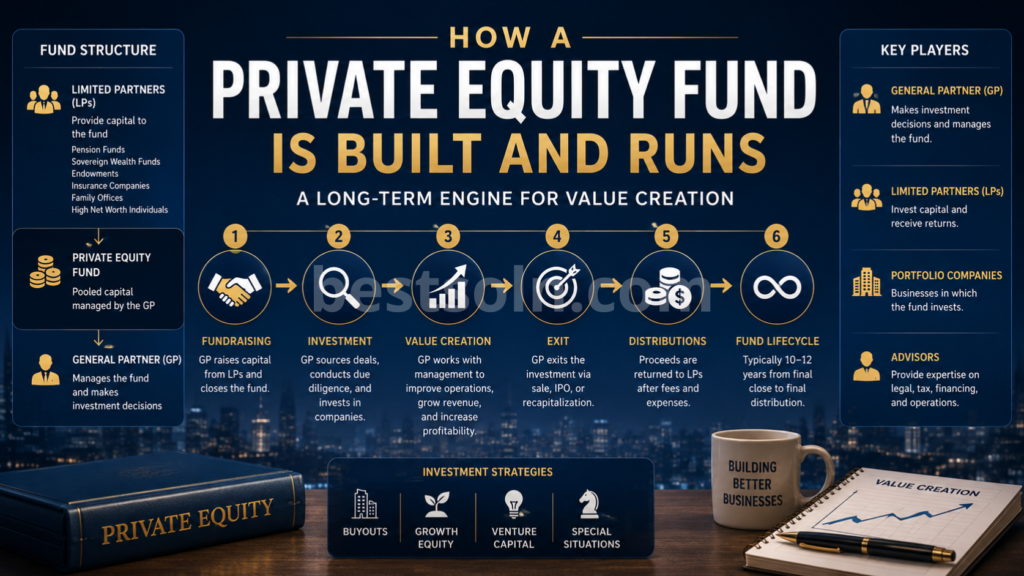
Most private equity investing happens through a limited partnership structure. The GP sets up a fund, usually with a fixed lifespan of somewhere between seven and twelve years, and goes out to raise commitments from LPs. Crucially, LPs don’t hand over all their money on day one. Instead, they pledge a certain amount, and the GP “calls” that capital in stages as investment opportunities appear.
A fund’s life typically unfolds in three broad phases.
The investment period, usually lasting three to six years, is when the GP actively hunts for and closes deals. During this stretch, returns on paper often look negative or flat, since management fees are being charged on committed capital while newly acquired companies haven’t had time to grow in value yet.
The value creation period is where the real work happens. The GP’s team rolls up its sleeves, working with company management to cut costs, expand into new markets, improve operations, or bolt on smaller acquisitions to build scale.
The exit or harvesting period is when investments get sold and cash flows back to LPs. This can drag on for years past the official end of the investment period as the fund works through its portfolio one company at a time.
This staggered pattern of cash going out early and coming back later produces a distinctive shape in performance charts known as the J-curve, something we’ll come back to when discussing metrics.
The Main Private Equity Strategies

Private equity is not one monolithic activity. It’s an umbrella term covering several distinct investment styles, each with its own risk and return profile.
Leveraged Buyouts (LBOs)
This is the strategy most people picture when they hear “private equity.” A firm acquires a relatively mature, cash-generating business, financing a large chunk of the purchase price with borrowed money rather than pure equity. In the early 1990s, equity typically made up only 20 to 25 percent of an LBO’s financing. That has shifted significantly over time, with median equity contributions exceeding 65 percent in more recent years, reflecting more conservative lending standards and a larger pool of equity capital chasing deals. Today’s typical buyout still leans on debt heavily, often in the 30 to 70 percent equity-to-debt range depending on market conditions and the target’s cash flow stability.
Venture Capital (VC)
Venture capital sits at the opposite end of the risk spectrum from buyouts. It funds young, unproven companies, usually in technology or life sciences, that have big growth ambitions but little or no track record. Funding tends to arrive in stages, commonly labeled Series A, B, C and so on, with each round marking a new milestone and typically a higher valuation. Early rounds are risky precisely because so much is still unknown about the company’s future, but the potential upside if the business succeeds can be enormous.
Growth Equity
Growth equity occupies the middle ground. It targets companies that are already established and generating revenue but need capital to expand into new markets, launch new products, or make acquisitions, often without the investor taking full control of the company.
Mezzanine Financing
Mezzanine capital is a hybrid that sits between senior debt and equity on a company’s balance sheet. It’s often used to plug a financing gap in a buyout when senior lenders won’t provide enough debt on their own. Because mezzanine investors take on more risk than senior lenders, they’re compensated with higher interest rates and sometimes an “equity kicker” that lets them share in the company’s upside.
Distressed Debt and Turnaround Investing
This strategy involves buying the bonds or loans of companies that are financially troubled or heading toward bankruptcy. One common approach, sometimes called “debt to control,” involves buying a company’s debt at a steep discount, then using creditor leverage to convert that debt into equity ownership during a bankruptcy or restructuring process, effectively taking control of the business at a low entry price.
Secondaries
Secondary investing means buying existing stakes in private equity funds or portfolios of direct investments from other investors who want liquidity before a fund’s natural end. This corner of the market has grown rapidly and now functions as an important release valve, giving LPs a way to cash out early and giving buyers exposure to already-seasoned assets while sidestepping some of the early-stage J-curve pain.
Specialty and Sector-Focused Strategies
Beyond the core categories, there are funds dedicated to specific industries such as healthcare, technology, or real estate, specific regions such as emerging markets, and specific themes such as impact investing or infrastructure. There’s also a growing category of subordinated and senior direct lending funds, sometimes called private credit, that has stepped in as traditional banks pulled back from parts of the lending market due to tighter regulation.
The Deal Process, Step by Step
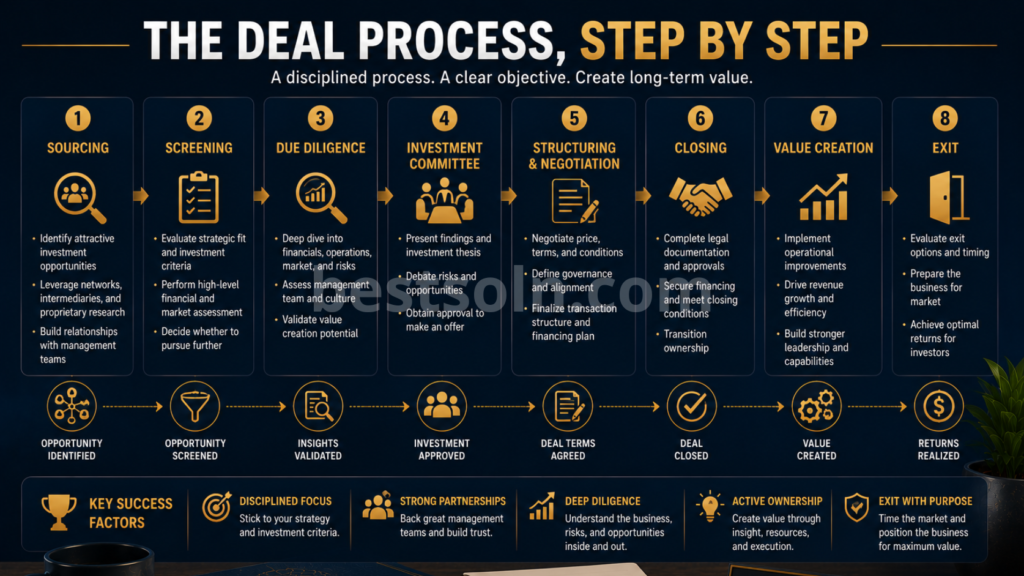
Understanding the mechanics of a private equity deal helps demystify why these transactions take months, sometimes years, to complete.
It starts with fundraising, where the GP markets the fund to prospective LPs using a private placement memorandum that lays out the strategy, target returns, and terms. Once enough commitments are secured, the fund officially closes.
Next comes sourcing deals. GPs maintain relationships with investment banks, brokers, and industry contacts to build a steady pipeline of potential targets. Firms that can find proprietary, off-market opportunities have a real edge, since competitive auctions tend to drive prices up.
Once a target is identified, due diligence begins in earnest. This is an exhaustive process covering historical financials, future cash flow projections, competitive positioning, management quality, and legal or regulatory risk. It’s genuinely thorough. Research on the industry suggests only a small fraction of deals that enter the pipeline, often cited around 3 percent for buyouts and even less for venture capital, actually make it through to a completed investment.
Assuming the target clears diligence, deal structuring and negotiation determine how the purchase will be financed, what ownership percentages result, and what protections and incentives get built into the contract. Then comes the acquisition itself, followed by post-acquisition management, where the fund’s team works alongside company leadership to execute the value creation plan.
Eventually, the fund pursues an exit. The main routes are a trade sale to a strategic buyer such as a competitor or larger corporation, a sale to another private equity firm known as a secondary buyout, an initial public offering that takes the company onto a stock exchange, or in less desirable cases, a straightforward liquidation of assets.
How Value Actually Gets Created

There’s a persistent myth that private equity returns come purely from financial engineering, essentially piling on debt and hoping for the best. That was truer decades ago than it is today. Research from Norges Bank Investment Management shows that in the earliest days of the buyout industry, leverage and multiple expansion, meaning buying cheap and selling at a higher valuation multiple, were the dominant sources of returns. As the industry has matured and competition for deals has intensified, operational improvement has become the bigger driver of value.
That operational work generally falls into three buckets.
- Governance engineering involves tightening board oversight, recruiting stronger management, and better aligning executive pay with performance.
- Financial engineering covers adjustments to the capital structure, how much debt versus equity a company carries, and how efficiently that structure is used.
- Operational engineering is the hands-on business improvement work: cutting unnecessary costs, expanding into new markets, redefining strategy, or pursuing bolt-on acquisitions to build scale in a fragmented industry.
Cost cutting deserves a specific mention because it’s genuinely controversial. Renegotiating supplier contracts or trimming headcount can boost short-term profitability, but taken too far it can damage employee morale, hollow out long-term capability, and in sectors like healthcare, research has flagged real concerns about service quality being compromised in the pursuit of financial results.
The Analytical Core: Valuation and Due Diligence
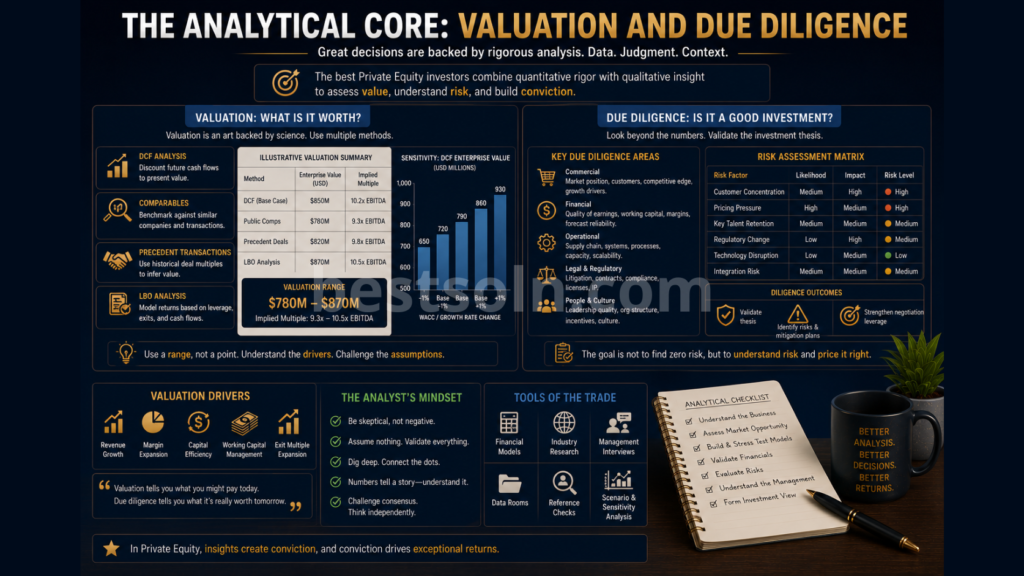
Every private equity deal comes down to one basic question. What is this company actually worth, and can you trust the numbers used to answer that? Getting this right is what separates a good investment from a costly mistake, which is why private equity firms spend months digging into a target company before ever agreeing on a final price.
Why Due Diligence Comes Before Valuation
You can’t put an accurate price tag on a business until you know exactly what you’re buying. That’s the whole point of due diligence. It’s an exhaustive, multidisciplinary review meant to confirm what the company actually owns, what it owes, and how much money it genuinely earns once you strip away anything misleading. Everything a firm learns during this process feeds directly into the valuation that follows, since a valuation built on shaky assumptions is really just a guess dressed up in spreadsheets.
The Three Sides of the Investigation
This investigation usually breaks down into three main areas, each looking at the business from a different angle.
Commercial due diligence looks outward at the market the company competes in. The team wants to know how big the potential customer base really is, how fast the business has grown and how fast it’s likely to keep growing, whether the company depends too heavily on just a handful of customers, and whether its products can hold up against competitors on price and quality over time.
Operational due diligence looks at how the business actually runs day to day. This means digging into how efficient the internal processes are, how stable the supply chain is, how much money will need to be spent on equipment and infrastructure going forward, and whether the technology systems in place can support future growth. The goal is to make sure the company can grow after the deal closes without suddenly needing a big unplanned injection of cash.
Financial due diligence is the deepest and arguably most important piece of the puzzle. This is where the buyer’s team pores over the target’s financial statements, checks that taxes have been properly paid, and examines exactly how cash moves through the business.
Getting to the Real Earnings Number
A huge part of financial due diligence comes down to something called quality of earnings, often shortened to QoE. The basic idea is simple. Companies report a profit number, usually EBITDA, but that number can be misleading if it includes things that won’t happen again or that don’t reflect how the business normally operates.
So the buyer’s team goes through the numbers line by line, stripping out anything that distorts the true picture. That might mean removing a one-time legal settlement, an unusual bonus paid out in a good year, founder pay that’s either too high or too low compared to what a normal executive would earn, a temporary spike in sales that isn’t likely to repeat, or overly aggressive accounting choices that make revenue look better than it really is. What’s left after all these adjustments is a much more honest sense of what the company actually earns in a normal year, and that adjusted figure is usually the starting point any serious valuation gets built on.
Locking In the Cash the Business Needs to Run
Financial due diligence also sets what’s called a working capital peg. This is basically a baseline for how much inventory, unpaid customer invoices, and unpaid bills the business needs to keep running smoothly on the day the deal closes. Setting this number matters because it stops a seller from draining cash out of the business right before selling it, leaving the buyer with a company that looks fine on paper but doesn’t actually have enough working capital to operate. Without this step locked down, even the most carefully calculated valuation can fall apart the moment the new owners actually try to run the business.
Turning the Numbers Into a Price
Once due diligence has produced a clean, trustworthy earnings figure, the next job is deciding what to actually pay for the business. There’s no single correct answer here, so buyers typically run a few different valuation approaches side by side and see where they land.
The discounted cash flow method, usually called DCF, tries to work out what a company is worth today based on all the cash it’s expected to generate in the future. The analyst builds out projections for the business over several years, then discounts those future cash flows back to today’s dollars using a rate that reflects how risky the investment is. It’s a genuinely useful exercise because it forces you to think through exactly how the business will actually grow, but it also depends heavily on assumptions about growth rates and discount rates, so small changes in those inputs can swing the final number quite a bit.
Comparable company analysis, often just called comps, takes a very different approach. Instead of building a forecast from scratch, you look at similar publicly traded companies and see what multiple of earnings or revenue the market is currently paying for them. If similar businesses are trading at, say, eight times EBITDA, that gives you a real-world benchmark for what the target company might be worth. The tricky part is finding companies that are genuinely comparable in size, growth, and market position, since no two businesses are ever a perfect match.
Precedent transaction analysis works along similar lines, but instead of looking at how public companies are currently priced, it looks at what buyers have actually paid for similar companies in past deals. This tends to include a control premium, since buying a whole company usually costs more than buying a small slice of it on the stock market, which makes this method especially useful in a private equity context where the whole point is acquiring control.
Finally, private equity firms often run what’s called an LBO valuation, which flips the whole process around. Rather than asking what a company is worth in the abstract, it asks a more practical question. Given how much debt the deal can support and the return the fund needs to hit by the time it exits, how much can the firm afford to pay today. This approach ties the price directly back to the fund’s own return targets, and it’s often the deciding factor in how aggressive or conservative a private equity firm gets during a competitive bidding process.
In practice, none of these methods are used in isolation. A private equity firm typically lays all four approaches side by side, and where they cluster together tells the buyer roughly what a fair price looks like. Where they disagree sharply is usually where the real negotiation, and the real risk, tends to live.
Fund Economics: Fees, Carry, and the Waterfall
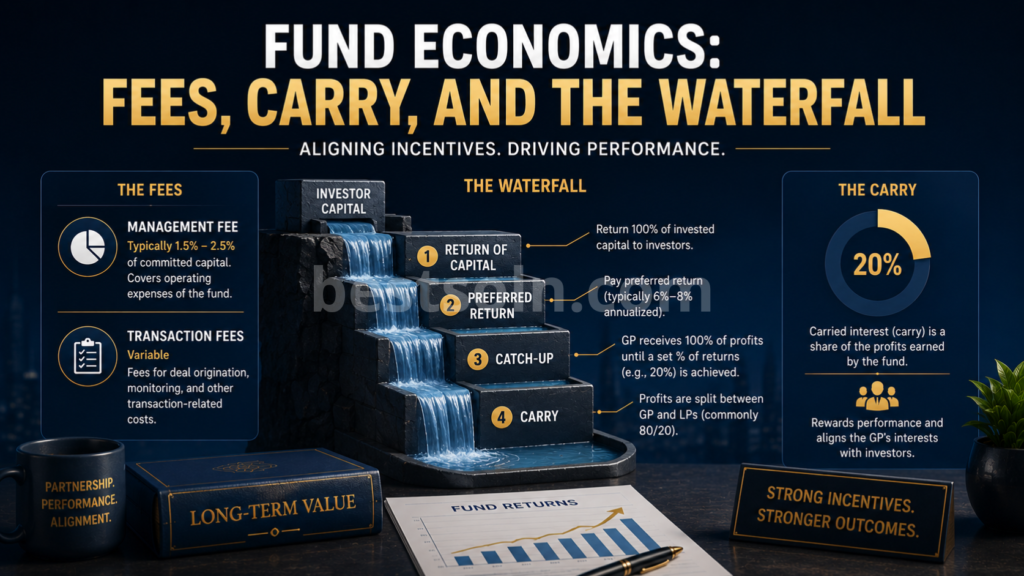
If there’s one part of private equity that trips people up, it’s the fee structure. The shorthand you’ll hear constantly is “two and twenty.”
The management fee is typically 1.5 to 2.5 percent of committed capital per year, charged to cover the fund’s operating costs, salaries, and due diligence expenses. For a billion-dollar fund charging a 2 percent fee, that’s 20 million dollars a year, whether or not the fund has actually deployed all that capital yet. This fee is usually calculated on committed capital during the investment period, then shifts to being calculated on invested or remaining capital afterward.
Carried interest, commonly called “carry,” is the GP’s share of the fund’s profits, typically 20 percent, although it can run higher for particularly sought-after managers. Carry is what genuinely aligns the GP’s incentives with LPs, because the manager only earns big money if the fund performs well.
Before any carry gets paid out, most funds include a preferred return or hurdle rate, commonly around 7 to 8 percent annually. LPs need to receive this minimum return on their capital before the GP starts sharing in profits at all. Once that hurdle is cleared, many funds include a catch-up period, where the GP receives a disproportionate share of profits until the agreed split, often 80/20 in favor of LPs, is reached. This entire sequence of who gets paid and in what order is known as the distribution waterfall, and it can be structured on a deal-by-deal basis, which tends to favor GPs by letting them earn carry earlier, or on a whole-fund basis, which protects LPs by ensuring all capital and preferred return is repaid first.
Funds also typically include a clawback provision, a mechanism forcing the GP to return excess carry if early gains turn out to have been offset by later losses, ensuring the manager never ends up with more than its contractually agreed share of profits.
The Incentive Architecture: Waterfalls and Carry

Private equity firms and their investors don’t just trust each other to play fair. Their financial interests are locked together through a very specific set of rules that determine exactly how profits get split. This system is called the distribution waterfall, and once you understand how it works, a lot of the industry’s incentives start making sense.
How the Money Actually Flows
Think of the waterfall as a series of buckets that need to fill up in order. Money can’t move to the next bucket until the one before it is full. Most private equity funds use a four-step version of this.
First, LPs get their original money back. Every dollar of profit that comes in goes straight to investors until they’ve recovered everything they originally put into the fund, plus any expenses along the way.
Second, LPs earn a minimum return on top of that. Before the GP sees a single dollar of profit, investors need to hit what’s called a preferred return, usually somewhere between seven and nine percent a year. This is the fund’s way of saying investors deserve a baseline reward just for tying up their money for so long.
Third comes something called the catch up. Once LPs have hit that preferred return, the GP starts receiving distributions too, and for a while, they get the lion’s share of what’s coming in. This catch up period exists so the GP can close the gap and end up with roughly the agreed cut of total profits, typically around twenty percent, rather than just a sliver of what’s left over.
Fourth, once everyone’s caught up, the real profit sharing begins. From this point on, any additional gains typically get split eighty percent to LPs and twenty percent to the GP. This final slice is what people mean when they talk about carried interest, or carry for short.
European versus American Waterfalls
Not every fund runs this waterfall the same way. There are two main models, and the difference between them matters a lot for how quickly a GP gets paid.
A European waterfall applies these rules across the entire fund as a whole. That means the GP doesn’t collect any carry until the fund overall has returned all capital and hit the preferred return for every investor. This model protects LPs more, since it prevents a GP from cashing in on early wins while later deals are still struggling.
An American waterfall works deal by deal instead. Here, the GP can start earning carry on individual successful investments even if other parts of the fund haven’t returned their capital yet. This is friendlier to GPs since it lets them get paid sooner, but it puts more of the risk on LPs if later deals underperform after the GP has already collected its share.
The comparative table below outlines the key structural differences between these two distribution models.
| Feature | European Waterfall (Whole Fund) | American Waterfall (Deal by Deal) |
| Profit Calculation | Based on the aggregate performance of the entire fund. | Based on the performance of each individual investment. |
| Timing of Carry | GP carry only crystallizes after LPs have recovered all capital and preferred returns across the entire fund. | GP carry is paid deal by deal following each profitable exit, regardless of unrealized losses. |
| LP Protection | High, as early exits cannot result in GP overcompensation. | Lower, requiring strong contractual safeguards to protect the principal. |
| Clawback Exposure | Low, as distributions are calculated globally at fund liquidation. | High, requiring the GP to return excess carry if subsequent deals underperform. |
| GP Cash Flow | Delayed, often requiring GPs to wait six to eight years to realize carry. | Accelerated, providing early liquidity to support GP growth and operating costs. |
Sweetening the Deal With Tiered Carry
Some funds take this a step further with what’s called tiered carried interest. Instead of a flat twenty percent cut no matter how well the fund performs, the GP’s share actually increases as returns climb higher.
A typical setup might look something like this. The GP earns ten percent carry on returns between eight and twelve percent. That climbs to twenty percent carry on returns up to twenty percent. And for truly exceptional performance above twenty percent, the GP might earn thirty percent carry.
The logic here is simple. Once a GP clears the basic hurdle, there’s always a risk they might coast rather than keep pushing for bigger wins. A tiered structure keeps them motivated to chase outsized returns all the way through, since their own payout keeps growing right alongside the fund’s success.
Measuring Performance: IRR, Multiples, and the J-Curve
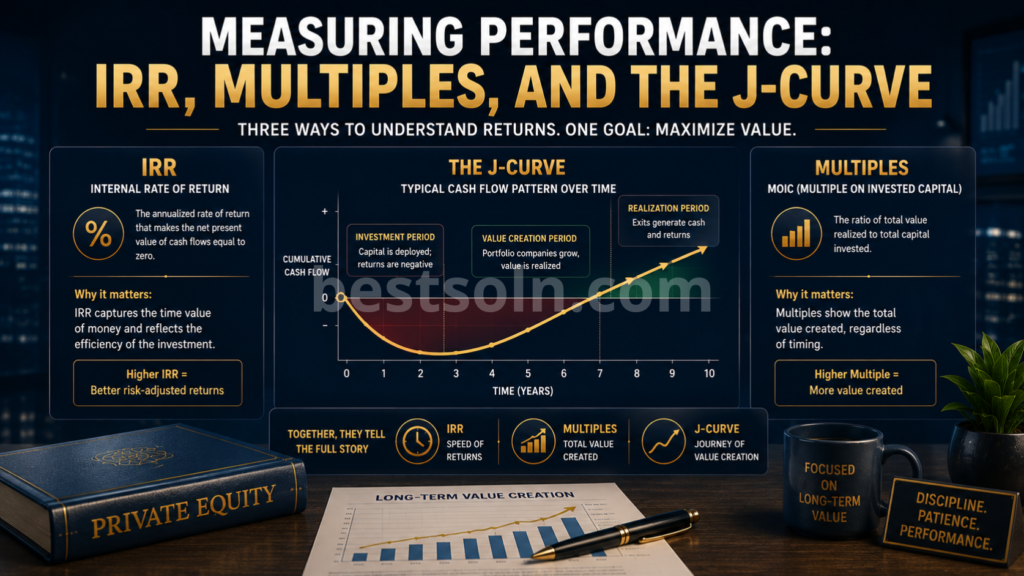
Private equity performance gets measured differently than public market returns, largely because cash flows into and out of a fund happen unevenly over many years rather than in one lump sum.
Internal rate of return (IRR) is the most widely quoted metric. It’s the annualized rate that makes the net present value of all the fund’s cash flows equal zero. IRR’s big advantage is that it accounts for the timing of cash flows, but that’s also its weakness: a fund that returns capital quickly can post a flattering IRR even if the actual dollar profit is smaller than a slower-moving fund that ultimately made more money.
Total value to paid-in capital (TVPI), sometimes called the multiple of invested capital, simply measures total value returned relative to capital invested. A TVPI of 2.0 means every dollar invested has generated two dollars of value, whether realized in cash or still sitting as an unrealized valuation on the books.
Distributions to paid-in capital (DPI), often nicknamed the realization multiple, measures actual cash returned to investors relative to what they put in. This metric matters enormously to LPs because it strips away paper gains and shows whether a fund has genuinely turned theoretical profit into real, distributable cash. Notably, industry surveys in 2025 and 2026 show DPI climbing in importance among institutional investors, now rivaling IRR as the metric that matters most, precisely because so much private equity capital has been sitting unrealized in portfolio companies that managers have struggled to sell in a difficult exit environment.
Public market equivalent (PME) attempts to answer a more useful question: how did this fund do compared to simply investing the same money in the public stock market at the same times? A PME above 1.0 means the private equity fund beat the public market benchmark on a cash flow-adjusted basis.
Then there’s the J-curve, a pattern that shows up almost universally in private equity fund performance charts. Early in a fund’s life, returns dip into negative territory because management fees are being charged on committed capital while few investments have had time to appreciate, and any early write-downs of underperforming deals hit the numbers hard. As the fund matures and successful investments get realized, performance climbs, eventually tracing a shape that resembles the letter J. Understanding the J-curve is essential for anyone new to private equity, because it explains why a fund’s early quarterly reports can look alarming even when the underlying strategy is working exactly as intended.
Real-Life Case Studies: Theory in Action
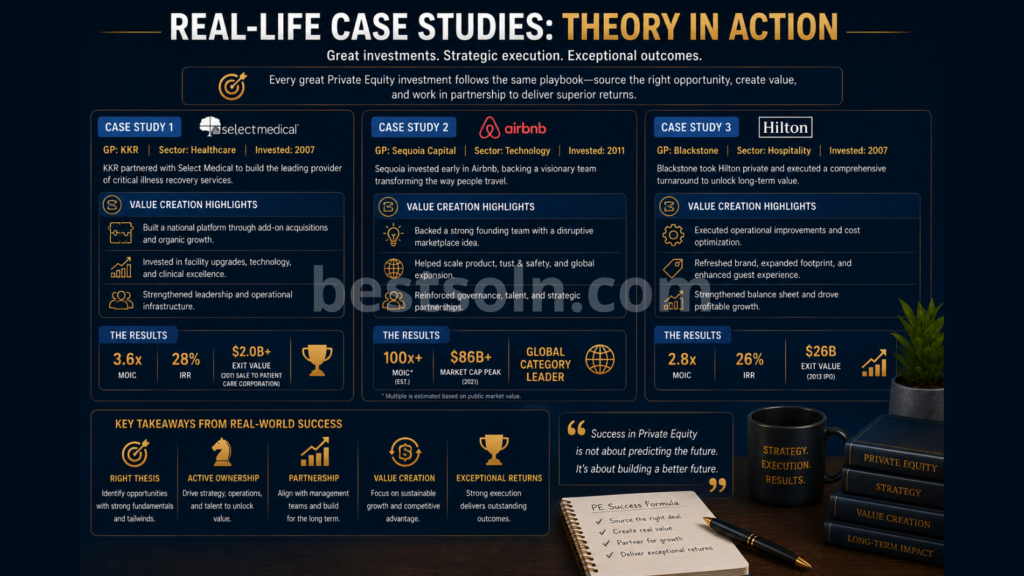
To truly grasp the impact of private equity, let’s look at two distinct examples that illustrate different strategies.
The Turnaround: Hilton Hotels
In 2007, Blackstone bought Hilton Hotels for roughly $26 billion right before the global financial crisis hit. It looked like a disaster. The value of the company plummeted, and debt loads were crushing.
Instead of selling, Blackstone held on. They replaced the CEO with Chris Nassetta, who focused on asset-light strategies (franchising rather than owning real estate) and global expansion. They waited out the storm. By the time Hilton went public again in 2013 and Blackstone fully exited in 2018, the firm had made a profit of roughly $14 billion. It is widely considered one of the greatest PE deals in history, proving that patience and operational changes can overcome even the worst macroeconomic timing.
The Consolidation: The Rise of Dentistry
In the UK and Europe, firms like Apax and others have utilized a “buy-and-build” strategy in the dental sector. They acquire small, independent dental practices and merge them into a large group.
By combining these small entities, they achieve economies of scale. They can negotiate better prices for equipment, centralize administrative tasks like HR and billing, and invest in better marketing. This transforms a fragmented market of struggling solo practitioners into a streamlined, profitable corporate entity. While this drives efficiency, it also sparks debate about the corporatization of healthcare, a topic frequently discussed in financial forums.
Why Investors Are Drawn to Private Equity

The case for private equity usually rests on a few pillars. Historically, top-performing private equity funds have delivered returns that outpace public markets by a meaningful margin. Analysis from McKinsey covering the past decade found that top-quartile buyout funds generated annualized returns well above both the S&P 500 and the MSCI World Index. Separately, research from Norges Bank Investment Management found that buyout funds have outperformed public equities by roughly 3 to 4 percentage points annually on average, even after accounting for fees, though the same research found venture capital and growth equity funds have actually underperformed public markets by 1 to 2 percentage points on average over their sample period, a reminder that private equity’s reputation for outperformance doesn’t apply evenly across every strategy.
Private equity also offers genuine diversification. Because valuations aren’t marked to market daily the way public stocks are, private equity investments can behave differently during market downturns, sometimes falling less sharply than listed stocks during periods of turmoil like the 2008 financial crisis or the initial Covid shock.
There’s also the manager selection story, which is arguably the single most important factor in private equity investing. The gap between top-performing and average-performing private equity managers is dramatically wider than the equivalent gap among public mutual fund managers. That dispersion means picking the right GP matters enormously more in private equity than it does in most other asset classes.
The Real Risks Investors Need to Understand
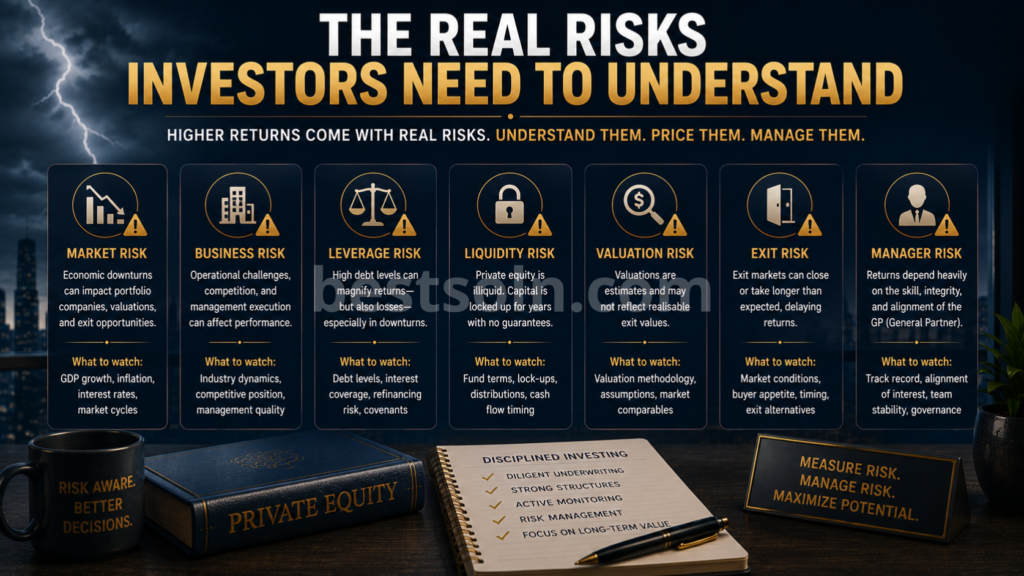
None of this comes without serious tradeoffs, and anyone considering private equity exposure needs to go in with eyes open.
Illiquidity is the defining risk. Once capital is committed to a fund, it’s typically locked up for a decade or more. There’s no way to simply sell your stake the way you’d sell a stock, and the secondary market for LP interests, while growing, often only offers steep discounts to reported value.
Valuation is inherently subjective. Because portfolio companies aren’t traded on public markets, their reported values rely on manager judgment rather than a live market price. Different firms use different valuation approaches, and reporting typically lags the actual quarter by one to three months.
Commitments are binding. Once you agree to invest, you generally can’t back out even if the manager starts underperforming. Limited partners have essentially no ability to fire an underperforming GP mid-fund, and defaulting on a capital call can mean forfeiting your entire stake.
Blind-pool investing is common. When you commit to a fund, you’re often committing before knowing exactly which companies the money will end up in, since funds are raised first and invested afterward. This makes manager due diligence before you invest absolutely critical.
Leverage cuts both ways. The same debt that can amplify returns on a successful buyout can also wipe out equity value entirely if a portfolio company stumbles, particularly during periods of tighter credit or rising interest rates.
There’s also a structural challenge that has become especially prominent recently. Industry data through 2025 and into 2026 pointed to a substantial backlog of unsold portfolio companies sitting on managers’ books, with some estimates counting tens of thousands of unexited investments across the industry. A slow initial public offering market and cautious buyers made it harder for funds to return cash to their investors, which in turn made fundraising for new funds tougher. There are signs this is starting to loosen as interest rates ease and deal activity picks back up, but it’s a good illustration of how the entire private equity ecosystem, fundraising, dealmaking, and exits, is deeply interconnected.
Where Private Equity Stands Today
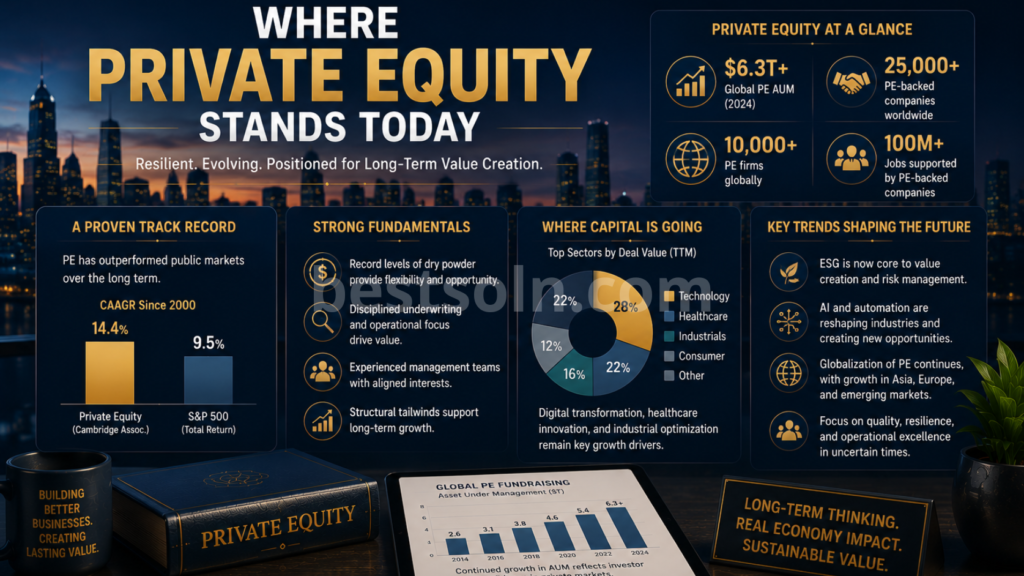
Private equity has changed shape considerably even in just the past few years. A few themes stand out heading into 2026.
The industry is widely described by major consulting firms as having matured. The tailwinds that powered outsized returns for two decades, namely falling interest rates, expanding valuation multiples, and abundant cheap debt, have largely faded. Returns going forward are expected to depend far more on genuine operational skill than on macroeconomic luck.
Secondary market transactions have become a permanent and growing fixture of the industry rather than a niche corner. They give LPs a way to gain liquidity before a fund naturally winds down and give buyers a way to access more mature, de-risked assets while avoiding some of the J-curve.
Private wealth and retail access is expanding meaningfully. Regulatory changes in the United States, including guidance opening the door for 401(k) retirement plans to include private market exposure, along with growth in semi-liquid and interval fund structures, are drawing individual investors into an asset class that used to be reserved almost exclusively for large institutions.
Sector specialization is intensifying. Managers are increasingly concentrating on areas like technology, healthcare, business services, and infrastructure, where deep domain expertise gives them a genuine edge in sourcing deals and creating value, rather than trying to be generalists across every industry.
Artificial intelligence has also entered the conversation in a serious way, with firms using it both to sharpen due diligence and to drive operational improvements inside portfolio companies, and industry commentary increasingly frames the ability to leverage AI effectively as a genuine competitive differentiator among managers going forward.
Recommended Reading

For readers who want to go deeper than any single article can take them, these books are widely regarded as some of the best resources on private equity, venture capital, and the broader world of leveraged investing.
- “King of Capital” by David Carey and John E. Morris – A detailed history of the rise of the modern buyout industry, told largely through the story of Blackstone.
- “Barbarians at the Gate” by Bryan Burrough and John Helyar – The classic, highly readable account of the RJR Nabisco leveraged buyout, still considered essential reading for understanding how LBOs work in practice.
- “The Masters of Private Equity and Venture Capital” by Robert Finkel and David Greising – Profiles of leading investors sharing how they actually approach deal-making and value creation.
- “Venture Deals” by Brad Feld and Jason Mendelson – A practical, plain-English guide to how venture capital term sheets and financing rounds actually work, written for founders and investors alike.
- “Private Equity Operational Due Diligence” by Jason A. Scharfman – A more technical resource for readers who want to understand how institutional investors actually evaluate and select fund managers.
- “The Business of Venture Capital” by Mahendra Ramsinghani – A comprehensive look at how venture funds are raised, structured, and managed from the inside.
Frequently Asked Questions
Q1: What is the difference between private equity and venture capital?
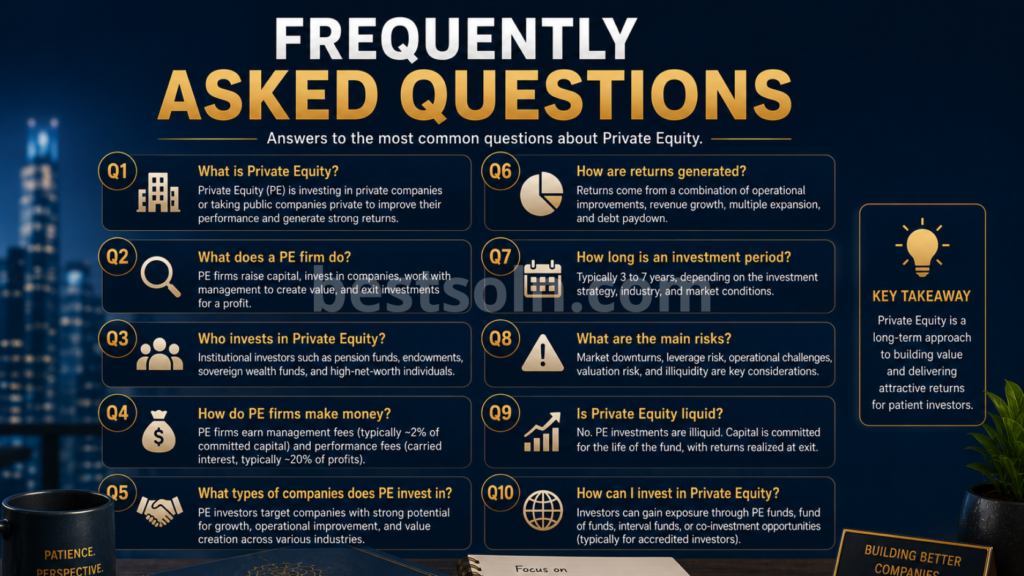
A: Venture capital is technically a subset of private equity. It specifically targets early-stage, high-growth companies, usually in exchange for minority ownership stakes, and accepts a higher failure rate in pursuit of outsized winners. Private equity in its broader sense, and especially in the context of leveraged buyouts, typically targets more mature, established companies and often takes majority or full control.
Q2: How much money do you need to invest in private equity?
A: Traditionally, private equity funds were reserved for institutional investors and wealthy individuals meeting accredited or qualified purchaser thresholds, which in the United States generally means a net worth above 1 million dollars or specific income requirements. That said, newer semi-liquid and interval fund structures, along with expanding retirement account access, are gradually lowering the practical barrier to entry for individual investors.
Q3: Why do private equity funds use so much debt?
A: Debt, when used carefully, amplifies equity returns because the fund only needs to put up a portion of the purchase price while still capturing the full upside if the company’s value grows. It also disciplines management, since debt payments must be made regardless of how the business is performing. The tradeoff is that too much leverage increases the risk of financial distress if the company underperforms.
Q4: What does carried interest mean in simple terms?
A: Carried interest is the share of a fund’s profits, typically around 20 percent, that goes to the fund manager rather than the investors, but only after investors have received their capital back plus an agreed minimum return. It’s designed to reward the manager for genuinely good performance rather than simply for managing a large pool of money.
Q5: Is private equity riskier than investing in the stock market?
A: It carries different risks rather than simply more or less risk. Private equity investments are illiquid, meaning your money is typically locked up for many years, and valuations are less transparent than publicly traded stocks. In exchange, investors have historically been compensated with the potential for higher returns and access to opportunities not available in public markets, though outcomes vary enormously depending on the manager and strategy chosen.
Q6: How long does a typical private equity investment last?
A: Most private equity funds have a contractual life of seven to twelve years, though this can extend further if exits take longer than expected. Individual portfolio company holding periods usually run between three and seven years before the fund looks to sell.
Q7: What is a J-curve in private equity?
A: The J-curve describes the typical pattern of a fund’s reported returns over its life. Returns often dip into negative territory in the early years because fees are being charged while investments haven’t had time to grow in value, then climb as successful investments are realized, tracing a shape resembling the letter J.
Q8: What is Quality of Earnings analysis, and how does it differ from a standard audit?
A: A standard audit verifies that a company’s financial statements comply with generally accepted accounting principles. In contrast, financial due diligence and QoE analysis evaluate the sustainability of the company’s operating earnings. The QoE report normalises EBITDA by identifying and adjusting for non-recurring revenue spikes, owner compensation adjustments, and unusual operational expenses to reflect sustainable trading performance.
Q9: Why do General Partners commit personal capital to their own funds?
A: The General Partner commitment, typically representing one to three percent of the total fund size, is designed to ensure that the fund managers have direct skin in the game alongside their investors. LPs demand a meaningful partner-level commitment to align economic incentives, ensuring that GPs share the risk of capital loss and do not prioritize fee stream generation over fund performance.
Q10: What is a clawback provision and when is it triggered?
A: A clawback provision is a contractual safeguard in the Limited Partnership Agreement, typically triggered at the final liquidation of a fund with an American waterfall structure. If the GP receives carried interest on early profitable exits, but subsequent investments perform poorly or write-offs occur, the final accounting may show that the GP received more than their contractually agreed twenty percent share of total fund profits. The clawback requires the GP to return the excess cash to the LPs.
Q11: How does the denominator effect restrict private equity fundraising?
A: The denominator effect occurs when public market equity and bond valuations experience a sharp decline. Because private equity assets are valued quarterly and do not experience immediate public market volatility, their share of the institutional allocator’s total portfolio mechanically increases, pushing the LP above its statutory target allocation limits. This restricts the LP’s ability to make new commitments to subsequent private equity funds, even if they have available cash.
Q12: What is private equity and how does it differ from mutual funds?
A: Private equity funds buy stakes in private companies (or take public companies private), whereas mutual funds invest in publicly traded stocks. PE funds are closed-end and illiquid: once you commit money, it’s typically locked up for many years. Mutual funds trade daily and are open-ended. Also, PE managers focus on active improvements and long-term growth, while mutual funds mainly follow market indexes or corporate earnings.
Q13: How do private equity firms compare to hedge funds?
A: The two are fundamentally different. Private equity firms buy controlling stakes in companies and hold them for years, actively managing them to create value. Hedge funds typically trade public securities, use complex strategies to generate returns from market movements, and hold positions for much shorter periods, sometimes seconds or days. Private equity funds generally do not use leverage within the fund itself (leverage is at the portfolio company level), while hedge funds often use leverage within the fund.
Q14: Why do PE firms fire employees?
A: Cost-cutting is often part of the value creation plan. If a company is bloated or inefficient, reducing headcount can improve margins quickly. However, modern PE firms increasingly focus on growth and revenue expansion rather than just slashing costs, as sustainable growth yields better exit multiples.
Conclusion

Private equity is neither the villain of corporate finance nor the guaranteed path to riches it’s sometimes made out to be. It’s a genuinely distinct way of owning and improving businesses, built on long time horizons, concentrated ownership, and active involvement that public market investing simply doesn’t allow for.
Understanding the fundamentals covered here, who the players are, how funds are structured, how deals move from sourcing to exit, how fees and carried interest work, and how performance actually gets measured, gives you the vocabulary and the framework to evaluate any specific opportunity, article, or pitch you come across afterward. The details of any individual fund or deal will always vary, but the underlying architecture rarely changes.
Whether private equity belongs in your own portfolio, your career path, or simply your general financial literacy is a personal call. But it’s clearly not going away. With trillions of dollars already committed and new channels opening for everyday investors to participate, this is an asset class worth genuinely understanding rather than just recognizing by name.











Leave a Reply