

- Home
- /
- Made in India
- /
- Sarvam AI: India’s AI Breakthrough
⏱️ Read Time:
Introduction
The global narrative of artificial intelligence has historically been a tale of two halves, one centered in the silicon-rich valleys of California and the other in the state-driven hubs of East Asia. However, the recent unveiling of India’s sovereign AI strategy, spearheaded by the Bengaluru-based startup Sarvam AI, has introduced a third, perhaps more inclusive, alternative. As of early 2026, the arrival of foundational models built from the ground up for the Indian context suggests that the era of simply localizing Western technology is coming to a close. India is no longer content with being the back-office of the world; it is now positioning itself as the primary architect of its own digital destiny. This shift is not merely a matter of national pride but a practical necessity driven by the unique linguistic, infrastructural, and economic realities of the subcontinent. By focusing on sovereign intelligence, India is ensuring that its data, culture, and governance are reflected in the tools that will soon define every aspect of its citizens’ lives.
The significance of Sarvam AI lies in its departure from the traditional scaling laws of machine learning. While global giants have spent billions chasing trillion-parameter models that require the energy output of small nations, Sarvam has embraced a philosophy of high-efficiency, targeted intelligence. The company’s breakthroughs in Mixture of Experts architecture and on-device processing have demonstrated that an AI model does not need to be the largest in the world to be the most effective for a specific population. At the India AI Impact Summit 2026, the company’s founders presented a vision where AI is not a luxury for those with the latest flagship smartphones but a utility accessible to the hundreds of millions who still use basic feature phones. This democratic distribution of intelligence is what defines the sovereign approach, moving away from a model of digital dependence toward one of strategic autonomy.
The Convergence of Public Infrastructure and Research Excellence

To understand the rapid ascent of Sarvam AI, one must look at the professional lineage of its founders, Vivek Raghavan and Pratyush Kumar. Their partnership represents a rare fusion of large-scale governmental project management and high-level academic research. This combination has allowed Sarvam to navigate the complexities of building technology that must function for a billion people while simultaneously pushing the boundaries of what is possible in computational linguistics.
Vivek Raghavan brings to the table an unparalleled experience in building India’s digital public infrastructure. His role as the chief product manager and biometric architect at the Unique Identification Authority of India was instrumental in the design and scaling of Aadhaar, the world’s largest biometric identity system. Having witnessed the transition of India from a cash-heavy, informal economy to one of the most sophisticated digital payment and identity markets in the world, Raghavan understands that for technology to succeed in India, it must be inclusive, cost-effective, and built on open standards. His work with the EkStep Foundation and his advisory roles for Digital India Bhashini have centered on the belief that language should not be a barrier to digital access.
Pratyush Kumar provides the deep technical rigor required to build foundational models. With a doctorate from ETH Zurich and a history of research at IBM and Microsoft, Kumar has spent years exploring the intersection of AI and Indian languages. His tenure as faculty at IIT Madras and his leadership at AI4Bharat allowed him to cultivate a team of researchers focused on creating high-quality datasets for the 22 scheduled languages of India. Together, Raghavan and Kumar have built Sarvam AI not as a traditional venture-backed startup seeking a quick exit, but as a long-term institutional player dedicated to the national mission of AI sovereignty.
The cultural impact of this work was recently highlighted by an anecdote involving a former Microsoft employee who joined Sarvam. Upon revealing the move to their parents after the India AI Impact Summit, the reaction was one of immense pride, reflecting a broader societal shift. In the past, a career at a global giant like Microsoft or Google was considered the pinnacle of professional achievement for an Indian engineer. Today, the opportunity to build foundational technology for India is increasingly viewed as a more prestigious and meaningful path. This shift in the talent landscape is a critical component of India’s burgeoning AI ecosystem, as the country’s best minds choose to stay home and solve local problems that have global implications.
Architectural Innovation: The Mixture of Experts Breakthrough
One of the most profound technical challenges in AI development is the balance between model capability and computational cost. For a country like India, where hardware resources and energy are often constrained, the brute-force scaling of parameters is not a sustainable path. Sarvam AI has addressed this by utilizing the Mixture of Experts (MoE) architecture for its flagship models, the Sarvam 30B and Sarvam 105B.
The MoE architecture functions by dividing the neural network into specialized sub-networks or experts. Instead of activating the entire model for every single prompt, the system dynamically routes the query to the specific experts most qualified to handle it. This results in a massive reduction in the number of parameters activated during inference, which in turn lowers latency and reduces the energy required for processing. This efficiency is what allows Sarvam’s models to deliver performance that rivals much larger global competitors while remaining significantly cheaper and faster to run.
The Sarvam 30B and 105B Model Specifications
The Sarvam 30B model is specifically designed for high-efficiency, real-time conversational applications. Despite its 30 billion total parameters, it only activates 1 billion parameters at a time to generate output tokens. This extreme leaness allows the model to be deployed in environments where latency is the primary concern, such as voice-based customer service or real-time translation on mobile devices. It has been trained on a massive corpus of 16 trillion tokens, ensuring a deep understanding of linguistic patterns and cultural context.
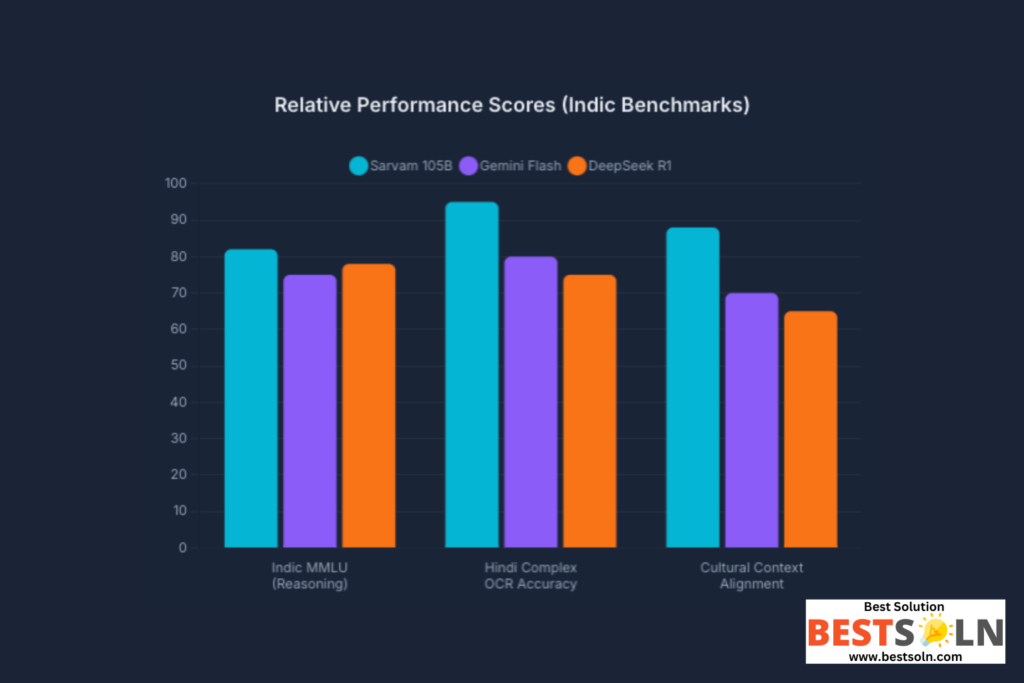
The Sarvam 105B model is the more powerful sibling, architected for complex reasoning, agentic workflows, and detailed document analysis. It activates 9 billion parameters and features a substantial context window of 128,000 tokens. This large context window is particularly vital for enterprise and government use cases, as it allows the model to process entire legal documents, financial reports, or technical manuals in a single prompt without the need for fragmenting the data. Benchmarks presented at the India AI Impact Summit 2026 suggest that the 105B model not only outperforms older versions of models like DeepSeek R1 but also offers superior performance in Indian languages compared to Google’s Gemini 2.5 Flash.
| Technical Parameter | Sarvam 30B | Sarvam 105B |
| Total Parameters | 30 Billion | 105 Billion |
| Activated Parameters | 1 Billion | 9 Billion |
| Context Window | 32,000 Tokens | 128,000 Tokens |
| Training Tokens | 16 Trillion | Trillions (Indic-Heavy) |
| Architecture | Mixture of Experts | Mixture of Experts |
| Optimized For | Low-Latency / Edge | Complex Reasoning / Agents |
The efficiency of these models is further enhanced by Sarvam’s proprietary tokenizers. In standard AI models, non-English scripts are often broken into a disproportionately high number of tokens, which increases the cost and time required for processing. Sarvam’s custom tokenizers for Indic scripts have achieved fertility rates (the number of tokens per word) that are nearly equivalent to English. This breakthrough means that processing a query in Hindi or Marathi is now as efficient as processing one in English, a critical step toward making AI economically viable for the Indian mass market.
Linguistic Sovereignty: Solving the Tower of Babel
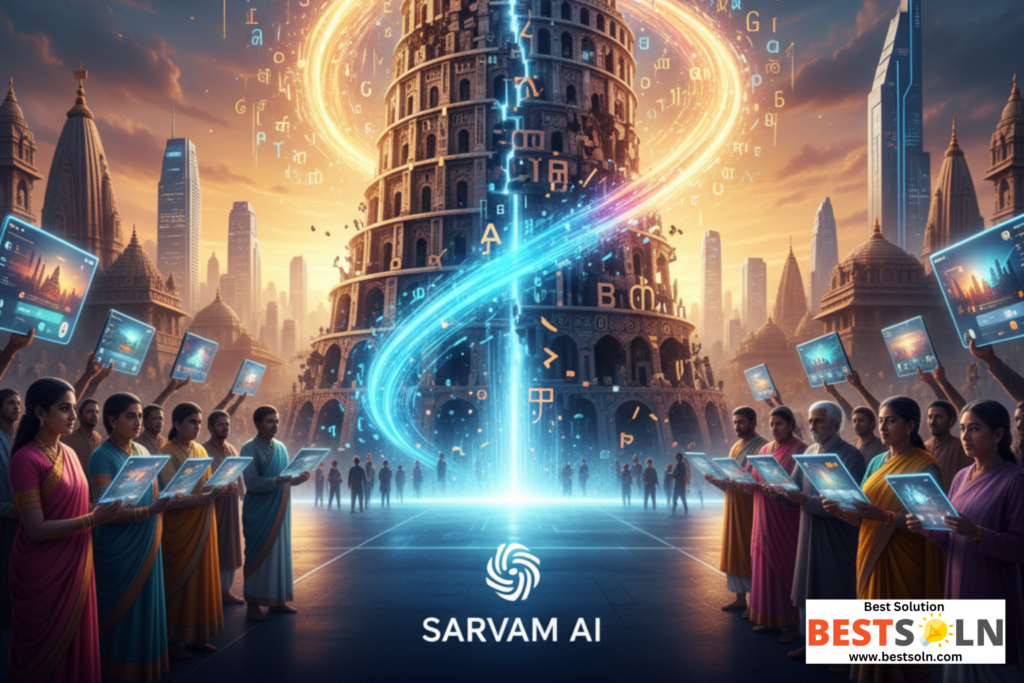
India’s linguistic landscape is one of the most diverse in the world, with 22 official languages written in a variety of scripts and spoken in thousands of regional dialects. For global AI models, these languages have historically been treated as “low-resource,” leading to poor performance and a lack of cultural nuance. Sarvam AI’s sovereign approach flips this hierarchy, treating Indian languages as first-class citizens in the development of its models.
The company’s product stack includes several specialized models designed to handle the multi-layered nature of Indian communication. The “Bulbul” model for text-to-speech supports 11 Indian languages and provides 39 unique voices that capture the natural cadence and emotional subtext of Indian speech. In blind tests, these voices have been preferred over global leaders like ElevenLabs due to their expressive quality and cultural resonance. Complementing this is “Saaras,” a speech-to-text model that supports all 22 scheduled languages and is capable of handling code-mixed speech, commonly known as Hinglish.
The Challenge of Code-Switching and Context
In everyday Indian conversation, it is rare for a person to stick strictly to one language. The blending of regional languages with English terms is a foundational part of the contemporary Indian identity. Sarvam’s models are optimized from the ground up to understand this “code-switching.” This is not just a matter of translation but of understanding context. For instance, an AI needs to know the difference between a literal translation and the colloquial subtext used in digital slang or professional environments.
During the India AI Impact Summit, co-founder Pratyush Kumar emphasized that AI must move beyond English to capture the lived experiences of users across different regions. This philosophy was put to the test when Prime Minister Narendra Modi, during a visit to the Sarvam pavilion, asked a pointed question: “Does it speak Gujarati?” The ability of the model to handle diverse dialects and regional scripts is the true benchmark of its utility for the Indian population. By training on 2 trillion high-quality Indic tokens, Sarvam has ensured that its models are grounded in the legal, social, and economic realities of India rather than being translated approximations of Western systems.
Sarvam Vision: A New Standard for Document Intelligence

While large language models often capture the headlines, Sarvam AI’s work in visual understanding represents a critical breakthrough for the practical application of AI in the Indian economy. The Sarvam Vision model, a 3 billion parameter state-space model, has demonstrated state-of-the-art accuracy in tasks that have traditionally been a weak point for global giants.
Optical Character Recognition (OCR) is particularly challenging in India due to the complexity of regional scripts, the prevalence of multi-script documents, and the poor quality of historical or handwritten records. Sarvam Vision was designed to solve these specific problems. It handles tasks such as image captioning, scene text recognition, chart interpretation, and complex table parsing across varied layouts.
Benchmarking Superiority
The performance of Sarvam Vision has been validated on the olmOCR-Bench, a rigorous test for document understanding. It achieved an accuracy of 84.3 percent on the English-only subset, outperforming much larger frontier models like Google’s Gemini 3 Pro and specialized OCR models like DeepSeek OCR v2. On the OmniDocBench v1.5, which tests the ability to read and understand real-world documents with complex formatting, Sarvam Vision scored 93.28 percent.
| Benchmark Task | Sarvam Vision (3B) | Gemini 3 Pro | DeepSeek OCR v2 |
| olmOCR-Bench Accuracy | 84.3% | Lower | Lower |
| OmniDocBench v1.5 | 93.28% | Competitive | Lower |
| Complex Table Parsing | Superior | Inconsistent | Inconsistent |
| Handwritten Text Support | Yes (Indic) | Limited | Limited |
The implications of this technology are vast. India has a massive volume of physical documents, from historical archives to current financial and legal records, that remain untapped because they are not digitized. By providing a tool that can accurately extract and interpret information from these documents, Sarvam AI is unlocking a wealth of knowledge that can drive everything from genealogical research to judicial efficiency. The company has also made its Document Intelligence API free for developers during the initial launch phase to encourage the creation of new applications based on this vision-language breakthrough.
Edge Intelligence: Democratizing AI for the Next Billion
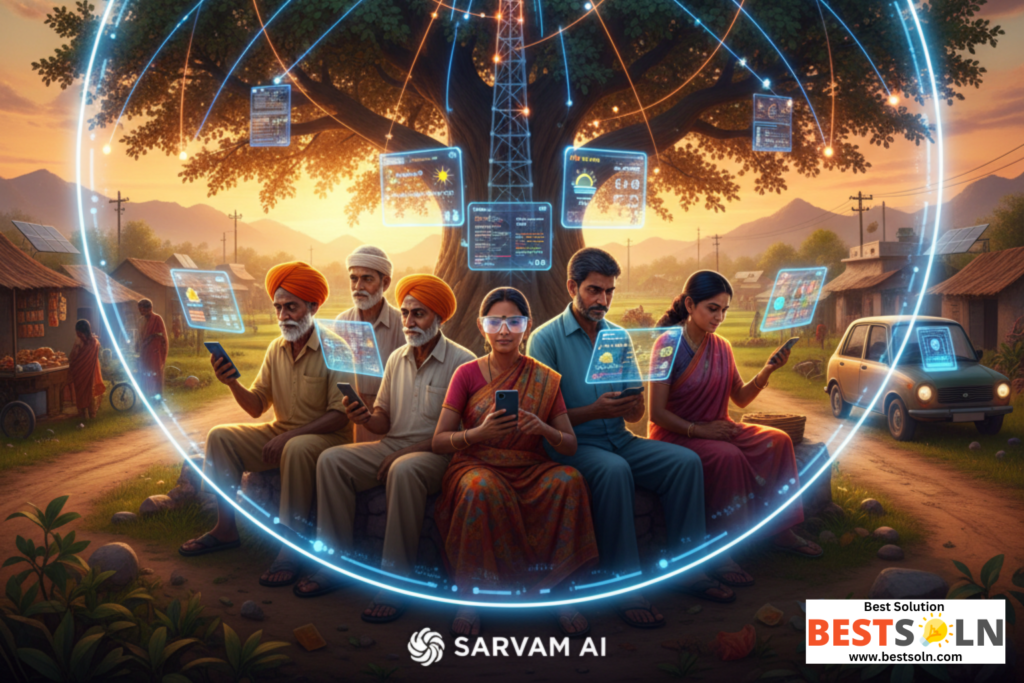
A central pillar of Sarvam AI’s sovereign strategy is the belief that AI should not be restricted to those with high-end devices and fiber-optic internet. In a country where hundreds of millions of people still use feature phones and where data costs remain a significant factor for the budget-conscious, the “cloud-only” model of AI is inherently exclusionary. Sarvam has addressed this by focusing on Edge AI, or on-device intelligence.
The company has developed “megabyte-sized” models that are small enough to run on the basic processors found in low-cost devices without needing to send data to a central server. This approach has several advantages: it ensures privacy, eliminates the latency caused by slow internet connections, and dramatically reduces the operational costs for the user.
The Nokia and HMD Partnership
In a landmark move, Sarvam AI partnered with HMD Global, the manufacturer of Nokia phones, to bring AI capabilities to feature phones. This collaboration allows users of basic handsets to interact with an AI-powered chatbot in multiple Indian languages using real-time voice conversations. For the first time, users who have been on the wrong side of the digital divide will have access to the same type of sophisticated AI tools that were previously reserved for smartphone owners. This integration is powered by the Sarvam 30B model, which was optimized specifically for real-time interactions on minimal hardware.
Sarvam Kaze: The Hardware Frontier
Beyond phones, Sarvam has ventured into original hardware with the unveiling of Sarvam Kaze, an indigenous AI-powered smart glass. Unlike traditional wearables that primarily serve as a secondary screen for a phone, Kaze is a standalone device that listens, understands, and captures the environment in real-time. It was personally tested by Prime Minister Narendra Modi at the Bharat Mandapam, where he explored its ability to respond to visual cues hands-free.
Scheduled for launch in May 2026, Sarvam Kaze represents a significant step toward a hands-free, voice-first computing future. The device is designed to be an open platform, allowing developers to create applications that leverage its on-device vision and speech models. By controlling both the software and the hardware, Sarvam is building a full-stack ecosystem that ensures technological sovereignty across all layers of the user experience.
Industrial AI and Strategic Partnerships

The impact of Sarvam AI extends deep into the industrial and enterprise sectors of India. Through strategic alliances with global tech giants, the startup is integrating its models into a variety of high-impact environments, from connected vehicles to industrial IoT systems.
Bosch and the Future of Mobility
The partnership with Bosch is aimed at bringing conversational AI onto car panels. At the India AI Impact Summit, Sarvam demonstrated an in-car voice assistant that could perform complex diagnostic tasks. A driver could ask if there was enough fuel to reach a specific destination, and the AI would respond conversationally after analyzing the vehicle’s fuel level and the route’s topography. Furthermore, the assistant could fetch service histories and display them on-screen in response to voice queries, highlighting a move toward low-latency, private, and intuitive vehicle interfaces.
Qualcomm and On-Device Performance
Sarvam’s collaboration with Qualcomm focuses on optimizing its indigenous models for the Snapdragon chipsets that power premium smartphones, laptops, and XR devices. This ensures that the AI models can perform real-time inference with maximum efficiency, further reducing the reliance on cloud processing. This is particularly relevant for professional applications on laptops, where speed and privacy are paramount.
NVIDIA and the Pravah Token Factory
On the infrastructure front, Sarvam has partnered with NVIDIA to launch “Pravah,” an AI token factory designed for production-grade inference. Built on NVIDIA’s high-performance infrastructure, Pravah is aimed at serving large-scale government and enterprise applications. This facility allows for the deployment of multilingual and multimodal models across entire sectors, providing the computational backbone required for India’s national AI ambitions.
| Partner | Sector | Objective | Key Outcome |
| HMD Global | Telecommunications | AI on Feature Phones | Voice-first AI for 100M+ users |
| Bosch | Automotive / IoT | In-car Voice Assistant | Natural language vehicle diagnostics |
| Qualcomm | Semiconductors | Device Optimization | Low-latency inference on Snapdragon |
| NVIDIA | Infrastructure | Pravah Token Factory | Large-scale enterprise AI deployment |
| UIDAI | Government | Aadhaar Enhancement | Multilingual voice-based fraud detection |
The Government’s Role: The IndiaAI Mission

The success of Sarvam AI is not an isolated event; it is a direct result of the Indian government’s proactive stance on artificial intelligence. The IndiaAI Mission, with a total outlay of over ₹10,300 crore, was established to foster a domestic AI ecosystem that can compete on the global stage while addressing local needs.
Sarvam AI was selected as a key beneficiary of this mission, receiving a financial grant of ₹246.72 crore to develop indigenous foundational models. This support has been instrumental in allowing the startup to acquire the massive compute resources necessary for training large-scale models. By providing subsidized access to 4,096 NVIDIA H100 GPUs through Yotta Data Services, the government has ensured that Sarvam has the “fuel” needed to build world-class technology.
Sovereign AI as National Power
The government views AI as a form of national power comparable to energy or defense. Union Minister Amit Shah recently stated that Sarvam AI exemplifies why the future belongs to India, noting that the company is advancing the vision of Viksit Bharat (Developed India). The strategy is to move away from being a “digital colony” that relies on foreign models and infrastructure. Instead, India is building a full-stack AI platform developed, deployed, and governed entirely within its borders.
This sovereign approach extends to state-level initiatives as well. The Government of Odisha is partnering with Sarvam to establish a 50MW AI-optimized Sovereign AI Capacity Hub for industrial safety. Similarly, the Government of Tamil Nadu and IIT Madras are developing “Digital Sangam,” India’s first Sovereign AI Research Park. These projects reflect a broad consensus that AI is the key to improving governance, productivity, and economic opportunity for the entire nation.
Consumer Impact: The Indus AI Assistant

While much of Sarvam’s work is foundational, the company has also entered the consumer market with “Indus,” an AI chat app designed specifically for the Indian user. Indus is positioned as a local alternative to ChatGPT and Gemini, focusing on the specific linguistic and cultural needs of the Indian audience.
Features of the Indus App
The app listing highlights several unique features that distinguish Indus from its global rivals:
- Multilingual Switching: Users can start a conversation in English and switch to Hindi or other regional languages mid-chat without any loss of context.
- Voice Integration: Deep support for voice commands, allowing for natural, conversational interaction.
- Document Tools: The ability to upload PDFs and images for analysis and to edit documents directly within the app.
- AI Agents: Initial tests suggest the inclusion of AI agents that can automate small tasks for the user.
The app is currently available on the Google Play Store and the Apple App Store, although access is restricted via a waitlist system to manage the high demand and compute capacity. Early feedback suggests that the app’s ability to handle regional scripts and cultural nuances makes it a compelling choice for Indian users who have found global models to be too Western-centric.
The Geopolitics of Sovereign AI

The rise of Sarvam AI represents a broader shift in the global geopolitical landscape. As AI becomes the central technology of the 21st century, the question of who controls the models, the data, and the infrastructure becomes a matter of national security and economic survival. India’s search for digital sovereignty is a response to the perceived threat that large foreign technology companies pose to domestic democracy and economic independence.
By building its own foundational models, India is ensuring that its legal, social, and economic realities are reflected in the AI systems its citizens use. This is particularly important for governance. When an AI assists a farmer with agricultural subsidies or helps a citizen navigate healthcare services, it needs to be grounded in the specific regulatory and cultural framework of India. A model trained primarily on Western data may inadvertently introduce biases or legal interpretations that are inappropriate for the Indian context.
Furthermore, the sovereign AI model allows India to participate in the global AI race on its own terms. Instead of simply being a market for foreign companies, India is now a “maker” that can export its specialized models to other emerging markets in Southeast Asia, Africa, and Latin America, where linguistic diversity and hardware constraints are similar.
Economic Multipliers and the Talent Ecosystem

The economic implications of India’s AI push are significant. Mature digital public infrastructure, combined with advanced AI, could add up to 4.2 percent to India’s GDP by 2030. Beyond the direct economic impact, the development of sovereign AI is fostering a new generation of talent. The IndiaAI Mission is not just about chips and data; it is about building the institutional imagination required to prepare India’s demographic dividend for higher-value cognitive work.
The success of Sarvam AI has validated the “public infrastructure mated with private innovation” model that India has successfully used in other sectors like digital payments. This model encourages a “Made in India” ecosystem that spans semiconductors, hardware assembly, and model training, creating jobs and stimulating innovation across the entire technology stack.
The “Suffer to Succeed” Philosophy
In an interview at the NDTV AI Summit, Pratyush Kumar spoke about the need for an “ability to suffer to succeed” when building foundational technology. This reflects the long-term, gritty nature of model development compared to the faster cycles of consumer app development. By choosing the harder path of training models from scratch, Sarvam is building a defensible technological moat that provides long-term value to the country.
Recommended Readings
- AI Nation: Bharat’s Path to AI Power by Dr. Ajay Kumar. This book offers a strategic blueprint for how India can leverage AI as a tool of national power and economic growth.
- The Singularity Is Nearer: When We Merge with AI by Ray Kurzweil. An updated look at the future of AI and its integration with human life, providing a futuristic perspective on where the technology is headed.
- Nexus: A Brief History of Information Networks from the Stone Age to AI by Yuval Noah Harari. A historical analysis of how information flows have governed human society, putting the current AI shift into a broader context.
- Supremacy: AI, ChatGPT, and the Race that Will Change the World by Parmy Olson. A deep dive into the competition between the world’s leading AI labs, illustrating the global landscape in which sovereign AI models are challenging.
- Unmasking AI: My Mission to Protect What Is Human in a World of Machines by Dr. Joy Buolamwini. This book explores the critical issues of bias and representation in AI, highlighting why locally-trained models like Sarvam’s are necessary for diverse populations.
Frequently Asked Questions

Q1: What exactly is “Sovereign AI” and why does it matter for India?
A: Sovereign AI refers to the development of artificial intelligence systems that are built, owned, and governed within a specific country using local data and infrastructure. For India, this is critical to ensure that AI systems understand regional languages and cultural nuances, comply with national laws, and keep sensitive citizen data within the country’s borders. It prevents “digital colonialism,” where a nation becomes dependent on foreign companies for its core technological needs.
Q2: How did Sarvam AI “beat” Google Gemini and ChatGPT?
A: The claim of “beating” global giants is specific to certain India-focused tasks. For example, Sarvam Vision achieved higher accuracy in reading complex Indian scripts and document layouts (OCR) than Gemini 3 Pro and ChatGPT. Similarly, their voice models are optimized for Indian accents and code-switching (mixing languages like Hindi and English), where global models often struggle with literal or unnatural translations.
Q3: Can Sarvam’s AI work without the internet?
A: Yes, a significant part of Sarvam’s strategy is “Edge AI.” They have developed highly optimized, small-footprint models that can run directly on the processors of devices like feature phones, smart glasses, and cars. This allows for real-time interaction without the need for a data connection, which is vital for users in areas with poor connectivity.
Q4: Is the Indus AI app a replacement for ChatGPT?
A: Indus is designed as a competitor that offers a more localized experience for Indian users. While ChatGPT remains superior in tasks like complex software coding and deep general reasoning, Indus offers better support for switching between Indian languages, voice-first commands, and document interpretation specific to the Indian context. It is an assistant tailored for the everyday needs of an Indian user.
Q5: What is the role of the Indian government in Sarvam’s success?
A: The government, through the IndiaAI Mission, has provided substantial support, including a financial grant of over ₹246 crore and subsidized access to high-end NVIDIA GPUs. This support is intended to help domestic startups build the foundational technology that would otherwise be too expensive to develop, ensuring that India has its own “sovereign” AI stack.
Conclusion: A Blueprint for the Global South

The journey of Sarvam AI from a research-led startup to a pillar of national infrastructure is a testament to the power of targeted innovation. By refusing to accept that AI must be a monolithic, English-centric technology, the company has opened up a new world of possibilities for the non-English-speaking population. The combination of architectural efficiency (MoE), linguistic mastery, edge intelligence, and strategic government support has created a blueprint that other nations in the Global South can follow.
As we move toward a future where AI is increasingly embedded in every device we own and every service we use, the importance of sovereignty cannot be overstated. India’s success in building an AI ecosystem that is developed, deployed, and governed entirely within its borders ensures that the country will not just witness the AI revolution but will lead it on its own terms. Sarvam AI’s tagline, “AI for All from India,” is more than just a marketing slogan; it is a declaration of intent for a new era of global technology where every voice, in every language, is heard and understood.













Leave a Reply