

- Home
- /
- Space Tech
- /
- Pixxel and Sarvam’s Pathfinder: India’s…
⏱️ Read Time:
Introduction
For years, the story of Indian space technology has mostly been about looking down. Satellites went up, cameras pointed at the Earth, and the real work happened later, back on the ground, where engineers sifted through images to find what mattered. That order of operations is about to change.
Bengaluru-based space company Pixxel and Bengaluru-based AI company Sarvam have announced a partnership to build what they are calling India’s first orbital data centre satellite. The mission, named Pathfinder, will not just capture data from space. It will process that data, run large AI models on it, and generate insights while it is still up there, without waiting for a signal to travel back to Earth first.
It sounds like science fiction, but it is scheduled to happen soon. Pixxel says the satellite could reach orbit as early as the fourth quarter of 2026. Here is what the mission actually involves, why two very different companies decided to build it together, and where it fits into a much bigger global race to move computing off the planet.
What Pixxel and Sarvam Actually Announced
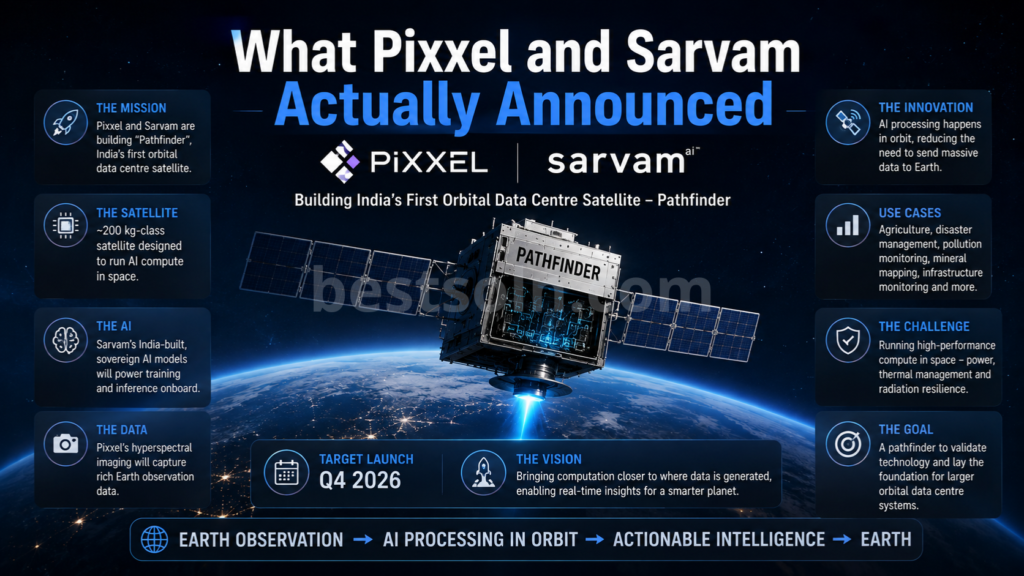
The partnership was made public in May 2026, and the division of labour is fairly clean. Pixxel will design, build, launch, and operate the satellite itself. Sarvam will supply the brains, an AI backbone that handles both training and inference directly on board, using language models built and governed entirely in India.
The satellite at the centre of it all is called Pathfinder. It belongs to what the industry calls the 200 kilogram class, a relatively compact spacecraft by the standards of a data centre, though not by the standards of a typical Earth observation satellite. Pixxel says Pathfinder is expected to reach orbit as early as the last quarter of 2026, a tight timeline that says a lot about how quickly this field is moving.
What makes Pathfinder different from a normal satellite is what it carries inside. Most satellites in orbit today use low-power edge processors that are built to survive the harshness of space rather than to perform heavy computation. Pathfinder instead carries data centre-class GPUs, the same category of hardware used in the ground-based facilities that train and run today’s most advanced AI systems. Reports around the announcement suggest the satellite could carry Nvidia Blackwell or H200-class chips, putting it in roughly the same silicon generation as a modern terrestrial AI cluster, just repackaged to survive launch, radiation, and the vacuum of space.
Alongside the compute hardware, Pathfinder will also carry Pixxel’s hyperspectral imaging camera, the same core technology the company has built its business around. Hyperspectral sensors capture far more detail than ordinary cameras. Instead of the three colour bands a regular camera sees, hyperspectral instruments can capture light across more than a hundred narrow bands, picking up chemical and biological signatures invisible to the human eye. That is what lets this kind of imaging spot a crop disease before it visibly spreads, trace a gas pipeline leak, or flag early signs of a wildfire.
| Feature | Description |
| Partners | Pixxel (Space-Tech) & Sarvam AI (Artificial Intelligence) |
| Satellite Name | Pathfinder |
| Primary Function | On-orbit data processing and AI model training/inference |
| Launch Timeline | Q4 2026 |
| Mass | Approximately 200 kg |
| Key Technology | Data center-grade Graphics Processing Units (GPUs) |
| Pixxel’s Role | Design, build, launch, and operate the satellite |
| Sarvam AI’s Role | Power the satellite with its AI stack to run language models in orbit |
| Mission Type | Proof-of-concept / Stress-test of AI systems in space |
Why Bother Processing Data in Space at All
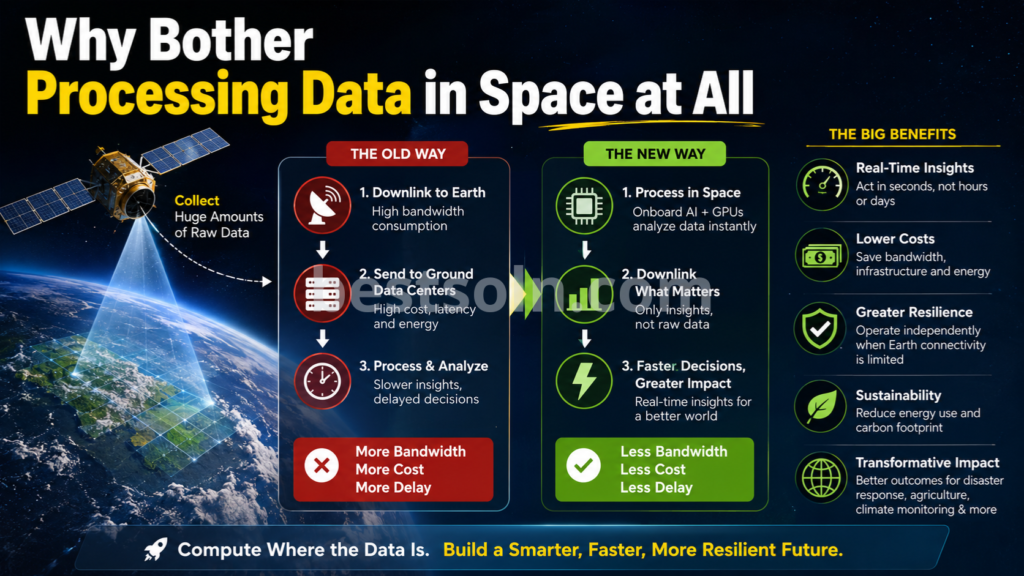
The obvious question is why any of this needs to happen in orbit rather than on the ground, where computing is cheaper, easier to cool, and easier to fix if something breaks.
The answer comes down to time and bandwidth. A satellite typically has to wait until it passes over a ground station to beam its images down. Once the data lands, it still needs to be transmitted, queued, and processed by systems on Earth before anyone actually gets an answer. For slow-moving questions, like mapping deforestation over a year, that delay barely matters. For fast-moving ones, like a wildfire spreading through dry brush or a chemical leak from a damaged pipeline, hours can be the difference between a contained incident and a disaster.
By running the analysis on board, Pathfinder can, in theory, flag a problem in the same pass that captures it, rather than waiting for the data to make a return trip to Earth and back through a processing queue. Instead of downlinking raw imagery and hoping someone notices the anomaly later, the satellite does the noticing itself.
There is also a resource argument behind this shift, and it goes beyond this one mission. Ground-based data centres are running into real constraints around power, land, water for cooling, and local regulation, especially as AI workloads keep growing. In orbit, solar panels can generate several times more usable energy than they would at ground level, since there is no atmosphere to filter sunlight and, depending on the orbit, near constant exposure to the sun. That is part of the pitch several companies around the world are now making for space-based compute: if energy and land are the bottleneck on Earth, orbit removes both constraints, at least on paper.
The Companies Behind the Mission
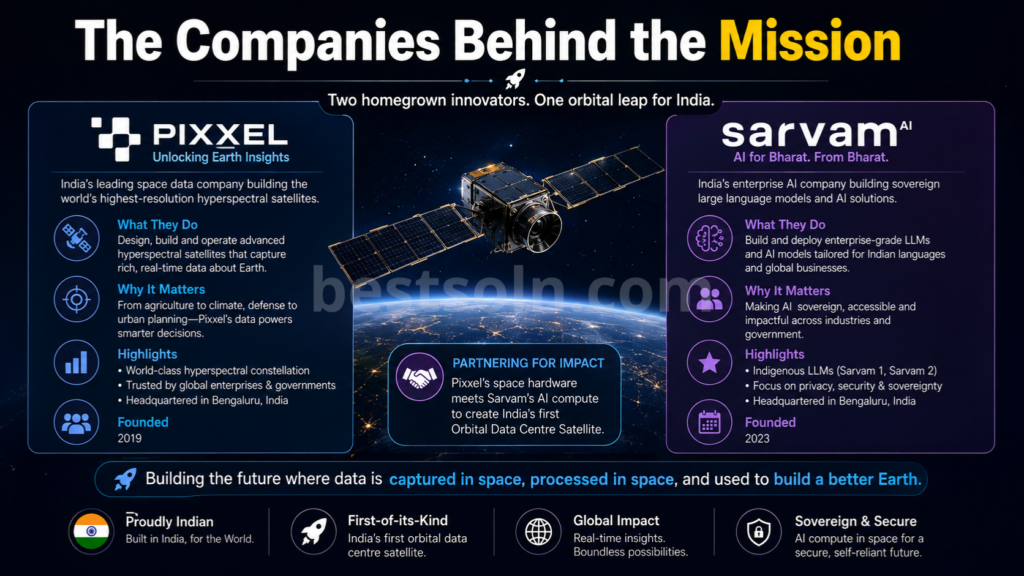
Pixxel: from three student founders to satellite manufacturer
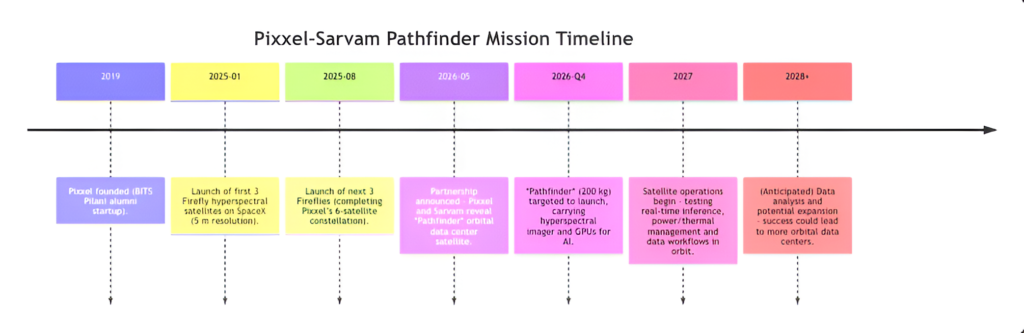
Pixxel was founded in 2019 by Awais Ahmed and Kshitij Khandelwal, who started the company when they were around twenty years old. The company built its name on hyperspectral Earth observation, launching a series of demonstration satellites before putting its Firefly constellation into orbit via a SpaceX rideshare mission in January 2025. Those satellites became, at the time, the highest resolution commercial hyperspectral satellites in operation, sharp enough to pick up subtle changes in vegetation health, water quality, and mineral composition that ordinary imaging satellites simply cannot see.
Pixxel has raised roughly ninety-five million dollars across its earlier funding rounds from backers including Google, Radical Ventures, Lightspeed, and Accenture, and has worked with organisations ranging from the Indian Space Research Organisation to NASA’s Jet Propulsion Laboratory. Around the time of the Pathfinder announcement, reports indicated the company was closing a much larger round, in the range of eighty to a hundred million dollars, that would push its valuation to roughly four hundred million dollars. That fundraising push lines up with a broader wave of investment into Indian space startups over the past year, alongside companies like Skyroot Aerospace, Agnikul Cosmos, and Digantara.
Pixxel says Pathfinder will be built at Gigapixxel, a new manufacturing facility the company is setting up with the capacity to produce up to a hundred satellites, a scale that would mark a significant jump from the handful of spacecraft Pixxel has built to date.
Pixxel CEO Awais Ahmed framed the shift toward orbital computing as a response to the growing strain on ground infrastructure, noting that orbital data centres open up a new frontier where compute can run on abundant solar power rather than land-bound resources.
Sarvam: India’s bet on owning its own AI stack
Sarvam is a younger company, founded in August 2023 by Pratyush Kumar and Vivek Raghavan. Both founders came from work that shaped India’s digital backbone before Sarvam existed. Kumar had led AI4Bharat, the open-source initiative at IIT Madras focused on building AI for Indian languages, while Raghavan spent years as chief biometric architect at UIDAI, where he helped build Aadhaar, India’s national identity system, and later contributed to the design of UPI, the payments rail that now handles a huge share of digital transactions in the country.
That background shows up directly in how Sarvam talks about its mission. The company has built foundation models trained from the ground up on Indian languages and data, including Sarvam 30B and Sarvam 105B, unveiled at the India AI Impact Summit in New Delhi in early 2026. It was also selected by the Indian government from a field of dozens of applicants to build the country’s sovereign large language model under the IndiaAI Mission. By June 2026, Sarvam had raised over two hundred million dollars in a Series B round backed by HCLTech and Bessemer Venture Partners, pushing its valuation past one billion dollars.
Sarvam CEO Pratyush Kumar has described the stakes in blunt terms, arguing that AI infrastructure is not just a software question; it is a sovereignty question. That framing, treating AI compute the way a country treats its currency or its power grid – something too important to outsource entirely – is essentially the thesis behind the Pathfinder mission. Running Indian built models on an Indian built satellite, without routing data through a foreign cloud provider or foreign ground infrastructure, is meant to be a small but concrete demonstration of that idea working in practice.
What the Mission Is Actually Meant to Prove
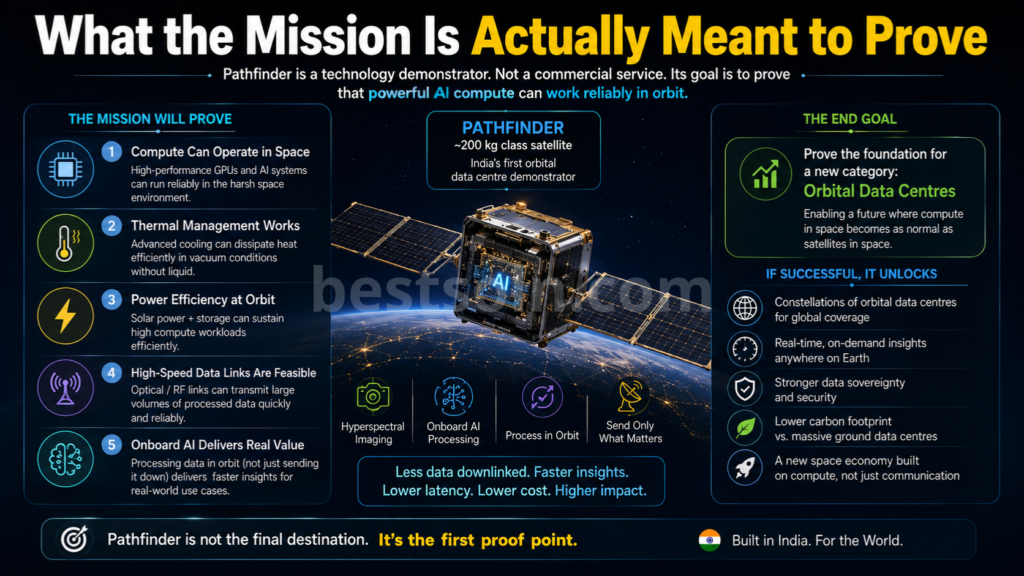
Pixxel and Sarvam have both been fairly candid that Pathfinder is a demonstrator, not a finished commercial product. Its job is to validate a set of things that are genuinely unproven at this scale, particularly for a satellite built and operated out of India.
That includes testing whether data centre-grade GPUs, which are designed for climate-controlled server rooms, can survive and perform reliably under the temperature swings, radiation exposure, and power constraints of low Earth orbit. It also includes proving that the full pipeline, from hyperspectral image capture to on-board model inference to a usable output, can work end-to-end without needing to touch a ground station in between. If that works, the two companies say it will lay the technical and commercial groundwork for larger, more capable orbital data centre systems down the line, built for organisations with heavy compute needs and a preference for keeping that compute under domestic control.
| Market Segment | Key Applications | Growth Projections |
| Defense & Security | ISR, border management, threat detection, space warfare operations | Highest market share in 2024; driven by geopolitical tensions |
| Commercial | Site selection, supply chain optimization, market analysis, asset tracking | Largest market share in 2024 |
| Government Agencies | Urban planning, land use mapping, policy making, national security | Held 42.32% of India’s satellite imagery market share in 2024 |
| Precision Agriculture | Crop health monitoring, yield prediction, soil analysis, irrigation management | Projected to expand at a 17.89% CAGR through 2030 |
| Financial Services & Insurance | Risk assessment, disaster damage assessment, claims verification | Expected to have the highest projected CAGR of 18.21% through 2030 |
| Platform-as-a-Service (PaaS)/API Access | Integration of real-time analytics into third-party applications | Projected to rise at an 18.34% CAGR to 2030 |
India Is Not Alone in This Race
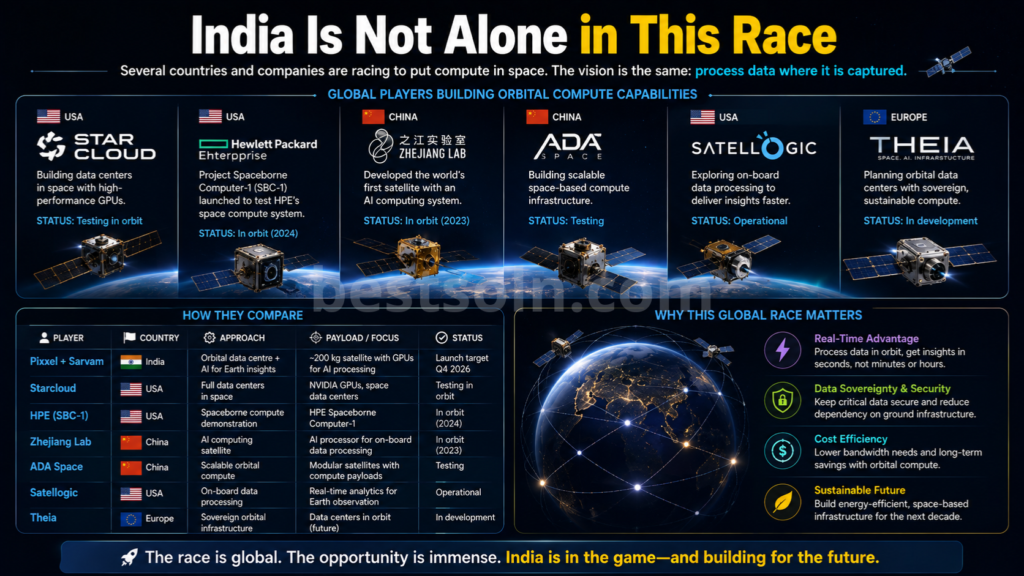
It is worth being clear-eyed about one thing: Pathfinder is a first for India, but orbital compute as a category is already a crowded and fast-moving field internationally.
In the United States, a startup called Starcloud made headlines in late 2025 when it became the first company to train a language model in orbit, running a small model on an Nvidia H100 GPU aboard its Starcloud-1 satellite. The company, backed by Nvidia and Y Combinator, has laid out plans for a much larger constellation aimed at eventually building a multi-gigawatt orbital data centre.
Google has its own effort, called Project Suncatcher, unveiled in November 2025. The plan involves clusters of satellites carrying Google’s own TPU chips, connected to each other through laser-based links, with early prototype satellites targeted for launch by 2027. Google’s own research on the project describes a conceptual cluster of dozens of satellites arranged within a kilometre of each other, working together as a single distributed system.
Beyond that, Axiom Space has been testing orbital data centre modules aboard the International Space Station, SpaceX has reportedly filed paperwork with US regulators covering a vast future constellation of data centre satellites, and Chinese state-backed efforts have floated plans for thousands of AI-carrying satellites by the end of the decade. None of these projects are fully operational commercial businesses yet. All of them are, in one way or another, racing to answer the same question Pixxel and Sarvam are asking with Pathfinder: does it actually make sense to move some fraction of the world’s AI computing off the planet?
| Project / Platform | Key Industry Partners | Payload Weight and Hardware Class | Primary System Architecture | Target Capabilities and Launch Window |
| Pathfinder | Pixxel, Sarvam AI | 200 kg class; Datacenter GPUs & Hyperspectral Sensors | Integrated optical-compute bus executing onboard inference and model adaptation | Real-time geospatial intelligence, disaster response; Target launch Q4 2026 |
| Starcloud (Lumen Orbit) | Starcloud, NVIDIA, SpaceX | 60 kg demonstrator; NVIDIA H100 GPUs | Hyperscale LEO data centre nodes operating continuous solar collection | Orbital model training, asynchronous cloud compute offloading; In-orbit training demonstrated Dec 2025 |
| Project Suncatcher | TPU clusters on compact satellite buses | Dense satellite constellations connected via 1.6 Tbps optical inter-satellite links | Distributed orbital supercomputing for large machine learning workloads; Theoretical and bench testing phase | |
| Orbital Data Center Nodes | Axiom Space, Red Hat, Microchip | Commercial space station payload modules | Space-hardened edge computing modules hosted on orbital infrastructure | Secure cloud storage, defense edge computing; AxDCU-1 prototype deployed Aug 2025 |
| Spaceborne Computer | HPE, NASA | Modified ProLiant and Edgeline commercial servers | COTS hardware utilizing software-based fault detection and adaptive throttling | Microgravity experiments, space research data processing; Spaceborne Computer-3 active on ISS |
The Hard Problems Nobody Has Fully Solved Yet
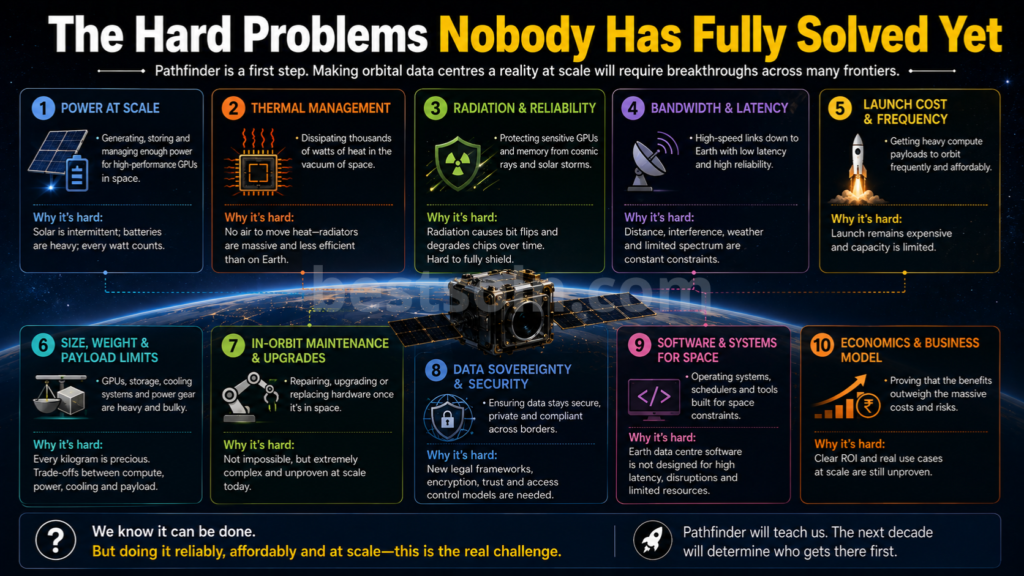
None of this is simple, and it is worth being honest about the obstacles rather than treating the announcement as a settled success.
Heat is probably the biggest one. A GPU running at full load generates a lot of heat, and on Earth that heat is carried away by air and water cooling systems. In the vacuum of space, there is no air to convect heat away, which means satellites have to rely entirely on radiating heat outward using large panels, a much slower and less efficient process. Companies working in this space have had to design cooling systems almost from scratch to deal with this.
Radiation is another serious concern. Consumer and data centre grade chips are not built to withstand the kind of high-energy particle bombardment that satellites experience outside the protection of Earth’s atmosphere, and repeated exposure can cause both gradual degradation and sudden failures. Launch costs, while falling, still make it expensive to send heavy compute hardware into orbit, and satellites are notoriously difficult to repair once something goes wrong thousands of kilometres above the ground. Regulatory questions around spectrum use, orbital debris, and international coordination remain largely unresolved as more of these projects come online at once.
None of these problems look impossible to solve. But they are the reason nearly every company in this space, Pixxel and Sarvam included, is describing its early missions as demonstrators rather than as finished products. Pathfinder’s real job over its operational life will be to generate hard data on how well this specific combination of hardware and software actually holds up once it leaves the ground.
What Comes Next
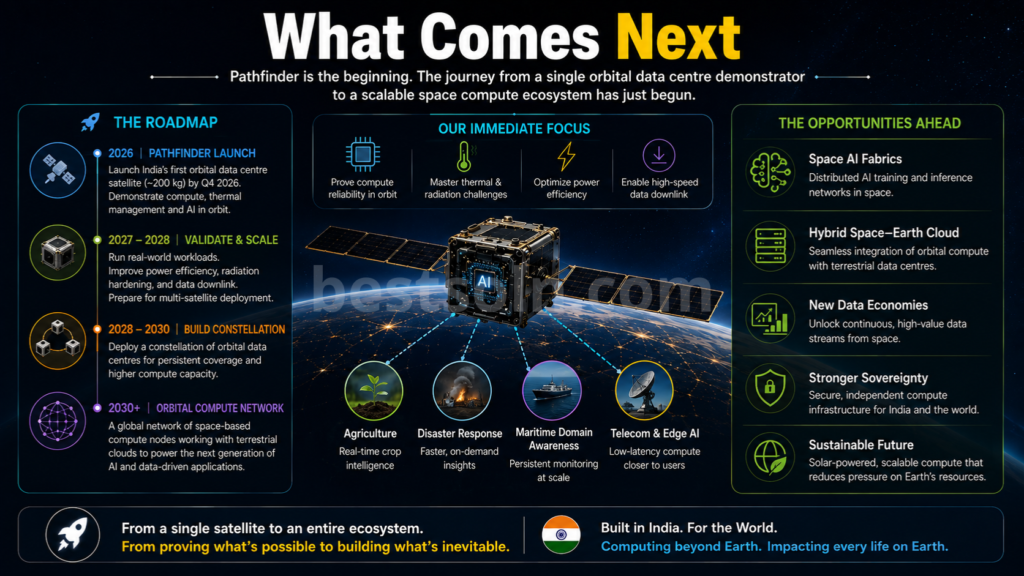
For now, the timeline is straightforward on paper and demanding in practice. Pixxel has set a target of reaching orbit as early as the fourth quarter of 2026, which leaves a fairly narrow window to finish building, testing, and integrating the satellite at the new Gigapixxel facility. Once in orbit, the mission will spend its early life validating performance, power management, and thermal behaviour under real operating conditions, along with testing the full workflow of capturing hyperspectral imagery and processing it with Sarvam’s models without relying on a ground station in the loop.
If the demonstration goes well, both companies have signalled interest in scaling the concept toward dedicated orbital data centre satellites built for organisations with heavy, sensitive, or strategic compute needs. Whether that materialises on the current timeline, or on a longer one, will depend heavily on how the Pathfinder mission actually performs once it is up there, which is exactly the point of running a demonstrator in the first place.
Recommended Readings
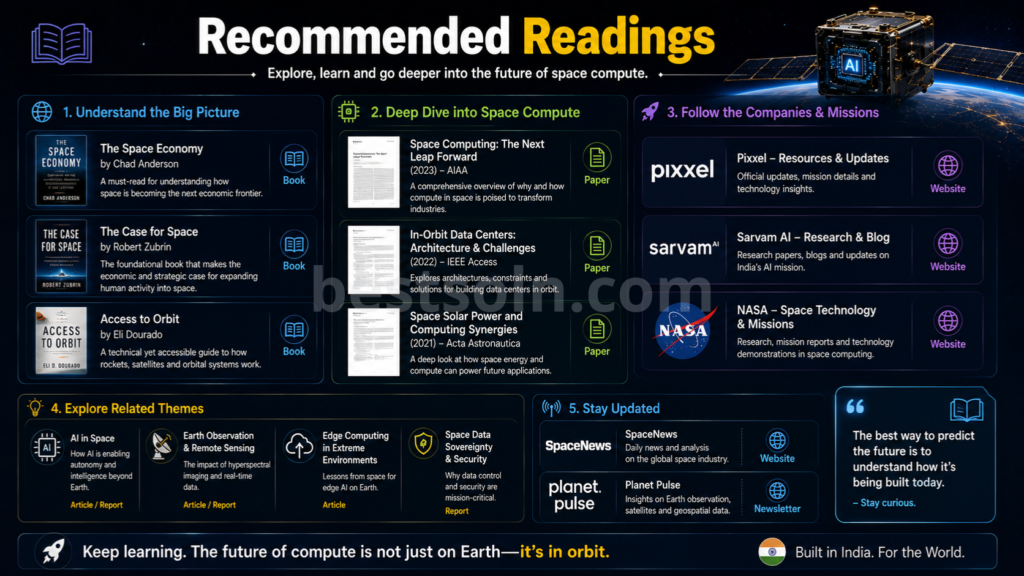
Based on the themes of this report, sovereign AI, space technology, and national strategy, here are several books that provide deeper context and foundational knowledge:
- “The Innovator’s Dilemma: When New Technologies Cause Great Firms to Fail” by Clayton M. Christensen: This book offers a theoretical framework for understanding disruptive technologies, which is highly relevant to analyzing how space-based AI might disrupt traditional geospatial data markets.
- “Architects of Intelligence: The Truth About AI from the People Building It” by Martin Ford: This collection of interviews with leading AI researchers provides deep insights into the technical and philosophical challenges of modern AI, including the practicalities of deploying AI in constrained environments.
- “Space 2.0: How Private Spaceflight, a Resurgent NASA, and International Partners are Creating a New Space Age” by Rod Pyle: This book provides an excellent overview of the ongoing commercialization of space, covering the technological advancements and business models that are enabling private companies like Pixxel to thrive.
- “The Code of Capital: How the Law Creates Wealth and Inequality” by Katharina Pistor: While focused on finance, this book offers a powerful lens for understanding how legal and regulatory frameworks (like data sovereignty laws) can be used to govern and control capital, including the “capital” of data and algorithms.
Frequently Asked Questions
What is the Pathfinder satellite?
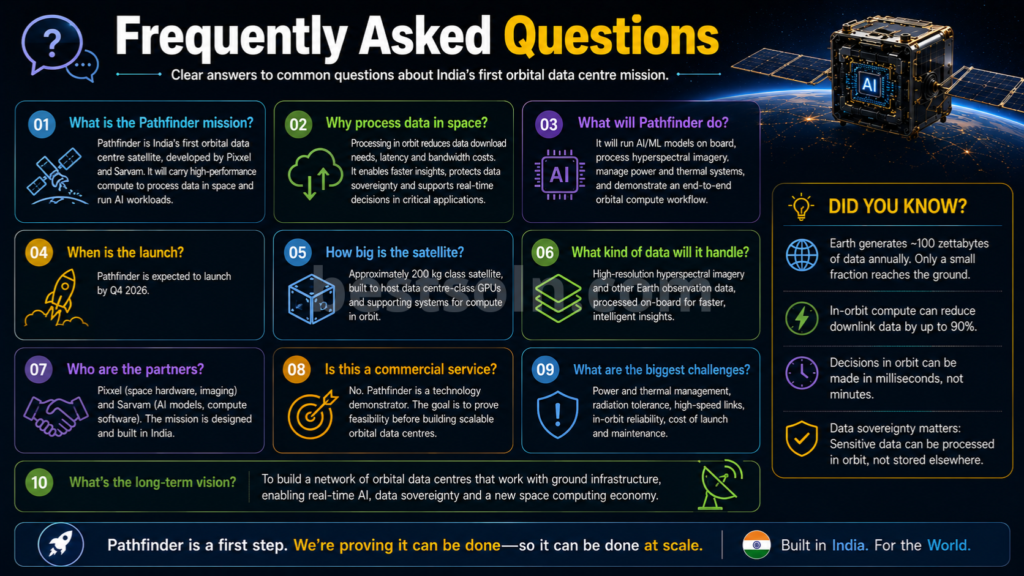
Pathfinder is a 200-kilogram-class satellite being built by Pixxel in partnership with Sarvam. It is described as India’s first orbital data centre satellite, carrying data centre-class GPUs and a hyperspectral imaging camera so it can process Earth observation data using AI models while still in orbit.
When will Pathfinder launch?
Pixxel has said the satellite is expected to reach orbit as early as the fourth quarter of 2026, though exact launch dates for satellite missions commonly shift as testing and integration work progresses.
What do Pixxel and Sarvam each do in this partnership?
Pixxel is responsible for designing, building, launching, and operating the satellite itself, along with supplying its hyperspectral imaging technology. Sarvam supplies the AI layer, running its language and vision models directly on the satellite’s onboard compute hardware for real-time inference.
Why process data in orbit instead of sending it back to Earth?
Processing data on board removes the delay involved in waiting for a satellite to pass over a ground station and for images to be downloaded and analysed afterward. For fast-moving events like wildfires, gas leaks, or infrastructure damage, that saved time can matter a great deal.
Is this the first orbital data centre attempt in the world?
No. Companies including Starcloud and Axiom Space in the United States have already tested AI compute hardware in orbit, and Google’s Project Suncatcher is pursuing a similar concept using its own chips. Pathfinder is described specifically as India’s first attempt at this kind of mission, not the world’s first.
What does “sovereign AI” mean in this context?
It refers to building and running AI models entirely within a country’s own infrastructure and legal jurisdiction, without depending on foreign cloud providers or foreign-owned hardware and software. Sarvam has built its business around this idea on the ground, and the Pathfinder mission extends the same principle into orbit.
What happens if the mission does not work as planned?
Both companies have described Pathfinder primarily as a demonstrator meant to test whether this combination of hardware and software can survive and perform in orbit. Even a partial success, or a mission that surfaces specific technical failures, would still generate data that shapes how future orbital compute missions from India are designed.
Conclusion
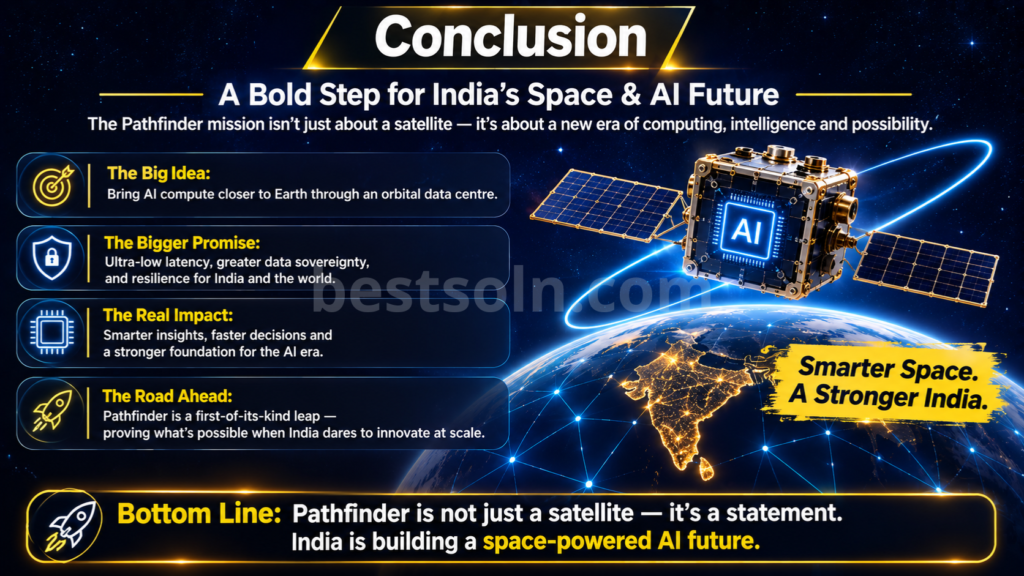
Strip away the novelty of the phrase “data centre in space,” and what Pixxel and Sarvam are really testing is a fairly simple idea: that a satellite does not have to be a dumb sensor waiting for instructions from the ground. It can carry the same class of chips that power today’s AI systems, look at the world with far more detail than the human eye allows, and start drawing conclusions before the data ever reaches a ground station.
Whether this specific mission becomes the first of many or simply a well-documented experiment, it marks a genuine first for India, an attempt to build not just a satellite, but a full sovereign pipeline from observation to insight, without depending on infrastructure the country does not control. Given how young both companies are, and how new this entire category of technology is worldwide, that alone makes Pathfinder worth watching closely over the next year.











Leave a Reply